
Learn how to build, optimise, and grow a sales funnel that attracts qualified prospects, nurtures leads, converts customers, and increases long-term revenue.
Introduction
A successful business does not depend solely on attracting website visitors or promoting products. It depends on turning the right people into interested prospects, helping them understand the value of an offer, building confidence in a brand, and guiding them towards making a purchase. This process requires a structured approach to customer acquisition and conversion, which is where a sales funnel becomes essential. A well-designed sales funnel helps businesses understand how potential customers move from their first interaction with a brand to becoming paying customers and, eventually, loyal advocates.
In today’s competitive digital marketplace, customers rarely purchase immediately after discovering a product or service. They often research different solutions, compare providers, read reviews, explore pricing, ask questions, and evaluate whether a particular offer meets their needs. Without a clearly defined customer journey, businesses may lose potential customers at multiple stages. A sales funnel addresses this challenge by creating a systematic process that delivers the right information, marketing message, offer, and follow-up at the right time. It combines marketing strategy, website design, content creation, lead generation, email communication, conversion optimisation, and customer relationship management into one connected system.
At MyFunnelScript, we understand the importance of building strategic sales funnels that help businesses attract qualified prospects, nurture relationships, improve conversions, and generate sustainable revenue. Whether you are a small business owner, digital marketer, consultant, freelancer, ecommerce entrepreneur, or established organisation, understanding how sales funnels work can significantly improve your marketing performance. In this guide, we will explore the fundamentals of sales funnels, their stages, strategic planning, customer psychology, funnel building, landing pages, lead magnets, email marketing, sales offers, automation, analytics, optimisation, and advanced growth strategies. The goal is to help you build a practical, customer-focused funnel that creates consistent opportunities, improves conversion rates, and supports long-term business growth.
Understanding Sales Funnels and Their Role in Modern Business Growth
A sales funnel is a structured marketing and sales process that guides potential customers through different stages of awareness, interest, consideration, decision-making, and purchase. It represents the journey a person takes from discovering a business to becoming a customer. The funnel concept is based on the idea that a large number of people may initially interact with a brand, but only a percentage will eventually take the desired action, such as purchasing a product, booking a service, subscribing, or requesting a consultation. Understanding this process enables businesses to identify where potential customers are entering, what information they need, and why some people move forward while others leave.
The reason a funnel is called a funnel is that its stages typically become narrower as prospects progress towards a conversion. At the top, businesses attract a broad audience through search engines, advertising, social media, content marketing, referrals, and other channels. These visitors may have different needs, levels of awareness, and purchasing intentions. As they interact with the business, some become interested enough to explore additional information, subscribe to an email list, request a demonstration, or compare available solutions. The business then focuses its communication on the people who show meaningful interest, helping them make an informed purchasing decision rather than treating every visitor as an immediate buyer.
A modern sales funnel should not be viewed as a rigid, one-directional process. Customers may enter at different stages, revisit previous pages, compare alternatives, return after several weeks, or purchase after receiving a recommendation. Some customers may already understand their problem and immediately evaluate pricing, while others need educational content before they recognise that a solution exists. Therefore, an effective funnel combines clear structure with flexibility. It uses relevant messaging, helpful content, responsive communication, and measurable actions to accommodate different customer behaviours. Businesses that understand these dynamics can develop a more efficient customer acquisition strategy, improve marketing alignment, reduce unnecessary friction, and create a stronger foundation for predictable revenue.
The Main Stages of a Sales Funnel and the Customer Journey
The traditional sales funnel consists of several interconnected stages, commonly described as awareness, interest, consideration, conversion, and retention. Each stage represents a different customer mindset and requires a different marketing approach. During the awareness stage, potential customers discover a problem, recognise a need, or encounter a business for the first time. They may find a company through a Google search, a social media post, a YouTube video, an advertisement, a blog article, or a recommendation from someone they trust. At this point, the primary objective is to attract attention and provide a relevant introduction rather than immediately push a purchase. Helpful educational content, informative advertising, and clear positioning are particularly effective because they allow people to understand what the business offers and why it may be relevant to them.
The interest and consideration stages focus on building engagement and helping prospects evaluate their options. Once someone recognises a problem, they usually want to understand possible solutions, compare providers, investigate features, assess benefits, and determine whether a product or service is suitable. Businesses can support this stage through detailed landing pages, guides, case studies, product demonstrations, webinars, comparison content, customer testimonials, and email sequences. The objective is to reduce uncertainty and demonstrate value. Instead of relying on aggressive sales language, businesses should explain how their solution works, what makes it different, what outcomes customers can realistically expect, and what limitations or requirements they should understand before making a decision.
The conversion stage occurs when a prospect completes the desired action, such as buying a product, signing up for a paid service, booking a consultation, or submitting a qualified enquiry. However, the customer journey does not end with the transaction. Retention, satisfaction, onboarding, ongoing support, repeat purchases, referrals, and customer advocacy are important parts of a sustainable funnel. A business that only focuses on acquiring new customers may overlook the revenue and growth opportunities created by existing relationships. By extending the funnel into the post-purchase experience, businesses can increase customer lifetime value, improve satisfaction, encourage repeat business, and create a more reliable revenue model. This broader perspective transforms the funnel from a simple conversion tool into a complete customer growth framework.
Defining Your Target Audience and Ideal Customer Profile
The effectiveness of a sales funnel depends heavily on the quality of the audience it attracts. A funnel can have excellent design, persuasive copywriting, automated emails, and attractive offers, but it will struggle to generate meaningful sales if it attracts people who do not need the product, cannot afford it, or are unlikely to benefit from it. Defining the target audience is therefore one of the most important steps before building any funnel. Businesses should identify the people most likely to experience the problem they solve, understand their circumstances, and have a genuine reason to consider the solution. This process involves researching demographic information, interests, behaviours, purchasing motivations, challenges, and decision-making preferences.
An ideal customer profile helps businesses describe the characteristics of their most valuable customers. For a business-to-business company, this may include industry, business size, job role, annual revenue, technology requirements, operational challenges, purchasing authority, and budget. For a business-to-consumer brand, the profile may focus on lifestyle, preferences, needs, income considerations, location, interests, and buying habits. Businesses should also identify customer pain points, desired outcomes, objections, and emotional motivations. For example, a person purchasing marketing software may not simply want additional features; they may want to save time, generate more qualified leads, simplify reporting, or reduce the uncertainty of growing their business. Understanding these deeper motivations helps marketers create messages that connect with the audience’s actual priorities.
Audience research should be based on real information rather than assumptions. Customer interviews, surveys, sales conversations, support tickets, reviews, website analytics, search queries, and competitor research can reveal valuable patterns. Businesses can use this information to create customer personas representing different segments of their audience. However, personas should remain practical rather than becoming fictional profiles filled with irrelevant details. A useful persona identifies what the customer needs, what prevents them from buying, which information influences their decision, and what communication would help them move forward. When audience research is integrated into funnel planning, businesses can improve targeting, create more relevant lead magnets, develop stronger offers, and deliver personalised experiences that attract prospects with a higher likelihood of converting.
Creating a Sales Funnel Strategy Before Building the Funnel
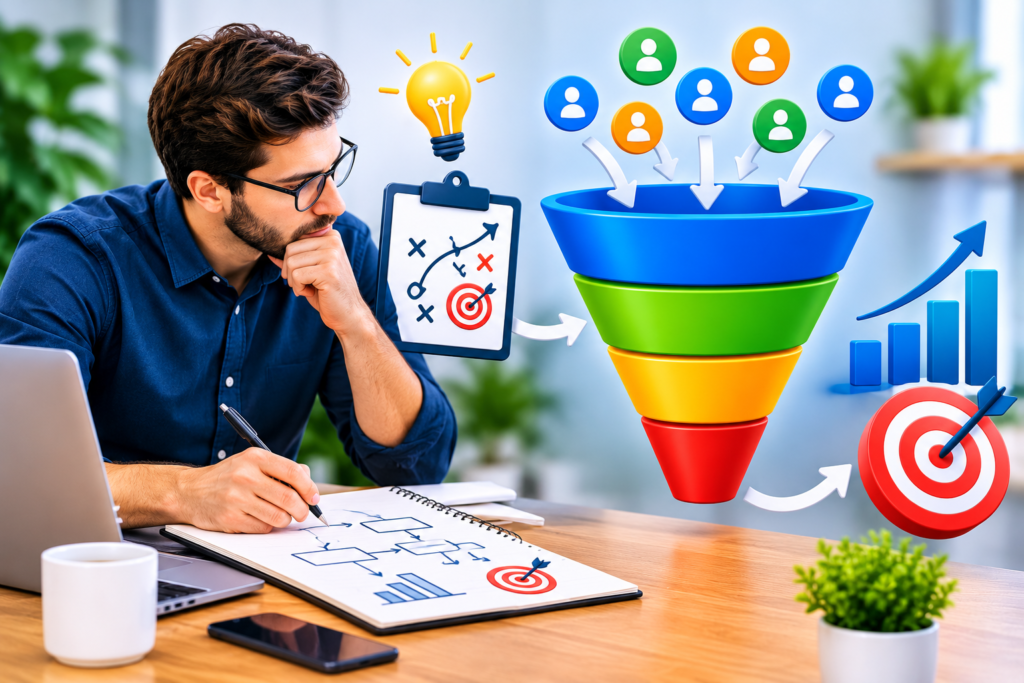
Building a sales funnel without a clear strategy often leads to disconnected marketing activities, unnecessary pages, weak offers, and poor conversion performance. A business should begin by defining what the funnel is expected to accomplish. The primary goal might be selling a digital product, generating qualified service enquiries, booking appointments, promoting a subscription, increasing ecommerce purchases, or building a list of potential buyers. Each objective requires a different funnel structure, customer journey, conversion action, and follow-up strategy. Establishing the desired outcome helps businesses avoid building features or pages that do not contribute meaningfully to the customer’s decision-making process.
A strong funnel strategy also identifies the offer, traffic source, audience, messaging, and conversion mechanism. Businesses should understand where their prospects are likely to come from, what promise will attract them, what action they should take first, and what happens after they complete that action. For example, a consultancy may attract visitors through educational articles, offer a downloadable business growth checklist, nurture subscribers through a targeted email sequence, and invite qualified prospects to book a discovery call. An ecommerce company may use product-focused advertising, a product landing page, customer reviews, checkout incentives, and post-purchase recommendations. The funnel should reflect the buying behaviour of the target audience rather than follow a generic template without considering context.
Strategic planning should also include measurable goals, budget considerations, operational capacity, and realistic expectations. Businesses need to decide how much they can invest in advertising, content creation, technology, sales support, and customer service. They should establish benchmarks for traffic, lead generation, conversion rates, cost per lead, customer acquisition cost, revenue, and return on investment. These measurements help determine whether the funnel is commercially viable. A funnel that generates a large number of leads but produces very few customers may not be successful, particularly if acquisition costs exceed revenue. By defining strategy before implementation, businesses create a clear roadmap that connects marketing activities with measurable commercial outcomes and makes future optimisation more focused.
Building an Effective Lead Generation System
Lead generation is the process of attracting potential customers and encouraging them to share their contact information or take another meaningful action that allows a business to continue the relationship. It is one of the most important components of a sales funnel because it creates a bridge between anonymous website visitors and identifiable prospects. Businesses can generate leads through organic search, paid advertising, social media, downloadable resources, webinars, newsletter subscriptions, free trials, consultation offers, events, and referral programmes. The best lead generation channel depends on the target audience, product, market, available resources, and customer purchasing behaviour. Rather than trying to use every channel simultaneously, businesses should focus on the channels that consistently attract relevant prospects.
A successful lead generation system offers something valuable in exchange for the prospect’s attention and information. This exchange might involve a free guide, checklist, template, educational video, product demonstration, trial, assessment, consultation, or access to useful resources. The value of the offer should be closely connected to the problem the business solves. A lead magnet that attracts people interested in unrelated topics may increase subscriber numbers but create little sales potential. For example, a marketing agency targeting small businesses could offer a website conversion checklist, a campaign planning template, or a guide to identifying wasted advertising spend. These resources attract prospects who are more likely to need the agency’s services and can naturally lead into relevant follow-up communication.
Lead generation should also prioritise quality, consent, and a clear value proposition. Collecting contact details without explaining what subscribers will receive can damage trust and reduce engagement. Forms should request only information that is genuinely needed, while privacy policies and consent requirements should be communicated appropriately. Businesses should also establish a process for managing leads, organising them into relevant segments, and responding promptly when someone requests information or assistance. A lead generation system becomes more valuable when it is connected to a structured follow-up process, allowing businesses to move prospects from initial interest towards meaningful conversations, product evaluation, and purchasing decisions instead of simply accumulating email addresses.
Designing High-Converting Landing Pages
A landing page is a dedicated webpage designed to encourage visitors to complete a specific action. Unlike a general website page that may contain multiple navigation options and competing objectives, a sales funnel landing page focuses on one primary conversion goal. That goal could be downloading a resource, registering for a webinar, requesting a consultation, starting a free trial, or purchasing a product. The most effective landing pages communicate their value quickly, making it easy for visitors to understand what is being offered, who it is for, why it matters, and what they should do next. A clear headline, supporting message, relevant visual, concise benefits, and prominent call to action are fundamental elements of a strong page.
Landing page copy should focus on the customer’s desired outcome rather than simply describing the business or listing product features. Visitors want to know how a solution will help them solve a problem, save time, reduce costs, improve performance, or achieve a specific goal. A headline should communicate the central benefit without making exaggerated or misleading claims. Supporting content can explain how the offer works, what is included, why it is useful, and what makes it different. Testimonials, reviews, case studies, guarantees where appropriate, and frequently asked questions can help address concerns. However, every element should support the primary conversion objective rather than distract visitors with unnecessary information.
Landing page design should prioritise clarity, usability, accessibility, and performance across devices. Visitors should be able to navigate the page easily, read the content comfortably, and complete the desired action without unnecessary friction. Forms should be straightforward, buttons should use clear action-oriented wording, and important information should not be hidden behind confusing layouts. Mobile responsiveness is especially important because a significant portion of traffic may come from smartphones and tablets. Businesses should test page speed, image optimisation, form functionality, readability, and layout consistency. They should also avoid intrusive pop-ups, misleading urgency, and excessive design elements that interfere with the customer experience. A landing page should create confidence and make the next step feel simple and worthwhile.
Creating Lead Magnets That Attract Qualified Prospects
A lead magnet is a valuable free resource, experience, or opportunity that a business provides in exchange for a prospect’s contact information or permission to continue communicating. It is one of the most effective ways to introduce potential customers to a sales funnel because it creates an initial exchange of value without requiring an immediate purchase. Instead of asking a visitor to buy before they understand the business, a lead magnet offers something useful that addresses a specific challenge. Examples include downloadable guides, checklists, templates, calculators, mini-courses, free trials, resource libraries, webinars, and personalised assessments. The best lead magnets are practical, relevant, easy to consume, and closely connected to the paid offer that follows.
Choosing the right lead magnet requires understanding what your audience wants to accomplish and what information would help them make progress. A generic ebook may attract downloads but fail to generate meaningful engagement if it does not address a pressing problem. A narrowly focused resource can often produce better results because it promises a specific outcome. For example, a business targeting entrepreneurs could offer a sales page review checklist, a lead generation worksheet, or a template for planning a promotional campaign. These resources attract prospects who are actively trying to solve a problem that the business is equipped to address. Relevance is more important than the number of downloads, particularly when the ultimate objective is generating customers rather than collecting contacts.
The lead magnet should also be designed to create a natural transition into the next stage of the funnel. After downloading a resource, the prospect should understand what additional help is available and how the business can support them further. This might involve a welcome email, a related educational resource, an invitation to watch a demonstration, or an introduction to a paid product or service. The lead magnet should deliver genuine value independently rather than withholding essential information to force a purchase. Businesses should measure its performance through opt-in conversion rate, lead quality, email engagement, subsequent sales, and the cost of acquiring leads. A lead magnet that attracts fewer but more relevant subscribers may outperform a highly popular resource that produces little commercial value.
Using Email Marketing to Nurture Leads and Build Trust
Email marketing is one of the most important tools for nurturing leads because it enables businesses to communicate with prospects after their initial interaction. Many people who visit a website or download a resource are not ready to buy immediately. They may need more information, time to compare options, reassurance about the quality of a product, or an opportunity to discuss their circumstances. A well-planned email sequence keeps the business connected with these prospects while delivering useful information that helps them make decisions. Unlike relying entirely on social media visibility or paid advertising, email provides a direct communication channel with people who have voluntarily subscribed, subject to applicable privacy and consent requirements.
A welcome email sequence is often the first step in a funnel’s email marketing strategy. The initial message should deliver the promised resource, explain what subscribers can expect, and introduce the brand in a straightforward manner. Subsequent emails can address common problems, provide practical advice, explain how a solution works, share customer experiences, answer objections, and present a relevant offer. The sequence should have a logical progression instead of repeating the same promotional message. For example, a prospect who downloads a guide about improving sales conversions might receive an email explaining common conversion problems, followed by a practical optimisation checklist, a case study, and an invitation to explore a related service. Each email should have a clear purpose and provide value even when the reader does not immediately purchase.
Email personalisation and segmentation can improve the relevance of follow-up communication. Businesses may segment subscribers based on the resource they downloaded, product interest, engagement level, previous purchases, or actions taken on the website. This allows them to send messages that better match each subscriber’s needs rather than delivering identical emails to everyone. Subject lines should accurately reflect the content, and messages should be readable on mobile devices with clear calls to action. Performance should be evaluated through meaningful metrics such as clicks, conversions, unsubscribe rates, deliverability, and revenue generated. Businesses should also respect subscriber preferences and make it easy to unsubscribe. Trustworthy email marketing prioritises helpful communication and long-term relationships rather than excessive promotional frequency.
Developing Compelling Offers, Pricing, and Conversion Incentives
The offer is the central element of a sales funnel because it determines what customers receive and why they should take action. A business may attract the right audience, create an excellent landing page, and send effective emails, but conversions will remain limited if the offer does not clearly solve a meaningful problem. A compelling offer communicates the product or service, its benefits, the expected experience, the value included, and the reasons it may be worth purchasing. Businesses should understand the difference between selling a product’s features and presenting the overall value of the solution. Customers generally evaluate whether an offer helps them achieve a desired outcome, whether the cost is reasonable, and whether they trust the business to deliver what it promises.
Pricing should reflect the value of the product, customer expectations, competitive positioning, business costs, and the target market’s purchasing capacity. Businesses can use different pricing structures depending on the nature of their offer, including one-time purchases, subscriptions, service packages, tiered pricing, bundles, retainers, or payment plans. Each structure should be easy to understand and should avoid creating confusion about what is included. For example, tiered pricing can help customers select an option based on their needs, while product bundles can increase perceived value by combining complementary items. However, pricing should not be manipulated through misleading comparisons, hidden charges, or unrealistic claims about savings. Transparency helps customers make informed decisions and strengthens confidence in the business.
Conversion incentives can help encourage action when they provide a legitimate reason for prospects to move forward. These may include a bonus resource, free onboarding, a trial period, a product bundle, a limited-time discount, complimentary consultation, or free shipping where relevant. Incentives should be aligned with the product and customer needs rather than added simply to create pressure. Artificial countdown timers, fabricated scarcity, deceptive pricing, and false claims about availability can damage trust and create a poor customer experience. A strong offer should remain attractive because of its genuine value. Businesses should test different offer structures, payment options, bonuses, guarantees, and calls to action to identify what improves conversions without compromising customer satisfaction or profitability.
Sales Funnel Copywriting and Persuasive Messaging
Sales funnel copywriting involves creating the messages that guide prospects through the funnel and help them understand why a product, service, or solution is relevant to their needs. It includes headlines, landing page descriptions, advertisements, email content, product descriptions, testimonials, calls to action, checkout messaging, and follow-up communication. Effective copywriting begins with customer research rather than assumptions about what sounds persuasive. Understanding customer frustrations, desired outcomes, objections, questions, and language patterns enables businesses to communicate in a way that feels relevant and clear. The strongest copy focuses on helping the reader understand a solution instead of using unnecessary jargon, exaggerated promises, or aggressive sales tactics.
A useful copywriting framework is to connect the customer’s problem with the solution, explain the benefits, provide supporting evidence, and communicate the next step. A headline should capture attention and establish relevance. The supporting copy should explain why the offer matters and what the prospect can expect. Benefits should be specific and credible, while product features should be explained in the context of their practical value. For example, instead of simply stating that a marketing platform includes automation, the copy might explain how automated follow-up helps businesses respond to new leads consistently and reduce repetitive administrative work. Testimonials, demonstrations, examples, and transparent explanations can support the message and help prospects evaluate whether the offer is appropriate for them.
Calls to action should be clear, direct, and aligned with the customer’s stage in the journey. Someone who has just discovered a business may be more comfortable downloading a guide than purchasing a premium service, while a prospect who has already reviewed the pricing and benefits may be ready to book a call or complete checkout. Copy should therefore reflect the level of commitment expected from the reader. Businesses should also review their messaging for clarity, accuracy, readability, accessibility, and consistency across advertising and landing pages. Testing headlines, benefit statements, button wording, and email subject lines can reveal which messages perform best. Persuasive copywriting should ultimately help customers make confident, informed decisions rather than pressure them into purchases they do not need.
Sales Funnel Automation and Integrating Marketing Tools
Sales funnel automation allows businesses to use software and predefined workflows to handle repetitive marketing and sales activities. It can include sending welcome emails, delivering lead magnets, assigning leads to sales representatives, updating customer records, triggering follow-up messages, recording purchases, notifying teams, and managing onboarding. Automation improves consistency and efficiency by ensuring that prospects receive timely communication and that important actions are not forgotten. However, automation should not be viewed as a replacement for strategy or human interaction. It is a mechanism for delivering a well-designed customer experience more reliably and efficiently.
A typical automated funnel may begin when a visitor completes a form on a landing page. The system records the lead, delivers the requested resource, adds the subscriber to an appropriate segment, and starts a welcome sequence. If the subscriber clicks a link related to a particular product, the system may deliver additional information about that solution. If the prospect requests a consultation, the automation can notify a sales representative, create a CRM record, and provide a booking confirmation. If a customer purchases, the workflow can stop promotional emails related to the purchased product and begin an onboarding sequence. These connected actions reduce manual work and help ensure that communication remains relevant to the individual’s behaviour.
Businesses should choose automation tools based on their requirements, budget, integration needs, and operational complexity. A smaller business may only need an email marketing platform, a landing page builder, and a payment system, while a larger organisation may require CRM software, analytics platforms, customer support tools, advanced segmentation, and multiple integrations. Before introducing automation, workflows should be mapped carefully to identify triggers, conditions, actions, exceptions, and failure points. Testing is essential because incorrect automation can send duplicate emails, deliver irrelevant offers, or create frustrating customer experiences. Businesses should also monitor data quality, security, permissions, and system reliability. Effective automation makes the customer journey more helpful and consistent while allowing the business team to focus on meaningful conversations, strategic decisions, and customer service.
Tracking Sales Funnel Analytics, KPIs, and Performance Metrics
Sales funnel analytics provide the information businesses need to understand how prospects move through the funnel and where opportunities are being lost. Without accurate tracking, marketing decisions are often based on assumptions rather than evidence. Businesses may generate website traffic without understanding whether those visitors are qualified, collect leads without knowing whether they convert, or invest in advertising without measuring profitability. Funnel analytics connect individual customer actions with overall business performance, helping identify which marketing activities produce the greatest value. A properly tracked funnel should measure the journey from initial traffic and engagement through lead generation, sales, customer retention, and repeat purchases.
Several key performance indicators are particularly useful when evaluating funnel performance. Website traffic measures how many visitors reach a page, while landing page conversion rate measures the percentage who complete the desired action. Lead conversion rate helps evaluate how effectively prospects become customers, and cost per lead reveals how much the business spends to generate each lead. Customer acquisition cost measures the overall cost of acquiring a customer, while average order value indicates the typical revenue generated from a transaction. Businesses can also evaluate email click-through rates, checkout abandonment, sales cycle length, customer lifetime value, and return on advertising spend. These metrics should be interpreted together because a high conversion rate does not necessarily indicate profitability if the offer is low-value or the acquisition costs are excessive.
Analytics tools should be configured to measure meaningful actions throughout the customer journey. Businesses can use website analytics, advertising platforms, CRM systems, email marketing reports, and conversion tracking tools to collect relevant information. For example, Google Analytics can help businesses analyse traffic sources, landing page engagement, user interactions, and conversions when properly configured. The Google Analytics documentation provides guidance on setting up and understanding analytics features. Businesses should establish clear conversion definitions, maintain consistent reporting, and avoid relying on vanity metrics such as impressions or page views without considering their commercial impact. Regular analysis of funnel performance helps identify bottlenecks, prioritise improvements, and make better decisions about advertising budgets, content strategy, landing pages, and follow-up communication.
Sales Funnel Optimisation, Testing, and Continuous Improvement
Sales funnel optimisation is the ongoing process of improving the performance of each stage of the customer journey. A funnel should not be considered complete simply because it has been launched. Customer behaviour changes, competitors introduce new offers, traffic sources evolve, technology changes, and businesses gain new insights from sales conversations. Continuous optimisation allows businesses to adapt to these developments and identify opportunities to improve conversions, reduce costs, increase customer value, and create a more efficient marketing system. The most successful optimisation process is based on actual data, customer feedback, and clearly defined objectives rather than random design changes.
One of the most useful optimisation methods is A/B testing, which compares two versions of an element to determine whether one performs better under similar conditions. Businesses may test landing page headlines, calls to action, page layouts, form length, email subject lines, pricing presentation, images, or offer structures. For example, a landing page may have a low conversion rate because the headline does not clearly communicate the benefit, the form requests too much information, or visitors do not understand what happens after submitting their details. Instead of changing everything at once, businesses should identify a potential problem, develop a specific hypothesis, test a suitable change, and evaluate the results. Reliable testing requires enough data to make meaningful comparisons and careful interpretation of results.
Optimisation should also include qualitative feedback because numerical metrics cannot always explain why prospects behave in particular ways. Customer interviews, support conversations, surveys, sales call notes, session recordings where appropriately consented to, and usability testing can reveal confusion, missing information, concerns, or unexpected obstacles. A business might discover that customers hesitate because they do not understand implementation requirements, are uncertain about pricing, or cannot find answers to common questions. Addressing these issues may improve conversions more effectively than changing button colours or adding promotional discounts. Funnel optimisation should be prioritised according to potential business impact, implementation effort, customer benefit, and confidence in the evidence. By adopting a structured improvement process, businesses can gradually build stronger conversion performance and more sustainable growth.
Common Sales Funnel Mistakes, Troubleshooting, and Frequently Asked Questions
Many businesses struggle with sales funnels because they focus on the technology or appearance rather than the customer journey. One common mistake is trying to attract everyone instead of targeting a clearly defined audience. Broad messaging may generate traffic but fail to connect with people who have a genuine need or purchasing intention. Another mistake is creating an offer that is unclear, too complicated, or disconnected from the customer’s problem. Businesses also frequently use landing pages with too many distractions, lengthy forms, confusing navigation, weak calls to action, or insufficient information about the product. These problems increase friction and make it harder for prospects to understand the offer or complete the desired action.
A further mistake is neglecting follow-up communication. Businesses often invest in advertising and lead generation but fail to nurture subscribers consistently, respond to enquiries promptly, or provide the information prospects need to make a decision. Others send excessive promotional emails without delivering meaningful value, causing subscribers to disengage. Poor tracking is another significant issue because businesses may not know where prospects abandon the funnel, which campaigns generate qualified leads, or whether advertising is profitable. Additional problems include relying on unrealistic sales projections, using misleading testimonials, offering unnecessary discounts, failing to test mobile experiences, and building complex automation before validating the underlying customer journey. The solution is to simplify the funnel, strengthen the offer, improve communication, and use real performance data to identify weaknesses.
Frequently Asked Questions
What is a sales funnel in simple terms?
A sales funnel is a process that guides potential customers from discovering a business to becoming paying customers. It uses marketing, content, offers, communication, and sales activities to help prospects understand a solution and make purchasing decisions.
How does a sales funnel work?
A sales funnel attracts potential customers, builds their interest, provides relevant information, addresses objections, and encourages them to complete a desired action. After the purchase, customer onboarding, support, retention, and follow-up can encourage additional sales and referrals.
What are the main stages of a sales funnel?
The main stages generally include awareness, interest, consideration, conversion, and retention. Businesses may use different stage names or additional steps depending on their product, audience, sales process, and customer journey.
How do I create a sales funnel for my business?
Start by identifying your target audience, understanding their problems, defining a clear offer, choosing an appropriate traffic source, and creating a landing page. Add a lead magnet or conversion mechanism, establish follow-up communication, configure tracking, and test the entire journey before launching.
Do I need a website to build a sales funnel?
A traditional website is not always necessary. A funnel can be built using dedicated landing pages, forms, email marketing tools, payment pages, and booking systems. However, a website can strengthen credibility, support organic search visibility, provide additional information, and help customers research the business.
How long does it take to build a sales funnel?
A simple funnel may be built within a few days if the offer, copy, design, and tools are already prepared. More complex funnels involving multiple landing pages, integrations, email sequences, advertising campaigns, and customer segmentation may require several weeks. The time needed depends on the scope, resources, and testing requirements.
How can I increase sales funnel conversion rates?
Improve audience targeting, strengthen your offer, make landing pages clearer, reduce unnecessary form fields, provide relevant proof, address objections, improve page speed, and create helpful follow-up communication. Test individual changes and measure the impact on actual sales rather than relying only on leads or clicks.
Are sales funnels suitable for small businesses?
Yes. Sales funnels can be particularly useful for small businesses because they help organise marketing activities, capture leads, follow up consistently, and identify opportunities without requiring a large sales team. A simple funnel with one clear offer and a well-designed follow-up process can be a strong starting point.
Sales Funnel Best Practices Summary for Sustainable Growth
Building an effective sales funnel requires a combination of customer research, strategic planning, clear messaging, relevant offers, conversion-focused design, helpful follow-up, reliable technology, and continuous improvement. Businesses should begin with a specific audience and a meaningful problem rather than attempting to build a complicated funnel without validating the demand. Every stage should serve a clear purpose, and every marketing activity should contribute to moving prospects towards an appropriate next step. A funnel should feel like a helpful journey that supports customer decisions, not a series of aggressive promotions designed to pressure visitors into purchasing.
The best practices for building and managing a sales funnel include creating a strong value proposition, selecting appropriate traffic sources, using relevant lead magnets, designing mobile-friendly landing pages, writing benefit-focused copy, simplifying conversion processes, and providing timely email follow-up. Businesses should maintain consistent messaging across advertisements, landing pages, emails, and sales conversations. They should also ensure that claims are accurate, pricing is transparent, customer testimonials are genuine, and privacy expectations are respected. Performance tracking should focus on qualified leads, sales, customer acquisition costs, revenue, retention, and profitability rather than superficial metrics. Tools should support the strategy instead of adding unnecessary complexity, and automation should be carefully tested before being used at scale.
Long-term funnel success depends on creating an experience that customers trust and find valuable. Businesses should listen to feedback, investigate abandoned purchases, identify common objections, review performance regularly, and improve the parts of the journey that create unnecessary friction. They should also consider what happens after a customer buys, including onboarding, product education, support, customer satisfaction, additional relevant offers, and opportunities for referrals. When marketing, sales, and customer service work together, a sales funnel becomes more than a lead generation mechanism. It becomes a connected growth system that helps businesses attract the right people, convert prospects more efficiently, build stronger relationships, increase customer lifetime value, and develop a more sustainable competitive advantage in an evolving digital marketplace.
Practical Sales Funnel Best Practices Checklist
- Define a specific target audience and ideal customer profile.
- Identify the customer’s main problem, motivation, and desired outcome.
- Create one clear, valuable offer.
- Select traffic channels that reach relevant prospects.
- Develop a high-converting landing page with a clear call to action.
- Use a relevant lead magnet where appropriate.
- Build a structured email follow-up sequence.
- Address objections through helpful content, evidence, and transparent information.
- Simplify forms, checkout processes, and booking experiences.
- Automate repetitive tasks while maintaining human support where needed.
- Track traffic, leads, conversions, revenue, and customer acquisition costs.
- Test headlines, offers, page layouts, and email messaging.
- Review customer feedback and improve the funnel regularly.
- Create a strong post-purchase experience that encourages satisfaction and retention.
- Focus on sustainable profitability instead of vanity metrics.
Want to Implement This Easily?
AI Implementation Prompt
Copy the prompt below and use it to turn this complete sales funnel guide into a practical, step-by-step implementation plan for your own business.
You are an expert consultant. Based on the blog post titled “Sales Funnel”, provide a step-by-step, practical implementation guide. Include tools, best practices, common mistakes to avoid, and advanced tips. Assume the reader wants to implement everything discussed in this article effectively.
Call to Action:
Want our help implementing this? Just reach out to us via our website contact form: