
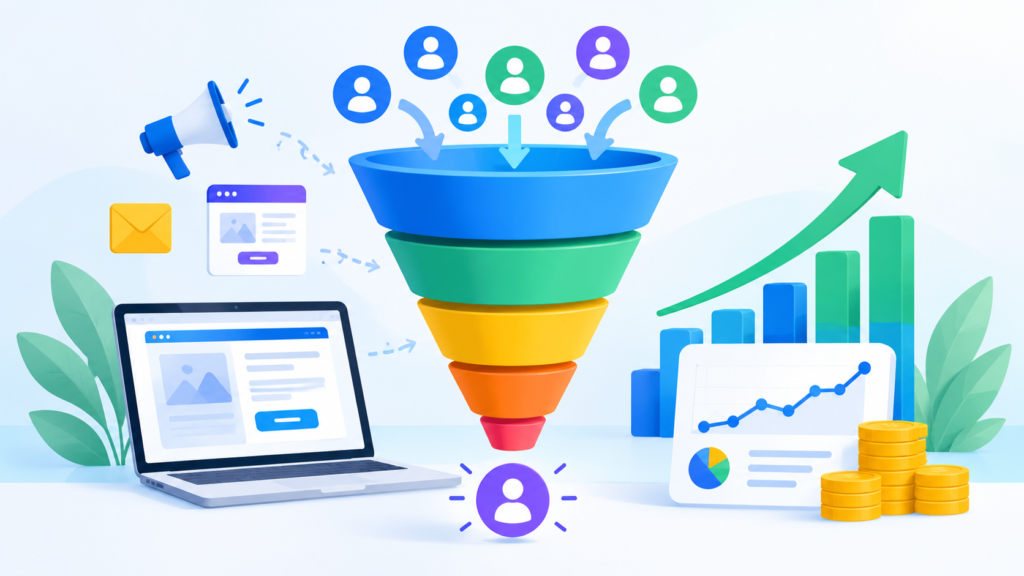
Discover how sales funnels attract qualified prospects, build trust, nurture leads, increase conversions, and create a predictable customer acquisition system.
Introduction
A successful business rarely grows from a single advertisement, landing page, or sales conversation. Sustainable growth comes from creating a connected customer journey in which every marketing and sales activity has a defined purpose. A well-designed sales funnel provides a framework for moving potential customers from their first interaction with a business toward a purchase, consultation, application, subscription, or another meaningful action.
Modern customers rarely follow a perfectly straight path. Someone may discover a company through search, read an educational article, watch a video, encounter a social media post, subscribe to an email list, compare competing solutions, return several days later, and finally become a customer. A funnel helps businesses understand and support this journey instead of treating every visitor as though they have identical awareness, intent, and purchasing motivation.
A strong funnel should not depend on pressure, exaggerated promises, or unnecessary complexity. Its purpose is to provide relevant information at the right stage so prospects can make informed decisions. This people-first approach aligns with Google’s guidance on people-first content, which emphasizes creating useful, original, reliable information for people rather than content primarily designed to manipulate search rankings. people-first content
For businesses that want to create a more structured customer acquisition process, MyFunnelScript provides a useful context for understanding how funnel strategy, messaging, offers, follow-up, and optimization can work together.
What Is a Sales Funnel and Why Does It Matter?
A sales funnel is a structured customer journey that guides potential buyers through different stages of awareness, consideration, decision-making, and conversion. The traditional funnel metaphor suggests that many people enter at the top while fewer eventually become customers. In practical business terms, however, a funnel is much more than a diagram showing declining numbers. It is a framework for understanding what customers need at different moments in their decision-making process.
At the beginning of the journey, prospects may not fully understand their problem or recognize that a solution exists. Educational articles, videos, social media content, search results, podcasts, guides, and advertisements can introduce the subject and create awareness. As prospects become more informed, they begin evaluating possible solutions. This is where detailed resources, demonstrations, comparisons, case studies, webinars, testimonials, and email nurturing can help. Eventually, the prospect reaches a stage where a commercial decision becomes appropriate, and the funnel should make that decision straightforward.
The value of a funnel also comes from its ability to make the customer journey measurable. Businesses can examine traffic, engagement, landing-page conversion rates, lead quality, email performance, sales-page visits, checkout starts, purchases, average order value, customer acquisition cost, retention, and lifetime value. If thousands of people visit a page but very few take action, the business has a measurable problem to investigate. If leads are plentiful but sales are weak, the issue may exist later in the journey.
A funnel therefore functions as both a customer journey framework and a diagnostic system. It gives marketers a way to identify where prospects lose interest and where improvements could produce meaningful business results.
Understanding the Different Stages of a Sales Funnel
Most sales funnel stages can be organized into four broad areas: awareness, consideration, conversion, and retention. These categories are useful for planning, although real customer journeys are rarely perfectly linear. A prospect can enter at different stages, revisit earlier information, compare alternatives, or interact with several channels before purchasing.
The awareness stage is about attracting relevant attention. Content at this stage can include educational blog posts, social media content, videos, podcasts, guides, search content, and advertising. The objective is to connect with people who have a problem, question, goal, or need related to the business. During consideration, prospects become more actively interested in potential solutions. They may compare providers, investigate features, read reviews, examine pricing, attend webinars, download resources, or request more information.
The conversion stage is where the business asks for a meaningful action. This could be a purchase, consultation, application, proposal request, registration, or subscription. The amount of information required before conversion depends on the complexity and perceived risk of the offer. A low-cost product may require little explanation, while an expensive service can require extensive education and trust-building. After conversion, retention becomes important. Onboarding, support, customer education, renewals, repeat purchases, referrals, and loyalty can all contribute to long-term customer value.
Understanding these stages prevents one of the most common funnel mistakes: using the same message for every prospect. Someone who has just discovered a problem needs different information from someone who is comparing two providers. Matching content and messaging to the prospect’s stage makes the journey more relevant and easier to navigate.
Defining the Right Target Audience Before Building a Funnel
A funnel cannot be truly effective if the business does not understand who it is trying to attract. Target audience research should therefore happen before landing pages, emails, advertisements, and offers are developed. A vague audience often produces vague messaging, while a well-defined audience makes it possible to communicate around specific problems, motivations, concerns, and desired outcomes.
Demographic information can be useful, but it should not be the only source of audience insight. Businesses should understand the customer’s circumstances, frustrations, goals, previous attempts, concerns, buying motivations, and decision-making process. Consider a company selling funnel optimization services. Its audience may not simply want “more leads.” It may want a predictable acquisition process because referrals are inconsistent, advertising costs are increasing, or existing leads are failing to convert.
Customer language is another valuable source of insight. Sales calls, interviews, reviews, surveys, customer-support conversations, search queries, and community discussions can reveal how real people describe their problems. Using this language naturally within funnel messaging can improve relevance because prospects recognize their own situation.
The final step is identifying the appropriate conversion action. Not every prospect should be pushed toward an immediate purchase. A complex service may require a consultation or application, while a digital product may be suitable for direct checkout. A software business might use a free trial or product demonstration. The appropriate funnel depends on the audience, offer complexity, price, trust requirements, and sales cycle.
Designing the Core Architecture of a High-Converting Sales Funnel
The architecture of a funnel defines how its pages, messages, offers, and actions connect. A basic funnel might include a traffic source, landing page, lead capture form, thank-you page, sales page, checkout, confirmation page, and follow-up sequence. More sophisticated systems may add webinars, quizzes, application forms, demonstrations, multiple offers, retargeting, upsells, downsells, and long-term customer nurturing.
One of the most important architectural principles is continuity. The promise made before someone enters the funnel should connect naturally with what they experience after clicking. If an advertisement promises a practical guide but the landing page immediately promotes an unrelated service, the journey becomes confusing. Likewise, if someone submits a form and receives no explanation of what happens next, valuable momentum can disappear.
Each page should have a dominant purpose. A lead-generation page should primarily encourage visitors to become leads. A sales page should help visitors understand and evaluate the offer. A checkout page should make the transaction straightforward. This does not mean every page must contain only one element; rather, secondary elements should support the main action instead of competing with it.
Technical quality is also part of funnel architecture. Pages should function correctly on mobile devices, load efficiently, use secure connections, and provide a clear experience. Google’s official page experience guidance recommends considering Core Web Vitals, secure delivery, mobile usability, intrusive elements, and whether the main content is easy to distinguish. page experience
A funnel that looks impressive but contains broken forms, slow pages, incorrect redirects, or unreliable tracking is not a finished funnel. Marketing architecture and technical execution must work together.
Creating Landing Pages That Turn Attention Into Action
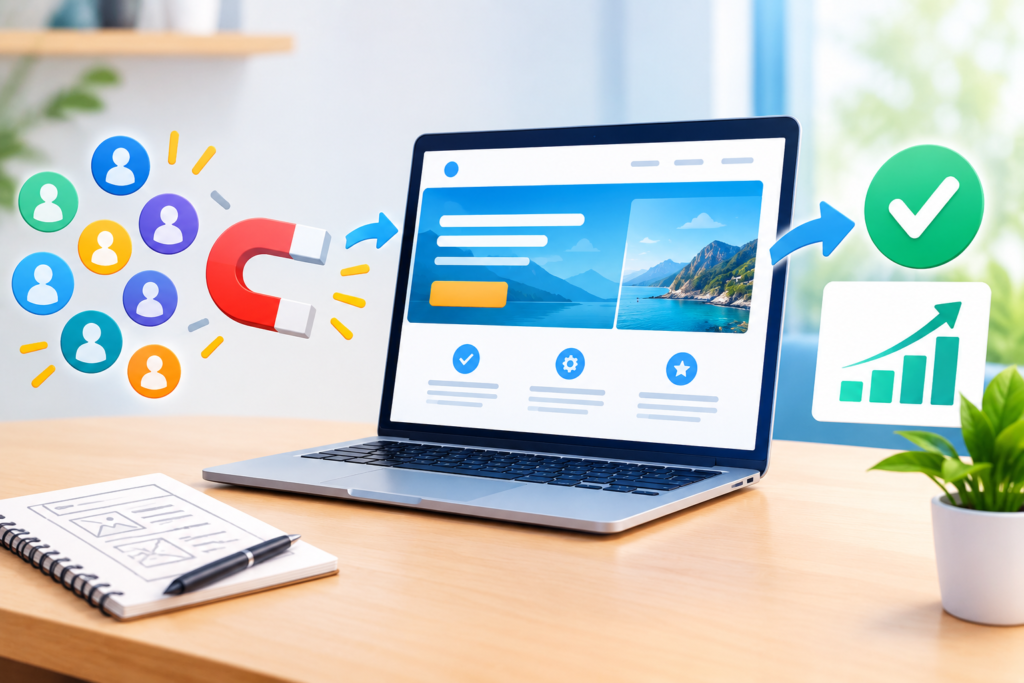
A landing page is often one of the most important conversion points in a funnel. It takes attention generated through search, advertising, email, social media, referrals, or another channel and attempts to turn that attention into a measurable action. Depending on the funnel, that action could be downloading a resource, requesting information, booking a consultation, registering for an event, starting a trial, or purchasing an offer.
Effective landing page optimization begins with message relevance. Visitors should quickly understand what the page offers, who it is intended for, why the offer matters, and what they should do next. Headlines should communicate a genuine benefit instead of relying on vague statements such as “transform your business.” Specific messaging makes it easier for visitors to determine whether the offer is relevant to them.
Trust signals can include genuine customer testimonials, case studies, credentials, transparent pricing, process explanations, guarantees where appropriate, privacy information, and clear contact details. These elements should be authentic. Fabricated testimonials, exaggerated claims, and unsupported guarantees can damage credibility instead of increasing conversions.
The call to action should be precise. “Book a consultation,” “Download the checklist,” “Start the trial,” or “Get the template” communicates the next step much more clearly than a generic button. Forms should request only information that is genuinely necessary at that stage. Before launch, test the complete journey from the first click through final confirmation, including forms, emails, tracking, payment processing, redirects, and mobile functionality.
A landing page is not successful simply because it looks professional. Its purpose is to create a clear, credible, and friction-free transition from visitor to the next stage of the funnel.
Building Offers That Give Prospects a Reason to Move Forward
An effective funnel requires an effective sales offer. No amount of page design or automation can permanently compensate for an offer that does not address a meaningful customer need. The offer should make the problem, desired outcome, solution, deliverables, expectations, and commitment clear.
A strong offer connects a specific problem with a desirable and credible outcome. It should explain how the solution works without promising results that cannot reasonably be controlled. For example, a marketing service can explain its process, deliverables, reporting, and objectives without guaranteeing a specific revenue increase that depends on numerous outside variables.
Offer packaging can influence how easily prospects understand the value. A consulting package might combine an audit, strategy session, implementation plan, and follow-up support. A digital product might include templates, examples, worksheets, and implementation guidance. Every component should serve a meaningful purpose. Adding random bonuses simply to make an offer appear larger can create confusion rather than value.
Pricing should reflect customer needs, delivery complexity, support requirements, market conditions, and business economics. Funnel models may use free resources, low-cost introductory products, core services, premium packages, subscriptions, or application-based offers. There is no universal pricing structure that works for every business.
Before launching, calculate acquisition costs, conversion assumptions, delivery expenses, refunds, support requirements, and customer lifetime value. A funnel that generates sales but loses money is not a successful funnel.
Using Lead Magnets and Lead Capture Strategically
A lead magnet is a useful resource provided in exchange for contact information, usually an email address. Common examples include checklists, templates, calculators, guides, reports, workshops, assessments, and mini-courses. The objective should not simply be to collect as many contacts as possible. A strong lead magnet attracts people who are genuinely relevant to the eventual offer.
The best lead magnets are closely connected to the problem a business solves. If a company sells funnel optimization services, a generic social media checklist may generate contacts who have little interest in funnel strategy. A funnel conversion checklist, landing-page audit resource, or sales-page review guide would be more closely aligned with the eventual service.
The resource itself should provide genuine value. Businesses should avoid intentionally making a lead magnet weak just to force prospects into a sales conversation. Delivering useful information creates an early experience of competence and reliability.
Lead capture should also establish clear expectations. Visitors should understand what they are receiving and what happens after they submit their information. If they are joining an email sequence, communication should remain relevant to the reason they subscribed.
Once the lead is captured, the first follow-up should deliver the promised resource promptly. Subsequent communication can educate the subscriber, address common questions, demonstrate expertise, explain possible solutions, and introduce an appropriate offer. The objective is to help the prospect make an informed decision rather than simply sending endless promotional messages.
Building an Email Nurture Sequence That Moves Leads Toward Conversion
Email nurturing is one of the most valuable components of a sales funnel because not every prospect is ready to purchase immediately. Someone may download a resource because they are researching a problem but still need more information before considering a solution. A well-planned email sequence gives the business an opportunity to remain useful and relevant while the prospect continues evaluating options.
A strong nurture sequence should have a logical progression. The first email can deliver the promised resource and establish expectations. Subsequent messages can explain the underlying problem, address common misconceptions, provide practical advice, demonstrate expertise, introduce a solution, answer objections, and eventually present an appropriate offer. The sequence should feel like a useful conversation rather than a collection of disconnected advertisements.
Segmentation can make nurturing considerably more relevant. Leads can be grouped according to the resource they downloaded, products they viewed, actions they completed, business needs, engagement levels, or purchasing stage. Someone who has repeatedly visited a pricing page may need different communication from someone who has only downloaded an introductory guide.
Email performance should be evaluated using meaningful metrics such as delivery rate, engagement, click-through rate, conversion rate, unsubscribe rate, and revenue attributed to campaigns where attribution is reliable. Open rates alone should not determine success because they do not represent the complete customer journey.
The goal of nurturing is not to force every subscriber through the same sequence. It is to provide useful information that helps qualified prospects move forward when they are ready.
Using Webinars, Demonstrations, and Educational Content Inside a Funnel
Some offers require more explanation than a conventional landing page can provide. Webinars and demonstrations can solve this problem by giving prospects a structured opportunity to understand a subject, see a process, evaluate expertise, and ask questions. They are particularly useful for professional services, software, education, consulting, and higher-consideration products.
A webinar funnel commonly includes an invitation page, registration form, confirmation page, reminder sequence, webinar experience, follow-up emails, and an offer or next step. Each stage should reinforce the same central promise. If the registration page promises practical instruction, the webinar should deliver meaningful instruction rather than functioning as an extended advertisement.
Educational content can also be distributed through videos, tutorials, case studies, guides, podcasts, comparison articles, and demonstrations. The right format depends on how the audience prefers to learn and how complex the product or service is. Businesses should not choose a format simply because it is currently popular.
Trust is particularly important in educational funnels. Claims should be supported where appropriate, examples should be genuine, and results should not be represented as guaranteed when they depend on factors outside the provider’s control. Demonstrating how something works is usually more persuasive than simply declaring that it works.
The transition from education to offer should also be natural. Once the prospect understands the problem and potential solution, the business can explain how its product or service provides the next logical step.
Creating Follow-Up Systems That Prevent Leads From Going Cold
Generating a lead is only the beginning of the relationship. A significant percentage of prospects will not purchase during their first interaction, which makes sales follow-up essential. Without a structured follow-up process, businesses can spend considerable money attracting prospects and then lose opportunities simply because communication stops too early.
Follow-up should provide a reason to continue the conversation. Depending on the business, that reason could be a useful resource, an answer to a common question, a product demonstration, a case study, a reminder, an invitation to speak with a specialist, or clarification of the next step. Repeating “Are you ready to buy?” without adding value can quickly become ineffective.
Timing also matters. Some prospects need immediate follow-up because they requested a consultation or demonstrated strong purchase intent. Others may require longer-term nurturing because they are researching a problem or waiting for the right budget or timing. The funnel should account for these differences.
A CRM or marketing automation system can help organize lead status, communication history, tasks, segmentation, and sales activity. Automation is useful for consistency, but it should not remove human judgment from high-value interactions. When a prospect has a complex requirement or significant purchasing decision, a personalized conversation can be much more valuable than another automated email.
The most effective follow-up systems balance automation with relevance. The objective is to remain present without becoming intrusive.
Understanding Conversion Rate Optimization for Sales Funnels
Conversion rate optimization, commonly called CRO, is the process of improving the percentage of visitors who complete a desired action. Within a sales funnel, optimization can occur at multiple points: advertisements, landing pages, forms, email sequences, sales pages, checkout experiences, booking pages, and post-purchase stages.
A useful CRO process begins with measurement. Businesses need reliable information about what visitors are doing before deciding what to change. If a landing page receives significant traffic but produces very few leads, the page deserves investigation. If many users begin checkout but abandon before payment, the problem may be related to price presentation, trust, payment options, technical errors, unexpected costs, or unnecessary friction.
Testing should be based on a clear hypothesis. Instead of changing five elements simultaneously, a business can identify a specific question such as whether a clearer value proposition improves registrations. The result should then be measured against a meaningful conversion metric.
Businesses should also avoid optimizing isolated numbers without considering lead quality. A change that increases form submissions by attracting irrelevant prospects may appear successful while reducing sales efficiency. Likewise, reducing a product’s price may increase purchases while damaging profitability.
The objective of CRO is therefore not simply to make percentages go up. It is to improve the entire economic and customer experience of the funnel.
Measuring the Metrics That Actually Matter
A data-driven sales funnel strategy depends on selecting metrics that connect marketing activity with business outcomes. Traffic is useful, but traffic alone does not pay the bills. Businesses should examine the progression from visitors to leads, qualified opportunities, customers, revenue, repeat purchases, and long-term customer value.
Important funnel metrics can include traffic volume, landing-page conversion rate, cost per lead, lead-to-customer conversion rate, customer acquisition cost, average order value, return on advertising spend, revenue per visitor, email conversion rate, sales-cycle length, refund rate, retention rate, and customer lifetime value.
Different businesses will prioritize different measurements. A high-ticket consulting company may focus heavily on qualified applications and sales conversations. An e-commerce business may prioritize product-page conversion, average order value, checkout completion, and repeat purchase rate. A subscription company may emphasize trial activation, paid conversion, churn, retention, and lifetime value.
Analytics implementation should be planned before launch rather than added after the funnel is already producing data. Businesses should establish meaningful conversion events and verify that tracking works across the journey. Google provides technical guidance around event measurement and analytics implementation that can help organizations build more reliable measurement systems. event measurement
Privacy and consent requirements should also be considered according to the applicable jurisdiction, business model, and data-processing practices. Tracking should serve a legitimate measurement purpose rather than collecting unnecessary information.
Using SEO and Paid Traffic to Feed the Funnel
A funnel requires a reliable source of relevant visitors. SEO can provide sustainable organic visibility by helping potential customers discover useful information when they are researching problems, solutions, products, and providers. Paid advertising can provide faster access to targeted audiences and allow businesses to test specific offers and messages.
Organic and paid traffic should not necessarily lead to the same page. Someone searching for an educational topic may be better served by a detailed guide, while someone searching for a specific service may be closer to a commercial decision. Matching search intent with the right landing experience can improve both relevance and conversion potential.
For organic search, businesses should focus on useful content, logical site structure, descriptive titles, strong internal linking, accessible pages, clear information, and trustworthy expertise. Google’s Search Essentials provides official guidance on technical requirements, spam policies, and key practices that can help content become eligible to appear in Google Search. Search Essentials
Paid traffic requires its own discipline. Campaigns should have clear objectives, controlled budgets, relevant targeting, accurate tracking, and landing pages that match the advertisement. Increasing advertising spend before establishing conversion economics can simply multiply losses.
The strongest acquisition strategy often combines multiple channels. Organic content can create long-term visibility, paid advertising can accelerate testing, email can nurture leads, partnerships can introduce qualified audiences, and referrals can reduce dependence on paid acquisition.
Technical SEO, Security, and Performance in Funnel Optimization
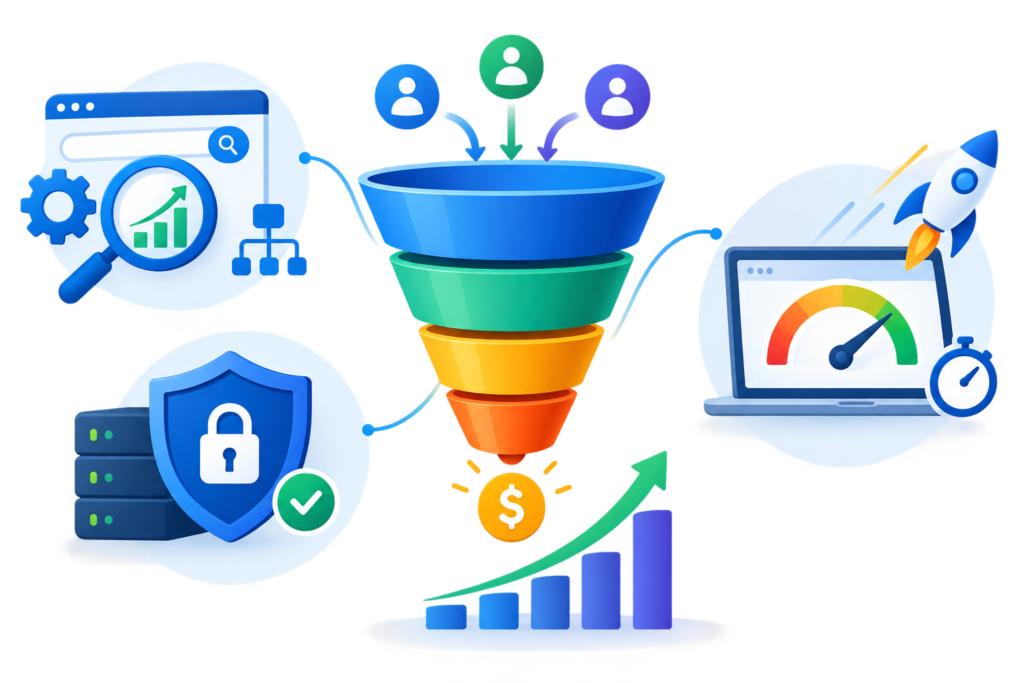
A funnel can have excellent copy and a compelling offer but still underperform because of technical problems. Technical SEO and website performance influence accessibility, discoverability, usability, and trust. Broken links, incorrect redirects, slow pages, mobile display problems, indexing issues, duplicate content, poorly implemented tracking, and insecure forms can create unnecessary friction.
Search engines need to be able to discover and understand relevant pages. Businesses should therefore pay attention to crawlability, indexing, canonicalization, structured data where appropriate, internal links, page titles, headings, and technical errors. Google’s documentation on structured data explains how eligible structured data can help search engines understand page content and potentially make pages eligible for enhanced search appearances. structured data
Security is equally important. Forms and checkout processes can handle sensitive customer information, so businesses should use HTTPS, secure hosting practices, strong access controls, reliable payment providers, appropriate backups, and updated software. Security is not simply a technical responsibility; it is part of the customer’s trust experience.
Performance should be measured on actual user experiences rather than judged only by how quickly a page appears on one developer’s computer. Mobile visitors may have slower connections or less powerful devices. Images, scripts, tracking tools, video embeds, and third-party applications should therefore be reviewed regularly.
Technical optimization should ultimately support people. The best funnel is not the one with the greatest number of technical features; it is the one that makes the customer’s journey reliable, understandable, secure, and efficient.
Best Practices, Common Mistakes, FAQs, and the Complete Implementation Framework
Building an effective funnel requires coordination between strategy, content, design, technology, measurement, and sales. The following best practices provide a practical framework for improving the system over time.
Best Practices Summary
Start with a clearly defined audience and a specific problem. Build the offer around a genuine customer need rather than attempting to manufacture demand through aggressive messaging. Give each funnel stage a clear purpose and make the transition between stages logical.
Keep the message consistent from advertisement or search result through landing page, follow-up, and offer. Reduce unnecessary friction without removing information prospects genuinely need. Use testimonials, case studies, demonstrations, credentials, transparent explanations, and accurate claims to build trust.
Measure the entire journey instead of focusing on vanity metrics. Monitor the relationship between traffic, leads, qualified opportunities, customers, revenue, acquisition cost, and lifetime value. Make improvements based on evidence and test one meaningful hypothesis at a time whenever possible.
Finally, maintain the funnel after launch. Offers change, customer expectations change, competitors change, technology changes, and traffic sources evolve. A funnel should therefore be treated as an operating system that requires ongoing review rather than a one-time project.
Common Sales Funnel Mistakes
One common mistake is building a funnel before understanding the audience. Another is creating an attractive landing page without a strong offer. Businesses also frequently introduce too many calls to action, use unclear messaging, collect excessive form information, or send leads into generic email sequences.
Another major problem is poor follow-up. A business may invest heavily in traffic and lead generation but provide little communication after the initial conversion. This leaves prospects without the information required to make a decision.
Some businesses also measure the wrong things. High traffic, social engagement, or email subscribers can look impressive without producing meaningful revenue. Funnel performance should ultimately be evaluated according to business objectives.
Technical mistakes can be equally damaging. Broken forms, inaccurate analytics, slow pages, failed integrations, mobile problems, insecure payment experiences, and incorrect redirects can undermine an otherwise strong funnel.
Frequently Asked Questions
What is the main purpose of a sales funnel?
The primary purpose of a sales funnel is to provide a structured path that helps relevant prospects move from initial awareness toward a desired action. That action might be a purchase, consultation, registration, application, subscription, or another conversion.
How many stages should a sales funnel have?
There is no universal number. A simple funnel may contain only a few steps, while a complex B2B or high-ticket funnel may contain many interactions. The appropriate number depends on the customer’s decision process, offer complexity, price, trust requirements, and sales cycle.
Do small businesses need sales funnels?
Yes, although the funnel does not need to be complicated. A small business might use a simple combination of an educational page, lead form, email sequence, consultation page, and follow-up process. The objective is to create a repeatable customer journey without adding unnecessary technology.
What makes a sales funnel high converting?
A high-converting funnel generally combines strong audience relevance, a compelling and credible offer, clear messaging, appropriate calls to action, trust signals, low unnecessary friction, reliable follow-up, and continuous measurement. Conversion rates also depend heavily on traffic quality and the nature of the offer.
Should every sales funnel include a lead magnet?
No. Lead magnets are particularly useful when prospects require education or are not ready to purchase immediately. A low-cost product, direct e-commerce offer, or high-intent service search may not require a lead magnet.
How long does it take to build a sales funnel?
The timeline depends on the funnel’s complexity, content requirements, technology, integrations, offer development, design, tracking, and testing. A simple funnel can be launched relatively quickly, while a sophisticated multi-stage system may require substantially more planning and implementation.
How do you know whether a sales funnel is working?
Look beyond individual conversion percentages. Examine the entire journey from traffic to leads, qualified prospects, customers, revenue, acquisition cost, retention, and lifetime value. A funnel is working when it produces commercially valuable outcomes efficiently and consistently.
Can sales funnels be automated?
Many repetitive activities can be automated, including lead delivery, email sequences, reminders, segmentation, appointment notifications, CRM updates, and certain follow-up processes. However, automation should support customer experience rather than replace appropriate human interaction.
From Funnel Strategy to Sustainable Growth
The most effective sales funnels are not simply collections of pages connected by buttons. They are carefully designed customer experiences that align audience needs, valuable information, persuasive offers, technology, sales processes, and measurable business outcomes.
A funnel should help the right people understand a problem, evaluate possible solutions, build confidence, and take an appropriate next step. When every stage supports that purpose, businesses can create a more predictable acquisition process while improving the experience for prospects and customers.
Optimization should continue after launch. Businesses can use customer feedback, analytics, sales conversations, support questions, testing, and changing market conditions to identify opportunities for improvement. The strongest funnel is rarely the first version. It becomes stronger through disciplined measurement and informed iteration.
The ultimate objective is not to create a complicated automated machine. It is to create a reliable system that connects customer intent with business value. When strategy, content, offer design, follow-up, technology, and measurement work together, a sales funnel can become an important foundation for sustainable growth.
Want to Implement This Easily?
Prompt Text: You are an expert consultant. Based on the blog post titled “Sales Funnels”, provide a step-by-step, practical implementation guide. Include tools, best practices, common mistakes to avoid, and advanced tips. Assume the reader wants to implement everything discussed in this article effectively.
CTA: Want our help implementing this? Just reach out to us via our website contact form: https://buywith.thrivecart.com/full-sales-funnel-templates/