
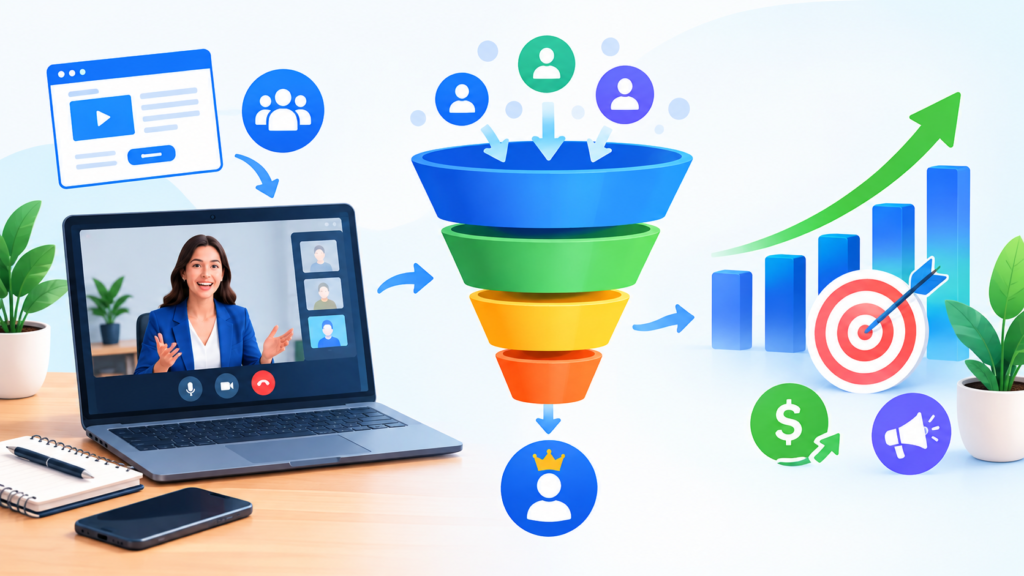
A webinar funnel guides prospects from initial awareness through registration, attendance, engagement, follow-up, and conversion. Learn how to build a practical webinar funnel that attracts the right audience, delivers useful education, nurtures trust, and turns qualified attendees into customers.
Introduction
A webinar funnel is more than a registration page followed by an online presentation. It is a connected customer journey designed to move a relevant prospect from curiosity to commitment through education, interaction, trust, and a clearly defined next step. When the funnel is properly designed, every stage has a specific job: attract the right people, explain why the webinar matters, make registration easy, increase attendance, deliver genuine value, present an appropriate offer, and continue the conversation after the event.
For businesses selling consulting, software, professional services, education, coaching, digital products, or other considered purchases, webinars can create an environment where prospects receive substantial information before making a buying decision. That educational element matters because many prospects do not need more advertising; they need greater clarity about their problem, the available solutions, the risks of doing nothing, and the practical path forward.
This guide explains how to build that journey from the ground up. It covers strategy, audience research, funnel architecture, registration pages, promotion, reminder sequences, webinar delivery, conversion, follow-up, evergreen systems, analytics, common mistakes, and implementation. The emphasis is on people-first marketing, measurable improvement, transparent communication, and a customer experience that remains useful even when the visitor is not ready to buy immediately.
For search visibility, the same principle applies to the supporting website content. Google recommends creating helpful, reliable, people-first content rather than content designed primarily to manipulate rankings. Its official resources include Google Search Essentials, while Google’s explanation of E-E-A-T highlights experience, expertise, authoritativeness, and trustworthiness as important concepts for assessing content quality.
Understanding What a Webinar Funnel Actually Does
A webinar funnel is a sequence of marketing and conversion steps that surrounds a webinar. The webinar itself is only one component. Before it, there may be advertising, organic content, email invitations, landing pages, registration forms, confirmation pages, calendar reminders, and pre-event education. After it, there may be replay emails, sales conversations, additional resources, objection handling, consultations, demonstrations, or an offer designed for qualified prospects.
The fundamental purpose is to create continuity between each stage. Someone who sees a promotional message should understand what they are being invited to. Someone who reaches the registration page should immediately understand the webinar’s topic, audience, benefit, timing, and expectations. Someone who registers should receive enough useful information before the event to remain interested. During the webinar, the presentation should deliver on the promise made before registration. Afterward, follow-up should help attendees understand their options rather than simply repeating a sales pitch.
This makes the funnel a system rather than a collection of disconnected pages and emails. A weak funnel can have excellent individual components but still produce poor results because the components do not align. For example, an advertisement might promise a detailed strategy while the webinar provides a generic overview. A registration page might attract thousands of people with an exaggerated claim, but those people may have little commercial relevance. A strong funnel instead maintains message consistency from the first touchpoint to the final conversion opportunity.
The most useful way to evaluate a webinar funnel is therefore not simply to ask, “How many people registered?” A better sequence of questions is: Did the funnel attract the right audience? Did the registration page communicate value clearly? Did registrants attend? Did attendees remain engaged? Did they understand the solution? Did qualified prospects take the intended next step? Those questions reveal where optimization should happen.
Defining the Audience, Problem, and Webinar Promise
The foundation of a successful webinar funnel is a clearly defined audience. A webinar intended for everyone often becomes relevant to almost nobody because the message lacks specificity. Instead of beginning with the presentation format, start by identifying the people most likely to benefit from the subject. Consider their current situation, experience level, common obstacles, desired outcome, purchasing context, and reasons they might hesitate to act.
A useful audience definition goes beyond demographics. A business owner might technically fit a target market, but the more important question is what problem they are actively trying to solve. Are they struggling to generate qualified leads? Are their sales calls inconsistent? Are they launching a new service? Are they spending money on advertising without understanding the resulting customer journey? The webinar topic should connect directly with a meaningful problem that the audience recognizes.
The webinar promise should then communicate a realistic outcome without making unsupported guarantees. Strong promises are specific enough to create interest but honest enough to establish trust. For example, “How to Structure a Webinar Funnel From Registration to Follow-Up” is clearer than a vague statement such as “Discover the Secret to Massive Growth.” The first tells the reader what will be covered. The second creates curiosity but gives little useful information about the actual experience.
Audience research can come from customer interviews, support questions, sales conversations, website analytics, search queries, surveys, community discussions, and previous campaign data. Look for repeated language. If prospects repeatedly describe the same problem using the same words, that language can inform the webinar title, registration page, email subject lines, and presentation structure. The goal is not to manufacture urgency; it is to make the value proposition easier for the right person to recognize.
Designing the Core Architecture of a Webinar Funnel
A practical webinar funnel commonly includes several connected stages: traffic source, registration page, confirmation page, reminder sequence, webinar experience, offer or next step, follow-up sequence, and measurement system. The exact architecture can vary according to the business model, but the underlying logic remains similar. Each stage should remove a specific obstacle between awareness and action.
The traffic source creates initial awareness. It might be organic search, social content, email, partnerships, paid advertising, direct outreach, or an existing customer audience. The registration page converts attention into a commitment. The confirmation experience reduces uncertainty and encourages calendar placement. Reminder communications reduce forgetfulness. The webinar converts attention into understanding. The post-webinar sequence gives people another opportunity to review the information, ask questions, access the replay, or move toward the appropriate commercial action.
Think of the architecture as a chain. If one link is weak, improvements elsewhere may have limited impact. Increasing traffic will not necessarily solve a registration-page problem. Improving the registration page will not automatically solve poor attendance. Increasing attendance will not fix a webinar that does not provide meaningful value. Likewise, a strong presentation can still underperform if the post-webinar offer is unclear.
The architecture should also accommodate different audience states. Some people will register immediately. Others will need additional information. Some will attend live. Others will watch the replay. Some will be ready to buy. Others will need a consultation, case study, product demonstration, or additional educational material. A well-built funnel does not treat every prospect identically. It provides logical next steps based on the prospect’s level of interest and readiness.
Creating a Webinar Registration Page That Converts the Right Visitors
The registration page has one primary responsibility: help the right visitor decide whether the webinar is worth attending. It should communicate the topic, audience, outcome, timing, presenter credibility, format, and registration action without forcing visitors to search through unnecessary information.
A strong headline should make the subject immediately understandable. Supporting copy should explain what the attendee will learn and why it matters. Where appropriate, include several concrete learning outcomes rather than generic statements such as “gain valuable insights.” For example, a webinar about funnel optimization could explain that participants will learn how to identify conversion leaks, structure follow-up sequences, and interpret basic funnel metrics. Specificity reduces ambiguity.
The registration form should request only information that has a genuine business purpose. Excessive fields can create friction, particularly on mobile devices. If a phone number is not necessary at registration, consider whether it needs to be collected at that point. Trust also matters. Be transparent about what happens after someone submits the form, how reminders will be delivered, and whether the webinar will be recorded.
Page performance is part of the overall user experience. Google’s guidance on page experience includes mobile usability, secure delivery, Core Web Vitals, and avoiding intrusive experiences among the areas site owners should consider.
You can therefore support the registration experience by using compressed images, efficient scripts, readable typography, accessible form controls, HTTPS, and a layout that works comfortably on smaller screens. A beautiful registration page that loads slowly or makes the form difficult to complete can lose potential registrants before the value proposition has a chance to work.
Building a Promotion Strategy That Attracts Qualified Registrants
Promotion should be designed around audience quality rather than registration volume alone. A campaign that generates 2,000 registrations but attracts people who have little interest in the eventual offer may be less useful than a smaller campaign that consistently attracts qualified prospects. The objective is to create a predictable connection between the audience problem, the webinar topic, and the business solution.
Organic promotion can include educational articles, social posts, email newsletters, short videos, search-focused content, community participation, and existing customer communications. Each piece should provide enough independent value to stand on its own while giving genuinely interested readers a reason to learn more through the webinar. This approach also reduces the need for exaggerated claims because the audience can evaluate the quality of the thinking before registering.
Paid promotion can provide additional reach, but the campaign should be monitored beyond the initial registration event. Useful measurements include cost per registration, attendance rate, engagement, qualified leads, booked calls, sales opportunities, and revenue attributable to the campaign. A cheap registration is not necessarily a valuable registration. The downstream metrics reveal whether the audience acquired through a particular source is actually progressing through the funnel.
Message consistency is particularly important. If a social post describes the webinar as an advanced tactical workshop but the registration page presents it as a beginner introduction, the mismatch can affect both registration quality and attendance expectations. Every promotional channel should communicate the same fundamental promise while adapting the format to the platform.
The promotion process should also start early enough to create awareness without allowing the campaign to become repetitive. Multiple reminders can use different angles: the problem being addressed, the practical outcomes, a specific lesson that will be covered, presenter credibility, frequently asked questions, or the limited-time nature of a scheduled event when that limitation is genuine.
Developing Registration Confirmation and Reminder Sequences
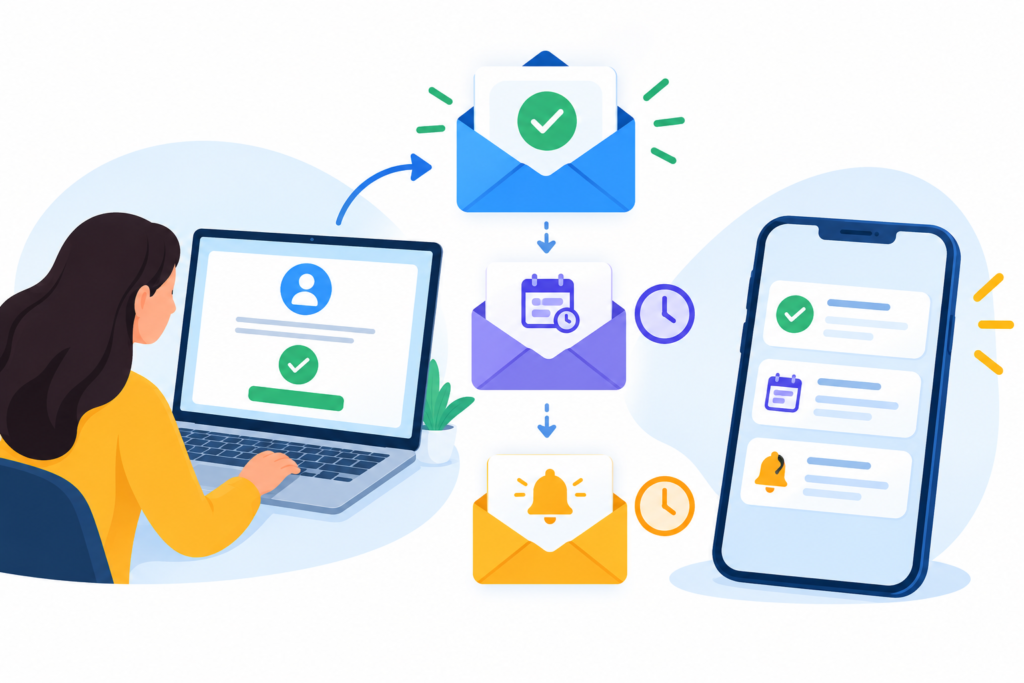
Registration does not guarantee attendance. The period between registration and the webinar is therefore an important part of the funnel. A confirmation page should immediately reassure the registrant that the process worked and provide practical information such as the event date, time, joining instructions, calendar option, and what they should prepare.
The confirmation experience can also strengthen commitment by explaining what the attendee will gain. Instead of simply saying “You are registered,” reinforce the value of the upcoming event. A short checklist might encourage attendees to bring a specific question, review a relevant resource, or identify the business problem they want to solve. This transforms the waiting period into part of the learning journey.
Reminder emails should be useful rather than repetitive. A sequence might include an immediate confirmation, a reminder several days before the event, another reminder on the day, and a final reminder shortly before the session. Exact timing should be adjusted according to the audience and event schedule. Each message should make joining easy while maintaining a clear reason to attend.
Technical reliability matters here as well. Joining instructions should be tested from the perspective of an actual attendee. Check the registration link, confirmation page, calendar event, meeting or streaming link, mobile experience, reminder timing, and replay process. If a platform is being used for live streaming, its own technical requirements should be reviewed. For example, YouTube’s official live-streaming guidance covers multiple streaming methods and account requirements.
The reminder sequence can also establish expectations about the presentation. If attendees know that there will be a practical demonstration, live Q&A, worksheet, or specific framework, they have a stronger reason to protect the time in their schedule.
Planning a Webinar Presentation That Delivers Genuine Value
The webinar presentation should be designed around the audience’s problem rather than around the company’s desire to promote a product. A useful structure often begins by establishing context, defining the problem, explaining why common approaches fail, introducing a better framework, demonstrating the framework, and then presenting the logical next step.
Opening minutes matter because attendees are constantly deciding whether continuing to watch is worth their time. Avoid spending the first ten minutes on an extended biography. Establish credibility briefly, explain what the audience will learn, and move quickly into the problem. Credibility is strongest when it supports the lesson rather than becoming the lesson.
The educational section should provide real, usable information. If the webinar promises a framework, actually explain the framework. If it promises a demonstration, show the process. If it promises mistakes to avoid, describe the mistakes and explain how to recognize them. Withholding the useful material to force a sale can damage trust and reduce the perceived value of the entire funnel.
A strong presentation also uses progression. Each section should naturally lead to the next. For example, a funnel webinar might explain why traffic alone does not create customers, then show how a registration experience affects lead quality, then demonstrate the importance of follow-up, and finally explain how the individual components operate as a complete system.
Visuals should support comprehension rather than overwhelm it. Use diagrams, examples, screenshots, frameworks, calculations, demonstrations, and concise slides where they help the audience understand a concept. Rehearse transitions and test audio, screen sharing, video playback, links, and presentation controls before the live event.
The goal is to make the attendee think, “I understand the problem better now, and I can see how the solution works.” That perception is more valuable than simply creating excitement.
Increasing Live Webinar Engagement and Audience Participation
A webinar is more effective when it feels like a guided experience rather than a long recorded lecture. Engagement can be created through questions, polls, chat prompts, examples, demonstrations, audience scenarios, Q&A, worksheets, and short reflection exercises. The exact methods depend on the platform and audience, but the principle is consistent: give attendees reasons to participate.
Questions should be easy enough to answer without interrupting the flow. For example, early in a funnel webinar, the presenter might ask attendees which stage creates the greatest challenge: attracting traffic, converting registrations, increasing attendance, delivering the presentation, or following up. The responses can make the content more relevant while giving the presenter useful qualitative information.
Audience interaction can also reveal objections. If multiple attendees ask whether a technique works with a small audience, limited budget, or specific business model, those questions can become part of the teaching. Addressing legitimate concerns directly is often more useful than pretending every attendee has identical circumstances.
The presenter should also monitor engagement signals. A sudden drop in attendance after a particular section may indicate that the content became too technical, repetitive, or disconnected from the original promise. A surge in questions may indicate strong interest in a particular concept. These observations can inform future webinar improvements.
For live-streaming environments, technical preparation remains important because connectivity issues can interrupt the audience experience. YouTube’s official streaming guidance recommends planning network capacity and testing the streaming setup before going live.
Ultimately, engagement should support learning rather than become entertainment for its own sake. Every interaction should have a reason. If a poll does not influence the discussion, a quiz does not reinforce learning, or a question does not help attendees think differently, it may simply create friction. Effective engagement makes the webinar more relevant, memorable, and useful.
Presenting the Offer and Call to Action Without Damaging Trust
The transition from education to commercial offer should feel logical. If the webinar has accurately explained the audience’s problem and demonstrated a practical solution, the offer can be introduced as a way to obtain additional help implementing what has been discussed.
A useful transition connects the education to the next step. For example, after explaining how to design a webinar funnel, the presenter might explain that implementing the complete system requires planning pages, automation, messaging, tracking, technical configuration, testing, and optimization. The commercial offer can then address those implementation requirements.
The call to action should be clear. Tell attendees exactly what to do, what happens after they do it, and who the next step is appropriate for. Avoid hiding the action inside a dense slide or giving multiple unrelated options at the same time. A focused CTA reduces cognitive load.
Trust is particularly important during this stage. Avoid unsupported income claims, fabricated scarcity, misleading countdowns, or promises that depend on circumstances outside the business’s control. If an offer has a genuine deadline, explain why. If places are limited because the service requires individual support, state that accurately. Transparency strengthens the relationship even when the prospect chooses not to buy.
Different prospects may require different next steps. Someone ready for implementation may book a consultation. Someone comparing solutions may request more information. Someone who is interested but not ready may benefit from the replay or another educational resource. A strong funnel therefore treats the CTA as the beginning of the next customer stage, not the end of the relationship.
Building a Follow-Up System for Attendees and Non-Attendees
The follow-up stage gives the business another opportunity to create value. It should not be treated as a sequence of repeated sales messages. Instead, segment people according to their behavior and provide information that matches their situation.
Attendees can receive a thank-you message, replay access where appropriate, key resources, answers to common questions, and a reminder of the relevant next step. People who registered but did not attend may receive a replay invitation with a concise explanation of what they missed. Prospects who clicked the offer but did not convert may receive additional information addressing common objections.
Segmentation can become more sophisticated as data accumulates. You might distinguish between people who watched most of the webinar, people who watched only the introduction, people who visited the offer page, and people who booked a call. The purpose is not to create unnecessary complexity. The purpose is to make communication more relevant.
Follow-up content can also extend the educational value of the webinar. A short email might explain one concept in more depth. Another might show a practical example. Another could address a common implementation mistake. This creates a sequence in which each message answers a natural question created by the previous message.
Timing should be tested rather than assumed to be universal. Some audiences respond quickly after an event; others need more time. The business should monitor engagement and conversion by message, while also paying attention to unsubscribe rates and negative feedback.
A mature follow-up system should also have clear stopping rules. Not every lead needs to remain in a high-frequency promotional sequence indefinitely. When the immediate webinar campaign ends, contacts can move into a broader educational or nurture system appropriate to their interests.
Turning a Live Webinar Into an Evergreen Funnel
An evergreen webinar funnel allows the educational experience to be presented repeatedly without requiring the presenter to host the same live session every time. This can create operational efficiency, but it should not be treated as a shortcut to quality.
The first requirement is a webinar that works without live interaction. Questions that depend heavily on real-time audience participation may need to be redesigned. References to a specific date or event should be removed or updated. Calls to action should work in the evergreen environment. Automated reminders, replay access, and scheduling logic should all be tested.
Evergreen systems can also use on-demand registration or scheduled viewing experiences. The appropriate model depends on the audience and the commercial process. Some businesses benefit from immediate access. Others may perform better when viewers choose from scheduled sessions because the appointment-like structure encourages commitment.
The content should be reviewed periodically. Market conditions, platform interfaces, statistics, product features, regulations, examples, and recommendations can change. An evergreen webinar that contains outdated information may gradually lose credibility. The automation may continue working perfectly while the content becomes less useful.
Evergreen performance should be evaluated separately from live performance. Compare registration rate, viewing behavior, engagement, CTA clicks, qualified leads, sales opportunities, and revenue. If the evergreen version produces weaker outcomes, identify whether the issue comes from the content, the registration experience, the timing, the offer, or the absence of live interaction.
An evergreen webinar should therefore be considered an operational format, not a permanent piece of content that never needs maintenance.
Measuring Webinar Funnel Performance With the Right Metrics
Measurement allows you to identify where the funnel is losing potential customers. Start with the complete journey rather than focusing on a single number.
At the top of the funnel, track traffic source, landing-page visits, registration conversion rate, and cost per registration where paid acquisition is involved. After registration, measure confirmation-page engagement, reminder-email performance, attendance rate, and viewing duration. During and after the webinar, monitor engagement, CTA clicks, consultation bookings, qualified leads, opportunities, and sales.
A simple funnel model might look like this:
Traffic → Registration → Attendance → Engagement → CTA → Qualified Lead → Customer
Each transition has a conversion rate. If 1,000 relevant visitors generate 100 registrations, the registration rate is 10%. If 100 registrants produce 40 attendees, the attendance rate is 40%. If 10 attendees become qualified opportunities, the opportunity rate from attendees is 25%.
The numbers are useful because they help isolate problems. A high registration rate with low attendance may indicate weak reminders or low-intent traffic. Strong attendance with low CTA engagement may suggest that the webinar does not connect its educational material to the next step. Strong CTA engagement with few qualified leads may indicate an offer or qualification problem.
Analytics should also be interpreted in context. Small sample sizes can create misleading fluctuations. Attribution can be imperfect when people interact with multiple channels before registering. Revenue may occur weeks or months after the original webinar. Therefore, avoid making major strategic decisions from one isolated metric.
For the website supporting the funnel, Google Search Console can provide information about how pages perform in Google Search. Search visibility should complement—not replace—conversion analytics because organic traffic only becomes commercially meaningful when the visitors are relevant and the user experience supports their goals. Google’s documentation also emphasizes that good page experience involves more than chasing one isolated metric.
Common Mistakes That Reduce Webinar Funnel Performance
One of the most common mistakes is starting with the webinar technology instead of the customer problem. Businesses can spend significant time comparing platforms, designing slides, and configuring automation before clearly defining who the webinar is for and what useful outcome it will provide. Technology supports the funnel; it does not create the strategy.
Another common mistake is overpromising. Headlines such as “guaranteed results,” “instant success,” or unrealistic financial claims may generate attention, but they can attract poor-fit prospects and damage trust. A specific educational promise is usually more sustainable. The registration page should make it clear what participants can reasonably expect to learn.
Poor follow-up is another frequent weakness. Some businesses put enormous effort into the live presentation and then send only one generic sales email. That leaves many legitimate questions unanswered. Attendees and non-attendees need different messages, and prospects at different stages need different levels of information.
Technical problems can also undermine a strong funnel. Broken registration links, incorrect time zones, missing calendar information, poor microphone quality, unstable internet, untested screen sharing, or inaccessible replay links can create avoidable friction. A complete technical rehearsal should simulate the attendee journey rather than simply confirming that the presenter can enter the meeting.
Other mistakes include asking for excessive registration information, using overly complicated forms, hiding the CTA, ignoring mobile visitors, failing to test email deliverability, and measuring only registrations instead of downstream outcomes.
From an SEO perspective, a related mistake is publishing generic content solely to attract search traffic. Google’s guidance emphasizes helpful, reliable, people-first content, and its Search Quality Rater Guidelines are intended to help evaluate whether search results satisfy users; rater scores themselves do not directly determine rankings.
Best Practices Summary for a High-Quality Webinar Funnel
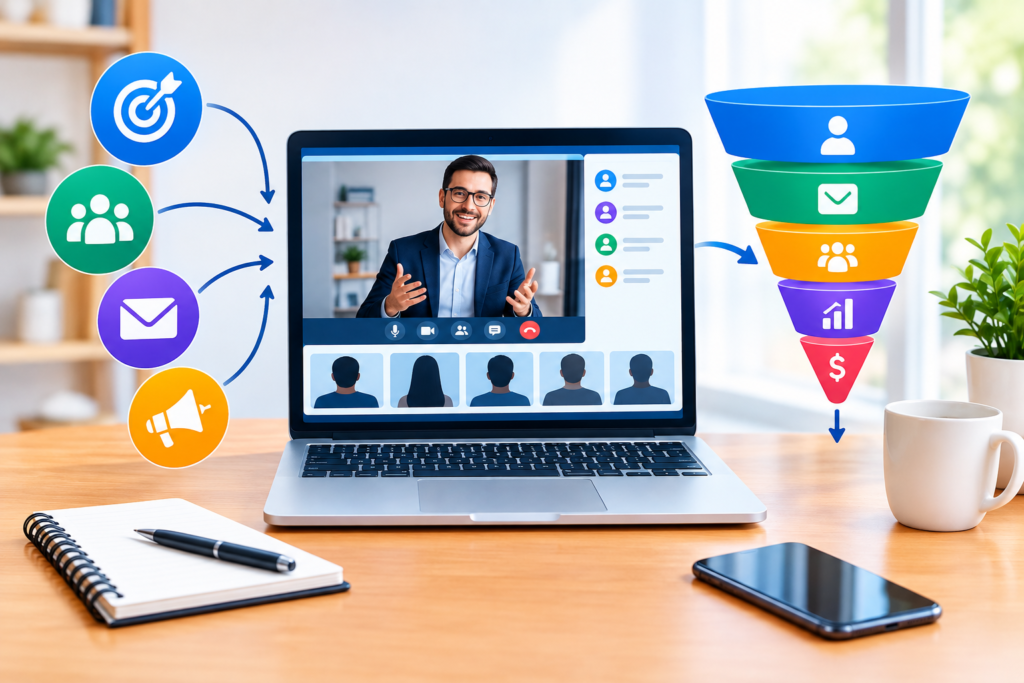
A strong webinar funnel begins with a specific audience and meaningful problem. Before building pages or automation, identify who should attend, what they are struggling with, and what useful transformation the webinar can realistically provide.
Keep the message consistent throughout the funnel. The advertisement, social post, email invitation, registration page, confirmation experience, webinar, and follow-up should all describe the same underlying promise. They can use different wording and formats, but the prospect should never feel that they were promised one experience and given another.
Make every stage useful. The registration page should clarify the decision. The confirmation page should reduce uncertainty. Reminder emails should make attendance easier. The webinar should provide substantive education. The CTA should explain the next step. Follow-up should answer questions and support decision-making.
Optimize based on evidence rather than assumptions. Track the complete customer journey and identify the largest meaningful drop-off. Test one significant variable at a time when possible. A better headline, shorter registration form, stronger reminder, improved presentation section, clearer CTA, or better follow-up sequence can each make a difference—but only measurement can show which change actually helped.
Technical quality should be treated as part of marketing quality. Secure pages, responsive design, reliable forms, fast-loading assets, accessible content, stable streaming, tested emails, and clear joining instructions all affect the experience.
For website content supporting the funnel, follow people-first SEO principles. Google’s official resources provide guidance through Google Search Essentials, Google SEO Starter Guide, and documentation covering search appearance and structured data.
Most importantly, do not judge a webinar funnel solely by how many people enter it. Judge it by whether the right people receive meaningful information, understand their options, and can take an appropriate next step.
FAQs
What is a webinar funnel?
A webinar funnel is a connected marketing and conversion journey built around a webinar. It typically includes promotion, registration, confirmation, reminders, the webinar experience, a call to action, and post-webinar follow-up. The purpose is to move relevant prospects from initial interest toward greater understanding and an appropriate next step.
How many steps should a webinar funnel have?
There is no universal number. A practical funnel may contain a traffic source, registration page, confirmation page, reminder sequence, webinar, offer page or booking process, and follow-up sequence. The right structure depends on the audience, sales cycle, product complexity, and webinar objective. Adding steps that do not improve the customer experience can create unnecessary friction.
What should a webinar registration page include?
A registration page should clearly explain the webinar topic, intended audience, useful outcomes, date and time, presenter information where relevant, format, and registration action. It should also make the process easy to complete on mobile devices. Avoid unnecessary form fields and exaggerated promises.
How can I increase webinar attendance?
Attendance can be supported through a clear value proposition, confirmation messaging, calendar options, useful reminder emails, practical pre-event information, and an easy-to-access joining link. Audience quality also matters. If promotional campaigns attract people who have little interest in the subject, registration numbers may look strong while attendance remains weak.
What should I include in the webinar presentation?
Include a clear introduction, the audience problem, relevant context, practical education, examples or demonstrations, a logical framework, audience interaction, and a clearly explained next step. The educational portion should deliver genuine value rather than withholding the useful material solely to create pressure for the offer.
Should a webinar be live or evergreen?
Both formats can work. Live webinars allow real-time interaction and can create stronger opportunities for questions, demonstrations, and discussion. Evergreen webinars can improve operational efficiency and provide more flexible access. The appropriate format depends on the business model, audience behavior, content type, and resources available.
What metrics should I track?
Track the complete funnel rather than one isolated number. Useful metrics include traffic, registration rate, cost per registration, attendance rate, viewing duration, engagement, CTA clicks, qualified leads, booked calls, opportunities, customers, revenue, and conversion rates between stages. These measurements help identify where improvement is needed.
How long should webinar follow-up last?
The answer depends on the sales cycle and audience. A short campaign might include several messages around the event and replay period, followed by a broader nurture sequence. More complex B2B or high-consideration purchases may require longer educational follow-up. The important principle is relevance: each message should provide a reason to continue the conversation.
Can a webinar funnel work for a small business?
Yes. A small business does not need a large audience to create a useful webinar funnel. A focused topic, clearly defined audience, reliable registration process, strong presentation, and appropriate follow-up can be more important than audience size. Starting with a manageable system also makes it easier to learn from real data before adding complexity.
Conclusion
A successful webinar funnel is built around a simple idea: give the right people a useful reason to move forward. That means understanding the audience before creating the presentation, communicating a realistic promise, building a friction-free registration experience, preparing attendees properly, delivering meaningful education, presenting a logical next step, and following up according to the prospect’s behavior.
The strongest systems are not necessarily the most complicated. They are the ones in which every component has a clear purpose. Traffic brings relevant people into the journey. The registration page explains the opportunity. Reminders encourage attendance. The webinar creates understanding. The offer provides an appropriate implementation path. Follow-up continues the conversation. Analytics reveal what needs improvement.
For businesses that want to develop this process systematically, MyFunnelScript can serve as the broader resource for building and improving funnel-based customer journeys. The objective should always remain the same: create an experience that is useful for the prospect while also creating a measurable path toward business growth.
A webinar is not simply an online presentation. When strategically connected to the rest of the customer journey, it can become an educational asset, trust-building mechanism, qualification system, and conversion pathway.
Want to Implement This Easily?
Prompt Text:
You are an expert consultant. Based on the blog post titled “(Webinar Funnel)”, provide a step-by-step, practical implementation guide. Include tools, best practices, common mistakes to avoid, and advanced tips. Assume the reader wants to implement everything discussed in this article effectively.
Call to Action: Want our help implementing this? Just reach out to us via our website contact form: https://buywith.thrivecart.com/full-sales-funnel-templates/