
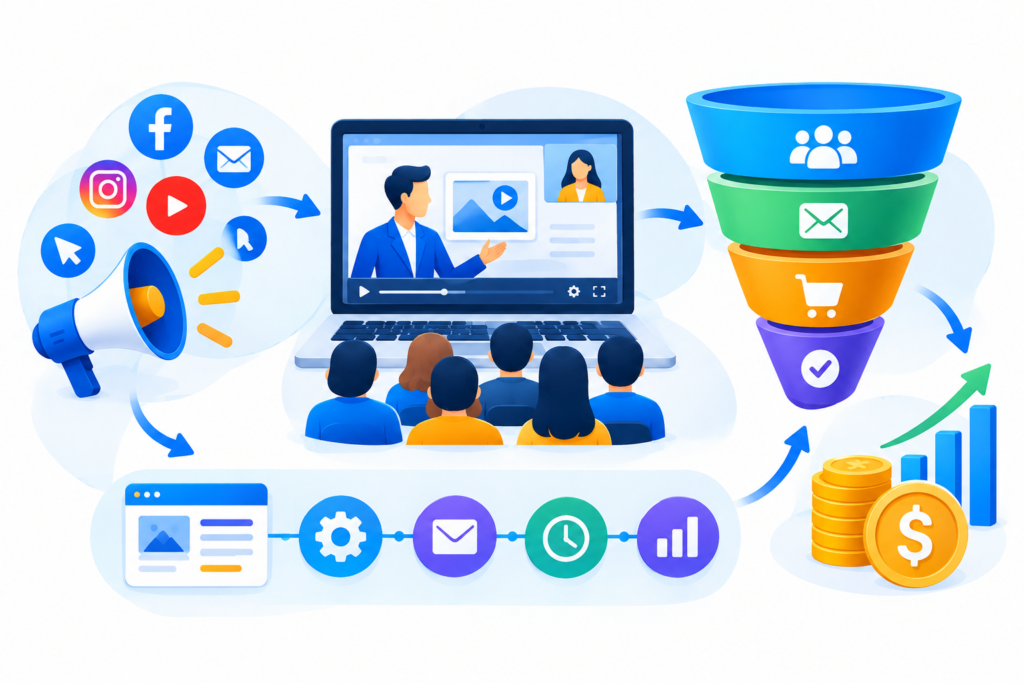
Learn how to build a high-converting webinar funnel that attracts qualified prospects, increases registrations and attendance, builds trust, and turns engaged attendees into customers through strategic education and follow-up.
Introduction
A webinar funnel is much more than a registration page followed by an online presentation. It is a complete customer journey that connects awareness, registration, preparation, attendance, education, engagement, conversion, and follow-up. When each stage is strategically connected, a webinar can become a powerful marketing asset for educating prospects, demonstrating expertise, overcoming objections, and guiding qualified buyers toward an appropriate next step.
For many businesses, the real challenge is not getting people to register. The bigger challenge is attracting the right people, getting them to attend, keeping them engaged, delivering genuine value, presenting a relevant offer, and continuing the conversation after the webinar. A campaign can generate hundreds of registrations while producing very few customers if the audience, topic, messaging, presentation, or follow-up process is poorly aligned.
A successful webinar funnel therefore needs to be viewed as a complete system. It should begin with a clearly defined audience problem and continue through every interaction that influences the prospect’s decision. For businesses using My Funnel Script, a webinar can become an important educational layer within a wider marketing journey that includes landing pages, promotional content, emails, sales pages, and other conversion assets.
Google’s guidance on helpful, reliable, people-first content emphasizes creating information primarily for people, demonstrating expertise, providing substantial value, and avoiding content created primarily to manipulate search rankings. Those same principles are highly relevant to webinar marketing: teach something genuinely useful, communicate honestly, support claims appropriately, and make the experience valuable even before a prospect buys.
This guide explains how to build a webinar funnel from the ground up. It covers audience research, funnel architecture, registration pages, promotion, reminders, presentation structure, offers, follow-up, automation, analytics, optimization, common mistakes, and best practices.
What Is a Webinar Funnel and How Does It Work?
A webinar funnel is a structured marketing and conversion journey that uses a webinar as a central educational experience. The funnel usually begins when a potential customer discovers the webinar through search, advertising, social media, email, referrals, partnerships, or another marketing channel. The prospect then visits a registration page, submits their information, receives confirmation and reminders, attends the webinar, engages with the presentation, evaluates the offer, and takes the next appropriate action.
The webinar itself is only one component. A complete funnel may contain advertisements, social posts, educational content, registration pages, confirmation pages, calendar invitations, reminder emails, webinar presentations, replay pages, offer pages, consultation forms, checkout pages, and post-webinar nurture sequences. Each component should have a clear purpose and should move the prospect naturally toward the next stage.
A typical journey can be represented as:
Traffic → Registration → Confirmation → Reminder → Attendance → Education → Offer → Follow-Up → Conversion
The first stage creates awareness. The registration stage earns a commitment of time. Confirmation establishes what happens next. Reminder communication protects the registration from being forgotten. The webinar delivers the educational experience. The offer presents a relevant solution. Follow-up helps prospects who are not ready to act immediately. Conversion represents the desired business outcome, whether that is a purchase, consultation, application, software trial, or another meaningful action.
This structure is similar to a broader sales funnel because both systems guide prospects through different levels of awareness and intent. However, the webinar adds an important educational component. Instead of asking a prospect to make an immediate buying decision, it gives them an opportunity to understand the problem, learn a framework, evaluate possible solutions, and build confidence before taking the next step.
That distinction makes webinars particularly useful for businesses selling services, consulting, coaching, education, software, professional expertise, and products that require explanation before purchase.
A webinar funnel can also be evaluated stage by stage.
If traffic is strong but registrations are weak, the registration page or message may need improvement.
If registrations are strong but attendance is weak, the problem may involve reminders, scheduling, audience quality, or perceived value.
If attendance is strong but engagement is weak, the presentation may be too generic, too long, or poorly structured.
If engagement is strong but conversions are weak, the offer, pricing, positioning, sales process, or follow-up may require attention.
This makes the funnel measurable.
Instead of asking, “Why is my webinar not working?”, marketers can ask:
Which stage is creating the greatest loss of qualified prospects?
That question leads to a much more useful optimization process.
A strong webinar funnel also avoids relying on exaggerated promises. A title such as “How to Build a Webinar Funnel From Registration to Follow-Up” gives the prospect a clear understanding of the subject. A vague headline promising a “secret formula” may attract attention, but it does not communicate enough information to establish genuine relevance.
The objective should not be to attract everyone.
The objective should be to attract people who have a genuine reason to attend.
Understanding the Different Stages of a Webinar Funnel
A webinar funnel becomes easier to build when each stage is treated as a separate customer experience with a specific purpose. The first stage is awareness. Prospects need to discover that the webinar exists and understand why it may be relevant to them. This can happen through search content, social media, advertising, email marketing, partnerships, referrals, or other channels.
The second stage is registration. At this point, the prospect has shown enough interest to consider investing time in the webinar. The registration page must therefore answer the most important questions quickly: What is the webinar about? Who is it for? What will I learn? When is it happening? How long will it take? Who is presenting it? What happens after I register?
The third stage is confirmation and preparation. Registration is not the end of the process. It is the beginning of the attendee experience. The confirmation should clearly communicate the event details and explain what happens next. Depending on the webinar, this could include adding the event to a calendar, reviewing preparation material, submitting questions, or simply understanding how to join.
The fourth stage is attendance. A registration only creates potential value. Attendance creates the opportunity for the business to deliver that value. This is why reminders matter. People register while intending to attend and later become distracted by work, family, competing priorities, or other events.
The fifth stage is education and engagement. The presentation should deliver what was promised. It should provide useful information, practical examples, frameworks, demonstrations, or insights that help attendees understand the topic more clearly.
The sixth stage is conversion. The presentation can introduce an offer or next step that logically connects to the problem being discussed. The offer might be a service, consultation, software product, course, template package, implementation program, or another solution.
The seventh stage is follow-up. Many attendees will not convert during the live session. They may need more information, a replay, additional proof, answers to objections, or time to evaluate the decision.
The final stage is measurement and optimization.
Every stage should be measurable where practical.
Google Analytics provides the ability to identify important user actions as key events and use those actions to evaluate marketing performance.
For example, a business might track:
Registration completion
Webinar attendance
Replay viewing
Offer-page visits
Consultation bookings
Lead submissions
Purchases
These events create a clearer picture of what happens throughout the customer journey.
The important point is that no single metric tells the entire story.
A webinar with 2,000 registrations may be less valuable than one with 300 highly qualified registrations if the smaller audience produces significantly better attendance, engagement, and customer acquisition.
Defining the Right Webinar Audience and Buyer Intent
Audience selection is one of the most important parts of building a profitable webinar funnel. A webinar that attempts to serve everyone usually becomes too general to create strong relevance. The audience should be specific enough that the right prospect can immediately recognize that the content is intended for them.
Begin with the problem.
What is the audience trying to accomplish?
What is preventing them from achieving it?
What have they already tried?
What mistakes are they making?
What questions do they repeatedly ask?
What information do they need before making a purchase?
These questions can reveal opportunities for webinar topics.
Customer conversations are particularly valuable. Sales calls, support requests, survey responses, reviews, community discussions, and previous campaign data can expose the exact language people use when describing their challenges.
That language can influence the webinar title and promotional messaging.
For example, suppose business owners repeatedly say:
“I am getting website traffic, but nobody is booking calls.”
A webinar about generic digital marketing may not address the underlying concern.
A more focused topic could be:
“How to Turn Website Visitors Into Qualified Leads Without Increasing Your Traffic.”
The second topic directly connects with the audience’s perceived problem.
Buyer intent also matters.
Someone at the awareness stage may need an educational webinar that explains the problem and introduces possible solutions.
Someone at the consideration stage may want a framework, comparison, demonstration, or implementation process.
Someone with high purchase intent may want proof, technical information, pricing guidance, implementation details, or answers to objections.
Understanding these differences can improve both the topic and the offer.
The audience should also match the eventual commercial solution.
If a webinar attracts people who cannot afford, use, or implement the product being offered, high registration numbers will not necessarily translate into strong business results.
This is why lead quality should be considered alongside lead volume.
The ideal audience definition may include:
Industry or market
Business size
Role or decision-making authority
Problem or desired outcome
Current level of knowledge
Purchase intent
Implementation capability
Fit with the offer
The more clearly these factors are understood, the easier it becomes to write the registration page and promotional materials.
Audience research should also be updated over time.
Markets change.
Customer expectations change.
Competitors introduce new approaches.
Technology changes.
New objections emerge.
A webinar funnel should therefore not be treated as a permanent document that never requires revision.
Designing the Core Architecture of a Webinar Funnel
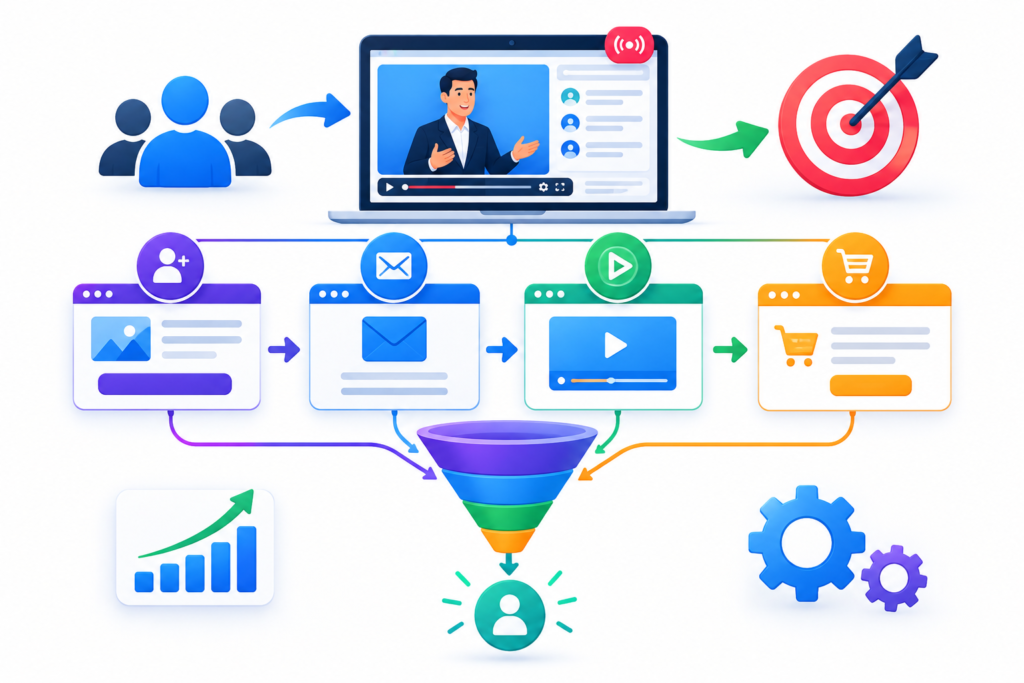
The core architecture connects every component into a single customer journey. A practical webinar funnel may include a traffic source, registration page, confirmation page, reminder sequence, webinar room or presentation, offer page, follow-up sequence, and analytics system.
The first principle is message continuity.
If an advertisement promises a detailed strategy but the webinar delivers a generic overview, the prospect experiences a disconnect.
If the registration page promises a practical framework but the presentation spends most of its time promoting a product, trust can decline.
If the webinar teaches one strategy but the offer suddenly promotes an unrelated product, the commercial transition feels forced.
Every stage should therefore reinforce the same core promise.
The second principle is friction reduction.
The registration process should be simple.
The confirmation process should be clear.
The webinar access instructions should work.
The presentation should load correctly.
The CTA should be easy to understand.
The checkout or booking process should not contain unnecessary obstacles.
The third principle is behavior-based segmentation.
Not every prospect should receive the same follow-up.
Someone who registered but never attended needs a different message from someone who attended the entire presentation.
Someone who clicked the offer but did not purchase may need objection handling.
Someone who purchased should move into onboarding.
This creates a more relevant experience.
The fourth principle is measurement.
Each important transition should have an appropriate measurement strategy.
Google explains that key events can be used to measure actions particularly important to a business and evaluate the channels and user paths associated with those actions.
For a webinar funnel, that could include:
Registration submitted
Webinar attended
Replay watched
Offer clicked
Consultation booked
Purchase completed
The fifth principle is technical reliability.
Before launching a campaign, test the complete funnel from the perspective of a real prospect.
Register yourself.
Receive the confirmation.
Click every link.
Add the event to a calendar.
Join the webinar.
Test the presentation.
Click the offer.
Submit the form.
Complete the purchase or booking process.
Check the tracking.
Check the mobile experience.
This end-to-end test can reveal problems that individual component testing may miss.
Google’s Google Search Essentials covers technical requirements, spam policies, and key practices relevant to making web content eligible to appear in Google Search.
While search visibility is only one part of webinar marketing, technical quality contributes to the overall reliability of the customer journey.
Creating a Webinar Topic That Attracts the Right Prospects
The webinar topic should sit at the intersection of audience demand, business expertise, and commercial relevance.
If there is audience demand but no connection to the business solution, the webinar may generate attention without producing meaningful commercial outcomes.
If the topic is highly relevant to the business but nobody cares about it, registration rates may remain weak.
If the topic is popular but outside the company’s actual expertise, the presentation may lack depth and credibility.
The best topics solve a genuine information gap.
For example:
How to Build a Webinar Funnel From Registration to Follow-Up
How to Increase Webinar Attendance Without Increasing Ad Spend
How to Create a Webinar Presentation That Educates and Converts
How to Turn Webinar Attendees Into Qualified Sales Opportunities
These titles communicate a specific subject and likely outcome.
Specificity is important because people need to understand what they are committing to.
A webinar called “Digital Marketing Secrets” is broad.
A webinar called “How to Build a Lead-Generating Webinar Funnel for a Professional Service Business” gives considerably more context.
The title should also be honest.
Avoid promising guaranteed income, instant results, or outcomes that depend on circumstances outside the business’s control.
Google’s people-first content guidance specifically encourages creators to focus on useful information for an intended audience rather than creating content primarily to attract search traffic.
The same philosophy works for webinar topics.
Choose the topic because it is genuinely useful to the audience.
Search demand can inform the decision, but it should not be the only reason the webinar exists.
Another effective approach is to identify questions that prospects ask immediately before making a purchase.
For example:
“Which strategy should I choose?”
“How much does implementation normally involve?”
“What mistakes should I avoid?”
“What should I measure?”
“How long does implementation take?”
“What should I prepare first?”
These questions can become webinar topics because they naturally sit close to the buying decision.
The strongest webinar topics often provide a bridge between education and implementation.
They teach the prospect enough to understand the problem and evaluate solutions while naturally creating interest in the next step.
Building a High-Converting Webinar Registration Page
The registration page is where interest becomes commitment.
Its job is not to explain every detail of the business.
Its job is to make the webinar’s value clear enough that the right visitor feels confident registering.
The headline should communicate the main subject or desired outcome.
The supporting copy should explain why the topic matters.
The learning outcomes should be concrete.
The presenter information should establish appropriate credibility.
The event details should remove uncertainty.
The registration form should be easy to complete.
The CTA should be clear.
A strong page might include:
A specific headline
A short value proposition
Three to five learning outcomes
Who should attend
Who may not benefit
Presenter information
Date and time
Duration
Live or recorded status
Registration form
Privacy information where appropriate
Clear CTA
The page should also maintain consistency with the promotional message.
If a visitor clicks an advertisement about improving webinar attendance and arrives at a page focused on sales funnels generally, the message mismatch may reduce trust.
The registration page should therefore continue the same conversation that began in the advertisement, email, social post, or search result.
Form design also matters.
Only request information that serves a genuine purpose.
If the webinar is free and the business asks for ten pieces of personal information, the form may create unnecessary friction.
The amount of information requested should be appropriate for the relationship and the business objective.
Trust signals should also be genuine.
Use real testimonials.
Use accurate credentials.
Use authentic case studies.
Explain claims.
Avoid fabricated numbers.
Avoid fake scarcity.
Avoid misleading countdown timers.
A registration page can be persuasive without being manipulative.
The goal is to help the visitor make an informed decision.
The best page makes the visitor think:
“This webinar is relevant to my situation, I understand what I will learn, and I know what happens after I register.”
That clarity can be more powerful than exaggerated persuasion.
Promoting the Webinar and Increasing Qualified Registrations
Promotion determines how many people enter the top of the webinar funnel, but the objective should be qualified registrations, not simply maximum registration volume.
Organic promotion can include search-optimized content, social media, email newsletters, website banners, existing customer communication, partner newsletters, community participation, referral campaigns, and educational resources.
Paid promotion can accelerate reach when the economics and audience fit make sense.
However, paid traffic should be evaluated beyond cost per registration.
Suppose Campaign A produces 500 registrations at a low cost.
Campaign B produces 200 registrations at a higher cost.
If Campaign A produces only five qualified opportunities while Campaign B produces thirty, Campaign B may be considerably more valuable.
This is why downstream performance matters.
The promotional message should also accurately represent the webinar.
If the advertisement promises:
“Learn how to build a complete webinar funnel”
the presentation should actually teach the audience how the system works.
Do not use an exaggerated promise simply because it generates more clicks.
That may increase registrations while reducing attendance quality and trust.
Email promotion can be particularly effective when the business already has a relevant audience.
Instead of repeatedly sending the same registration message, create a sequence with different purposes.
One message can introduce the problem.
Another can explain what attendees will learn.
Another can address a common objection.
Another can provide a practical example.
The final reminder can focus on date, time, and access details.
Partnership promotion can also be useful.
Relevant agencies, consultants, software companies, professional communities, industry newsletters, and complementary businesses may already have access to the desired audience.
The partnership should make sense for both sides.
The promotional strategy should ultimately answer one question:
Why should this specific person care about this specific webinar right now?
If the answer is clear, promotion becomes much more effective.
Creating Reminder Sequences That Increase Webinar Attendance
Registration creates intent, but it does not guarantee attendance.
People become busy.
They forget.
They lose confirmation emails.
They register for multiple events.
They experience unexpected priorities.
A reminder sequence helps protect the commitment that has already been made.
Immediately after registration, the prospect should receive a confirmation that clearly states:
The webinar date
The webinar time
The access method
The expected duration
What they will learn
What they should do next
If appropriate, provide a calendar option.
As the event approaches, reminder communication should reinforce value rather than simply repeat the event details.
For example, one reminder can explain the three major concepts attendees will learn.
Another can answer a common question.
Another can explain how to prepare.
The final reminder can focus on joining instructions.
This creates a sequence in which each message performs a different job.
The tone should remain useful rather than aggressive.
Avoid fake urgency.
Avoid claims such as “last chance” when another webinar is scheduled next week.
Avoid pretending that an automated webinar is live if it is not.
Transparency is especially important because the reminder sequence is part of the trust-building process.
The technical side should also be tested.
Check:
Email delivery
Links
Calendar invitations
Time zones
Mobile formatting
Webinar access
Replay availability
Tracking
If the audience is international, time-zone clarity is particularly important.
The goal is to make attendance easy.
A good reminder sequence does not make the prospect feel pressured.
It makes the prospect feel prepared.
Structuring a Webinar Presentation That Delivers Genuine Value
The presentation is the central educational experience of the funnel.
Everything promised before the event should be delivered during it.
A useful structure might begin with the problem.
Explain why the problem matters.
Clarify common misconceptions.
Introduce the framework.
Teach the framework.
Demonstrate how it works.
Explain common mistakes.
Show examples.
Then introduce the next step.
This structure creates a logical progression.
The opening should establish expectations quickly.
Avoid spending too much time on a lengthy personal biography.
Credibility matters, but it should support the lesson.
A concise introduction can explain who the presenter is, why the subject matters, and what attendees will learn.
Then move into the educational content.
The webinar should provide genuine value.
If the session promises a framework, explain the framework.
If it promises a demonstration, demonstrate.
If it promises mistakes to avoid, describe the mistakes and explain how to prevent them.
The audience should leave with greater understanding even if they never purchase anything.
This is particularly important from an E-E-A-T perspective.
Google’s guidance encourages content that demonstrates first-hand expertise and depth of knowledge and gives readers enough information to accomplish their goal.
A webinar should follow the same principle.
Do not intentionally make the educational section shallow simply to force the audience toward the offer.
Instead, provide valuable knowledge and explain why implementation may require additional resources, expertise, technology, or support.
Visual presentation also matters.
Use diagrams where a process needs explanation.
Use examples when a concept is abstract.
Use screenshots when demonstrating software.
Use calculations when discussing economics.
Use case studies when evidence is relevant and available.
Avoid slides overloaded with text.
The presenter should remain focused on helping the audience understand.
Engagement can be encouraged through questions, polls, chat interaction, demonstrations, or Q&A.
The objective is not to create interaction for its own sake.
Every interaction should support understanding.
A strong webinar creates the feeling that the attendee has spent their time well.
That is one of the most valuable outcomes a webinar funnel can produce.
Creating a Webinar Offer and Call to Action That Converts
Once the educational portion of a webinar has delivered genuine value, the next step is to introduce an offer that provides a logical path toward implementation. The offer should not feel like a completely separate sales presentation. Instead, it should connect directly to the problem discussed during the webinar and explain how the product or service can help the audience move from understanding to action.
A strong webinar offer begins by identifying the gap between knowing what to do and actually doing it. A presenter might teach attendees how a webinar funnel works, explain the major components, and demonstrate the strategic principles involved. The offer can then provide the resources, templates, technology, consulting, implementation, or support required to put those principles into practice. This creates a natural relationship between the educational content and commercial solution. The prospect understands what needs to happen and can then decide whether they want assistance executing it.
The call to action should be specific and easy to understand. Instead of using vague phrases such as “Learn More,” use action-oriented language that accurately describes the next step, such as Book a Strategy Call, Start Your Trial, Get the Templates, Apply for the Program, or Request a Consultation. The CTA should also explain what happens after the click. If the prospect is booking a consultation, explain what the conversation involves. If they are purchasing a product, clearly communicate what they receive. Transparency reduces uncertainty and supports trust.
A strong offer can include relevant proof, such as authentic testimonials, case studies, demonstrations, customer examples, or documented results. However, every claim should accurately represent the evidence behind it. Do not imply that a particular result is guaranteed when outcomes depend on implementation, market conditions, audience quality, pricing, competition, and many other variables.
The offer should also explain who it is designed for. Not every webinar attendee will be a suitable customer, and acknowledging that fact can increase credibility. A professional offer might say that the service is most appropriate for businesses that already have a defined offer and audience, while explaining that people at an earlier stage may benefit from additional educational resources first.
The strongest webinar CTA does not pressure every attendee into buying immediately. It gives qualified prospects a clear next step while allowing others to continue learning.
Designing Post-Webinar Follow-Up That Continues the Conversation
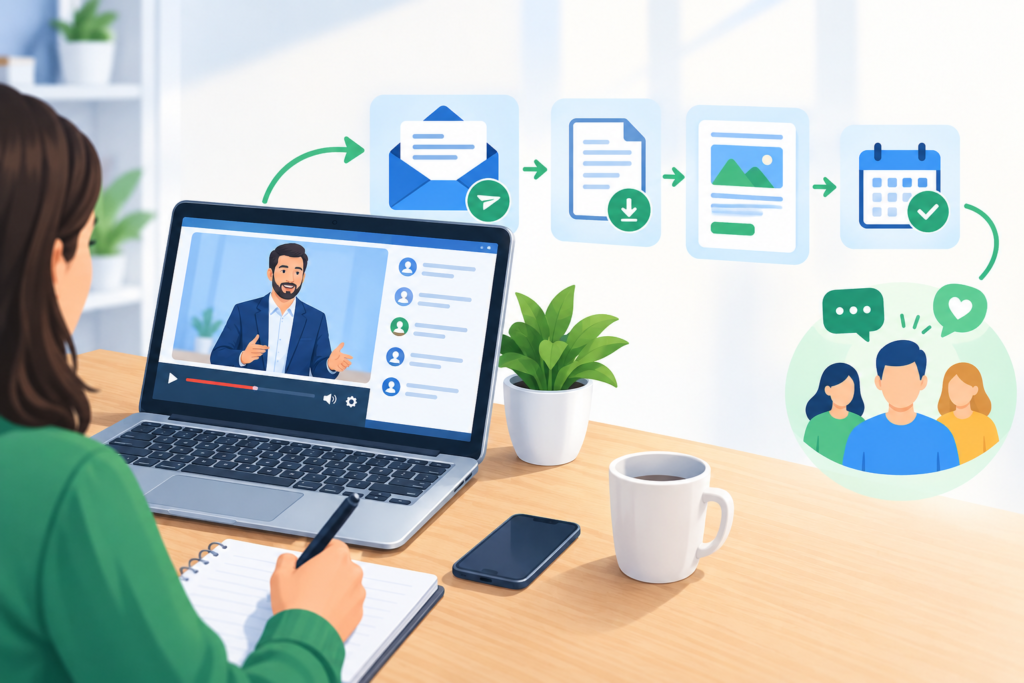
Many businesses invest substantial effort into preparing and promoting a webinar but underestimate what happens afterward. Yet a significant portion of potential conversions may occur during the follow-up period rather than during the live presentation. Some attendees need additional time to evaluate the offer, while others have questions that were not answered during the session.
A strong webinar follow-up sequence should therefore be planned before the webinar begins. The sequence should account for different behaviors. Someone who registered but did not attend should receive a different message from someone who watched the entire presentation. Likewise, a prospect who clicked the offer but did not purchase may need more specific information than someone who showed little engagement.
The first follow-up can provide the replay or key resources where appropriate. The purpose should be to make the promised value accessible rather than simply saying that the prospect missed the event. A second communication can reinforce the main lesson and explain why the subject matters. A third can address a common objection. A later message can introduce relevant proof, a demonstration, or a practical example. Finally, a decision-oriented message can explain the next step for prospects who are ready to move forward.
Segmentation makes these messages more relevant. Potential segments include:
Registered but did not attend
Attended briefly
Attended most of the webinar
Watched the replay
Clicked the offer
Booked a consultation
Purchased
Each group has different needs.
For example, a non-attendee needs access and context. A highly engaged attendee may need a stronger explanation of implementation. Someone who clicked an offer but did not purchase may need answers about pricing, suitability, timing, or expected deliverables.
Follow-up should not become endless promotional pressure. Its purpose is to help prospects make an informed decision.
It is also important to remove customers from prospect sequences when they convert. Continuing to send sales-oriented messages to someone who has already purchased can create confusion and damage the customer experience.
A well-designed sequence therefore moves people forward rather than repeatedly sending the same message.
Using Automation to Build an Evergreen Webinar Funnel
Automation can transform a webinar from a one-time event into a repeatable marketing system. Instead of manually sending confirmation emails, reminders, replay messages, and follow-up communications, an automated system can coordinate these actions based on registration and engagement behavior.
An evergreen webinar funnel can operate continuously, allowing qualified prospects to register and access the educational experience according to a predefined schedule or on-demand model. This can be useful for businesses that have a presentation capable of delivering consistent value over time.
However, automation should never be used to create a misleading customer experience. If the webinar is prerecorded, the funnel should not falsely imply that the presenter is delivering the session live. If an offer uses genuine deadlines, those deadlines should be real. If availability is limited, the limitation should actually exist.
Automation works best when it handles repetitive coordination while humans remain responsible for strategy and quality.
A typical automated sequence may look like:
Visitor → Registration → Confirmation → Reminder → Webinar → Engagement Tag → Follow-Up → Conversion → Customer Onboarding
Behavioral triggers can make the system more sophisticated. For example, a person who attends the webinar might receive one sequence, while a person who registers but does not attend receives another.
A prospect who clicks an offer could receive information addressing common objections.
A person who books a call can be moved into a preparation sequence.
A customer can be transferred into onboarding.
These transitions reduce irrelevant communication.
Automation also makes testing easier. If the same journey operates repeatedly, the business can collect more data and identify patterns.
However, automated systems need regular maintenance. Links can break. Platforms change. Tracking can stop working. Offers become outdated. Email sequences can become repetitive. Webinar content can become less relevant as markets evolve.
The funnel should therefore be reviewed periodically.
Automation should create consistency, not neglect.
Measuring Webinar Funnel Performance With Meaningful Analytics
A webinar funnel should be measured according to business objectives rather than vanity metrics. Registration volume is useful, but it does not tell you whether the campaign is attracting the right people or generating customers.
At the top of the funnel, useful measurements can include traffic, traffic source, impressions, clicks, registration conversion rate, and cost per registration.
The next stage can measure attendance rate, viewing duration, audience engagement, questions, poll participation, and replay consumption.
The commercial stage can measure offer clicks, applications, booked calls, purchases, revenue, customer acquisition cost, and return on investment.
Google Analytics allows businesses to identify important user interactions as key events and evaluate how marketing channels contribute to those actions. (support.google.com)
For example, a business might define:
Registration: A lead-generation event.
Attendance: An engagement event.
Offer click: A commercial-intent event.
Booked call: A qualified opportunity.
Purchase: A revenue event.
This creates a measurement hierarchy.
The most important question is not:
How many people registered?
It is:
How many qualified prospects moved through the funnel and produced meaningful business outcomes?
Consider two campaigns.
Campaign A produces 1,000 registrations, 150 attendees, 20 sales conversations, and two customers.
Campaign B produces 300 registrations, 180 attendees, 40 sales conversations, and eight customers.
Campaign A looks better if registration volume is the only metric.
Campaign B is clearly stronger from a business perspective.
Attribution should also be considered. A prospect might discover a business through organic search, later see a social post, receive an email, register through an advertisement, attend a webinar, and eventually purchase after a follow-up message.
No single interaction necessarily deserves all the credit.
Google Analytics provides reporting capabilities that help businesses understand acquisition, engagement, and conversion activity across different channels. (support.google.com)
The goal is to connect marketing activity with actual outcomes.
Optimizing Conversion Rates Across the Entire Webinar Funnel
Optimization should begin with the biggest bottleneck.
If a large amount of relevant traffic reaches the registration page but few visitors register, focus on the registration experience before changing the webinar presentation.
If registration is strong but attendance is weak, examine reminders, scheduling, audience quality, event expectations, and access instructions.
If attendance is strong but engagement is low, evaluate presentation structure, pacing, topic relevance, visuals, and interaction.
If engagement is high but offer clicks are low, investigate whether the CTA is sufficiently relevant and whether the webinar has established a clear reason to take the next step.
If offer clicks are strong but purchases remain low, investigate the offer, price, proof, checkout experience, qualification process, and objections.
This creates a logical optimization framework:
Traffic problem → Improve acquisition
Registration problem → Improve landing page
Attendance problem → Improve reminders and commitment
Engagement problem → Improve presentation
Offer problem → Improve positioning and CTA
Conversion problem → Improve sales experience
Testing should also be based on clear hypotheses.
Instead of randomly changing a headline, define what you expect the change to accomplish.
For example:
“A more specific registration-page headline may increase qualified registrations because visitors will immediately understand who the webinar is designed for.”
This makes the test measurable.
Possible elements to test include:
Headline
Subheadline
CTA wording
Form length
Presenter positioning
Learning outcomes
Reminder timing
Email subject lines
Webinar length
Offer presentation
Pricing structure
Booking process
Checkout experience
Do not change everything simultaneously when you want to understand causality.
Also combine quantitative analytics with qualitative feedback.
Numbers can tell you where people are dropping out.
Customer interviews, survey responses, sales-call notes, questions, and support conversations can help explain why.
That combination is much more powerful than relying on analytics alone.
Common Mistakes That Reduce Webinar Funnel Performance
One of the biggest mistakes is creating the webinar before clearly defining the audience problem. Businesses sometimes begin with the product they want to sell and then build a webinar around it. The resulting presentation can feel like an extended advertisement instead of an educational experience.
Another mistake is choosing a topic that is too broad. A webinar called “Digital Marketing Strategies” may sound useful but gives the prospect little reason to believe the session is specifically relevant to their situation. A focused topic can communicate value much more clearly.
A third mistake is optimizing for registration volume rather than lead quality. A campaign can generate hundreds or thousands of registrations that have little commercial relevance. Cheap registrations are not necessarily valuable registrations.
Weak reminder systems are another common problem. People register with good intentions and forget. Without useful confirmation and reminders, attendance can fall substantially.
Some businesses also make the presentation too promotional. If the audience spends most of the webinar listening to product features instead of learning something useful, trust can decline.
Other common mistakes include:
Using exaggerated promises
Making unsupported claims
Using fake scarcity
Creating unnecessarily long registration forms
Ignoring mobile users
Failing to test technical links
Providing a weak or unclear CTA
Sending the same follow-up to every attendee
Failing to offer a replay when appropriate
Ignoring people who showed strong buying intent
Continuing sales emails after purchase
Tracking registrations but not revenue
Never reviewing webinar performance after launch
Technical problems deserve particular attention. A broken registration form or inaccessible webinar link can destroy conversions regardless of how good the marketing strategy is.
Before launch, complete the funnel yourself from beginning to end.
Test the registration.
Test the confirmation.
Test the calendar invitation.
Test the webinar link.
Test the presentation.
Test the CTA.
Test the booking or checkout process.
Test the tracking.
A professional funnel should be treated as a customer experience, not merely a collection of marketing assets.
Best Practices Summary for Building a High-Converting Webinar Funnel
A successful webinar funnel starts with a clearly defined audience and a meaningful problem. The topic should address a genuine information gap and connect naturally to the business’s expertise and commercial solution.
The registration page should make the webinar’s purpose immediately clear. Visitors should understand what they will learn, who the webinar is for, when it happens, and what happens after registration.
Promotion should focus on attracting relevant prospects rather than generating maximum registrations. Organic and paid channels can both work when the messaging, audience, and measurement strategy are aligned.
The reminder sequence should make attendance easy. Confirmation messages, useful reminders, calendar options, access instructions, and clear expectations can reduce friction.
The presentation should deliver genuine educational value. A webinar should not withhold all useful information merely to make the offer appear necessary. Instead, it should teach a meaningful framework and explain where additional implementation support may be valuable.
The offer should logically follow the education.
The CTA should be clear.
Proof should be authentic.
Claims should be supportable.
Follow-up should be segmented.
Automation should improve consistency without creating misleading experiences.
Analytics should measure the entire customer journey.
Optimization should focus on the biggest bottleneck.
Google’s guidance encourages content creators to evaluate whether their content provides substantial, original, useful information and demonstrates appropriate expertise. (developers.google.com)
The same philosophy can guide webinar strategy.
The best funnel is not necessarily the most complicated.
It is the one that provides the clearest journey from problem → education → trust → solution → action.
Frequently Asked Questions
What is a webinar funnel?
A webinar funnel is a structured marketing journey that uses a webinar as an educational and conversion experience. It generally includes traffic generation, registration, confirmation, reminders, attendance, presentation, offer, follow-up, and conversion.
How does a webinar funnel generate leads?
A webinar funnel generally generates leads by offering useful educational information in exchange for registration details. Once someone registers, the business can communicate with that prospect before and after the event, provided the communication follows applicable consent and privacy requirements.
What should a webinar registration page include?
A registration page should clearly communicate the webinar topic, audience, learning outcomes, date, time, duration, presenter information, and registration process. It should also contain a clear CTA and avoid unnecessary form fields that create friction.
How can I increase webinar attendance?
Attendance can be improved through clear event positioning, immediate confirmation, useful reminders, calendar invitations, accessible joining instructions, and strong audience targeting. The perceived value of the webinar also matters. People are more likely to attend when they clearly understand what they will gain.
Should a webinar be live or automated?
Both models can work. Live webinars are useful for interaction, demonstrations, Q&A, and real-time engagement. Automated webinars can provide scalability and consistent availability. The appropriate model depends on the audience, business model, content, resources, and customer experience.
How long should a webinar be?
There is no universal ideal length. A webinar should be long enough to deliver the promised educational value without adding unnecessary material. A focused 45-minute presentation can be more effective than a poorly structured presentation lasting two hours.
What should happen after a webinar?
After the webinar, prospects should receive relevant follow-up based on their behavior. Non-attendees may receive replay access, while engaged attendees may receive additional resources, objection handling, proof, or a direct offer. Customers should transition into onboarding.
Which webinar funnel metrics should I track?
Useful metrics include traffic, registration rate, registration cost, attendance rate, engagement, replay consumption, offer clicks, booked calls, applications, purchases, revenue, and customer acquisition cost. The most important metrics depend on the business model, but revenue and qualified opportunities should ultimately matter more than registration volume alone.
Conclusion
A successful webinar funnel is not built around a single presentation. It is built around a complete customer journey that helps the right people move from awareness to understanding, from understanding to trust, and from trust to an informed decision.
The strongest funnels begin with audience research. They identify a genuine problem, create a relevant educational topic, communicate a clear promise, and build a registration experience that respects the prospect’s time.
From there, the funnel protects attendance through useful reminders, delivers genuine educational value through the webinar, and introduces an offer that naturally connects to what was taught.
The work does not stop when the webinar ends.
Follow-up, segmentation, analytics, automation, and continuous optimization determine whether the webinar becomes a repeatable business asset or simply a one-time marketing event.
A high-performing funnel should therefore be evaluated as a complete system.
Are the right people registering?
Are qualified registrants attending?
Are attendees receiving genuine value?
Does the offer logically follow the education?
Are prospects receiving appropriate follow-up?
Are conversions being measured accurately?
Is the funnel improving over time?
When these questions are answered consistently, webinars can become much more than online presentations. They can become structured education and conversion systems that help businesses build authority, nurture qualified prospects, and create more predictable opportunities.
The most sustainable approach is simple: teach honestly, communicate clearly, measure intelligently, and continuously improve the customer experience.
Want to Implement This Easily?
Prompt Text:
You are an expert consultant. Based on the blog post titled “Webinar Funnel”, provide a step-by-step, practical implementation guide. Include tools, best practices, common mistakes to avoid, and advanced tips. Assume the reader wants to implement everything discussed in this article effectively.
Call to Action: Want our help implementing this? Just reach out to us via our website contact form: https://buywith.thrivecart.com/full-sales-funnel-templates/