
Learn how to create, optimize, and scale Facebook™ Ads that generate qualified leads, increase conversions, and maximize ROI. This comprehensive guide covers campaign strategy, audience targeting, creative best practices, AI-driven optimization, and proven advertising techniques for long-term business success.
Introduction
Facebook™ Ads remain one of the most powerful digital advertising platforms for businesses looking to attract qualified prospects, generate leads, and increase sales. Despite growing competition across digital channels, Meta’s advertising ecosystem continues to provide unmatched audience targeting, sophisticated machine learning, and scalable campaign optimization that allows businesses of every size to reach the right people at the right time.
Whether you’re promoting an online service, eCommerce store, webinar, SaaS platform, coaching business, or local company, Facebook™ Ads can produce measurable growth when supported by a clear strategy and high-quality creative assets. Today’s advertisers must go beyond simply boosting posts or selecting broad audiences. Successful campaigns require thoughtful planning, compelling messaging, effective funnel design, accurate conversion tracking, and continuous optimization based on real performance data.
At My Funnel Script, we understand that sustainable advertising success isn’t about chasing shortcuts or relying on outdated tactics. Instead, it comes from combining strategic planning, audience insights, persuasive copywriting, and continuous testing to build campaigns that consistently deliver profitable results. Throughout this guide, you’ll discover practical frameworks, expert recommendations, and actionable techniques that align with Google’s Experience, Expertise, Authoritativeness, and Trustworthiness (E-E-A-T) principles while following modern advertising best practices.
Why Facebook™ Ads Continue to Deliver Outstanding Results
Facebook™ Ads have evolved significantly over the past decade. While privacy updates, increased competition, and changing consumer behavior have transformed digital advertising, the platform remains one of the world’s most effective paid marketing channels. Businesses continue investing heavily because Facebook and Instagram collectively reach billions of active users, offering unmatched opportunities to connect with audiences across nearly every industry and demographic.
One of the platform’s greatest strengths is its sophisticated advertising algorithm. Instead of relying solely on manual optimization, Meta’s machine learning continuously analyzes user behavior, engagement patterns, conversion signals, and historical campaign data to improve ad delivery. This allows advertisers to focus more on creative strategy, customer experience, and business objectives while the platform optimizes impressions for likely converters. Understanding how machine learning works enables marketers to create campaigns that complement automation rather than compete with it.
Another major advantage lies in Facebook™ Ads’ ability to support the entire customer journey. Businesses can generate awareness among new audiences, nurture interested prospects with educational content, retarget website visitors who didn’t convert, and encourage repeat purchases from existing customers. Rather than viewing advertising as a one-time transaction, successful organizations build integrated campaigns that guide prospects from initial discovery through long-term customer relationships. This full-funnel approach increases lifetime customer value while reducing acquisition costs over time.
Understanding the Facebook™ Ads Ecosystem
Many advertisers mistakenly believe Facebook™ Ads are limited to the Facebook platform itself. In reality, Meta’s advertising network spans multiple high-traffic environments, including Facebook, Instagram, Messenger, Audience Network, and various partner placements. This integrated ecosystem allows businesses to maintain consistent messaging while reaching users across multiple touchpoints without managing separate advertising platforms.
Every advertising campaign begins with selecting an objective that aligns with business goals. Objectives such as Awareness, Traffic, Engagement, Leads, App Promotion, and Sales help Meta determine how ads should be delivered to maximize desired outcomes. Choosing the appropriate objective significantly impacts campaign performance because the system optimizes delivery differently depending on whether you’re seeking clicks, purchases, leads, or brand visibility.
Understanding campaign structure is equally important. A Facebook™ advertising account typically consists of Campaigns, Ad Sets, and Ads. Campaigns define overall objectives, Ad Sets control audiences, placements, budgets, and schedules, while individual Ads contain creative assets including images, videos, headlines, descriptions, and calls to action. Organizing campaigns logically improves reporting, simplifies optimization, and makes scaling successful campaigns far more efficient over time.
Building a Strong Advertising Strategy Before Spending Your Budget
Many advertising campaigns fail not because Facebook™ Ads are ineffective but because businesses launch campaigns without a clearly defined strategy. Successful advertising begins long before creating the first advertisement. It starts by understanding business goals, identifying target audiences, analyzing competitors, defining conversion events, and developing messaging that addresses genuine customer needs.
A comprehensive advertising strategy answers several essential questions. Who is the ideal customer? What problems are they trying to solve? What motivates purchasing decisions? Which objections prevent conversion? How does your offer differ from competitors? These strategic insights shape every aspect of campaign development, from audience targeting and creative design to landing page optimization and follow-up email sequences.
Equally important is defining measurable success metrics. Businesses should establish Key Performance Indicators (KPIs) before launching campaigns rather than evaluating results subjectively after spending advertising dollars. Common metrics include Cost Per Lead (CPL), Return on Ad Spend (ROAS), Cost Per Acquisition (CPA), Conversion Rate, Click-Through Rate (CTR), Customer Lifetime Value (CLV), and Average Order Value (AOV). Tracking these metrics consistently allows marketers to make informed optimization decisions rather than relying on assumptions.
Defining Your Ideal Customer with Precision
Successful Facebook™ advertising depends on delivering relevant messages to the right audience. Broad targeting may generate impressions, but precision targeting improves engagement, conversions, and advertising efficiency. Building detailed customer personas enables advertisers to create campaigns that resonate with real customer motivations instead of relying on generic messaging.
An effective customer profile extends beyond demographic information such as age, gender, and location. Businesses should explore behavioral patterns, purchasing habits, professional backgrounds, interests, online activities, preferred content formats, and emotional triggers. Understanding these deeper characteristics allows advertisers to craft compelling messages that speak directly to audience challenges and aspirations.
Customer research should combine multiple data sources. Website analytics, CRM systems, customer interviews, surveys, support conversations, social media engagement, and sales feedback all provide valuable insights into customer behavior. Rather than assuming what customers want, successful advertisers use actual data to refine audience segments continuously. As campaigns generate new performance data, audience definitions become increasingly accurate, leading to higher conversion rates and lower acquisition costs.
Choosing the Right Campaign Objective
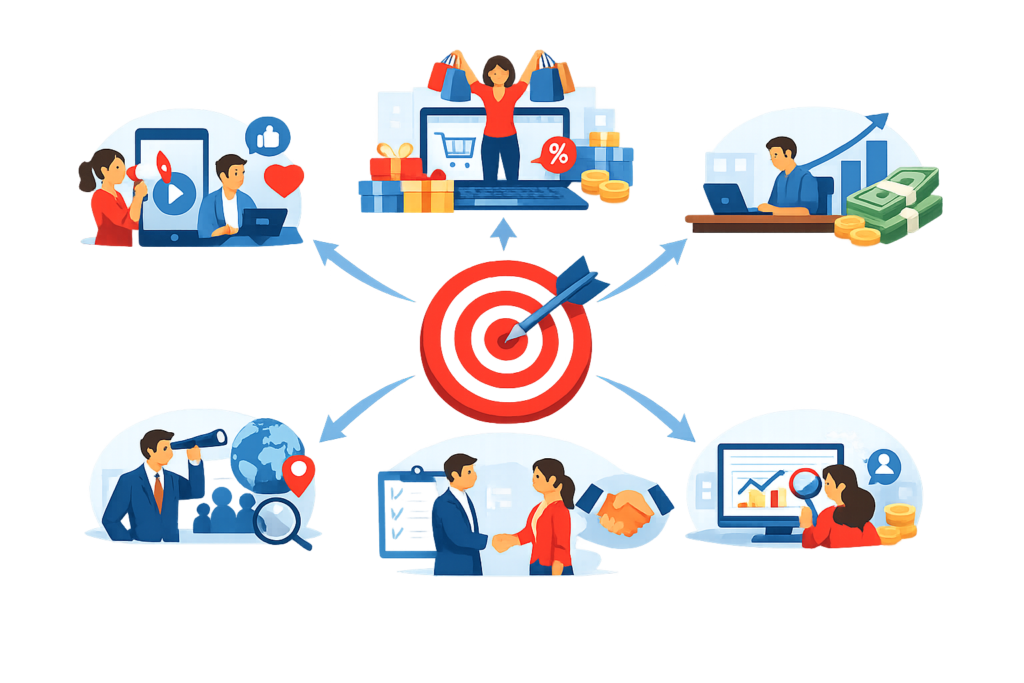
Selecting the appropriate campaign objective is one of the most important decisions advertisers make. Meta’s advertising platform uses campaign objectives to determine how ads are delivered, which users see them, and how optimization algorithms prioritize impressions. Choosing the wrong objective can reduce campaign effectiveness even if creative assets and targeting are otherwise excellent.
For businesses seeking immediate revenue, Sales campaigns typically provide the strongest optimization because the platform focuses on users most likely to complete purchases. Organizations prioritizing lead generation may benefit from Lead campaigns that streamline information collection through instant forms or website conversions. Brands focused on visibility may begin with Awareness campaigns before transitioning prospects into consideration and conversion stages through retargeting sequences.
Rather than running every objective simultaneously, successful advertisers align campaign goals with the customer journey. Awareness campaigns introduce new audiences to the brand, Engagement campaigns build trust through valuable content, Traffic campaigns encourage website exploration, and Sales campaigns convert interested prospects into paying customers. Structuring campaigns according to buyer intent improves advertising efficiency while creating a more personalized customer experience throughout the sales funnel.
Crafting High-Converting Facebook™ Ad Cop
Compelling ad copy transforms ordinary advertisements into powerful sales tools. While images and videos attract attention, persuasive messaging motivates users to click, engage, and convert. Effective Facebook™ ad copy combines clarity, empathy, credibility, and relevance to communicate value within just a few seconds of user attention.
Strong advertising copy begins with understanding customer pain points. Rather than immediately promoting product features, successful ads acknowledge audience frustrations, aspirations, or challenges before presenting solutions. Headlines should capture curiosity without resorting to misleading clickbait, while primary text explains benefits in conversational language that feels authentic rather than overly promotional. Including social proof, measurable outcomes, or customer success stories further strengthens credibility.
Calls to action should be direct, specific, and aligned with campaign objectives. Instead of vague phrases such as “Learn More,” advertisers often achieve stronger performance with messaging that clearly communicates expected outcomes. Consistency between ad messaging and landing page content also plays a crucial role in improving Quality Rankings and conversion rates. Every element should reinforce the same promise, creating a seamless experience from advertisement to final conversion.
Designing Creative That Stops the Scroll
Creative quality has become one of the strongest predictors of Facebook™ advertising success. Users scroll through enormous amounts of content every day, making visual differentiation essential. High-performing creatives capture attention immediately, communicate value quickly, and encourage meaningful engagement without overwhelming viewers with excessive information.
Video continues to dominate engagement across Meta platforms because it communicates emotion, demonstrates products, and builds trust more effectively than static imagery alone. However, images remain highly effective when professionally designed, visually simple, and focused on one primary message. Advertisers should prioritize clean layouts, authentic photography, consistent branding, and readable typography while avoiding clutter that distracts from the core offer.
Creative testing should become an ongoing process rather than a one-time activity. Businesses should experiment with different headlines, visuals, color palettes, video lengths, testimonials, calls to action, and messaging angles to identify combinations that consistently outperform alternatives. Rather than assuming one creative will remain effective indefinitely, marketers should regularly refresh assets to reduce audience fatigue and maintain strong campaign performance over time.
Optimizing Landing Pages for Higher Facebook™ Ads Conversion Rates
Driving clicks through Facebook™ Ads is only one part of the customer acquisition process. The destination users reach after clicking your advertisement often determines whether your investment generates profitable conversions or wasted advertising spend. A high-performing landing page creates continuity between the advertisement and the visitor’s expectations by delivering a consistent message, compelling offer, and friction-free user experience. If your ad promises a free consultation, downloadable resource, webinar, or exclusive discount, the landing page should immediately reinforce that promise without forcing visitors to search for the information they expected. Consistency improves user confidence while also increasing conversion rates and lowering acquisition costs.
Landing page optimization should prioritize speed, clarity, trust, and simplicity. Slow-loading pages can dramatically increase abandonment rates before visitors even engage with your content. Google’s Core Web Vitals provide valuable guidance for improving loading performance, responsiveness, and visual stability. Learn more from Core Web Vitals. Likewise, ensuring your pages meet Google’s SEO Starter Guide recommendations creates a better overall user experience while supporting long-term organic visibility. Effective landing pages should feature a compelling headline, concise supporting copy, persuasive social proof, customer testimonials, benefit-focused messaging, and a clear call-to-action that encourages visitors to complete the desired conversion.
Trust signals also play an essential role in improving campaign performance. Displaying security badges, customer reviews, certifications, guarantees, privacy assurances, and recognizable client logos can reduce hesitation during the decision-making process. Businesses should also minimize distractions by removing unnecessary navigation options and focusing visitor attention on a single conversion goal. Continuous A/B testing of headlines, button colors, form length, page layouts, imagery, and messaging helps identify improvements that steadily increase conversion rates over time. Small optimization gains across multiple page elements often compound into substantial increases in return on advertising investment.
Measuring Facebook™ Ads Performance with Meaningful Metrics
Launching campaigns without accurate measurement is similar to driving without a dashboard—you have little understanding of whether you’re moving toward your destination efficiently. Successful advertisers evaluate campaign performance using meaningful business metrics rather than vanity metrics alone. While impressions, likes, and engagement provide useful context, the primary objective should always be measuring outcomes that contribute directly to business growth, including qualified leads, revenue, customer acquisition costs, and long-term profitability.
Facebook™ Ads Manager offers comprehensive reporting capabilities that allow marketers to analyze campaign performance at every level. Understanding metrics such as Click-Through Rate (CTR), Cost Per Click (CPC), Cost Per Lead (CPL), Cost Per Acquisition (CPA), Return on Ad Spend (ROAS), Conversion Rate, Frequency, Reach, and Customer Lifetime Value enables smarter optimization decisions. Businesses should avoid evaluating campaigns based on isolated metrics because strong performance usually results from balancing multiple indicators simultaneously. For example, a higher CPC may still produce better profitability if conversion rates and average order values increase significantly.
Accurate reporting depends on reliable tracking implementation. Installing the Meta Pixel and configuring Conversions API improves conversion attribution while helping advertisers adapt to modern privacy changes. Additionally, integrating website analytics through Google Analytics provides deeper insights into visitor behavior after ad clicks. Combining multiple measurement tools creates a more complete understanding of campaign effectiveness, enabling businesses to optimize not only advertising performance but also the overall customer journey.
Leveraging AI, Automation, and Machine Learning for Smarter Advertising
Artificial intelligence has become one of the most influential technologies within Facebook™ Ads. Rather than replacing marketers, AI enhances decision-making by analyzing massive volumes of user behavior, conversion signals, engagement trends, and campaign performance data far beyond what humans can evaluate manually. Businesses that understand how Meta’s machine learning operates can develop campaigns that complement automation instead of restricting it with unnecessary complexity.
Modern advertising platforms automatically optimize bidding strategies, audience delivery, placement selection, and budget allocation based on campaign objectives. Advertisers benefit most when they provide high-quality creative assets, accurate conversion tracking, compelling offers, and sufficient performance data for algorithms to learn effectively. Constantly editing campaigns or resetting learning phases too frequently can interrupt optimization and reduce overall efficiency. Allowing campaigns adequate time to gather statistically meaningful data often leads to stronger long-term performance.
Automation should always support strategic thinking rather than replace it. Businesses remain responsible for understanding customer psychology, developing persuasive messaging, creating valuable offers, and improving post-click experiences. AI excels at processing data and optimizing delivery, but human expertise remains essential for storytelling, brand positioning, customer relationship building, and strategic marketing decisions. Organizations that combine intelligent automation with experienced marketing leadership consistently outperform those relying solely on either technology or manual processes alone.
Scaling Facebook™ Ads for Sustainable Long-Term Growth
Many advertisers achieve encouraging early results with Facebook™ Ads but struggle when they attempt to increase budgets and reach larger audiences. Scaling is not simply a matter of doubling your daily budget. Sustainable growth requires preserving campaign efficiency while gradually expanding reach, testing new audiences, refreshing creative assets, and maintaining accurate conversion tracking. Businesses that scale strategically often achieve consistent profitability, whereas aggressive budget increases can disrupt Meta’s learning phase and reduce overall campaign performance.
One effective scaling strategy is gradual budget expansion. Increasing campaign budgets by approximately 15–20% every few days allows Meta’s machine learning to adapt without significantly affecting optimization. Advertisers should also diversify audience targeting by testing lookalike audiences, broad targeting, interest combinations, and retargeting campaigns simultaneously. According to Meta Business Help Center, allowing sufficient data collection before making major adjustments helps the delivery system optimize campaign performance more effectively. Instead of relying on one successful audience, businesses should continuously identify new customer segments capable of generating profitable conversions.
Creative diversification is equally important during scaling. Even high-performing advertisements eventually experience audience fatigue as users repeatedly encounter the same messaging. Refreshing visuals, headlines, videos, testimonials, and calls-to-action keeps campaigns engaging while maintaining click-through rates and conversion performance. Successful advertisers also monitor frequency, customer acquisition cost, and Return on Ad Spend (ROAS) closely. Scaling should always prioritize profitability over volume because sustainable business growth depends on maximizing long-term customer value rather than simply increasing advertising spend.
Common Facebook™ Ads Mistakes That Reduce Campaign Performance
Even experienced marketers occasionally make mistakes that negatively impact campaign performance. Understanding these common issues allows businesses to avoid unnecessary budget waste while improving overall advertising efficiency. One of the most frequent mistakes is launching campaigns without clearly defined business objectives. Advertisers who prioritize clicks instead of qualified leads or sales often generate impressive-looking reports without meaningful business results. Every campaign should align directly with measurable business goals and customer acquisition strategies.
Another common issue involves poor audience targeting. Many advertisers attempt to reach everyone instead of focusing on the individuals most likely to benefit from their products or services. Broad messaging combined with generic creative usually results in lower engagement, higher costs, and weaker conversion rates. Businesses should continually refine audience segments using customer research, first-party data, website analytics, CRM insights, and campaign performance reports. Installing the Meta Pixel correctly and validating events through Meta Events Manager also helps improve optimization accuracy and conversion tracking.
Many campaigns also fail because advertisers ignore the importance of testing and optimization. Launching one advertisement and expecting consistent long-term success rarely produces sustainable results. Successful marketers continually experiment with creative variations, headlines, offers, landing pages, bidding strategies, and audience combinations. They monitor meaningful performance indicators rather than making emotional decisions based on short-term fluctuations. Continuous testing creates valuable insights that improve campaign efficiency while reducing advertising costs over time.
Best Practices Summary
Building successful Facebook™ Ads campaigns requires much more than attractive graphics and compelling headlines. Long-term success comes from combining strategic planning, audience research, persuasive messaging, optimized landing pages, accurate conversion tracking, creative testing, and continuous performance analysis. Businesses that consistently follow proven advertising principles typically achieve stronger conversion rates, lower acquisition costs, and higher customer lifetime value than those relying on guesswork or outdated tactics.
Key best practices include understanding your ideal customer, selecting campaign objectives that align with business goals, implementing the Meta Pixel and Conversions API, creating high-quality creative assets, maintaining message consistency between advertisements and landing pages, and monitoring performance using reliable analytics. Businesses should also stay informed about evolving privacy standards by reviewing Google’s Creating Helpful, Reliable, People-First Content guidance and Google Search Essentials, which emphasize delivering valuable user experiences and trustworthy digital content.
Finally, sustainable advertising success depends on continuous learning. Consumer behavior, advertising technology, platform algorithms, and market competition continue evolving rapidly. Organizations that regularly test new ideas, analyze campaign data, refresh creative assets, and refine customer experiences position themselves for long-term growth. Rather than seeking quick wins, focus on building repeatable advertising systems that consistently generate qualified leads, increase revenue, and strengthen customer relationships over time.
Frequently Asked Questions
1. How much should I spend on Facebook™ Ads?
Your budget depends on your business goals, industry competition, and customer acquisition costs. Many businesses begin with a modest daily budget while gathering performance data, then gradually increase spending as profitable campaigns emerge.
2. Are Facebook™ Ads still effective?
Yes. Facebook™ Ads remain one of the world’s most effective digital advertising platforms because of Meta’s advanced audience targeting, machine learning optimization, and extensive user base across Facebook, Instagram, Messenger, and Audience Network.
3. What is the Meta Pixel?
The Meta Pixel is a tracking tool that measures visitor actions on your website, helping advertisers optimize campaigns, build remarketing audiences, and improve conversion tracking.
4. How long does it take for Facebook™ Ads to produce results?
Some campaigns generate results within days, while others require several weeks of testing and optimization. Businesses should allow sufficient time for Meta’s learning phase before making significant campaign changes.
5. Which ad format performs best?
There is no universal winner. Video ads, carousel ads, image ads, collection ads, and lead generation ads can all perform exceptionally well depending on your audience, objectives, and creative quality.
6. Why is my cost per lead increasing?
Higher competition, audience fatigue, outdated creatives, inaccurate targeting, poor landing page experiences, or seasonal demand changes can all contribute to rising advertising costs.
7. How often should I refresh my creatives?
Review campaign performance regularly. If engagement, click-through rates, or conversion rates begin declining while frequency increases, it’s generally time to introduce fresh creative variations.
8. Can small businesses succeed with Facebook™ Ads?
Absolutely. Small businesses often compete successfully by targeting highly specific audiences, creating valuable offers, optimizing landing pages, and continually improving campaigns through testing and performance analysis.
Conclusion
Facebook™ Ads continue to provide businesses with one of the most powerful opportunities to attract qualified prospects, build lasting customer relationships, and generate measurable revenue growth. Success, however, depends on strategic planning, accurate audience targeting, compelling creative, reliable tracking, continuous optimization, and a commitment to delivering genuine value throughout the customer journey.
At My Funnel Script, we believe successful advertising is built on proven strategy rather than shortcuts. By applying the principles outlined throughout this guide, businesses can create scalable advertising systems that generate consistent leads, increase sales, and support sustainable long-term growth while aligning with modern digital marketing best practices.
Want to Implement This Easily?
Prompt Text:
You are an expert consultant. Based on the blog post titled “Facebook™ Ads”, provide a step-by-step, practical implementation guide. Include tools, best practices, common mistakes to avoid, and advanced tips. Assume the reader wants to implement everything discussed in this article effectively.
Call to Action:
Want our help implementing this? Just reach out to us via our website contact form: