
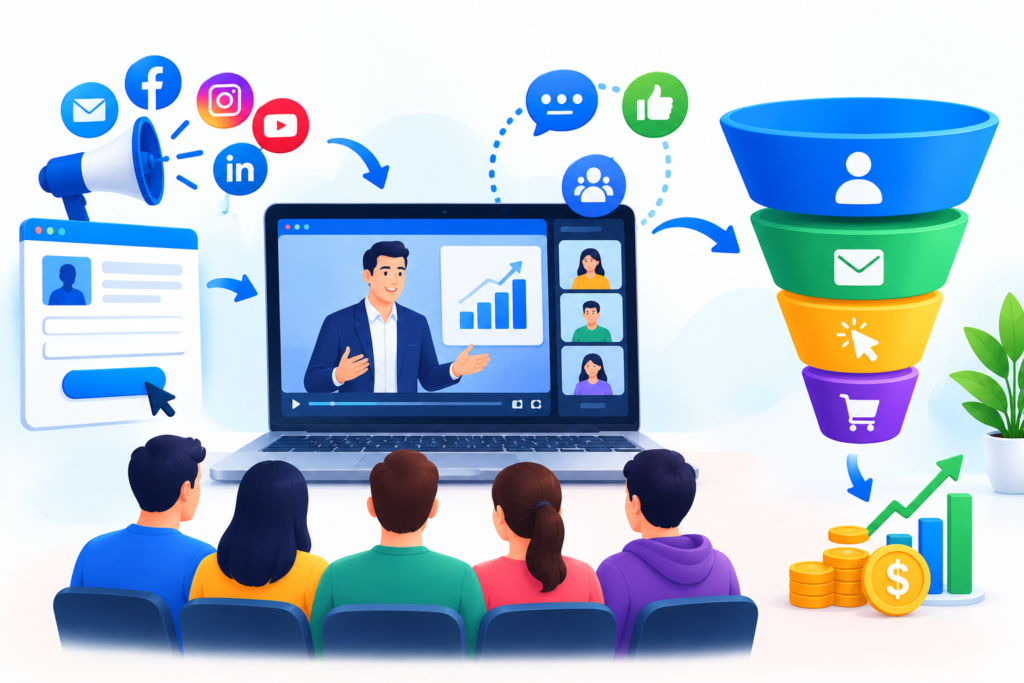
Learn how to build a high-converting webinar funnel that attracts qualified leads, increases attendance, nurtures prospects, and generates consistent sales with proven marketing strategies.
Introduction
A webinar funnel is a strategic marketing system that guides potential customers from discovering your brand to registering for a webinar, attending the presentation, engaging with your offer, and eventually becoming paying customers. Instead of relying on a single promotional campaign to generate sales, a well-designed webinar funnel combines targeted traffic, persuasive landing pages, automated email communication, valuable educational content, and carefully planned follow-up sequences to create a more predictable customer acquisition process.
Webinars have become a valuable marketing tool for businesses that need to explain complex products, demonstrate expertise, build trust, and help potential customers make informed purchasing decisions. Whether you provide consulting services, sell online courses, promote software, offer professional services, or operate a digital marketing agency, webinars give you an opportunity to educate your audience before asking them to buy. This educational approach can make your sales process more natural because prospects understand the problem, learn possible solutions, and see how your offer fits their needs.
However, successful webinar marketing requires more than hosting a presentation and collecting email addresses. Every stage must work together. Your advertising and content need to attract the right audience, your registration page must communicate a clear benefit, your reminders should encourage attendance, and your presentation must deliver genuine value. After the webinar, relevant follow-up messages can answer objections, provide additional resources, and explain the next step.
At MyFunnelScript, the focus is on helping businesses understand practical funnel strategies that connect marketing activity with measurable outcomes. This guide explains how to plan, build, optimize, and measure a webinar funnel, including its essential components, automation processes, conversion techniques, common mistakes, and long-term growth opportunities.
The goal is not simply to generate more registrations. It is to create a reliable system that attracts relevant prospects, delivers a useful learning experience, strengthens customer relationships, and supports sustainable business growth.
Understanding What a Webinar Funnel Is and How It Works
A webinar funnel is a structured customer journey built around an online educational event. It combines marketing pages, registration forms, email sequences, webinar content, sales opportunities, and post-event communication to move potential customers toward a relevant business outcome. Unlike a basic webinar registration process, which may end when someone signs up, a complete funnel considers what happens before registration, between registration and attendance, during the event, and after the presentation finishes.
The process usually begins when a potential attendee discovers your webinar through search engines, social media, paid advertising, email marketing, a partner recommendation, or an existing website. The person then visits a landing page that explains the webinar’s topic, identifies the audience it serves, and describes what attendees can expect to learn. If the value proposition matches the visitor’s needs, the visitor completes the registration form. Confirmation messages and reminders help the registrant prepare for the event, while the webinar itself provides education, practical examples, demonstrations, and an appropriate next step. Depending on the business model, that next step might be booking a consultation, purchasing a product, joining a course, requesting a demonstration, or downloading a more detailed resource.
A webinar funnel can serve several different objectives. A business-to-business software company may use a product demonstration to generate qualified sales conversations. A consultant might teach a workshop that leads to strategy sessions. An online educator may offer a free training session that introduces a paid course. An agency might explain how a particular marketing challenge can be solved and then present its services. The funnel structure remains similar, but the content, qualification process, and conversion goal should reflect the audience’s buying journey. Before building anything, define the single primary outcome the webinar should support. This prevents unnecessary steps and makes performance easier to evaluate.
A useful way to visualize the process is:
Audience Discovery
Search, social media, advertising, referrals, and email
Webinar Registration
Landing page, benefits, and registration form
Attendance and Education
Confirmation, reminders, presentation, and interaction
Conversion and Follow-Up
Offer, replay, email nurturing, and sales conversations
The most important principle is that every stage should prepare the prospect for the next one. When the webinar promise, landing page, presentation, and final offer are aligned, the experience feels consistent rather than like a series of disconnected marketing activities.
Why a Webinar Funnel Is Important for Business Growth
A properly planned webinar funnel can help businesses educate potential customers at scale without requiring an individual sales conversation with every interested prospect. A single presentation can introduce a service, explain a complicated process, answer recurring questions, and demonstrate expertise to many people at once. This makes webinars particularly useful for businesses whose products or services require explanation before customers feel comfortable making a purchase.
One major advantage is the opportunity to build trust before presenting a sales offer. Potential customers often need to understand a problem, compare available approaches, and assess whether a provider understands their situation. A useful webinar gives them an opportunity to evaluate the quality of your thinking. For example, a marketing agency could explain why a business receives website traffic but struggles to generate enquiries, demonstrate how landing-page messaging affects conversion, and show a practical framework for improving lead quality. The audience receives useful information, while the agency establishes a relevant reason for offering professional support. Trust should come from the quality and accuracy of the presentation rather than exaggerated claims or artificial urgency.
Webinars can also improve lead qualification. A person who registers for a detailed session about improving sales conversion may have a stronger interest in the subject than someone who casually visits a general blog post. Attendance, questions, poll responses, and requests for further information can provide additional signals about audience needs. These signals should be interpreted carefully: attendance alone does not prove buying intent, and engagement data should not be treated as a guarantee that someone is ready to purchase. Nevertheless, when handled responsibly, these interactions can help a sales team prioritize relevant follow-up and tailor its communication.
Another advantage is content reuse. A well-produced webinar can become a source of shorter educational videos, blog articles, email lessons, social media posts, frequently asked questions, and downloadable resources. Repurposing should preserve the original context and accuracy rather than simply duplicating the same message everywhere. Businesses can also use performance data to improve future campaigns. Registration conversion rates, attendance rates, audience questions, replay engagement, and qualified enquiries can reveal which topics resonate and where the journey needs improvement.
The financial value of a webinar funnel depends on its economics, audience quality, and execution. Businesses should measure the cost of attracting registrants alongside the number of qualified leads, customers acquired, revenue generated, and resources required to deliver the event. A large registration list is not necessarily valuable if few registrants attend or the attendees are unlikely to buy. Similarly, a smaller, highly relevant audience may produce stronger commercial results. The objective is to build a repeatable process that supports profitable customer acquisition while delivering a worthwhile experience to participants.
Identifying Your Target Audience and Choosing the Right Webinar Topic
The quality of a webinar funnel begins with understanding the people it is designed to serve. Before writing a headline or building a registration page, identify your ideal audience, the problem they want to solve, the result they hope to achieve, and the obstacles preventing them from moving forward. A webinar that tries to appeal to everyone usually becomes too broad to feel personally relevant. A clearly defined audience allows you to create a focused presentation that addresses a specific challenge with practical recommendations.
Start by examining existing customer conversations, sales enquiries, support requests, customer feedback, search queries, and frequently asked questions. Look for repeated problems and the language people use to describe them. A small business owner might say, “We get visitors, but nobody contacts us,” rather than “Our conversion rate optimization strategy is underperforming.” Understanding these differences helps you develop a webinar title that communicates the problem in familiar terms. If you have existing customers, ask which information helped them make their decision, what they struggled with before buying, and what they wish they had understood earlier. Use this evidence to identify a topic that reflects actual demand instead of relying solely on assumptions.
Next, connect the audience’s problem to a useful educational outcome. Strong webinar topics are specific enough to promise a clear learning experience but broad enough to provide meaningful discussion. For example, “Digital Marketing Strategies” is a wide subject that gives potential attendees little information about what they will gain. “How to Build a Lead Generation Funnel for a Service Business” is more focused and attracts people with a recognizable goal. Other examples include improving webinar attendance, creating better landing pages, building an effective email follow-up sequence, or understanding which funnel metrics matter most. The promise should describe what the session genuinely teaches, not guarantee a particular financial result.
Consider the audience’s level of awareness when choosing the topic. Beginners may need an introduction to the problem and a simple framework. More experienced professionals may prefer advanced implementation methods, troubleshooting, or comparisons between different approaches. A webinar aimed at people who are just discovering a problem should not assume they already understand specialist terminology. Conversely, an advanced audience may disengage if the session spends too much time on basic definitions.
Finally, validate the topic before investing heavily in production. Review relevant search demand, discuss the idea with prospective attendees, publish a short survey, or test a few topic headlines through existing communication channels. If people express interest, investigate what they expect to learn and what questions they want answered. A strong webinar topic combines audience demand, business relevance, and the ability to deliver meaningful value within the available time. When these elements align, promotion becomes easier because the webinar solves a recognizable problem for a clearly identified group.
Creating a High-Converting Webinar Registration Landing Page
The webinar registration landing page is one of the most important components of the funnel because it turns interested visitors into registered attendees. Its purpose is not to explain every detail of your business. Instead, it should help the right visitor quickly understand what the webinar covers, who should attend, what they can learn, and how to reserve a place. A clear page reduces uncertainty and makes the registration decision easier without relying on misleading promises or excessive persuasion.
Begin with a benefit-focused headline that accurately reflects the session. The headline should connect the topic to a meaningful audience problem or desired outcome. A supporting description can explain the practical skills, concepts, or decisions the attendee will understand by the end. Include the webinar date, time, duration, delivery format, and presenter information when relevant. If the event includes a live question-and-answer session, demonstration, workbook, or other resource, explain it accurately. Avoid vague claims such as “discover the secret to unlimited sales” unless the session genuinely supports a defensible and clearly defined claim. Specificity helps potential attendees determine whether the event is worth their time.
The registration form should request only information that is genuinely useful for delivering the webinar or supporting a clearly explained follow-up process. A name and email address may be enough for many educational events. Additional questions can be appropriate when a sales team needs to understand a registrant’s role, business type, or main challenge, but every extra field introduces friction. If qualification requires several questions, consider asking them after registration or using a progressive process. Explain how personal information will be used and provide an appropriate privacy notice. Follow applicable privacy requirements and obtain the necessary consent for marketing communication rather than assuming that registering for an event automatically authorizes every type of promotional email.
Page design and performance also influence the experience. Use readable typography, clear visual hierarchy, accessible contrast, descriptive form labels, and a prominent registration button. Make the page work well on mobile devices, where visitors may have limited screen space or slower connections. Compress images, avoid unnecessary scripts, and test the form submission process from beginning to end. Google’s guidance on Core Web Vitals can help you understand important aspects of loading performance, responsiveness, and visual stability. These measures support a more usable page, although good performance alone does not guarantee high conversion rates.
Include relevant trust signals where they are genuine. A presenter biography, verifiable experience, an accurate explanation of the teaching approach, or a relevant customer example can help visitors assess credibility. Testimonials should be authentic and presented with appropriate context. Do not invent attendee numbers, customer results, endorsements, or scarcity claims. Finally, measure the landing page’s performance by comparing visitors with completed registrations and evaluating the quality of those registrants. Test one meaningful change at a time, such as the headline, form length, or call to action. The objective is to make the registration process clearer and more useful, not simply to increase the number of people who submit a form.
Building an Effective Webinar Promotion Strategy
Even an excellent webinar can underperform if the right people never discover it. A promotion strategy should combine channels that match your audience’s habits, the complexity of your offer, your available budget, and the time remaining before the event. Rather than publishing the same announcement everywhere and hoping for results, create a coordinated plan that introduces the problem, communicates the webinar’s value, addresses likely questions, and gives suitable prospects multiple opportunities to register.
Organic promotion can include relevant blog content, search-optimized educational pages, social media posts, newsletters, community participation, and direct outreach to existing contacts where appropriate. A blog article about the problem addressed in your webinar can introduce readers to the topic and provide a natural invitation to attend a deeper training session. Social media content can highlight a common mistake, share a practical tip, or explain a question that the webinar will explore in greater depth. Email subscribers may be especially relevant when they have previously shown interest in the subject, but promotional messages should respect their communication preferences and applicable consent requirements. Partner promotion can also help when another organization serves a similar audience without creating a direct conflict of interest.
Paid advertising may be useful when you need to reach a defined audience beyond your existing network. Campaigns can direct visitors to the webinar registration page through search ads, social advertising, or other suitable placements. Before spending heavily, establish a test budget and define the results that would justify continuing. Track the source of registrations using consistent campaign parameters, and evaluate lead quality alongside registration cost. A low-cost registration is not automatically successful if the people signing up are unlikely to attend or benefit from the offer. Ensure your advertisements accurately describe the webinar and that the landing page fulfills the promise made in the ad.
Promotion should begin early enough for the audience to discover the event and arrange their schedules. The appropriate lead time depends on the topic, audience, event format, and complexity of the decision being promoted. A short practical workshop may require less advance promotion than an executive-level session involving several stakeholders. Build a schedule that includes the initial announcement, educational reminders, a final registration message, and event-day communication. Each message should add value rather than repeat the same headline without new information.
Measure the performance of individual channels rather than treating all traffic as equivalent. Review registrations by source, registration conversion rate, attendance rate, engagement, qualified enquiries, and eventual sales. Where possible, distinguish new audiences from existing contacts to understand whether the campaign is expanding reach or activating people who already know your brand. Use reliable tracking and document your campaign assumptions so results can be compared over time. An effective webinar promotion strategy is not about maximizing impressions. It is about reaching the right people with a relevant promise and giving them a clear reason to attend.
Designing Webinar Registration Confirmation and Reminder Emails
The registration process does not end when a visitor submits a form. A webinar funnel needs a clear communication sequence that confirms the registration, explains what happens next, and helps the attendee remember the event. Without appropriate follow-up, interested prospects may forget the date, lose the registration link, or become uncertain about how to join. Confirmation and reminder emails reduce this avoidable friction and help create a professional experience from the moment someone registers.
The confirmation email should arrive promptly after successful registration. It should acknowledge the registration, provide the event date and time with the correct time zone, explain how to join, and include any relevant preparation instructions. If the webinar platform supports calendar invitations, provide a convenient way to add the event to the attendee’s calendar. You can also explain whether attendees will be able to ask questions, receive a recording, or access supplementary materials. Keep the message focused on the information people need rather than immediately filling it with sales promotions. Test the registration workflow to ensure that the confirmation is delivered, links work correctly, and the event details match the information on the landing page.
Reminder emails should follow a planned schedule based on the event format and audience. For example, a live webinar might use a reminder one day before the event, another a few hours beforehand, and a final message shortly before the session begins. These are starting points, not universal rules. The best timing depends on the audience, event length, registration behavior, and communication preferences. Each reminder should make the joining process easy by including the relevant link, start time, and a concise explanation of the value participants can expect. Avoid excessive reminders that create frustration or make the event feel like an aggressive sales campaign.
Email personalization can improve relevance when it uses accurate information. You might address attendees by their first names, refer to the webinar topic they registered for, or provide preparation material related to their stated interests. However, personalization should not come at the expense of reliability. Incorrect merge fields, broken links, inconsistent event times, and contradictory instructions can damage trust. Test messages across common email clients and devices, and verify the complete sequence before launching the campaign.
Automation makes this process easier to manage. An email marketing platform or customer relationship management system can trigger confirmation messages immediately and schedule reminders according to the webinar date. It can also distinguish between different event registrations and prevent people from receiving irrelevant messages. If an event is rescheduled or cancelled, the system should communicate the change clearly and promptly.
Finally, measure more than email open rates. Review delivery failures, link clicks, attendance, unsubscribe rates, and the number of registrants who actually join. Email privacy features can make open-rate data less reliable, so use several indicators rather than treating one metric as definitive. The goal is to send useful, timely communication that helps people attend the webinar and makes every step of the customer journey feel organized and trustworthy.
Structuring Webinar Content That Builds Trust and Encourages Conversions
The webinar presentation is the central value-delivery component of the funnel. Advertising may attract attention and a landing page may secure a registration, but the quality of the actual session influences whether attendees trust the presenter, understand the subject, and consider the next step. A successful webinar should therefore be designed as an educational experience first and a sales opportunity second. When participants receive useful information and understand how it applies to their circumstances, a relevant offer can follow naturally.
Begin with a clear learning objective. Identify the main problem the audience wants to solve and organize the presentation around a small number of meaningful lessons. An effective structure might include an introduction to the problem, an explanation of why common approaches fail, a practical framework, a demonstration or example, and a summary of the recommended actions. For instance, a webinar about lead generation could explain how to align audience targeting, landing-page messaging, lead capture, and follow-up communication. Rather than listing dozens of disconnected tactics, show how the components work together. Practical examples, demonstrations, checklists, and realistic scenarios help participants translate concepts into action.
The opening minutes deserve particular attention because attendees need to understand why the session is relevant and what they will gain by staying. Introduce the topic, explain the learning outcomes, and establish your credibility through relevant experience or evidence. Avoid lengthy biographies and exaggerated claims. Throughout the presentation, use clear transitions and periodically connect each lesson to the central objective. Encourage participation through questions, polls, chat discussions, or brief exercises when those activities suit the audience and platform. Interaction should support learning rather than interrupt the presentation with unnecessary distractions.
A sales presentation can be included when it genuinely relates to the educational content. The transition should explain why the next step is relevant, which problems the offer addresses, who is likely to benefit, and what the attendee can reasonably expect. Describe the service, product, course, or consultation accurately, including important limitations and conditions. A useful offer presentation may include a demonstration, implementation example, explanation of deliverables, answers to common objections, and a clear call to action. Do not fabricate testimonials, guarantee results that depend on external factors, or use artificial countdowns to pressure people into making decisions.
Plan the presentation’s length around the complexity of the topic and the audience’s available time. A focused workshop may work well in a shorter session, while a technical demonstration or advanced training may require more time. Reserve space for questions when interaction is part of the promise. Rehearse the presentation, check audio and screen sharing, prepare backup materials, and ensure that slides remain readable on smaller screens.
After the event, review audience questions, feedback, drop-off patterns, and conversion activity. These observations can reveal where explanations were unclear, which topics attracted interest, and which objections deserve attention in future sessions. A strong webinar presentation does not depend on theatrical persuasion. It combines relevant teaching, credible evidence, practical guidance, and an honest next step that allows interested participants to continue their journey.
Automating Your Webinar Funnel for Better Efficiency and Scalability
Webinar funnel automation allows businesses to manage repetitive marketing tasks without manually handling every registration, reminder, attendance update, and follow-up message. When implemented correctly, automation saves time, reduces administrative errors, and creates a more consistent experience for prospective customers. It is especially valuable when a business runs webinars regularly, promotes multiple events, or needs to communicate with different audience segments based on their behavior. However, automation should support a well-designed customer journey rather than replace thoughtful marketing strategy.
Start by mapping the complete process from registration to conversion. Identify which actions should trigger specific communications and what information needs to move between your registration page, webinar platform, email marketing system, and customer relationship management software. For example, a completed registration can trigger a confirmation email and create an attendee record. A scheduled reminder can then be sent before the event, while attendance information can determine whether someone receives a replay message, an attendee follow-up, or a different educational sequence. If a participant books a consultation or purchases the advertised product, the system should recognize that action and stop sending irrelevant promotional messages.
Choose tools based on your requirements rather than selecting the most complicated technology available. A small business may need only a landing page builder, webinar platform, email marketing service, and a straightforward integration. A larger organization may require advanced CRM workflows, lead scoring, sales team notifications, reporting dashboards, and integration with several marketing channels. Before purchasing software, identify your essential features, expected audience size, data requirements, budget, and technical capabilities. Confirm that the tools support the integrations you need and that personal information can be handled appropriately.
Automation rules should be documented and tested before the funnel goes live. Test registration, confirmation delivery, reminder timing, webinar attendance synchronization, replay access, sales conversions, unsubscribe requests, and exceptional cases such as cancelled events. Check what happens if a contact registers twice, uses an incorrect email address, or purchases an offer before receiving the final sales message. A workflow that functions correctly for one test registration may still fail when multiple conditions occur simultaneously.
Personalization should be based on relevant, reliable information. You might send a more advanced resource to experienced attendees or a beginner’s guide to people who identify as new to the subject. Yet excessive segmentation can make a simple campaign unnecessarily difficult to maintain. Start with a small number of meaningful audience groups and expand only when the distinction improves the experience or business outcome.
Finally, establish ongoing maintenance procedures. Review automation performance, remove obsolete workflows, update event details, check integration permissions, and monitor delivery errors. Automation can increase efficiency, but poorly configured automation can multiply mistakes at scale. The objective is to create a dependable system that handles routine tasks accurately while allowing your team to focus on delivering valuable presentations and supporting qualified prospects.
Creating a Webinar Sales Funnel That Converts Attendees Into Customers
A webinar sales funnel connects the educational experience to a relevant purchasing decision. Its purpose is to help interested attendees understand how a product or service can address their needs and provide a clear route to the next step. That next step may be an immediate purchase, a consultation, a product demonstration, a trial, or an application process. The appropriate conversion action depends on the offer’s price, complexity, perceived risk, and the amount of information a prospect needs before deciding.
The first requirement is alignment between the webinar topic and the offer. If a session teaches business owners how to improve lead generation, a service that helps implement lead capture and follow-up systems may be a logical next step. An unrelated offer, however, can make the presentation feel like a disguised advertisement. Explain how the proposed solution relates to the problem discussed during the webinar, what it includes, and what type of customer is likely to benefit. Provide enough information for people to assess suitability rather than assuming every attendee should buy.
The offer itself should be easy to understand. Describe the deliverables, implementation process, relevant support, pricing or pricing approach, eligibility requirements, and any important limitations. Where the product is suitable for self-service purchasing, a clear checkout page may be enough. For a complex service, a discovery call or consultation may be more appropriate because both parties need to understand requirements before making a commitment. Keep the call to action specific. Instead of offering several competing next steps, choose the primary action that best fits the audience’s stage in the buying journey.
The conversion page must continue the same message established during the webinar. If the presentation promises a particular service, the destination should explain that service clearly without introducing unexpected fees or conditions. Ensure that forms are functional, payment methods work, contact information is available, and the page performs well on mobile devices. Trust can be strengthened through accurate company details, clear policies, genuine testimonials, and realistic explanations of the purchasing process. Never fabricate endorsements or imply that a customer will achieve a guaranteed result when outcomes depend on factors beyond your control.
For higher-consideration offers, the sales process may require additional nurturing. Some attendees will be interested but not ready to purchase immediately. They may need time to evaluate costs, consult colleagues, compare alternatives, or understand how implementation works. Provide relevant resources and opportunities to ask questions without creating unnecessary pressure. A follow-up email that explains the implementation process may be more helpful than repeating a discount message.
Measure conversion quality at each stage. Track the proportion of registrants who attend, attendees who take the intended action, leads who qualify, and qualified opportunities that become customers. Also examine refunds, cancellations, customer satisfaction, and delivery costs where applicable. A webinar funnel should not be judged solely by the number of immediate sales. Its longer-term value depends on attracting appropriate customers, setting accurate expectations, and supporting successful customer relationships.
Developing a Post-Webinar Follow-Up and Lead Nurturing Strategy
The webinar follow-up process is essential because many potential customers need additional information before making a decision. Some attendees may be ready to act immediately, while others may want to review the material, discuss the offer with colleagues, or learn more about their options. Registrants who missed the live session may still be interested in the subject. A well-planned follow-up strategy recognizes these differences and provides relevant next steps instead of treating every contact identically.
Begin by identifying the main audience groups you can reliably distinguish. These may include attendees, registrants who did not attend, people who requested a consultation, and customers who purchased the offer. Send attendees a thank-you message that summarizes the session and provides any promised resources. If a recording is available, explain how to access it and whether access has an expiry date. Where the webinar included a product or service offer, provide a concise explanation of the next step and an opportunity to ask questions. The first follow-up should reinforce the value of the session rather than overwhelm recipients with a long series of sales messages.
For people who registered but did not attend, a replay invitation can be appropriate. Acknowledge that they were unable to join and make it easy to access the material if a recording exists. You may also offer a relevant summary or an invitation to a future session. Avoid suggesting that every non-attendee was careless or uninterested; scheduling conflicts, technical difficulties, and unexpected responsibilities can prevent attendance. The objective is to preserve a useful relationship and provide an alternative route to the information.
Longer-term nurturing should address questions that commonly arise during the buying process. For example, a service provider might explain how implementation works, what resources a customer needs, which mistakes to avoid, and how to evaluate whether the service is suitable. Case studies can demonstrate real processes and outcomes when the evidence is genuine and presented with appropriate context. Educational emails should continue to offer value even when the recipient does not purchase immediately. Use the contact’s interests and stated preferences to determine which material is relevant, and respect unsubscribe requests and applicable marketing regulations.
A simple sequence might include a post-event thank-you email, a replay or resource message, an educational follow-up, an explanation of the offer, and a later message addressing common questions. The intervals should reflect the decision-making process rather than follow an arbitrary schedule. A low-cost digital product may require a shorter sequence than an enterprise service with a long evaluation cycle.
Monitor the results of your follow-up strategy using meaningful indicators such as link clicks, qualified enquiries, consultation bookings, purchases, unsubscribes, and negative feedback. Avoid relying on email opens alone. Review whether the messages help recipients progress or simply create additional noise. If a prospect has already purchased, remove them from the acquisition sequence and move them into appropriate onboarding communication. Effective nurturing respects the audience’s time, responds to their interests, and makes it easier to take the next step when they are ready.
Optimizing Your Webinar Funnel for Higher Conversion Rates
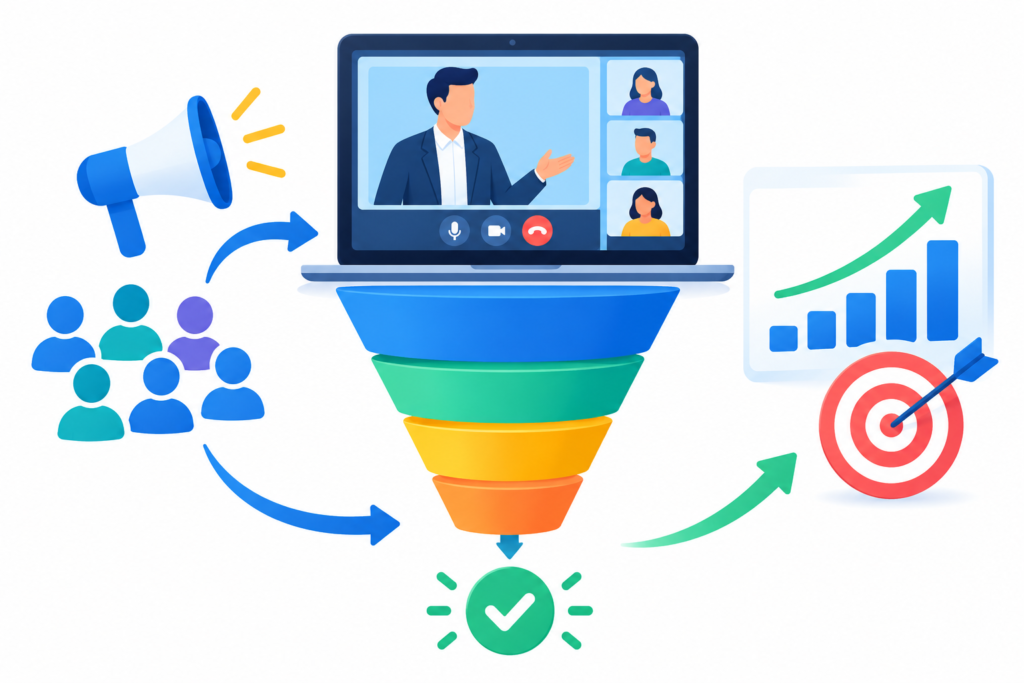
Webinar funnel optimization is the process of improving each stage of the customer journey using evidence rather than guesswork. A funnel can attract considerable traffic but produce few registrations, generate many registrations but poor attendance, or deliver a well-attended event without producing qualified enquiries. Each problem requires a different investigation. Improving the entire funnel therefore begins with identifying the stage where the largest meaningful loss occurs and determining why it happens.
Start by establishing a baseline. Measure landing-page visits, completed registrations, attendance, engagement, follow-up actions, qualified leads, and sales. Calculate conversion rates using clearly defined denominators. For example, the registration conversion rate is the number of completed registrations divided by the number of relevant landing-page visitors, multiplied by 100. The attendance rate is generally the number of people who attend divided by the number of registrants, multiplied by 100, although your reporting should specify how late arrivals, repeat joins, and on-demand viewers are counted. Consistent definitions make comparisons more useful and prevent misleading conclusions.
Once the baseline is established, investigate the likely causes of underperformance. A low registration rate may indicate that the headline does not communicate a compelling benefit, the audience is poorly targeted, the page lacks important event details, or the registration form asks for too much information. A low attendance rate may point to weak reminders, inconvenient scheduling, an unclear event promise, or registration traffic with limited interest. Strong attendance but few sales may indicate a mismatch between the topic and offer, insufficient educational depth, weak qualification, or a confusing call to action. These are hypotheses to test, not automatic explanations.
Use controlled experiments where practical. You might compare two headline variations, test a shorter registration form, or change the placement of a clear call to action. Define the primary measurement before starting the test and collect enough data to make a reasonable comparison. If several major elements change simultaneously, it becomes harder to identify which change influenced the result. Smaller campaigns may not generate enough traffic for statistically reliable experiments, so combine quantitative data with customer feedback and observed behavior.
Technical usability deserves attention as well. Test registration on mobile devices, inspect page loading performance, verify that confirmation emails arrive, and ensure that the webinar joining link works. Check that analytics events are recorded correctly and that duplicate registrations are not inflating the numbers. Google’s documentation on event measurement explains how events can be used to measure meaningful interactions in Google Analytics.
Optimization should also account for lead quality and customer experience. A headline that increases registrations by attracting people who are unlikely to benefit may damage the funnel’s overall economics. Likewise, an aggressive offer may increase short-term purchases but contribute to refunds or dissatisfaction if expectations are inaccurate. Compare conversion metrics with qualified leads, revenue, customer outcomes, and campaign costs. The best improvements strengthen the complete journey rather than maximizing a single number in isolation.
Measuring Webinar Funnel Performance With Analytics and KPIs
Performance measurement helps businesses understand whether their webinar funnel is attracting the right audience, delivering a valuable experience, and supporting commercial objectives. Without clear measurement, marketing decisions may depend on vanity metrics such as impressions, total registrations, or social media engagement. These indicators can be useful in context, but they do not independently demonstrate that the funnel is generating qualified opportunities or sustainable revenue.
Begin by selecting metrics that correspond to the funnel’s stages. At the awareness stage, measure relevant website traffic, campaign reach, and engagement with promotional content. At registration, review landing-page conversion rate, cost per registration, and the distribution of sign-ups by traffic source. During the event, measure attendance rate, participation, viewing duration where available, questions submitted, and audience feedback. After the webinar, evaluate replay engagement, consultation requests, qualified leads, purchases, and revenue attributable to the campaign where reliable attribution is possible.
Essential webinar funnel KPIs
Registration conversion rate
\[ \frac{\text{Completed Registrations}}{\text{Landing Page Visitors}}\times100 \]
Shows how effectively the registration page turns visitors into registrants.
Attendance rate
\[ \frac{\text{Live Attendees}}{\text{Registrants}}\times100 \]
Shows what proportion of registrants attended the live event.
Cost per registration
\[ \frac{\text{Relevant Campaign Spend}}{\text{Attributed Registrations}} \]
Helps evaluate the cost of generating webinar registrations.
Lead-to-customer conversion rate
\[ \frac{\text{Customers Acquired}}{\text{Qualified Leads}}\times100 \]
Shows how effectively qualified leads become customers over a defined period.
For a practical example, imagine a webinar campaign that attracts 1,000 landing-page visitors, generates 200 registrations, and brings 100 people to the live event. Its registration conversion rate is 20%, and its live attendance rate is 50%. If 10 qualified attendees subsequently become customers, that represents 10% of the live audience. These figures illustrate the calculations only; they are not industry benchmarks or predictions of what a particular campaign will achieve. The business should assess whether the results meet its objectives, costs, and audience expectations.
Revenue analysis should include relevant expenses. Depending on the campaign, these may include advertising, software subscriptions, production, presenter time, staff costs, and sales follow-up. Distinguish revenue from profit and be careful when assigning credit to the webinar if customers also interacted with other marketing channels. Attribution models provide useful perspectives but do not always establish that one campaign caused a purchase.
Use a consistent reporting period and maintain a record of campaign changes, event topics, promotional channels, and offer variations. Segment results where it helps explain differences in audience quality or behavior. Protect personal information, restrict access to analytics data, and avoid collecting data that has no clear purpose.
A useful reporting dashboard should answer three questions: where are suitable prospects entering the funnel, where are they dropping out, and which improvements are most likely to support the business objective? When measurement is tied to clear decisions, analytics becomes a practical tool for improving the webinar experience and allocating marketing resources more effectively.
Common Webinar Funnel Mistakes and How to Avoid Them
Even a well-planned webinar funnel can underperform when small mistakes accumulate across promotion, registration, delivery, and follow-up. Many problems are not caused by a lack of sophisticated software. They arise because the business fails to understand its audience, promises more than it delivers, neglects technical preparation, or measures the wrong outcomes. Identifying these mistakes early can save time, reduce wasted advertising spend, and protect customer trust.
One common mistake is choosing a topic that is too broad or disconnected from the audience’s immediate needs. A webinar titled “Everything About Marketing” gives potential attendees little reason to prioritize the event. A more focused topic that addresses a specific challenge makes the value clearer. Another mistake is building a registration page around the business rather than the attendee. Long company histories, generic descriptions, and vague benefits can distract visitors from the question that matters most: what will I learn, and why is it relevant to me? Keep the message focused and support credibility with accurate, relevant evidence.
Overcomplicating registration is another avoidable problem. Requiring extensive personal details before explaining the event’s value can reduce participation and create unnecessary privacy concerns. Collect the minimum information needed at that stage, explain how it will be used, and ask additional qualification questions only when there is a clear reason. Similarly, businesses sometimes spend heavily on advertising before testing the landing page, confirmation process, and tracking. This creates a risk of paying for traffic that cannot be converted or measured reliably. Test the complete journey before increasing campaign spend.
Poor presentation quality can also undermine the funnel. Unclear audio, unreadable slides, missing demonstrations, and long periods of irrelevant content make it difficult for participants to remain engaged. Technical failures are particularly damaging when the presenter has not prepared backup materials or an alternative joining method. Rehearse the session, test the equipment, check the webinar platform, and prepare a clear response plan for unexpected problems.
A further mistake is treating every registrant as equally likely to buy. Some people want to learn, some are exploring a problem, and others are actively evaluating a solution. Sending all of them the same aggressive sales sequence can weaken trust and increase unsubscribes. Use relevant behavioral information to tailor communication while avoiding assumptions that engagement guarantees purchasing intent. Likewise, do not stop communicating with interested prospects simply because they did not buy immediately. Provide useful resources and appropriate opportunities to continue the conversation.
Finally, many businesses measure success only by registrations or immediate revenue. They overlook attendance quality, customer acquisition costs, refunds, sales cycle length, and the actual usefulness of the webinar. A campaign that generates many sign-ups but few relevant leads may need a different audience or topic rather than more promotion. Review the entire funnel, investigate the underlying causes, and prioritize changes that improve both customer experience and business results.
Webinar Funnel Best Practices Summary
A reliable webinar funnel combines clear audience targeting, useful educational content, straightforward registration, consistent communication, relevant offers, and careful measurement. No individual tactic guarantees success. Results depend on the market, audience needs, product or service, competition, budget, and execution. The most effective approach is to establish a strong foundation, test important assumptions, and improve the system using real feedback and performance data.
Define one primary objective. Decide whether the webinar should generate qualified leads, book consultations, sell a product, demonstrate software, or support another measurable outcome. A clear objective helps determine the topic, audience, call to action, and metrics.
Choose a specific audience and relevant topic. Research actual customer problems, review common questions, and validate demand before committing to the presentation. Make the webinar promise specific, credible, and achievable within the session.
Create a clear registration experience. Use an accurate headline, explain the benefits, display the event details, minimize unnecessary form fields, and test the page on mobile devices. Provide a suitable privacy notice and explain how registration information will be handled.
Promote through appropriate channels. Combine organic content, email, partnerships, and paid advertising where they fit your audience and resources. Track registrations by source and evaluate lead quality rather than choosing channels solely by reach or low registration cost.
Deliver genuine educational value. Organize the webinar around clear learning objectives, practical examples, and relevant demonstrations. Establish credibility honestly, answer common questions, and connect the final offer to the subject of the presentation.
Automate communication carefully. Configure confirmation messages, reminders, replay emails, and follow-up sequences. Test every trigger, link, time zone, and audience condition before launch, and ensure that customers and unsubscribed contacts do not receive inappropriate messages.
Build a relevant post-webinar journey. Give attendees access to promised resources, provide suitable alternatives for people who missed the event, and nurture interested prospects with helpful information. Make the next step clear without using misleading urgency or unsupported guarantees.
Measure the full funnel. Track registration conversion, attendance, qualified leads, sales, costs, and customer outcomes. Use consistent metric definitions and reliable tracking so the results can guide practical decisions.
Improve one important issue at a time. Identify the biggest point of friction, develop a reasonable hypothesis, and test a targeted change. Combine analytics with audience feedback to understand not just what happened, but why.
Maintain trust and technical reliability. Keep claims accurate, protect personal information, respect communication preferences, and provide a dependable webinar experience. Review the system after each event and update the process as audience needs and business objectives change.
These practices create a repeatable foundation for webinar marketing. Rather than rebuilding the entire funnel for every event, document the workflow, retain what performs well, and adjust the parts that require improvement. Over time, this disciplined approach can make campaign planning more efficient and help the business deliver a more consistent experience to potential customers.
Frequently Asked Questions
What is a webinar funnel, and how does it work?
A webinar funnel is a marketing process that guides people from discovering an online event to registering, attending, engaging with the presentation, and taking a relevant next step. It typically includes promotional content, a registration page, confirmation and reminder emails, the webinar itself, and follow-up communication. Depending on the business model, the final action might be purchasing a product, booking a consultation, requesting a demonstration, or joining a longer-term nurturing sequence. Its purpose is to connect education with a clear customer journey rather than treating the webinar as an isolated event.
How do I create a webinar funnel from scratch?
Begin by defining the audience, the problem the webinar will solve, and the business outcome you want to support. Choose a focused topic, develop a credible learning promise, and create a landing page with essential event information and a straightforward registration form. Set up confirmation and reminder emails, prepare a useful presentation, and decide what attendees should do after the session. Test the complete registration and attendance process before promoting the event. After the webinar, measure results, collect feedback, and improve the weakest stage of the funnel.
Which tools do I need to build a webinar funnel?
The tools depend on the complexity of your campaign. A basic funnel may require a landing page builder, webinar hosting platform, email marketing software, and analytics. More advanced systems may include a CRM, marketing automation, payment processing, scheduling software, and integration tools. Choose technology based on your actual requirements, expected audience size, budget, data protection needs, and technical capabilities. Before committing to a platform, confirm that it supports the features and integrations necessary for registration, reminders, attendance tracking, follow-up, and reporting.
How can I increase webinar registration rates?
Improve registration rates by making the webinar’s value clear and relevant to a defined audience. Use a specific headline, explain what attendees will learn, display the date and time, establish credibility, and make the registration process easy. Align advertisements and promotional messages with the landing-page promise so visitors receive a consistent experience. Test meaningful changes such as the headline, page structure, call to action, or form length. Review traffic quality alongside conversion rate because increasing registrations from poorly matched visitors may not improve the funnel’s overall performance.
How do I improve webinar attendance rates?
Start by attracting people who have a genuine interest in the topic and communicating a clear reason to attend. Send an immediate confirmation email with the joining details, followed by appropriately timed reminders. Include the correct time zone, make calendar access convenient, and explain what participants can expect to learn. Test the joining link and provide clear instructions for technical issues. If attendance remains low, examine the source of registrations, event scheduling, reminder engagement, and audience feedback rather than assuming that sending more emails will solve the problem.
Should I use a live webinar or an automated webinar funnel?
A live webinar is useful when interaction, real-time questions, audience feedback, or live demonstrations are important. An automated or on-demand webinar can make the content available across different schedules and reduce the need to repeat the same presentation. Some businesses combine both formats, using live sessions to learn about audience needs before creating an on-demand resource. The best option depends on the topic, audience expectations, available resources, and need for real-time interaction. Clearly disclose whether an event is live, prerecorded, or available on demand so attendees understand the experience they are registering for.
How long should a webinar presentation be?
There is no single ideal duration for every webinar. A focused educational session may need less time than a technical demonstration, detailed workshop, or advanced training. Plan the length around the learning objective and the complexity of the material. Allow enough time for an introduction, practical teaching, relevant examples, a clear conclusion, and questions where appropriate. Avoid adding unnecessary content simply to make the session longer. Tell registrants the expected duration and review attendance patterns and participant feedback to determine whether the timing works for your audience.
How do I measure the success of a webinar funnel?
Evaluate the entire customer journey instead of relying on registrations alone. Useful measurements include landing-page conversion rate, cost per registration, attendance rate, engagement, qualified leads, consultation bookings, sales, revenue, and relevant campaign expenses. Establish clear definitions for each metric and use consistent reporting periods. Consider lead quality and customer outcomes alongside short-term conversion figures. For example, a smaller audience that produces suitable customers may be more valuable than a larger audience with little commercial relevance. Use the findings to identify friction and prioritize improvements.
What should I send to webinar attendees after the event?
Send a thank-you email that includes any promised resources, the replay link if available, and a clear next step. If you presented an offer, explain how interested attendees can learn more or proceed. Additional emails can answer common questions, explain implementation, share relevant examples, or provide useful educational material. Tailor communication to the recipient’s interests and actions, and stop acquisition messages when they become irrelevant. Respect consent requirements, communication preferences, and unsubscribe requests throughout the process.
Can a webinar funnel work for small businesses and service providers?
Yes. Small businesses and service providers can use webinar funnels to explain their expertise, educate prospective clients, answer recurring questions, and generate qualified enquiries. A consultant might run a workshop that leads to a discovery call, while an agency might teach business owners how to identify weaknesses in their marketing process before presenting its services. The funnel does not need to be complicated. Start with one audience, one relevant topic, a simple registration process, and a clear follow-up plan. Expand the system only when performance data and business needs justify the additional complexity.
Conclusion
A successful webinar funnel is more than a registration page followed by an online presentation. It is a coordinated marketing system that attracts relevant people, sets accurate expectations, delivers practical education, and helps interested prospects decide what to do next. Each stage contributes to the overall experience, from the first promotional message to the final follow-up email.
The strongest webinar funnels begin with audience research and a focused topic. They use clear landing pages, convenient registration, reliable reminders, and presentations that prioritize genuine learning. They connect the educational content to a relevant offer, provide appropriate follow-up for different audience needs, and use analytics to identify where improvements will have the greatest impact. They also recognize that technology, advertising, and automation are only useful when they support a meaningful customer journey.
Businesses should avoid treating registration volume as the sole indicator of success. A better assessment considers audience relevance, attendance, engagement, qualified opportunities, acquisition costs, customer satisfaction, and the longer-term value of the relationships created. These measures encourage better decisions and help distinguish activities that generate attention from those that support sustainable growth.
For businesses developing these systems, MyFunnelScript provides a starting point for understanding funnel strategy and implementation. The practical next step is to choose one webinar idea, define its intended audience and outcome, build the essential components, and test the entire journey before scaling promotion. Use each event as an opportunity to learn from real audience behavior and improve the next campaign.
A consistent process, credible teaching, responsible communication, and continuous improvement can turn webinar marketing into a valuable part of a broader customer acquisition strategy. The goal is not simply to host more webinars. It is to create experiences that help the right people make informed decisions while supporting measurable business objectives.
Want to Implement This Easily?
AI IMPLEMENTATION PROMPT
You are an expert consultant. Based on the blog post titled “(Webinar Funnel)”, provide a step-by-step, practical implementation guide. Include tools, best practices, common mistakes to avoid, and advanced tips. Assume the reader wants to implement everything discussed in this article effectively. Copy implementation prompt
Call to action: Want our help implementing this? Just reach out to us via our website contact form: https://buywith.thrivecart.com/full-sales-funnel-templates/