

Learn how Facebook™ Ads help businesses reach targeted audiences, generate quality leads, increase conversions, and build profitable advertising campaigns with proven strategies.
Introduction
Facebook™ Ads have become an important part of digital marketing for businesses that want to reach potential customers, build brand awareness, generate qualified leads, and increase online sales. Whether a business operates locally, sells products through an online store, offers professional services, or promotes digital products, paid social advertising can create opportunities to connect with relevant audiences. However, successful advertising requires more than publishing an attractive image and setting a daily budget. It involves understanding customer needs, developing persuasive messaging, choosing suitable campaign objectives, tracking meaningful results, and improving performance through consistent testing.
For businesses that want to turn advertising activity into measurable growth, Facebook™ Ads provide a way to introduce products and services to people who may not have discovered the brand through organic channels. Advertisers can develop campaigns around different stages of the customer journey, from introducing a problem-solving product to encouraging interested prospects to request a quote, register for a webinar, or complete a purchase. The strongest campaigns connect these objectives to a clear marketing strategy instead of treating each advertisement as an isolated activity. This approach becomes especially useful when paid advertising supports a well-designed sales funnel, relevant landing pages, and follow-up communication that helps prospects make informed decisions.
At MyFunnelScript, the broader principle behind effective funnel marketing is that advertising should contribute to a complete customer acquisition process rather than focus exclusively on clicks or impressions. A campaign may attract thousands of visitors without producing profitable sales if its message is unclear, its landing page is confusing, or its offer does not match the audience’s needs. By combining thoughtful audience research, compelling creative assets, reliable measurement, and a structured conversion journey, businesses can make better advertising decisions and use their budgets more efficiently. This guide explains the foundations of Facebook™ Ads, practical campaign strategies, audience targeting, creative development, conversion tracking, and optimization techniques that advertisers can apply to build a more sustainable advertising system.
Understanding Facebook™ Ads and How They Work
Facebook™ Ads are paid promotional messages delivered through Meta’s advertising system. Depending on campaign settings, eligible placements, and available formats, advertisements can appear across Facebook and other Meta platforms, including Instagram. Businesses use these campaigns to introduce their offerings, encourage engagement, attract website visitors, collect leads, promote products, and generate purchases. Unlike organic content, which depends on distribution among followers and other unpaid discovery opportunities, paid advertising allows businesses to allocate a budget toward reaching selected audiences and pursuing a defined marketing outcome. The value of this system comes from combining relevant creative content with appropriate delivery settings and a clear conversion objective.
A Facebook™ advertising campaign generally follows a hierarchy. At the campaign level, the advertiser selects an objective aligned with the desired result. At the ad set level, the advertiser configures elements such as audience settings, placements, budget, schedule, and optimization options. At the ad level, the advertiser develops the actual promotional content, including the image or video, primary text, headline, destination, and call to action. Understanding this structure helps businesses organize their campaigns, separate different audience strategies, and test variations without making unnecessary changes to unrelated settings. Advertisers should review the current options available in their accounts because Meta’s interfaces, campaign objectives, and optimization features can change over time.
Successful advertising also depends on understanding the relationship between the advertisement and the customer’s experience after clicking. An engaging image may attract attention, but the destination page must deliver on the promise made in the advertisement. If an ad promotes a free consultation, the landing page should explain the consultation and make booking straightforward. If it advertises a product discount, the relevant product page should clearly display the offer and its conditions. This consistency supports customer trust and can reduce the number of visitors who abandon the journey because the destination differs from their expectations. Businesses should review Meta advertising policies before publishing campaigns and ensure their offers, claims, targeting, and destination pages comply with applicable requirements.
Defining Clear Advertising Goals and Campaign Objectives
Every effective advertising strategy begins with a clear business goal. Before creating a campaign, an advertiser should determine what the business needs to achieve, which customers it wants to reach, and how success will be measured. Brand awareness, website traffic, lead generation, online purchases, and customer re-engagement represent different marketing priorities. A campaign designed to introduce a new business to unfamiliar audiences should not necessarily use the same strategy as one intended to convert visitors who have already explored a product page. Defining the objective first makes it easier to choose suitable creative formats, design an appropriate customer journey, and establish realistic performance expectations.
Meta’s advertising system uses campaign objectives and delivery optimization to guide how advertisements are distributed. The available objectives and settings may vary as the platform evolves, so advertisers should select from the options currently shown in Ads Manager rather than relying on outdated tutorials. For example, a business seeking enquiries should consider whether its intended outcome is a website form submission, a messaging conversation, or another supported lead action. An online retailer may focus on purchases when it has the necessary tracking and conversion setup. Choosing an objective that aligns with the intended result helps the advertising system optimize toward more relevant actions instead of emphasizing a metric that has little direct connection to the business’s actual goals.
Goals should also be measurable and commercially meaningful. Instead of setting a vague target such as increasing advertising success, a business could aim to generate a specific number of qualified enquiries within a defined period while keeping the cost per qualified lead below an economically sustainable threshold. An online store might measure purchase conversion rate, customer acquisition cost, average order value, and return on advertising spend. These metrics provide a stronger basis for decisions than impressions or likes alone. Advertisers should establish baseline performance, document their assumptions, and allow sufficient time and data to evaluate results. A clear objective does not guarantee success, but it creates a practical framework for deciding what to test, what to improve, and when a campaign needs a strategic adjustment.
Understanding Your Target Audience Before Spending
Audience research helps advertisers understand the people most likely to benefit from a product or service. Businesses should investigate their customers’ challenges, motivations, purchasing concerns, preferred solutions, and decision-making processes before developing advertisements. Useful sources of insight may include customer interviews, sales conversations, support enquiries, website analytics, product reviews, and existing customer feedback. These sources can reveal the language people use when describing their problems and the objections that prevent them from purchasing. Advertising becomes more relevant when its message reflects genuine customer needs rather than relying on broad assumptions about age, location, interests, or lifestyle.
Advertisers can translate their research into practical audience hypotheses. A company selling project management software might explore messaging around reducing administrative work, improving team coordination, or making deadlines easier to manage. Although these benefits may relate to the same product, they address different motivations and can support distinct creative tests. Audience selection should remain compliant with Meta’s targeting policies and applicable privacy requirements. Advertisers must not assume that every targeting option is available in every account, region, or advertising category. Certain sensitive or regulated areas may have additional restrictions, and businesses should avoid targeting practices that discriminate against protected groups or misuse personal information.
A practical audience strategy combines research with disciplined testing. Businesses can begin with a reasonable audience definition based on their product, market, geography, and available first-party insights. They can then compare different messaging approaches and assess which combinations attract qualified prospects. Broad targeting may work well in some situations, especially when the advertising system has sufficient conversion signals, while more focused audience strategies may be useful when a product serves a clearly defined market. Neither approach is universally superior. Advertisers should compare actual business outcomes, evaluate audience quality, and avoid narrowing audiences so aggressively that delivery becomes unnecessarily constrained. The objective is not to identify every personal characteristic of a potential buyer; it is to reach appropriate people with useful, relevant advertising.
Building a Strong Facebook™ Ads Campaign Structure
A well-organized campaign structure makes advertising easier to manage, measure, and improve. Advertisers should separate campaigns when they have genuinely different objectives, business outcomes, or measurement requirements. Within each campaign, ad sets can represent meaningful differences in audience strategy, budget allocation, placements, or delivery settings. Individual advertisements can then test creative concepts, headlines, images, videos, and calls to action. This structure creates a logical relationship between strategy and performance data, helping businesses understand which element may be contributing to a result. Excessive fragmentation, however, can spread budgets and conversion signals across too many small segments, making it difficult to evaluate performance confidently.
Naming conventions are a simple but valuable part of campaign management. A consistent naming system can identify the campaign objective, target market, offer, creative concept, and launch period. For example, a business might use a naming format such as LeadGen_UK_Consultation_TestA_October. The purpose is not to follow one universal naming formula but to make campaigns easy to identify in reports and internal discussions. Advertisers should also maintain a record of major changes, including budget adjustments, creative replacements, audience updates, and landing-page revisions. This history makes it easier to distinguish genuine performance changes from the effects of multiple simultaneous edits.
Campaign structure should reflect the business model and the amount of reliable data available. A small business testing its first lead-generation offer may benefit from a simple setup with a clear objective and a limited number of meaningful creative variations. A larger advertiser with several products, markets, and conversion paths may require a more developed structure. In both cases, every additional campaign or ad set should have a clear purpose. Advertisers should avoid duplicating campaigns merely because a result looks disappointing after a short period, particularly when the original campaign has not collected enough information to support a decision. A disciplined structure reduces unnecessary complexity and helps the team concentrate on the factors most likely to improve results.
Creating High-Converting Ad Creatives and Persuasive Copy
Advertising creative influences whether people notice a message, understand its relevance, and decide to take the next step. Strong creative begins with a clear customer benefit rather than a list of product features. A business selling a scheduling tool, for example, might communicate how the tool helps teams coordinate appointments more efficiently instead of simply describing its interface. The advertisement should quickly establish what is being offered, who may benefit, and why the offer deserves attention. Specific, credible benefits are generally more useful than exaggerated promises, vague superlatives, or claims that cannot be supported by evidence.
The primary text, headline, visual, and call to action should work together. The primary text can introduce a problem, explain a relevant benefit, address a common objection, or present an offer. The headline can reinforce the main value proposition, while the visual should make the message easier to understand. Video can demonstrate a product, explain a process, or show how a service works in a realistic context. Static images may communicate a single benefit more quickly, especially when the design has a clear focal point. Advertisers should test creative formats based on the needs of their audience and the placement requirements available in their accounts. Essential information should remain understandable on smaller screens, and any promotional conditions should be easy to find.
Persuasive copy must also be truthful and appropriate for the audience. Avoid fabricated testimonials, misleading discounts, unrealistic guarantees, unsupported performance claims, and language that implies knowledge of a person’s sensitive personal characteristics. A message should not pressure readers with deceptive urgency or promise results that the business cannot reasonably substantiate. Before launching a campaign, review the Meta Advertising Standards and confirm that both the advertisement and its destination comply with relevant requirements. A useful creative-testing process changes one meaningful element at a time when practical, records the intended hypothesis, and evaluates outcomes against the campaign’s actual objective. This approach helps advertisers discover which messages attract qualified customers rather than merely generating attention.
Choosing Landing Pages That Turn Clicks Into Leads and Sales
The landing page is a critical part of the advertising journey because it determines what happens after a person clicks an advertisement. A campaign may attract the right audience at a reasonable cost but still produce poor results if the landing page is confusing, slow, difficult to navigate, or inconsistent with the advertisement. Each campaign should direct visitors toward a clear next step, such as requesting a quotation, booking a consultation, registering for an event, or purchasing a product. Removing unnecessary distractions and presenting the offer clearly can help visitors understand what they will receive and how to proceed.
Message consistency is especially important. If an advertisement promises a free strategy session, the destination page should prominently explain the session, its intended audience, and the booking process. If an ad promotes a particular product, visitors should reach the relevant product page rather than a generic homepage that requires them to search for the item. The headline, supporting copy, visual identity, and offer should reinforce the same promise throughout the journey. Forms should request only the information reasonably necessary for the next step, and businesses should explain how submitted information will be used. Clear privacy information, accessible design, mobile-friendly layouts, and straightforward navigation can help establish confidence.
Landing-page optimization should be based on evidence rather than assumptions. Advertisers can review page conversion rate, form completion, checkout abandonment, mobile usability, and the quality of leads generated. A page that produces many inexpensive enquiries may not be successful if most enquiries are irrelevant or unable to purchase. Similarly, a more expensive lead may be commercially valuable when it has a substantially higher chance of becoming a customer. Businesses should test meaningful changes such as the headline, offer presentation, form length, supporting evidence, and call-to-action wording. They should also review Google’s guidance on page experience and Core Web Vitals to understand important aspects of website usability and performance. These resources complement, rather than replace, direct testing of landing-page conversion performance.
Planning a Realistic Advertising Budget and Managing Costs

An effective advertising budget should be connected to the business’s economics, sales process, and capacity to fulfil demand. Before setting daily or campaign-level spending limits, businesses should estimate the value of a successful conversion and the maximum acquisition cost they can reasonably sustain. For a service business, this may involve calculating the percentage of qualified leads that become paying customers, average revenue per customer, delivery expenses, and gross margin. For an online store, the calculation may include product margin, fulfilment costs, payment fees, returns, and repeat-purchase behaviour. These figures provide a more meaningful basis for budget decisions than choosing a spending level solely because competitors appear to be spending more.
Suppose a service business generates 100 enquiries and 10 become customers. If each customer produces $500 in gross profit before advertising and other acquisition expenses, those conversions create $5,000 in gross profit before deducting the advertising budget and other relevant costs. This does not mean the business can spend the entire amount on advertising, because it must also account for operating expenses and its desired profit. The example illustrates why the quality of enquiries and the conversion rate of the sales process matter alongside the cost per lead. A low cost per enquiry is useful only when those enquiries contribute to commercially valuable outcomes.
Budget management also requires patience and controlled experimentation. Very small budgets may take longer to produce enough data for reliable comparisons, while excessively high spending can create avoidable losses before an offer has been validated. Advertisers should establish spending limits, define performance thresholds, and monitor results at appropriate intervals rather than making reactive changes after every fluctuation. Daily performance can vary because of competition, audience response, placement mix, and other factors. Budget increases should reflect evidence that the campaign can acquire customers at an economically acceptable cost and that the business can handle the resulting demand. A sustainable strategy prioritizes profitable growth, not spending more simply to generate a larger number of impressions or clicks.
Setting Up Conversion Tracking and Measuring Campaign Performance
Conversion tracking helps advertisers understand what happens after someone interacts with an advertisement. Instead of measuring success only through impressions, clicks, or engagement, businesses can use conversion data to evaluate meaningful actions such as completed purchases, submitted enquiry forms, booked appointments, and registrations. Accurate measurement allows advertisers to compare campaigns based on their contribution to business objectives. Without reliable tracking, a campaign may appear successful because it attracts inexpensive traffic even though very few visitors become qualified leads or paying customers.
Meta Pixel is one tool used to measure website activity and support advertising optimization. When appropriately configured, it can help businesses report eligible website events, understand conversion behaviour, and build audiences in accordance with applicable platform rules. The Conversions API can provide another method of sharing eligible event data with Meta through a server-side connection. Depending on the implementation, advertisers may use these tools together to improve event measurement and reduce gaps caused by browser restrictions or other technical limitations. However, implementation requires careful attention to event configuration, data quality, consent requirements, and privacy obligations. Businesses should consult the official Meta Business Tools Terms and current Meta implementation documentation before collecting or transmitting event information.
A reliable measurement framework begins by identifying the actions that matter most to the business. For lead generation, these actions might include form submissions, qualified leads, appointments, and closed sales. For ecommerce, they may include product views, add-to-cart events, checkout initiation, and completed purchases. Events should be implemented consistently, tested before launch, and checked for duplication or missing information. Advertisers should also compare platform-reported conversions with relevant information from their customer relationship management system, analytics platform, or order records. Differences between systems can occur because of attribution settings, reporting windows, consent choices, tracking limitations, and the way conversions are defined. Understanding these differences is essential to making informed decisions instead of treating any single dashboard as a perfect representation of reality.
Optimizing Campaigns for Better Results and Lower Acquisition Costs
Campaign optimization is the process of improving advertising performance through structured analysis and controlled changes. It begins with identifying the biggest obstacle in the customer journey. If advertisements receive impressions but few clicks, the creative concept, audience relevance, or offer may need attention. If visitors click but rarely complete the intended action, the landing page, offer clarity, or conversion process may be responsible. If leads are inexpensive but rarely become customers, the business may need to improve qualification, messaging, or follow-up. This diagnostic approach is more effective than changing every campaign setting whenever results fluctuate.
Advertisers should evaluate performance using metrics that reflect the intended business outcome. Click-through rate can help assess how often people click after seeing an advertisement, while cost per click describes the average cost of those clicks. Conversion rate shows the proportion of relevant visitors who complete a defined action. Cost per lead and customer acquisition cost measure different stages of the acquisition process, and return on advertising spend compares attributed revenue with advertising expenditure. Each metric has limitations, so it should be interpreted alongside other relevant evidence. For example, a rising cost per click does not automatically mean a campaign has become less profitable if the visitors it attracts are more likely to purchase.
A disciplined optimization routine separates observation from action. Advertisers can review delivery and technical issues frequently, assess performance trends on a consistent schedule, and make significant strategic decisions when sufficient evidence is available. They should document changes to budgets, creatives, landing pages, and audience settings so they can understand what happened after each adjustment. When testing a new creative concept, it is often helpful to avoid changing several other major variables at the same time. Businesses should also recognize that short-term performance changes may reflect normal variation rather than a lasting trend. The goal is to improve the quality and economics of customer acquisition over time, not to achieve an artificially low cost for one isolated metric.
Using Retargeting to Reconnect With Interested Audiences
Retargeting, also called remarketing in many marketing contexts, involves showing relevant advertising to eligible audiences who have previously interacted with a business. These interactions might include visiting a website, engaging with content, watching a video, or taking another action supported by the advertising platform. Retargeting can be useful because people do not always purchase or submit an enquiry during their first interaction. They may need additional information, time to compare alternatives, reassurance about product quality, or an opportunity to understand how a service works before deciding.
A thoughtful retargeting strategy reflects the prospect’s stage in the buying journey. Someone who viewed a product page might benefit from an advertisement that explains the product’s practical advantages or answers a common purchasing question. Someone who began completing a lead form but did not submit it may respond to a clearer explanation of the consultation process, provided the campaign is configured appropriately and respects applicable restrictions. A person who has already purchased may be more interested in complementary products, maintenance services, or relevant educational content than in an advertisement asking them to buy the same item again. These approaches should remain helpful and proportionate rather than repeatedly displaying the same message without considering its relevance.
Retargeting requires attention to audience eligibility, privacy, frequency, and platform policies. Businesses should not assume that every website visitor can be included in every audience or that every targeting feature is available for every advertising category. Audience size may be limited by consent choices, technical implementation, platform rules, or the number of eligible interactions. Advertisers should use appropriate data-handling practices, review the applicable Meta Advertising Standards, and avoid creating messaging that reveals or implies sensitive personal information. They should also monitor frequency and performance to identify when advertisements may be becoming repetitive. Effective retargeting gives interested prospects useful reasons to continue their journey without creating unnecessary pressure or compromising trust.
A/B Testing Creative, Offers, Audiences, and Landing Pages
A/B testing allows advertisers to compare alternative approaches and learn which changes are associated with better results. Rather than relying exclusively on personal preferences, a business can test different headlines, visuals, value propositions, offers, or landing-page elements against a defined objective. For example, a software company might compare an advertisement focused on saving time with one emphasizing easier team collaboration. Both versions could promote the same product, but each would communicate a different benefit. Measuring their performance can help reveal which message attracts more relevant prospects in the tested audience and context.
A useful experiment begins with a specific hypothesis. An advertiser might predict that demonstrating a product in a short video will generate more qualified leads than using a static image because prospects will better understand how the product works. The test should define the primary metric, the element being compared, the intended audience, and the conditions under which the result will be evaluated. Where practical, the advertiser should avoid changing unrelated variables during the same experiment. If the video and the offer, audience, budget, and landing page all change simultaneously, it becomes harder to determine which difference contributed to the outcome. Testing one meaningful variable at a time is not an absolute rule for every experimental design, but it is a useful starting point for many small businesses.
Results should be interpreted with care. A version that performs better over a short period may not remain superior when audience conditions change, and small differences may be caused by random variation. Advertisers should consider conversion volume, the value of the resulting customers, the consistency of results, and the practical importance of the observed difference. They should also distinguish between creative engagement and business effectiveness. An advertisement that generates many clicks may still be inferior if those visitors rarely convert. Once a meaningful winner emerges, the business can apply the learning to future campaigns and develop a new test. Over time, this process builds a useful evidence base about customer motivations, messaging preferences, and the offers most likely to support profitable growth.
Connecting Facebook™ Ads With Sales Funnels and Follow-Up Marketing
Advertising performs best when it connects to a complete customer acquisition process. A sales funnel organizes the journey from initial awareness to consideration, conversion, and potentially repeat business. Facebook™ Ads can introduce a product to new audiences, direct interested people toward a landing page, encourage a lead submission, or support a purchase. Subsequent steps may include email communication, educational content, a consultation, a product demonstration, or a carefully designed checkout experience. The specific journey depends on the complexity of the offer, the buyer’s needs, and the amount of information required before making a decision.
For example, a business selling a high-value professional service may find that a single advertisement rarely provides enough information to secure a purchase. Instead, the advertisement could invite suitable prospects to download a practical resource or register for a webinar. A follow-up sequence might then explain the service, answer common questions, provide relevant evidence, and offer an opportunity to book a consultation. By contrast, a business selling an inexpensive product may use a more direct path from advertisement to product page and checkout. Neither model is automatically superior; the appropriate funnel depends on the customer journey and the economics of the business.
Integration between advertising and follow-up systems can improve measurement and operational consistency. A customer relationship management platform may help track the progression from new enquiry to qualified opportunity and eventual sale. Email automation can deliver relevant information based on a person’s requested resource or selected preferences, subject to appropriate permissions. Businesses should define clear ownership for responding to leads, establish reasonable response times, and monitor whether prospects receive the promised information. They should also ensure that customer data is handled lawfully and securely. When campaign reporting is connected with actual sales outcomes, marketers can identify which advertisements contribute to valuable customers rather than optimizing exclusively for the earliest measurable action.
Improving Mobile Advertising Experience, Placement Selection, and Creative Formats
Mobile usability is a major consideration in Facebook™ Ads because many people encounter advertisements while browsing social platforms on smartphones. An advertisement may look attractive on a desktop monitor but become difficult to understand when viewed on a smaller screen. Text may be too small, the main subject may be cropped, and important information may disappear when the creative is displayed in a different placement. Businesses should therefore design advertisements with mobile viewing in mind, using clear visual hierarchy, readable typography, focused messaging, and appropriate image or video dimensions. The central message should remain understandable even when a viewer spends only a short time looking at the advertisement.
Placement selection should reflect the campaign objective, audience behaviour, and creative requirements. Depending on the available settings, advertisements may appear in Facebook feeds, Stories, Reels, and other eligible placements across Meta’s advertising ecosystem. Different placements create different viewing experiences. A feed advertisement may have more room for explanatory text, while a short vertical video may be better suited to demonstrating a product quickly. Advertisers can consider automated placement options where appropriate, while ensuring that their assets display correctly and comply with current specifications. Rather than assuming one placement is always the cheapest or most profitable, businesses should assess results in the context of their overall campaign and the quality of the conversions produced.
The destination experience is equally important. A mobile advertisement that loads quickly but sends visitors to a slow, cluttered website creates an unnecessary barrier to conversion. Businesses should test their landing pages on actual mobile devices, confirm that forms are easy to complete, check that buttons are accessible, and ensure that essential information remains visible without excessive scrolling. Images and videos should be optimized to balance quality with loading performance, while unnecessary scripts and intrusive pop-ups should be reviewed. Advertisers can use Google’s PageSpeed Insights to investigate page performance and its mobile usability guidance to understand mobile-oriented website considerations. These resources help identify technical improvements, but campaign-specific testing remains necessary to determine whether the changes improve lead quality, purchases, or other business outcomes.
Scaling Successful Campaigns Without Sacrificing Profitability
Scaling a Facebook™ Ads campaign means increasing its ability to generate valuable business results while maintaining acceptable economics. It does not simply mean raising the advertising budget. Before scaling, advertisers should confirm that the offer converts consistently, the tracking setup is functioning, the landing page supports the intended action, and the business can fulfil additional demand. They should also review whether their current results are based on sufficient evidence or whether a brief period of unusually strong performance is creating unrealistic expectations. A campaign that generates a few profitable sales may be promising, but additional testing may be needed before committing substantially more money.
There are several ways to approach growth. A business may gradually increase spending on a campaign that has demonstrated sustainable results, test additional creative concepts, explore suitable new audiences, or expand into another geographic market when its product and operations support that decision. Each approach introduces different risks. Increasing spending may change delivery patterns or acquisition costs, while expanding to a new audience may reveal different objections and purchasing behaviours. Creative expansion can help the business communicate its offer through multiple relevant angles, reducing dependence on a single advertisement. The appropriate strategy depends on available budget, campaign maturity, audience size, and the quality of existing results. Advertisers should avoid treating any single scaling method as a universal formula.
Profitability should remain the central measure of sustainable growth. Businesses need to monitor customer acquisition cost, contribution margin, conversion quality, refund rates where relevant, and the actual revenue associated with their advertising efforts. Return on advertising spend is useful, but revenue divided by advertising spend does not automatically represent profit. A campaign generating substantial revenue can still lose money when product costs, fulfilment expenses, commissions, taxes, and other operating costs are high. Advertisers should establish financial guardrails before increasing budgets and compare results over an appropriate period. Scaling should proceed in a way that preserves operational capacity, customer experience, and cash flow. If performance deteriorates, the right response may be to improve the offer or customer journey rather than continuing to increase spending in the hope that volume will solve the underlying problem.
Building a Long-Term Facebook™ Ads Strategy for Sustainable Growth
A long-term advertising strategy connects customer research, creative development, campaign management, conversion tracking, and commercial decision-making into a repeatable process. Businesses should avoid relying on isolated campaign launches or temporary tactics without understanding why those tactics work. Instead, they can maintain a regular schedule for reviewing customer feedback, examining performance trends, testing new messages, improving landing pages, and documenting lessons from previous campaigns. This process turns advertising into an ongoing source of market insight. The information gained from successful and unsuccessful tests can also improve product positioning, sales conversations, website content, and the broader customer experience.
A sustainable strategy also requires realistic expectations and responsible marketing practices. Advertising platforms change, audience behaviour evolves, and competitors adjust their offers. A campaign that performed well several months ago may need a different creative approach as customer needs or market conditions change. Businesses should therefore review their assumptions periodically and avoid depending entirely on one audience, one advertisement, or one traffic source. Maintaining accurate records, using appropriate data safeguards, reviewing platform policies, and making honest claims help protect both customer trust and campaign continuity. Advertisers should also distinguish between a temporary performance decline and a deeper issue with product-market fit, offer relevance, or sales execution.
Ultimately, profitable advertising depends on the connection between customer value and business execution. A relevant advertisement attracts attention, a convincing offer creates interest, a useful landing page supports the next step, and an effective sales process helps convert suitable prospects into customers. Accurate measurement reveals where improvement is needed, while disciplined testing helps identify more effective ways to communicate and convert. Businesses that follow this approach can build a more adaptable advertising system instead of chasing superficial metrics or assuming that increased spending will automatically produce growth. The objective is to create campaigns that serve the audience, support the business’s financial goals, and improve through consistent learning.
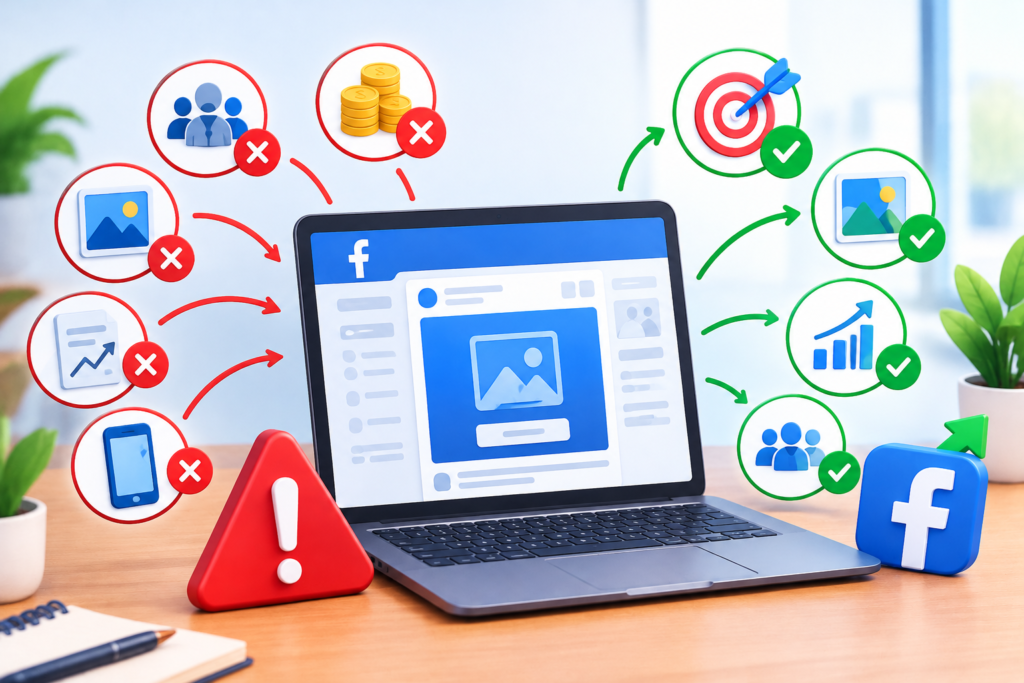
Common Mistakes in Facebook™ Ads and How to Avoid Them
Choosing the Wrong Campaign Objective
A frequent mistake is selecting an objective because it produces attractive dashboard numbers rather than because it supports the intended business outcome. For example, a campaign designed to generate website visits may attract visitors without producing qualified leads. Businesses should define the desired action before launching a campaign and select an available objective and optimization setting that align with that action. They should then evaluate whether the campaign produces meaningful business results rather than assuming that high engagement guarantees commercial success.
Targeting Too Broadly or Too Narrowly Without Evidence
Some advertisers define audiences so broadly that their messaging lacks relevance, while others create numerous narrow segments that restrict delivery and divide limited budgets. Neither approach is automatically wrong, but both can create problems when used without a clear rationale. Audience choices should reflect customer research, the offer, campaign objectives, and available data. Testing should determine whether broader or more focused targeting produces better qualified conversions. Businesses should also review applicable platform restrictions before using audience options, especially for regulated advertising categories.
Using Weak Creative and Generic Messaging
Advertisements that rely on vague phrases, crowded designs, or unsupported claims may struggle to communicate meaningful value. Simply stating that a service is excellent or that a product is the best option does not explain why the audience should care. Effective creative identifies a relevant problem, presents a credible benefit, and gives people a clear next step. Businesses should develop specific messages based on customer questions and test different creative approaches while keeping claims truthful and substantiated.
Sending Every Visitor to the Homepage
A homepage often serves several audiences and business objectives, which can make it an unsuitable destination for a campaign promoting one specific offer. Visitors may have to navigate multiple menus before finding the information promised in the advertisement. Advertisers should create or select a relevant landing page that continues the same message and makes the intended action straightforward. The page should answer essential questions, explain the offer, provide appropriate trust signals, and work reliably on mobile devices.
Ignoring Conversion Tracking and Lead Quality
Launching campaigns without checking conversion events makes it difficult to distinguish meaningful outcomes from superficial activity. Incorrect event configurations, duplicate reporting, or missing tracking can lead to misleading conclusions. Businesses should test their measurement setup before launch and compare platform data with relevant business records. They should also assess the quality of leads and the percentage that progress to sales. An inexpensive enquiry is not necessarily valuable if it rarely becomes a customer.
Making Changes Too Frequently
Constantly adjusting budgets, audiences, and creative elements can make campaign performance difficult to interpret. Advertisers may abandon a promising strategy before sufficient evidence is available or attribute a result to the wrong change. A better approach is to establish review intervals, record important adjustments, and define practical criteria for decisions. Immediate action remains appropriate when there is a clear technical failure, policy problem, unexpected spend issue, or other urgent concern, but routine optimization should be based on meaningful evidence.
Scaling Before Confirming Profitability
Increasing a budget because an advertisement generates clicks or a small number of sales can expose a business to unnecessary financial risk. Before scaling, advertisers should understand customer acquisition costs, conversion rates, contribution margins, and the business’s ability to fulfil additional demand. They should also account for the possibility that results may change as spending increases. Gradual, evidence-based growth is generally more prudent than making a large budget increase without clear performance thresholds.
Neglecting Policy Compliance and Customer Privacy
An advertisement can create problems even when its commercial message appears persuasive. Misleading claims, inappropriate targeting, prohibited products, unclear promotional terms, and improper data collection may lead to rejected advertisements, account restrictions, customer complaints, or legal issues. Advertisers should review the current Meta Advertising Standards and applicable privacy requirements before launching campaigns. Consent, data minimization, secure handling, and accurate disclosures should be built into the marketing process rather than addressed only after a problem arises.
Best Practices Summary for Successful Facebook™ Ads
Start With Customer Research and a Clear Objective
Begin every campaign by identifying the audience’s needs, the value of the offer, and the specific action the business wants people to take. Use customer conversations, sales data, support questions, and existing research to develop relevant messages. Choose a campaign objective that supports the intended outcome and establish realistic performance targets before spending money. A clear plan makes it easier to evaluate results and avoid decisions based solely on impressions, likes, or clicks.
Develop Relevant Creative and Consistent Offers
Create advertisements that communicate one primary benefit and provide a clear next step. Use appropriate images, video, headlines, and supporting copy to make the offer easy to understand. Ensure the landing page matches the advertisement and provides the information visitors need to proceed. Test different creative concepts and messages, but avoid misleading claims, artificial urgency, and unsupported promises. Creative decisions should be informed by customer needs and measured results rather than design preferences alone.
Establish Reliable Tracking and Meaningful Reporting
Check conversion events before launching campaigns and confirm that they represent the actions the business intends to measure. Review advertising results alongside relevant sales, CRM, and website data. Track cost per qualified lead, customer acquisition cost, conversion rate, and profitability where appropriate. Understand attribution limitations and reporting differences before drawing conclusions. Reliable measurement supports better budgeting decisions and helps identify where the customer journey needs improvement.
Optimize With Structured Experiments
Use testing to compare meaningful alternatives in creative, offers, landing pages, and audience strategies. Begin with a clear hypothesis and define the primary metric before running the experiment. Allow sufficient time and data for a useful assessment, while addressing genuine technical or policy issues promptly. Document the results and apply useful lessons to subsequent campaigns. Avoid repeatedly changing multiple settings without a clear reason, as this can make it difficult to determine what actually improved performance.
Protect Profitability as Campaigns Grow
Set spending limits based on the business’s economics and capacity to serve customers. Evaluate lead quality and completed sales rather than assuming that a low cost per click means a campaign is profitable. Increase budgets only when results support the decision, and monitor whether acquisition costs remain sustainable as volume grows. Review the complete cost of serving customers, including relevant delivery, fulfilment, and operating expenses. Sustainable growth depends on financial discipline as much as advertising performance.
Maintain Compliance, Transparency, and Customer Trust
Review current advertising policies, respect applicable privacy requirements, and ensure that claims can be supported. Use customer information responsibly and provide clear explanations where appropriate about how information is collected and used. Keep promotional terms understandable, avoid prohibited targeting practices, and ensure landing pages deliver what advertisements promise. These practices help protect customers, support a credible brand reputation, and reduce avoidable campaign disruptions.
Frequently Asked Questions
1. What Are Facebook™ Ads, and How Do They Work?
Facebook™ Ads are paid advertisements managed through Meta’s advertising system. Businesses use them to reach eligible audiences, promote products and services, generate enquiries, encourage engagement, and support online purchases. Advertisers select a campaign objective, configure delivery settings, and create advertisements containing text, images, video, and a destination or call to action. The system distributes advertisements according to the available settings and its delivery optimization mechanisms. Advertisers then monitor results and adjust their strategies based on relevant performance data.
The effectiveness of a campaign depends on several connected factors, including audience relevance, offer quality, creative execution, landing-page experience, measurement accuracy, and budget management. Simply publishing an advertisement does not guarantee sales. Businesses should develop a clear strategy, test their assumptions, and evaluate whether their campaigns generate commercially meaningful outcomes.
2. How Much Should a Business Spend on Facebook™ Ads?
There is no universal budget that works for every business. The appropriate amount depends on the product or service, target market, competition, conversion rate, customer value, and the business’s ability to absorb advertising costs. A small business may begin with a controlled testing budget, while an established advertiser with reliable conversion data may have the resources to invest more confidently.
Before choosing a budget, estimate how much the business can afford to spend acquiring a customer. For lead-generation campaigns, consider the proportion of enquiries that become qualified opportunities and paying customers. For ecommerce, calculate margins after relevant product, fulfilment, and transaction expenses. Start with a manageable amount, establish clear performance thresholds, and increase spending only when the available evidence supports further investment.
3. Are Facebook™ Ads Suitable for Small Businesses?
Yes. Facebook™ Ads can be useful for small businesses when the audience, offer, and campaign objective are clearly defined. Local service providers may use them to generate enquiries, while consultants can promote discovery calls, and online retailers can advertise products. Businesses can also test educational content or lead magnets to introduce their services to potential customers.
Small businesses should avoid spreading limited budgets across too many campaigns or targeting variations without a clear purpose. A simpler setup, a relevant landing page, and a small number of meaningful creative tests may provide a more useful starting point. The business should also establish a process for responding to leads quickly and measuring how many enquiries turn into paying customers.
4. What Is the Difference Between Facebook™ Ads and Organic Facebook Marketing?
Facebook™ Ads involve paid distribution, allowing advertisers to allocate a budget toward reaching eligible audiences and pursuing defined campaign objectives. Organic Facebook marketing involves publishing content without paying for the distribution of each post. Organic activity can help businesses share expertise, develop a community, answer customer questions, and maintain relationships with existing followers.
The two approaches can support each other. Organic content may reveal which topics attract useful engagement, while paid campaigns can help distribute selected messages to relevant audiences. However, engagement with an organic post does not automatically predict advertising profitability. Businesses should assess each activity according to its purpose and use paid and organic marketing in a coordinated way.
5. How Can I Reduce the Cost of Facebook™ Ads?
Reducing advertising costs starts with understanding which part of the customer journey is inefficient. If an advertisement attracts few relevant clicks, review the creative, message, offer, and audience strategy. If people click but do not convert, examine landing-page relevance, loading performance, form complexity, and the clarity of the offer. If leads are inexpensive but rarely become customers, improve qualification and the sales follow-up process.
Businesses should also review conversion tracking, test new creative concepts, and compare campaign performance using meaningful outcomes. Reducing cost per click alone is not sufficient if the resulting traffic produces fewer sales. A more useful goal is to improve the cost of acquiring a qualified lead or profitable customer while maintaining an acceptable customer experience.
6. What Is Meta Pixel, and Why Is It Important?
Meta Pixel is a website tracking tool that can help advertisers measure eligible website activity and support advertising optimization. When configured appropriately, it can record events associated with actions such as viewing a page, adding an item to a cart, or completing a purchase. These events help advertisers understand how people interact with their websites after engaging with advertisements.
The implementation must be tested carefully to ensure that events are recorded accurately and are not unintentionally duplicated. Advertisers should consider the applicable privacy requirements, consent choices, and Meta’s data-handling rules. Some businesses may also use the Conversions API as part of their measurement setup. Neither tool guarantees complete attribution, so platform reporting should be interpreted alongside relevant business records and other measurement sources.
7. How Long Does It Take to See Results From Facebook™ Ads?
The time required to see meaningful results depends on the campaign objective, budget, audience size, conversion volume, offer, and complexity of the buying process. Some campaigns may generate early engagement or enquiries quickly, while others require more time to gather enough information for useful evaluation. A high-value service with a lengthy sales cycle may take considerably longer to assess than a low-cost product with a straightforward checkout.
Advertisers should distinguish between early activity and reliable evidence of performance. A few clicks or initial conversions may be encouraging, but they do not necessarily establish that a campaign is profitable or scalable. Define review intervals, monitor relevant metrics, and allow sufficient data to accumulate where practical. Address technical failures, policy issues, or uncontrolled spending immediately rather than waiting for a scheduled review.
8. Can Facebook™ Ads Generate Leads and Sales Automatically?
Facebook™ Ads can automate aspects of advertisement delivery and conversion optimization, but they do not eliminate the need for an effective business process. Campaigns may help generate leads or purchases when the offer, audience, creative, and conversion path work together. However, lead quality, customer questions, pricing concerns, fulfilment, and sales follow-up still influence the final outcome.
Businesses can connect campaigns with suitable CRM systems, email platforms, booking tools, and ecommerce systems to automate parts of the customer journey. These integrations can support timely follow-up and more consistent reporting when configured correctly. Advertisers should test automation workflows, protect customer information, and establish a process for handling exceptions. Automation is most valuable when it supports a well-designed customer experience rather than attempting to compensate for a weak offer or unclear sales process.
Conclusion
Facebook™ Ads can become a valuable part of a business’s marketing system when campaigns are planned around genuine customer needs and measurable commercial outcomes. Success depends on more than selecting an audience or creating an attractive advertisement. Businesses must connect relevant messaging with a compelling offer, an appropriate landing page, reliable conversion tracking, and a sales process capable of turning interest into customers. Each part of the journey contributes to the overall result, so improving one element may not be enough when another creates a significant barrier.
A sustainable strategy combines careful budgeting, structured experimentation, accurate measurement, and ongoing attention to customer experience. Advertisers should use campaign data to identify weaknesses, evaluate lead quality and profitability, and scale only when results justify additional spending. They should also remain attentive to changes in platform features, advertising standards, and privacy obligations. No campaign can guarantee a particular return, but a disciplined process makes it easier to learn from results, manage risk, and improve future decisions.
For businesses looking to connect paid advertising with a complete conversion journey, MyFunnelScript emphasizes the importance of treating each campaign as part of a wider sales system. The goal is to attract the right people, communicate genuine value, make the next step straightforward, and measure what happens afterward. With a clear strategy and consistent execution, businesses can build advertising campaigns that support customer relationships and sustainable growth rather than relying on short-term engagement metrics alone.
Want to Implement This Easily?
Prompt Text:
You are an expert consultant. Based on the blog post titled “(Facebook™ Ads)”, provide a step-by-step, practical implementation guide. Include tools, best practices, common mistakes to avoid, and advanced tips. Assume the reader wants to implement everything discussed in this article effectively.
Call to Action:
Want our help implementing this? Just reach out to us via our website contact form: https://buywith.thrivecart.com/full-sales-funnel-templates/