
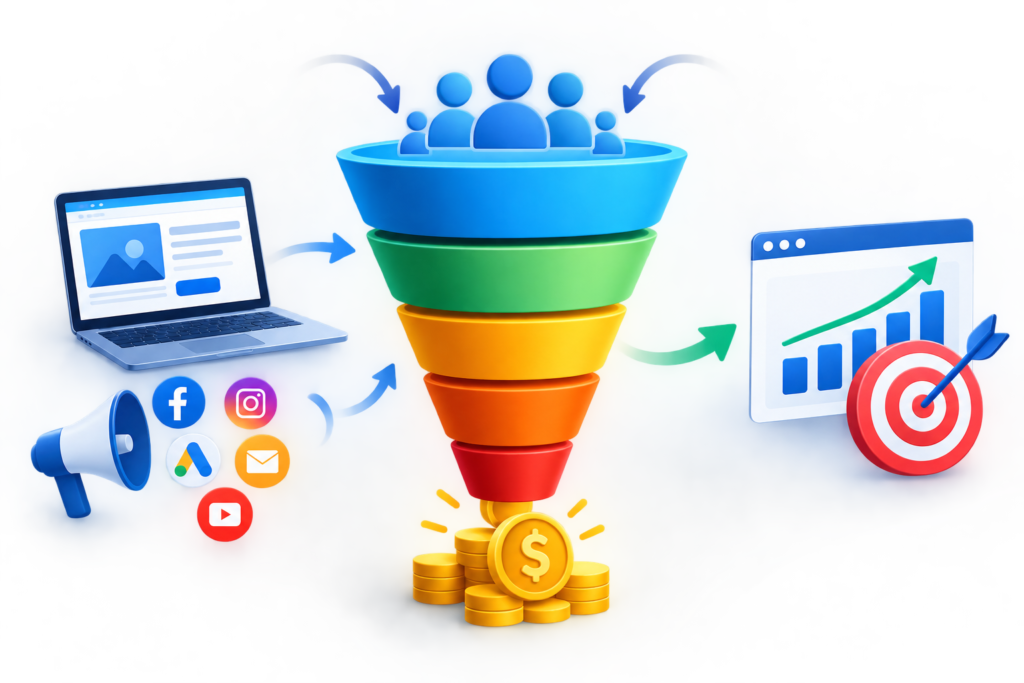
Learn how sales funnels attract prospects, capture qualified leads, build trust, increase conversions, and create a scalable customer journey using practical strategies, optimization techniques, automation, and proven best practices.
Introduction
A successful online business needs more than traffic. It needs a structured process for turning attention into interest, interest into trust, and trust into action. This is where sales funnels become one of the most important frameworks in modern digital marketing. Instead of expecting every visitor to purchase immediately, a well-designed funnel guides potential customers through a series of relevant experiences based on their needs, awareness, questions, and buying intent.
A sales funnel can include content, advertisements, landing pages, lead magnets, email sequences, webinars, product demonstrations, sales pages, consultations, checkout experiences, follow-up campaigns, and customer retention strategies. The individual components are important, but the real value comes from how those components work together. A visitor should understand what problem is being addressed, why the solution matters, what makes the offer credible, and what action they should take next.
For businesses developing a complete funnel strategy, My Funnel Script can serve as a relevant destination for funnel-focused resources and solutions. However, successful funnel building is ultimately about understanding people rather than simply assembling pages and automation. The most effective funnels are designed around customer needs and provide useful information at every stage of the buying journey.
This principle also aligns with Google Search Essentials, which emphasizes helpful, reliable, people-first content and warns against practices designed primarily to manipulate search rankings. A sales funnel should follow a similar philosophy. Its purpose should be to make the customer’s decision easier, clearer, and more informed rather than simply pushing visitors toward a transaction.
This comprehensive guide explains how sales funnels work, how to plan each stage, how to create compelling offers, how to design landing pages, how to nurture leads, how to use automation, how to measure funnel performance, and how to optimize the entire customer journey for sustainable business growth.
What Is a Sales Funnel?
A sales funnel is a structured customer journey that moves a potential customer from initial awareness toward a desired business outcome. That outcome might be a purchase, consultation, application, subscription, free trial, registration, booking, or another meaningful conversion. The term “funnel” reflects the fact that businesses generally attract a larger number of people at the beginning of the journey than the number who eventually become customers.
At the top of the funnel, prospects may know very little about a business or the solution it provides. Some may only recognize a problem. Others may be researching possible solutions without having decided what they need. As they progress, prospects typically become more informed and selective. They may consume educational content, compare providers, download resources, join an email list, attend a webinar, request a demonstration, or speak with a sales representative.
The funnel therefore provides a framework for matching communication with customer intent. A person discovering a problem for the first time generally needs different information from someone comparing two competing products. Sending both people the same sales message can create unnecessary friction.
A practical sales funnel can contain several interconnected stages:
- Awareness — attracting people who may have a relevant problem or need.
- Interest — encouraging visitors to explore the topic or solution.
- Lead generation — creating a valuable exchange that captures contact information.
- Nurturing — building understanding, credibility, and trust.
- Consideration — helping prospects evaluate the solution.
- Conversion — encouraging the appropriate purchase or action.
- Retention — creating a positive post-purchase experience.
- Expansion — encouraging repeat purchases, referrals, renewals, or relevant upgrades.
These stages are not necessarily linear. A customer might discover a brand through search, leave the site, return through an email, watch a product demonstration, compare alternatives, and then purchase several weeks later.
That is why a good funnel should not be designed as a rigid sequence that assumes everyone behaves identically. Instead, it should provide useful opportunities for people to continue based on their individual level of interest and readiness.
The best sales funnels reduce confusion. They help prospects understand what the offer is, who it is for, why it matters, how it works, and what to do next.
Why Sales Funnels Matter for Business Growth
One of the biggest advantages of a sales funnel is that it turns marketing into a more measurable system. Without a funnel, businesses often look at individual metrics such as website traffic, advertisement clicks, social media impressions, email opens, or sales without understanding how those activities connect.
A properly structured funnel allows marketers to examine the entire customer journey. You can measure how many people see an advertisement, how many click, how many reach a landing page, how many submit a form, how many engage with follow-up communication, how many enter a sales conversation, and how many ultimately become customers.
This makes it easier to identify the real bottleneck.
For example, imagine that 20,000 people reach the first stage of a campaign, 2,000 visit the landing page, 500 become leads, 100 become qualified opportunities, and 20 become customers. If the campaign generates plenty of qualified leads but few purchases, increasing traffic may not solve the underlying problem. The sales presentation, pricing, offer structure, objection handling, or follow-up process may require attention.
On the other hand, if a landing page converts only a small percentage of highly relevant visitors, improving that page may generate substantial additional revenue without increasing advertising spend.
This is the foundation of conversion rate optimization. Instead of always asking, “How can we get more visitors?” businesses can also ask, “How can we help more of our existing visitors take the right next step?”
Funnels also make personalization easier. A new visitor can receive introductory educational content, while someone who has already downloaded several resources can receive more advanced information. A prospect who has viewed pricing may need objection-handling content, while an existing customer may be better suited to onboarding or retention communication.
A funnel can therefore improve both marketing efficiency and customer experience.
The important distinction is that a funnel should not be optimized purely for the highest possible conversion percentage. A misleading promise might produce more immediate conversions but create refunds, complaints, poor reviews, and low customer retention.
The strongest funnel is the one that attracts the right people, sets accurate expectations, communicates genuine value, and creates customers who are satisfied with the decision they made.
Understanding the Main Stages of a Sales Funnel
Although funnel terminology varies between industries, most successful sales funnel strategies contain several recognizable stages. Understanding these stages helps businesses create appropriate content and calls to action for different levels of customer awareness.
The first stage is awareness. At this point, the prospect may not know the business and may not even understand the full nature of their problem. Content at this stage should generally educate rather than aggressively sell. Blog posts, educational videos, social content, search-driven resources, guides, podcasts, and introductory advertisements can all help create awareness.
The second stage is interest and consideration. The prospect now understands the problem and is exploring possible solutions. This is where deeper educational resources, comparisons, case studies, demonstrations, webinars, email sequences, and detailed product information can become valuable.
The third stage is conversion. The prospect has enough interest to consider taking a commercial action. At this point, the funnel should make the decision easier by presenting the offer clearly, addressing relevant objections, explaining expectations, and providing a straightforward next step.
The fourth stage is retention. A purchase should not automatically represent the end of the customer journey. New customers may need onboarding, training, support, documentation, product education, or implementation assistance.
The fifth stage is expansion and advocacy. Satisfied customers may purchase additional products, renew subscriptions, upgrade services, recommend the business, or provide testimonials and referrals.
Each stage has a different psychological purpose.
Awareness answers:
“What is this problem?”
Consideration answers:
“What solutions are available?”
Conversion answers:
“Why should I choose this solution?”
Retention answers:
“How do I get the promised value?”
Expansion answers:
“What else can help me achieve my goals?”
This framework prevents a common marketing mistake: asking for a purchase before the prospect has received enough information to make a confident decision.
How to Define Your Ideal Funnel Audience
The quality of a sales funnel depends heavily on the quality of its audience definition. If the business attempts to speak to everyone, the messaging often becomes generic, the offer becomes less relevant, and the funnel attracts people who may never become customers.
Audience research should go beyond basic demographics. While location, age, industry, company size, or job title can be useful, stronger funnel planning investigates the prospect’s actual situation.
Consider questions such as:
- What problem is the customer trying to solve?
- What outcome do they want?
- What have they already tried?
- Why did previous solutions fail?
- What concerns could prevent them from purchasing?
- What factors influence their decision?
- What information do they need before trusting a provider?
- How urgent is the problem?
- What alternatives are they considering?
- What would make the solution feel worth the investment?
The answers help create more precise messaging.
For example, saying that a funnel is designed for “small businesses” provides very little strategic direction. A more useful audience might be “service businesses that generate leads online but lose prospects because follow-up is inconsistent.” That description identifies both the audience and the problem.
Understanding customer awareness levels is equally important.
An unaware prospect may need educational content. A problem-aware prospect may need a framework for understanding possible solutions. A solution-aware prospect may want comparisons. A product-aware prospect may need proof, pricing information, implementation details, or answers to final objections.
The funnel should adapt accordingly.
Customer language is another valuable source of insight. Sales calls, support conversations, reviews, questionnaires, surveys, online communities, and customer interviews can reveal the exact words people use when describing their challenges.
Those phrases can inform headlines, FAQs, email copy, advertisements, educational content, and sales-page sections.
Importantly, audience research should not be manipulated to justify assumptions. The goal is to understand real customer needs rather than inventing exaggerated problems.
A well-defined audience ultimately improves the entire funnel because every subsequent decision becomes easier: the offer, message, lead magnet, content, calls to action, follow-up sequence, and qualification process can all be aligned around a specific customer.
Building a Strong Funnel Offer
A sophisticated funnel cannot rescue an offer that customers do not value. You can create beautiful landing pages, complex automation, detailed email sequences, and extensive advertising campaigns, but if the underlying offer does not solve a meaningful problem, conversion performance will remain limited.
A strong offer clearly communicates what the customer receives, what problem it addresses, what outcome it supports, and why it is relevant to the customer’s current situation.
This does not mean making unrealistic promises.
Instead, effective offer development focuses on clarity and relevance. A customer should quickly understand what is being offered and why it could help.
For a lead-generation funnel, the initial offer could be a:
- Checklist
- Template
- Strategy guide
- Audit
- Assessment
- Calculator
- Webinar
- Free consultation
- Demonstration
- Educational course
- Case study
The lead magnet should have a logical relationship with the eventual commercial offer. If someone downloads a resource about email automation and the business sells email automation services, the connection is natural.
This creates what can be called an offer bridge. The free or low-friction resource solves part of the problem while demonstrating why a more comprehensive solution may be valuable.
For example, a checklist could help a business identify weaknesses in its sales process. The paid service could then provide a complete implementation. The free resource creates immediate value while naturally introducing the larger solution.
The core commercial offer should also communicate benefits rather than relying exclusively on features.
A software platform may include automation, integrations, analytics, segmentation, and templates. Those are features. The customer may actually care about reducing manual work, responding to leads faster, improving organization, or creating a more consistent customer experience.
That distinction should influence funnel messaging.
A strong offer also addresses risk and uncertainty. Customers may wonder:
- Will this work for my situation?
- How difficult is implementation?
- What happens after purchase?
- How much time will I need?
- What support is available?
- Is this suitable for my business size?
- What happens if I need help?
Answering legitimate questions builds confidence.
The objective is not to make an offer sound bigger than it really is. It is to make its real value easier to understand.
Creating High-Converting Landing Pages
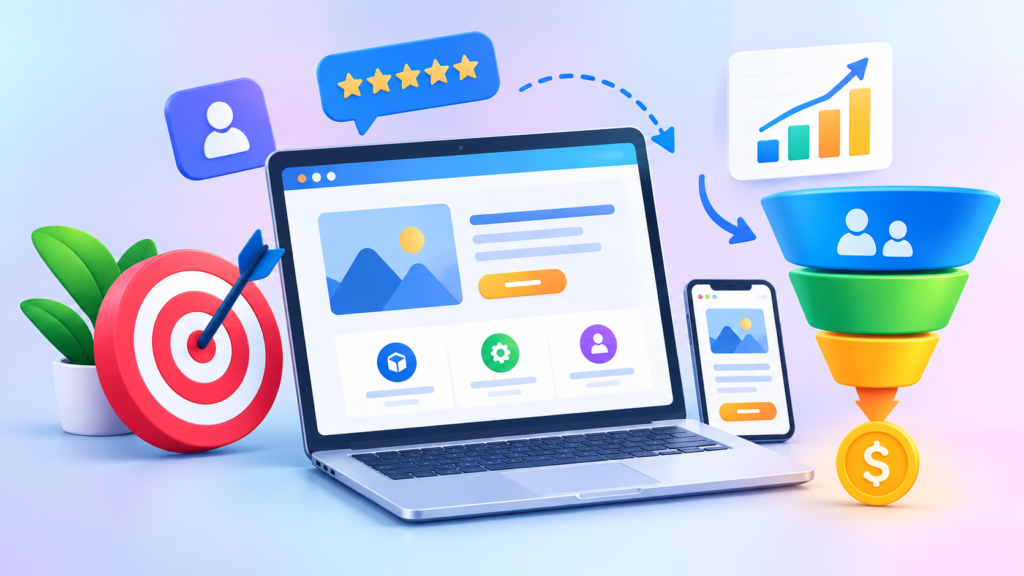
Landing pages are often the central conversion point within a sales funnel. They receive traffic from search, advertising, email, social media, referrals, or other channels and encourage visitors to take a specific next step.
A high-performing landing page begins with message alignment.
If a visitor clicks an advertisement promising a specific solution, the landing page should immediately reinforce that expectation. Sending the visitor to a generic homepage or a page containing unrelated information can create friction.
The headline should communicate the main value proposition clearly. Supporting content should then explain the problem, solution, benefits, evidence, process, and next action.
A practical landing page structure may include:
- Clear headline
- Supporting value proposition
- Primary call to action
- Explanation of the problem
- Key benefits
- How the solution works
- Relevant proof
- Objection handling
- FAQs
- Final call to action
The exact structure should depend on the offer.
A simple low-cost product does not necessarily need a huge sales page. A complex B2B service may require extensive explanation because the prospect needs information about implementation, integrations, security, support, pricing, and expected outcomes.
Avoid adding sections merely because another funnel contains them.
Every section should answer a question, remove uncertainty, demonstrate value, or help the visitor decide whether the next step is appropriate.
Technical performance matters as well. Google recommends making pages accessible to search engines and users, and its SEO documentation explains that technical accessibility is part of creating a search-friendly website. The SEO Starter Guide provides Google’s broader guidance on helping search engines understand website content.
Mobile usability, readable text, accessible forms, logical page structure, secure connections, and efficient loading all contribute to the overall experience.
The landing page should also be easy to scan. Visitors frequently evaluate a page before deciding whether to read it carefully. Clear headings, concise paragraphs, useful lists, descriptive buttons, and relevant visuals can make important information easier to find.
Most importantly, avoid deceptive conversion tactics.
Artificial countdowns, misleading buttons, hidden conditions, exaggerated guarantees, and confusing checkout flows may produce short-term actions but can damage trust.
A landing page should persuade through clarity, relevance, evidence, and value.
Lead Magnets and Lead Capture Strategies
A lead magnet provides something useful in exchange for contact information, typically an email address. It is often the first meaningful conversion in a lead-generation funnel.
The strongest lead magnets solve a specific problem quickly.
A generic ebook may attract attention, but a focused resource such as a “Sales Funnel Audit Checklist” can be more immediately useful because the visitor understands exactly what they will receive.
Other effective formats include templates, worksheets, calculators, assessments, webinars, case studies, strategy guides, checklists, and short educational courses.
The most important consideration is relevance.
If the lead magnet attracts people who are interested in a topic but have no realistic need for the company’s paid solution, the email list may grow without producing meaningful commercial results.
For example, a company selling advanced sales automation might offer a detailed resource explaining how to identify sales-process bottlenecks. People who download that resource have demonstrated a potentially relevant problem.
The next stage of the funnel can then provide deeper education about solving those bottlenecks.
Lead capture forms should also be designed around friction.
Ask for information that is genuinely necessary. If an email address is sufficient for the next step, requiring a phone number, company revenue, address, job title, and multiple other fields may unnecessarily reduce conversions.
However, qualification can sometimes be valuable for high-ticket services. A consultation funnel may need additional information because the sales team must determine whether the prospect is a suitable fit.
The correct balance depends on the business model.
After submission, the visitor should receive a clear confirmation experience. Tell them what happens next and deliver the promised resource promptly.
The lead magnet should also establish appropriate expectations about future communication.
Trust is especially important at this stage because the prospect has voluntarily provided personal information. The business should handle that information responsibly and communicate transparently.
A lead magnet is therefore more than an email collection mechanism. It is the beginning of a relationship.
If the first interaction delivers genuine value, the prospect has a reason to continue listening.
If the first interaction feels disappointing, misleading, or excessively promotional, the funnel can lose trust before the sales process has even started.
Designing an Effective Email Nurture Sequence
Once someone becomes a lead, the funnel needs a strategy for maintaining the relationship. Email nurturing can provide that bridge between the initial opt-in and the eventual purchase decision.
However, effective nurture emails should not consist of repeated sales pitches.
The sequence should gradually build understanding and confidence.
A practical nurture sequence might include:
Email 1 — Deliver the resource
Give the subscriber exactly what was promised. Keep the message simple and explain what they can expect next.
Email 2 — Identify the problem
Help the reader understand an important challenge related to the topic.
Email 3 — Teach a useful strategy
Provide actionable information that can be applied independently.
Email 4 — Explain common mistakes
Show why certain approaches fail and what a better approach looks like.
Email 5 — Demonstrate the solution
Use an example, case study, walkthrough, or demonstration to show how the problem can be addressed.
Email 6 — Address objections
Answer realistic concerns about price, complexity, time, implementation, suitability, or risk.
Email 7 — Present the offer
Explain how the company’s solution can help and provide a clear next action.
The sequence should not necessarily follow exactly seven emails. The appropriate number depends on the complexity of the product, buying cycle, audience, and customer expectations.
For a low-cost product, prospects may make decisions quickly. For a high-ticket service, the customer may need weeks of education and evaluation.
Segmentation can improve relevance.
A prospect who has repeatedly engaged with advanced content may be ready for a different message than someone who has only downloaded an introductory resource.
Behavioral information can therefore help create more relevant experiences.
The objective is not to send the maximum number of emails. The objective is to provide the right information at the right stage.
A strong nurture sequence leaves the subscriber better informed even if they do not purchase immediately.
That is an important distinction between useful email marketing and aggressive promotion.
The strongest sales funnels create trust before asking for significant commitment.
Building High-Converting Sales Pages
A sales page is one of the most important conversion assets in a sales funnel because it brings together the offer, value proposition, supporting evidence, objections, and call to action in one focused experience. While a landing page may primarily capture a lead, a sales page typically has the more demanding responsibility of helping a qualified prospect make a purchasing decision. That means the page needs to communicate enough information to reduce uncertainty without overwhelming the reader with unnecessary copy.
A strong sales page begins with a clear explanation of the customer’s problem and desired outcome. Instead of immediately listing every product feature, explain why the problem matters and what changes when it is solved. The offer should then show how the solution addresses that problem. Benefits should be specific and realistic, while supporting features can explain how those benefits are delivered. If relevant, include demonstrations, customer experiences, case studies, testimonials, comparisons, guarantees, implementation details, and answers to common questions. Every element should have a purpose: clarify value, establish credibility, or remove a genuine barrier to action.
The call to action should also be consistent throughout the page. A prospect who is ready to move forward should not have to search for the next step. However, a good sales page should not rely on pressure tactics. False scarcity, misleading countdown timers, exaggerated claims, or unclear pricing conditions can undermine trust. Instead, build confidence by being transparent about what customers receive, who the solution is designed for, what the process looks like, and what happens after purchase. This people-first approach complements Google’s guidance around creating helpful and reliable experiences, including its SEO Starter Guide, which emphasizes making content useful and understandable for visitors as well as search engines.
Using Conversion Psychology Without Manipulation
Understanding customer psychology can make a sales funnel more effective, but ethical persuasion is fundamentally different from manipulation. The purpose of conversion psychology should be to understand how people evaluate decisions and remove unnecessary uncertainty, not to pressure someone into purchasing something that is inappropriate for them. A trustworthy funnel makes the decision easier by presenting relevant information in a logical sequence.
One important psychological principle is clarity. People are more likely to continue when they understand what is being offered and what will happen next. Another is perceived value. Customers naturally compare the expected benefits of a solution with its price, time commitment, effort, and perceived risk. A funnel can improve this evaluation by explaining the problem clearly, demonstrating how the solution works, providing genuine evidence, and showing what implementation involves. Social proof can also help because real customer experiences can reduce uncertainty, provided testimonials and results are authentic and accurately represented.
Another important factor is friction. Every unnecessary form field, confusing navigation element, unclear price, unexpected checkout step, or technical problem can create hesitation. Reducing friction does not mean hiding important information. It means presenting important information in a way that is easy to understand and act upon. A strong funnel should also respect the prospect’s autonomy. If a customer decides not to purchase, the experience should remain professional rather than using deceptive pop-ups, repeated pressure, or misleading claims. Long-term trust is more valuable than a single forced conversion because satisfied customers can create repeat business, referrals, reviews, and brand credibility.
Creating Webinar and Educational Funnels
Webinar funnels can be particularly effective for businesses selling complex products, professional services, consulting, coaching, software, training, and other solutions that require education before purchase. Unlike a short advertisement or product page, a webinar provides an extended opportunity to explain a problem, teach a useful concept, demonstrate expertise, and introduce a relevant solution.
A typical webinar funnel may include an invitation page, registration form, confirmation page, reminder emails, the webinar itself, follow-up communication, and a sales or consultation page. The registration page should communicate a clear reason to attend rather than simply announcing the webinar topic. A strong title identifies a meaningful problem or outcome while avoiding unrealistic promises. During the webinar, the educational component should provide genuine value. Teaching something useful establishes credibility because attendees can experience the presenter’s knowledge rather than simply being told that the business is an expert.
The follow-up stage is equally important. Some attendees may be ready to purchase immediately, while others may need additional information. People who registered but did not attend may need access to a replay or alternative resource. Attendees who watched the entire presentation may be ready for a detailed offer, while those who left early may need more foundational education. This creates opportunities for segmentation based on behavior. The goal should not be to bombard every registrant with identical promotional messages. Instead, webinar follow-up should answer unanswered questions, provide useful resources, explain the offer, and give interested prospects a clear next step.
A well-designed webinar funnel can therefore function as both an education system and a conversion system. Its strongest advantage is the ability to build understanding before asking for a significant commitment.
Designing Application and Consultation Funnels
Application funnels are especially useful for high-ticket services, consulting, agencies, coaching, professional services, and other businesses where not every prospect is an appropriate customer. Instead of allowing every visitor to proceed directly to a purchase, an application funnel gathers information that helps determine fit.
The first stage usually communicates who the service is for, what problem it solves, what type of outcome the customer can expect, and what the application process involves. The application itself should ask meaningful questions. These might cover business objectives, current challenges, budget considerations, timeline, previous solutions, and desired outcomes. However, every question should have a reason. Excessively long forms can discourage good prospects while providing little additional value.
The qualification process should be treated as a two-way evaluation rather than a one-sided sales mechanism. The business needs to determine whether the prospect is a good fit, but the prospect also needs to determine whether the provider is appropriate. Clear information about services, process, expectations, pricing ranges where appropriate, and likely outcomes can improve the quality of conversations.
After submission, the funnel should provide clear next steps. If qualified prospects are invited to book a call, the scheduling process should be straightforward. Confirmation emails can explain what will happen during the conversation and what information the prospect should prepare. If someone is not a fit, a respectful alternative may be more appropriate than forcing them into an unsuitable sales process.
The purpose of an application funnel is therefore not simply to filter people out. Its purpose is to create better alignment between the customer’s needs and the provider’s capabilities. That can improve lead quality, sales efficiency, customer satisfaction, and long-term retention.
Connecting Automation to the Customer Journey
Automation allows businesses to perform repetitive funnel tasks consistently without requiring a team member to manually manage every interaction. Common automated actions include sending lead magnets, delivering welcome emails, assigning tags, segmenting contacts, sending reminders, notifying sales representatives, updating customer records, and initiating follow-up sequences.
However, automation should support the customer journey rather than replace strategic thinking. A common mistake is to automate every possible action without considering whether the resulting experience feels natural. Receiving six unrelated emails because someone clicked several different links is not personalization; it is often a sign of poorly coordinated automation.
Effective funnel automation starts with clear triggers and outcomes. For example, submitting a lead form might trigger resource delivery and a welcome sequence. Attending a webinar could trigger educational follow-up. Requesting a product demonstration might notify a sales representative. Completing a purchase could remove the customer from prospect campaigns and move them into onboarding.
Segmentation makes automation more useful. Contacts can be organized according to factors such as funnel stage, product interest, engagement, customer status, or stated needs. This allows communication to become more relevant.
Automation should also include safeguards. Businesses should monitor for duplicate messages, outdated campaigns, conflicting sequences, broken links, failed integrations, and customers receiving prospecting emails after purchasing. Periodic audits are essential because automated systems can continue operating long after the original strategy has changed.
The strongest approach is human-guided automation. Automation handles repetitive processes, while people remain responsible for strategy, complex questions, relationship management, customer support, and decisions requiring judgment.
Technology should make the experience more consistent, not less human.
Measuring Funnel Performance With the Right KPIs
A sales funnel cannot be optimized effectively if its performance is not measured. However, tracking dozens of metrics without understanding their relationship can create more confusion than clarity. The key is to identify the metrics that correspond to each stage of the customer journey.
At the top of the funnel, businesses may monitor traffic volume, traffic sources, impressions, engagement, click-through rates, and content interactions. During lead generation, important metrics can include landing-page conversion rate, form completion rate, cost per lead, lead quality, and lead-to-opportunity rate. At the sales stage, businesses may track consultation bookings, sales conversion rate, customer acquisition cost, average order value, and revenue generated.
For example, the basic conversion-rate calculation is:
Conversion Rate = Conversions ÷ Total Visitors × 100
If 1,000 people visit a landing page and 80 complete the intended action, the conversion rate is 8%.
But conversion rate alone does not tell the complete story.
Suppose Funnel A generates 500 leads at a low cost but only five customers, while Funnel B generates 150 leads at a slightly higher cost but produces 30 customers. Funnel B may be considerably more valuable despite generating fewer leads.
This is why businesses should connect funnel metrics to revenue and customer quality whenever possible.
Customer acquisition cost, customer lifetime value, average order value, refund rate, retention rate, and repeat-purchase rate can reveal whether the funnel is producing sustainable business results.
Analytics should also be implemented carefully. Google provides guidance through Google Analytics, while Search Console can help businesses understand their performance in Google Search.
The objective is not to collect data for its own sake. The objective is to use evidence to answer practical questions:
Where are prospects leaving?
Which traffic sources produce the best customers?
Which pages create friction?
Which offers attract qualified prospects?
Where should the business invest additional resources?
Good measurement turns funnel optimization from guesswork into an ongoing improvement process.
Optimizing the Funnel for Higher Conversion Rates
Conversion optimization is the process of improving the percentage of appropriate visitors who complete a desired action. Effective optimization begins by identifying a specific problem rather than randomly changing page elements.
Start with funnel data. If many visitors reach a page but few continue, investigate the page. If many people submit a form but few become qualified opportunities, investigate lead quality and targeting. If prospects reach checkout but abandon their purchase, examine pricing clarity, payment options, technical issues, trust concerns, and unexpected friction.
Customer feedback can be particularly valuable. Analytics can tell you what is happening, but customer conversations can help explain why. Surveys, interviews, support tickets, sales calls, session recordings where appropriately implemented, and usability testing can reveal obstacles that quantitative data alone cannot identify.
A/B testing can then be used when sufficient traffic and a clear hypothesis exist. Instead of changing everything simultaneously, test meaningful variables such as headlines, calls to action, page structure, offer presentation, or form length. The goal is to learn which change produces a meaningful improvement for the intended audience.
Avoid declaring success based on tiny or short-term fluctuations. Funnel performance can vary because of traffic sources, seasonality, audience differences, promotions, and other external factors.
Optimization should also consider downstream outcomes. If a new headline increases lead volume but attracts poorly qualified prospects, the change may not represent a true improvement.
The best funnel optimization process therefore follows a cycle:
Measure → Identify → Hypothesize → Test → Analyze → Improve → Repeat
This approach encourages evidence-based decision-making rather than endless design changes.
Using Retargeting to Re-Engage Interested Prospects
Not every prospect converts during their first interaction. People may be researching, comparing alternatives, waiting for a budget decision, discussing the purchase with another decision-maker, or simply getting distracted. Retargeting can provide another opportunity to reconnect with people who have already demonstrated interest.
A strong retargeting strategy should reflect the person’s previous interaction. Someone who visited an educational article should not necessarily receive the same advertisement as someone who reached a pricing page. Likewise, someone who already purchased should normally be excluded from advertisements designed to sell the product they already own.
Segmentation is therefore essential.
Retargeting audiences can be organized around meaningful behaviors such as visiting specific pages, interacting with content, starting a form, registering for an event, or abandoning a checkout process. Each audience can receive messaging that reflects its relationship with the offer.
However, retargeting should be controlled carefully. Showing the same advertisement repeatedly can create annoyance and reduce brand perception. Frequency management, audience exclusions, creative rotation, and appropriate campaign durations can help create a better experience.
Retargeting should also provide genuine additional value. Instead of repeatedly saying “Buy now,” a campaign might answer an objection, provide a comparison guide, demonstrate the product, share a relevant case study, or explain implementation.
The principle is simple: continue the conversation rather than repeating the same sales pitch.
Retargeting is most effective when it fills a genuine information gap. The prospect has already shown interest, so the campaign should help them progress toward a decision rather than simply reminding them that the business exists.
Increasing Customer Lifetime Value After Conversion
A sales funnel should not stop at the purchase. Acquiring a new customer can require significant time and resources, so creating a strong post-purchase experience can be one of the most important opportunities for sustainable growth.
The first priority is customer success. New customers should understand what they purchased, how to get started, where to find support, and what results they can reasonably expect. Effective onboarding can reduce confusion, increase product adoption, and improve satisfaction.
After the initial purchase, businesses can identify appropriate opportunities for retention and expansion. These might include renewals, complementary products, premium services, upgrades, maintenance plans, training, or additional features. However, upselling should be based on genuine relevance.
If a customer purchased a solution to solve one problem, the next offer should logically address another need that may arise from their situation. Irrelevant promotions can make customers feel that the company is focused on revenue rather than their success.
Customer feedback should also become part of the funnel. Reviews, surveys, support interactions, interviews, and usage patterns can reveal where customers are receiving value and where improvements are needed.
Satisfied customers can become powerful advocates. Genuine reviews, referrals, testimonials, and case studies can strengthen future funnel performance because they provide evidence from real experiences.
Customer lifetime value can be considered through a simple conceptual relationship:
Customer Lifetime Value ≈ Average Purchase Value × Purchase Frequency × Customer Lifespan
The precise calculation can vary depending on the business model, margins, retention, and other factors.
The larger lesson is that the best funnel does not merely maximize the number of first purchases. It creates an experience that encourages satisfaction, retention, repeat business, and advocacy.
Common Sales Funnel Mistakes Businesses Make
One of the most common funnel mistakes is trying to sell too early. A prospect who has just discovered a problem may not be ready for a major purchase. Immediately presenting an aggressive sales pitch can create resistance. Better funnel design recognizes different awareness levels and provides appropriate educational steps.
Another common mistake is building a funnel around the business rather than the customer. Companies often focus heavily on features, company history, awards, internal processes, or technical details without clearly explaining why the information matters to the prospect. Strong messaging connects the solution to the customer’s actual problem and desired outcome.
Poor message alignment is another frequent problem. An advertisement may promise one thing while the landing page discusses something else. The visitor then wonders whether they are in the right place. Consistency between traffic source, headline, offer, and call to action helps create a smoother experience.
Some businesses also collect too many leads without evaluating lead quality. A funnel that produces thousands of low-intent contacts may look successful in a dashboard while generating little revenue. Lead quality should therefore be measured alongside lead volume.
Other mistakes include:
- Using unclear calls to action
- Creating overly complicated forms
- Ignoring mobile users
- Sending irrelevant automated emails
- Failing to follow up quickly
- Using fake testimonials
- Making unrealistic promises
- Hiding important pricing or conditions
- Neglecting post-purchase onboarding
- Tracking vanity metrics instead of business outcomes
- Changing multiple variables without testing
- Forgetting to exclude existing customers from prospect campaigns
- Ignoring technical errors
- Allowing broken automation to continue running
A particularly damaging mistake is treating the funnel as a one-time project. Customer behavior changes, offers evolve, competitors introduce alternatives, technology changes, and pages can become outdated.
A funnel should therefore be treated as a living business system that requires measurement, maintenance, testing, and improvement.
Best Practices Summary
The most effective sales funnels share several characteristics. They begin with a clearly defined audience and a specific customer problem. Rather than trying to appeal to everyone, they identify who is most likely to benefit from the solution and create messaging around that audience’s actual needs.
They also provide value throughout the journey. Educational content builds awareness, lead magnets create an initial exchange, email sequences develop understanding, sales pages explain the offer, demonstrations provide evidence, and onboarding helps customers achieve the expected outcome.
A practical sales funnel best-practice checklist includes:
- Define the ideal customer before building the funnel.
- Identify the customer’s primary problem and desired outcome.
- Map content to different awareness stages.
- Create a relevant lead magnet.
- Keep landing-page messaging aligned with the traffic source.
- Use clear and descriptive calls to action.
- Address legitimate objections.
- Provide genuine proof rather than exaggerated claims.
- Keep forms as simple as practical.
- Design for mobile users.
- Maintain strong technical performance.
- Build useful email nurture sequences.
- Segment contacts based on meaningful behavior.
- Automate repetitive tasks while retaining human oversight.
- Track funnel metrics from traffic through revenue.
- Measure lead quality, not just lead volume.
- Test significant changes using evidence.
- Improve pages based on customer feedback.
- Retarget interested prospects responsibly.
- Provide strong customer onboarding.
- Develop retention and repeat-purchase strategies.
- Review automation regularly.
- Remove outdated or misleading content.
- Protect customer trust at every stage.
For SEO-related funnel content, follow Google Search Essentials, use descriptive and useful content, and avoid tactics intended primarily to manipulate rankings. For technical performance, Google’s Core Web Vitals resources provide guidance around important aspects of user experience such as loading performance, responsiveness, and visual stability.
The central principle is simple: build the funnel around the customer journey, not around the technology.
Technology can automate a process, but it cannot determine whether the offer genuinely solves a meaningful problem. Analytics can reveal conversion rates, but they cannot replace customer understanding. Design can improve presentation, but it cannot compensate for a weak value proposition.
The strongest funnels combine strategy, useful content, credible communication, technical quality, measurement, and continuous improvement.
Frequently Asked Questions
What Is the Main Purpose of a Sales Funnel?
The primary purpose of a sales funnel is to guide potential customers through a structured journey from initial awareness to a meaningful conversion. Rather than treating every visitor as equally ready to buy, the funnel provides different types of information and experiences according to the customer’s level of awareness and intent.
A funnel can also help businesses measure where prospects enter, engage, leave, and convert. This makes it possible to identify bottlenecks and improve specific stages instead of changing the entire marketing strategy without evidence.
How Many Stages Should a Sales Funnel Have?
There is no universal number of stages that every business should use. A simple product may require only a few steps, such as advertisement, landing page, checkout, and onboarding. A high-ticket service may require educational content, lead capture, nurturing, qualification, consultation, proposal, purchase, and onboarding.
The correct number of stages depends on customer complexity, buying cycle, price, trust requirements, and the amount of information needed before purchase.
Adding unnecessary steps can create friction, while removing important stages can leave prospects with unanswered questions.
What Is the Difference Between a Sales Funnel and a Marketing Funnel?
The terms are often used interchangeably, but they can emphasize different parts of the customer journey. A marketing funnel generally focuses on attracting and educating audiences, while a sales funnel often focuses more heavily on qualification, conversion, and revenue.
In practice, the two systems frequently overlap. Content may generate awareness, email may nurture interest, and sales processes may convert qualified opportunities.
The most useful approach is to view them as connected parts of the same customer journey rather than completely separate systems.
Do Small Businesses Need Sales Funnels?
Yes, although a small business does not necessarily need a complicated funnel. A simple service business might use educational content, a lead-generation page, an email sequence, and a consultation booking process.
The important factor is not complexity. It is alignment.
A small business can benefit from having a clear path that explains how someone moves from discovering the business to becoming a customer. Even a basic funnel can make marketing more organized and measurable.
How Long Does It Take to Build a Sales Funnel?
The timeframe varies significantly depending on the complexity of the business and funnel. A basic lead-generation funnel can be created relatively quickly, while a sophisticated funnel involving multiple offers, automation sequences, segmentation, integrations, analytics, and testing can require substantially more planning and implementation.
The planning stage is often more important than rushing to launch.
Before building pages, determine the audience, offer, customer journey, traffic source, conversion goal, follow-up process, and measurement framework.
What Is a Good Sales Funnel Conversion Rate?
There is no single conversion rate that can be considered universally “good.” Performance depends on traffic source, industry, offer price, customer awareness, funnel stage, device, audience quality, and conversion definition.
A landing page may have one conversion rate, while a sales call may have another and checkout may have another.
Instead of comparing a funnel against arbitrary benchmarks, businesses should monitor their own historical performance and connect conversion metrics to qualified leads, customers, revenue, retention, and profitability.
Should Every Sales Funnel Use Email Marketing?
Not necessarily, but email can be extremely useful when the buying process requires follow-up or education. Email is particularly valuable when prospects do not purchase immediately after their first interaction.
For straightforward purchases, a short follow-up sequence may be enough. For complex services or high-value products, a longer educational sequence may help prospects understand the solution and address concerns.
The correct approach depends on customer behavior and the length of the buying cycle.
How Often Should a Sales Funnel Be Optimized?
A funnel should be monitored continuously, but that does not mean making random changes every day. Businesses should regularly review performance data, customer feedback, technical issues, campaign quality, automation, and conversion rates.
Major optimization decisions should be based on sufficient evidence.
A useful process is to identify the largest bottleneck, develop a hypothesis, make a controlled change, measure the result, and document what was learned. Over time, these improvements can create substantial gains.
Conclusion
A well-designed sales funnel is much more than a sequence of landing pages and automated emails. It is a strategic system for understanding how people discover a problem, evaluate solutions, develop trust, make purchasing decisions, and interact with a business after conversion.
The strongest funnels begin with the customer. They identify a specific audience, understand its problems, develop a relevant offer, create useful content, capture qualified leads, nurture relationships, present clear sales information, and make the conversion process straightforward. After the purchase, they continue the journey through onboarding, customer support, retention, and relevant expansion opportunities.
For businesses seeking resources and solutions related to funnel development, My Funnel Script provides a relevant destination for exploring funnel-focused strategies and assets. But the underlying principles remain universal: clarity, relevance, value, trust, measurement, and continuous improvement.
Successful funnel building also requires patience. There is rarely one magical headline, button, advertisement, or email that transforms an entire business overnight. Sustainable performance comes from understanding customers, collecting meaningful data, improving weak points, and consistently delivering a better experience.
From an SEO perspective, funnel content should also remain genuinely useful. Following Google Search Essentials, creating people-first content, maintaining technically accessible pages, and avoiding manipulative optimization practices provides a stronger foundation for sustainable organic visibility.
Ultimately, the best sales funnel does not simply create more transactions. It creates a clearer path from problem to solution, helps the right customers make informed decisions, and gives businesses a repeatable system for creating long-term value.
Want to Implement This Easily?
Prompt:
You are an expert consultant. Based on the blog post titled “(Sales Funnels)”, provide a step-by-step, practical implementation guide. Include tools, best practices, common mistakes to avoid, and advanced tips. Assume the reader wants to implement everything discussed in this article effectively.
Call to Action:
Want our help implementing this? Just reach out to us via our website contact form: Full Sales Funnel Templates.