
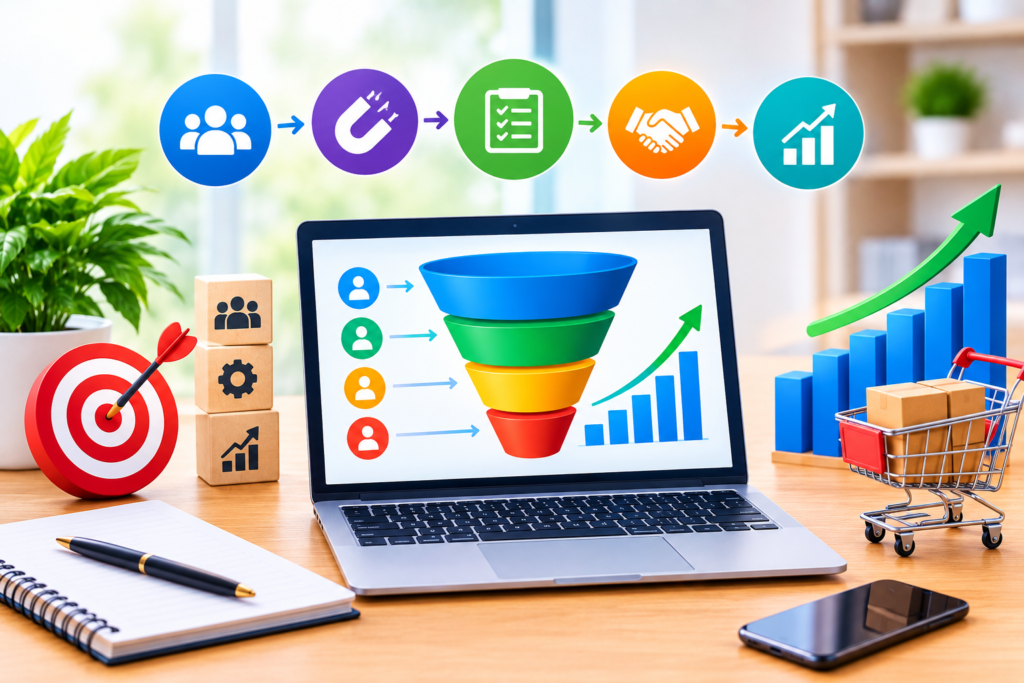
Learn how to build a high-converting sales funnel that attracts qualified leads, nurtures prospects, increases conversions, and supports sustainable business growth.
Introduction
A successful business needs more than a great product, a professional website, or a steady stream of visitors. It needs a reliable system that guides potential customers from their first interaction with a brand to making a purchase and, ideally, becoming loyal customers. This is where a sales funnel becomes an essential part of a modern business growth strategy. It provides a structured approach to attracting attention, building trust, understanding customer needs, presenting relevant solutions, and encouraging profitable buying decisions.
A sales funnel helps businesses understand how prospects move through the buying journey and why some people become customers while others leave without taking action. Instead of relying on random marketing activities, businesses can create connected experiences across landing pages, email campaigns, educational content, webinars, product demonstrations, sales conversations, and follow-up communications. Each interaction serves a purpose, helping potential customers gain the information and confidence they need to move closer to a decision.
At MyFunnelScript, the focus is on understanding how a well-designed sales process can turn marketing activity into measurable business opportunities. Whether you operate a small service business, manage an online store, sell digital products, or run a consulting company, a carefully planned funnel can improve lead quality, clarify your messaging, and make customer acquisition more consistent. This guide explains the foundations of sales funnel strategy, the stages involved, the tools and techniques businesses can use, and the practical decisions that influence conversion performance. Part 1 covers the fundamentals, customer journey, funnel stages, audience research, funnel planning, lead generation, and landing page optimization. Part 2 will cover lead nurturing, automation, conversion optimization, analytics, common mistakes, best practices, FAQs, and a practical implementation prompt.
Understanding What a Sales Funnel Is and Why It Matters
A sales funnel is a structured process that moves potential customers from discovering a business to considering its offer, making a purchase, and potentially buying again. The term funnel describes the fact that many people may enter the process, while a smaller proportion progress through each subsequent stage. For example, a business might attract thousands of website visitors in a month, capture a portion of those visitors as leads, engage a smaller group through email or consultations, and convert some of them into paying customers. The actual numbers vary by industry, traffic quality, offer, price, and customer intent, so businesses should measure their own performance rather than rely on universal conversion benchmarks.
The purpose of a sales funnel is not simply to persuade as many people as possible to buy. It is to make the buying journey clearer and more relevant for both the customer and the business. Someone who has just discovered a service may need educational information before they are ready to compare providers. A prospect who has already evaluated several alternatives may instead need transparent pricing, a demonstration, testimonials, or a straightforward way to speak with a sales representative. A thoughtful funnel delivers the right information at the appropriate stage instead of presenting the same sales message to everyone.
Sales funnels are particularly valuable because they make the marketing and sales process easier to understand, measure, and improve. Without a defined process, a business may spend money on advertising without knowing whether visitors are suitable prospects, lose qualified leads because follow-up is inconsistent, or struggle to explain why revenue has changed. A funnel provides measurable stages that help identify these problems. Businesses can examine visitor-to-lead conversion, lead qualification, sales meeting attendance, purchase completion, and repeat purchases to understand where improvements are needed. When building a digital funnel, it is also useful to follow Google Search Essentials when creating search-focused content and to ensure that the experience serves people rather than manipulating search rankings. Ultimately, a sales funnel should be treated as a customer experience and revenue management system, not merely a collection of marketing pages.
How the Sales Funnel Aligns With the Customer Buying Journey
The customer buying journey describes the decisions, questions, and experiences that influence a person’s choice to purchase a product or service. A sales funnel organizes the business’s marketing and sales activities around that journey. Although traditional models often divide the process into awareness, consideration, and decision, real buying behavior is rarely perfectly linear. A potential customer might discover a brand through search, visit its website, leave to compare competitors, return through a social media advertisement, and finally purchase after receiving a useful email. An effective funnel accounts for these different paths instead of assuming that every prospect will follow the same sequence.
During the awareness stage, prospects are usually trying to understand a problem, explore an opportunity, or discover available solutions. They may search for educational articles, watch explanatory videos, or ask questions in online communities. The business should focus on providing relevant information and demonstrating an understanding of the audience’s situation. During consideration, prospects typically compare approaches, providers, prices, capabilities, and potential risks. Useful content at this point may include detailed service pages, comparison guides, product demonstrations, case studies, and answers to common objections. During the decision stage, customers may need clear offer details, credible evidence, a transparent purchasing process, and reassurance about what happens after payment.
Understanding the buying journey also requires recognizing the emotional and practical barriers that affect decisions. A business customer may worry about implementation time, internal approval, or the return on investment. An individual purchasing an online course may question whether the material is suitable for their experience level or whether they will have enough time to complete it. A customer considering a professional service may want to know who will perform the work, what is included, and how progress will be communicated. These concerns should influence the information presented at each funnel stage. Instead of forcing every prospect toward an immediate sale, businesses can use educational resources, qualification questions, transparent policies, and relevant follow-up to help people make informed decisions. The result is a buying experience that supports trust, reduces confusion, and attracts customers whose needs align with the offer.
The Main Stages of a Modern Sales Funnel
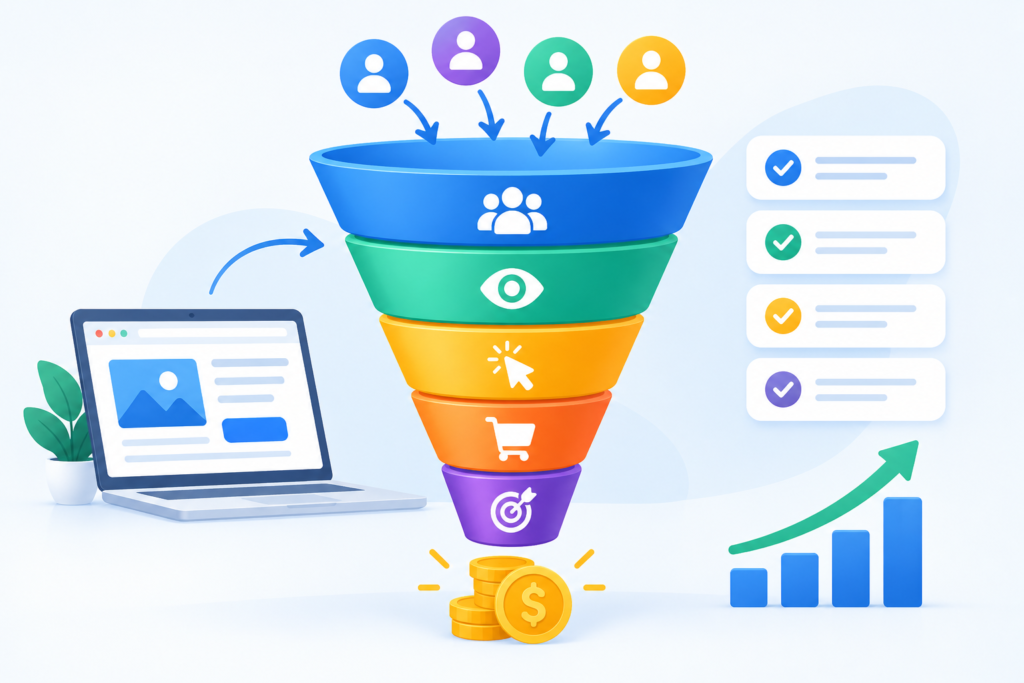
A practical sales funnel can be organized into five connected stages: awareness, interest, consideration, conversion, and retention. Awareness introduces potential customers to the business through channels such as organic search, paid advertising, social media, referrals, partnerships, and educational content. Interest develops when visitors engage more deeply, explore relevant resources, subscribe to a newsletter, or request additional information. At these early stages, the business should prioritize relevance and clarity. Broad traffic numbers alone do not reveal whether a funnel is attracting people who have a genuine need for the product or service.
The consideration stage helps qualified prospects evaluate whether the offer is appropriate for them. Depending on the business model, this may involve email sequences, product comparisons, webinars, consultations, free trials, sample resources, or demonstrations. The conversion stage then makes it possible for a prospect to take the desired action, such as purchasing a product, booking a consultation, signing a service agreement, or enrolling in a program. Conversion performance depends on the entire experience, including offer relevance, price, perceived risk, payment options, page usability, and the clarity of the next step. A persuasive headline cannot compensate for a confusing checkout process or an offer that does not meet the customer’s needs.
Retention begins after the first conversion and should be considered part of the broader revenue system. Customers may need onboarding instructions, product education, technical assistance, progress updates, or recommendations for complementary services. A positive post-purchase experience can encourage repeat orders, renewals, referrals, and stronger customer relationships. However, retention should never depend on making cancellation difficult or pressuring customers into unnecessary purchases. The aim is to deliver continued value and make future transactions worthwhile. Businesses should define the purpose of every stage, identify the customer action that signals progress, and measure the relevant outcomes. For example, a software company may measure trial activation before tracking paid subscriptions, while a consultancy may measure qualified enquiries, booked meetings, proposal acceptance, and client retention. Tailoring the funnel stages to the actual buying process creates more useful insights than applying a generic template without considering the business model.
Identifying Your Ideal Customer and Target Audience
A high-performing sales funnel begins with a clear understanding of the people it is designed to serve. The ideal customer profile describes the characteristics of customers who are most likely to benefit from an offer and create a sustainable business relationship. For business-to-business companies, this profile may include company size, industry, operational challenges, budget, decision-making authority, and existing technology. For business-to-consumer companies, useful factors may include customer needs, interests, purchasing motivations, budget constraints, experience level, and preferred buying methods. These characteristics should be based on evidence wherever possible rather than assumptions about what a typical customer might want.
Customer research can combine sales conversations, customer support questions, website analytics, existing customer feedback, reviews, surveys, and search query analysis. Sales teams can explain which objections arise most often and what information prospects request before purchasing. Support teams can identify recurring frustrations, while customer interviews can reveal why people selected a product, what alternatives they considered, and what nearly prevented them from buying. Businesses should look for repeated patterns across multiple sources rather than treating a single comment as proof of a universal preference. If a company has little customer data, it can begin with structured interviews and small marketing tests, then refine its understanding as results accumulate.
The research should lead to actionable audience segments and messaging decisions. A company selling project management software, for example, may serve small teams that need simplicity as well as larger organizations that require permissions, reporting, and integrations. These groups may need different landing pages, demonstrations, and follow-up sequences because their priorities differ. A consultant serving both first-time entrepreneurs and established businesses may need separate resources that reflect differences in budget, urgency, and complexity. The objective is not to create dozens of narrowly defined audiences without a practical reason. It is to identify meaningful differences that affect buying decisions. Customer information should also be collected and used responsibly, with appropriate privacy notices, permission practices, and data security measures. When the ideal customer profile is grounded in real evidence, a sales funnel becomes more relevant, advertising becomes easier to target, and sales conversations can focus on problems the business is genuinely equipped to solve.
Creating a Compelling Offer and a Clear Value Proposition
A sales funnel cannot consistently outperform the quality and relevance of the offer it presents. An offer explains what the customer receives, which problem it addresses, how the solution works, and why it may be worth the required investment. A value proposition communicates the central benefit in language that the intended audience can understand. It should explain the practical outcome rather than rely on vague claims such as “the best service,” “revolutionary results,” or “unmatched quality.” A clear proposition helps visitors quickly determine whether the offer is relevant to their circumstances.
To develop a strong offer, begin by connecting customer research with a specific problem and a realistic outcome. A website design company might offer a structured website improvement service for businesses whose existing sites make it difficult for customers to understand their services or submit enquiries. The offer could explain the assessment process, the deliverables, the expected project timeline, and the information the client must provide. A digital product business might provide a starter package that includes training materials, templates, and implementation guidance. In both cases, clarity reduces uncertainty because customers can evaluate what they are purchasing. Supporting details such as demonstrations, sample deliverables, documented processes, and relevant case studies can make the offer easier to assess.
Pricing, guarantees, bonuses, and payment arrangements should reinforce the offer rather than distract from weaknesses in its core value. A discount may help a price-sensitive customer, but repeated discounts can condition customers to wait for promotions or reduce profitability. A guarantee can reduce perceived risk when its terms are clear, appropriate, and commercially sustainable, but it should never promise outcomes the business cannot reasonably control. Bonuses are useful when they solve a related problem, not when they merely increase the apparent size of a package. Before launching the funnel, verify that every major claim is accurate and that the business can deliver what it promises. For advertising and promotional communications, review the FTC advertising and marketing guidance as a useful reference for truthful claims and responsible marketing, while ensuring that the rules applicable to the business’s own jurisdiction are followed. A compelling offer earns attention by making value understandable, credible, and relevant.
Building a Lead Generation Strategy That Attracts Qualified Prospects
Lead generation is the process of attracting potential customers and encouraging them to share their details or take another meaningful step toward a business relationship. In a sales funnel, effective lead generation is not simply about collecting the largest possible number of email addresses. It is about attracting people who are likely to need the offer and providing a worthwhile reason for them to engage. Depending on the business, this can involve search engine optimization, paid search, social media campaigns, partnerships, referral programs, webinars, downloadable resources, or educational video content. The best channel depends on where the target audience looks for information and how much explanation is required before the offer makes sense.
A useful lead magnet provides a specific benefit in exchange for a prospect’s details. Examples include a checklist, practical workbook, industry report, calculator, assessment, template, introductory lesson, or detailed implementation guide. Its value should relate directly to the product or service being sold. A company offering sales funnel consulting, for example, could provide a funnel planning worksheet that helps business owners identify their audience, offer, traffic sources, and conversion steps. This attracts prospects who are already thinking about improving their sales process and gives the business a natural way to continue the conversation. The lead capture form should request only the information needed at that stage. Asking for excessive personal or business details can discourage submissions, especially when the visitor has not yet established trust.
Lead generation channels should be evaluated by lead quality and eventual business outcomes rather than by volume alone. A paid campaign may generate inexpensive form submissions but attract people who have no realistic intention or ability to purchase. A smaller campaign aimed at a more specific audience may generate fewer leads but produce more qualified enquiries and revenue. Businesses should therefore monitor the relationship between traffic source, lead qualification, sales activity, and completed purchases. They should also explain how submitted information will be used and obtain the permissions required for subsequent marketing communications. When using organic search to attract prospects, follow Google’s SEO Starter Guide to support useful, discoverable website content. The objective is to build a dependable pipeline of relevant prospects whose needs match the offer, not to maximize form submissions at any cost.
Designing High-Converting Landing Pages for Your Sales Funnel
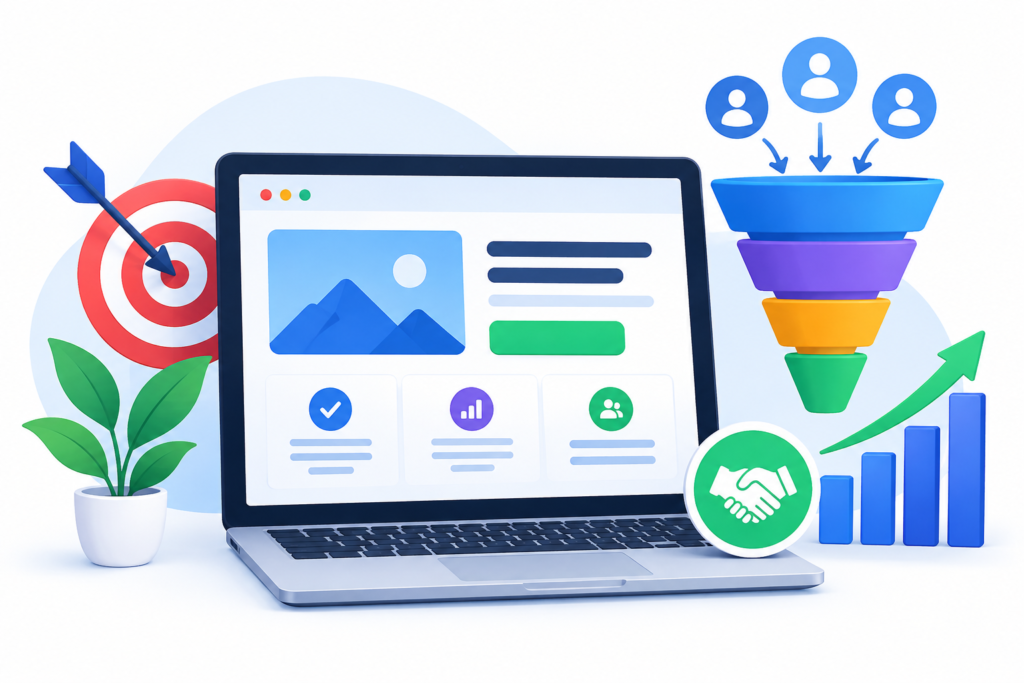
A landing page is a focused webpage designed to encourage a specific action, such as downloading a resource, registering for a webinar, requesting a consultation, starting a trial, or purchasing a product. Within a sales funnel, the landing page connects the promise made in an advertisement, search result, email, or social media post with the next step in the customer journey. A well-designed page maintains message consistency: if an advertisement promises a practical guide to improving lead conversion, the landing page should clearly present that guide rather than divert visitors into an unrelated offer. This continuity helps people understand that they have reached the right destination.
The most important elements usually include a clear headline, a concise explanation of the benefit, relevant supporting information, credible evidence where available, and a prominent call to action. The headline should communicate the page’s purpose without exaggerated promises. Supporting copy should explain what the visitor will receive, who the offer is intended for, and what happens after they submit a form or click a button. Testimonials, examples, case studies, and qualifications can strengthen credibility when they are genuine, relevant, and presented accurately. Forms should be easy to complete, with labels that explain what information is required. If a business needs several qualification details, it may be appropriate to collect essential information first and gather additional details later through a consultation or onboarding process.
Page usability is equally important. Slow loading, confusing navigation, intrusive pop-ups, unreadable text, broken buttons, and unexpected fees can undermine an otherwise compelling offer. Landing pages should work well on mobile devices, provide accessible labels and readable contrast, and communicate clearly what happens after the visitor takes action. Technical performance can be reviewed using Core Web Vitals, which cover important aspects of loading performance, responsiveness, and visual stability. Businesses should test the full user journey, including form validation, confirmation messages, payment steps, and follow-up delivery, rather than checking only whether the page looks correct. Once the page is live, measure meaningful outcomes such as completed registrations, qualified leads, purchases, and abandonment. A landing page becomes more effective through evidence-based refinement: identify a specific problem, make a focused change, and compare results over an appropriate period. The goal is to create an experience that makes the next step clear and trustworthy, not to rely on decorative design or aggressive persuasion alone.
Using Email Marketing to Nurture Leads and Build Trust
Email marketing is one of the most useful ways to maintain communication with prospects after they enter a sales funnel. Many people who download a resource, subscribe to a newsletter, or request information are not ready to purchase immediately. They may still be researching the problem, comparing solutions, discussing the investment with colleagues, or waiting for the right time to act. A well-planned email sequence gives a business an opportunity to provide useful information, answer questions, demonstrate expertise, and help prospects understand whether its offer is suitable. Rather than treating every subscriber as an immediate sales opportunity, effective lead nurturing builds a relationship over time.
A practical email nurturing sequence should have a clear purpose at every stage. The first email can deliver the promised resource and explain how to use it. A subsequent message might address a common challenge, provide an educational example, or explain a process that helps the reader make progress. Another email could share a relevant case study, describe the service methodology, or answer a frequent objection. When the prospect has received enough information to evaluate the offer, a direct invitation to book a consultation, attend a demonstration, or review a product can be appropriate. The sequence should reflect the audience’s needs and the original reason for subscribing. For example, someone who downloads a sales funnel planning template should receive information about funnel strategy and implementation rather than unrelated promotional messages.
Personalization can improve relevance when it is based on information that customers have willingly provided or on appropriate, transparent behavioral signals. A business may create separate sequences for people interested in different services, customers evaluating different product categories, or prospects at different stages of the buying journey. However, segmentation should remain manageable, and automated messages should be reviewed for accuracy before launch. Email frequency should also respect audience expectations, marketing permissions, and applicable privacy and electronic communications laws. Businesses should provide a straightforward unsubscribe mechanism and avoid misleading subject lines or fabricated urgency. Performance measurement should extend beyond open rates, which can be affected by privacy protections and email-client behavior. Clicks, replies, qualified enquiries, purchases, unsubscribe rates, and revenue per subscriber offer additional insight into whether a campaign is helping the business and its audience. The most effective email funnel combines consistency with genuine usefulness: every message should give the reader a reason to continue the conversation.
Implementing Sales Funnel Automation Without Losing the Human Touch
Sales funnel automation uses software to complete repetitive marketing and sales tasks according to defined rules, events, or customer actions. Depending on the business, automation may deliver lead magnets, send welcome emails, assign leads to sales representatives, update customer relationship management records, schedule reminders, trigger onboarding instructions, or notify a team when a prospect requests a consultation. These processes can reduce administrative work, improve response consistency, and make it easier to manage a growing number of leads. However, automation is only valuable when it supports a sensible customer journey. Automating a confusing process simply allows the confusion to happen faster and at a larger scale.
A basic automation workflow starts with a clearly defined trigger, such as a completed registration form or a requested product demonstration. The system then performs an appropriate action, such as sending a confirmation email, recording the source of the lead, and assigning a follow-up task. Conditions can determine what happens next. A prospect who books a meeting might leave the general promotional sequence and enter a preparation sequence, while someone who has not completed a form could receive a reminder if that communication is appropriate and permitted. A customer who completes a purchase should usually move into an onboarding or customer support journey instead of continuing to receive messages encouraging them to buy the same product. These rules reduce irrelevant communication and help keep records consistent across marketing and sales activities.
Reliable automation requires careful planning, testing, monitoring, and maintenance. Before building a complex workflow, document the trigger, intended outcome, conditions, timing, responsible team member, and exception handling. Test the workflow using sample contacts and realistic scenarios, including missing data, duplicate submissions, failed payments, unsubscribes, and changes to customer status. Ensure that messages contain correct links and that customers are not repeatedly contacted because of a technical error. Access to customer information should be restricted to authorized people, and data should be collected and retained only as needed for legitimate business purposes. Avoid sending automated messages that pretend to be personal communications from an individual when they are not. Automation should make service more dependable, not create a false impression of personal attention. By combining useful automated steps with human support for complex questions, objections, and high-value decisions, a business can build a scalable sales funnel without making the customer experience feel impersonal.
Creating Effective Calls to Action and Improving Conversion Rates
A call to action, commonly called a CTA, tells the visitor what to do next. It might invite someone to download a guide, register for a webinar, request a quote, book a consultation, start a trial, or complete a purchase. In a sales funnel, each CTA should match the visitor’s level of readiness and the value offered at that point. Someone exploring a problem may respond better to an educational resource than to an immediate invitation to buy an expensive service. A prospect who has already reviewed pricing and compared solutions may be ready for a direct purchase or consultation. Matching the CTA to customer intent helps reduce unnecessary friction and makes the next step easier to understand.
Strong CTAs use clear, accurate language and explain the action rather than relying on vague instructions. For example, “Download the Funnel Planning Checklist” describes a specific outcome, while “Click Here” gives little information about what will happen. A CTA should also be visually identifiable, accessible, and placed where it makes sense within the page. Supporting copy can answer practical questions about what the user will receive, whether registration is required, how long an appointment takes, or what happens after submitting a request. A business should not hide important conditions behind a button or imply that an action is free when it requires payment. Trust depends on consistency between the promise made before the click and the experience that follows it.
Conversion rate optimization involves systematically improving the proportion of eligible visitors who complete a desired action. Begin by identifying the relevant conversion event and calculating a reliable baseline. For example, if 100 of 2,000 eligible landing-page sessions result in a completed registration, the observed registration conversion rate is 5%. This figure becomes a starting point for evaluating future changes, provided the measurement method remains consistent. Potential improvements might include simplifying a form, making the offer clearer, addressing a common objection, improving mobile usability, or reducing unnecessary checkout steps. Test one major change at a time when practical, and allow enough data to accumulate before drawing conclusions. Traffic sources, device types, seasonality, and audience differences can all affect results. A higher conversion rate is not automatically better if it comes from misleading messaging or attracts customers who are unlikely to benefit from the offer. The goal is to increase meaningful conversions while preserving customer trust, product suitability, and long-term business value.
Choosing the Right Sales Funnel Tools and Technology
The technology behind a sales funnel should support the business’s actual requirements rather than introduce complexity for its own sake. A small business may need only a website, a landing page builder, an email marketing platform, a payment processor, and a simple customer relationship management system. A larger company with several sales teams, multiple product lines, and complex qualification rules may require more advanced integrations, reporting, lead routing, and automation. The right setup depends on the number of leads, the complexity of the buying process, the team’s technical skills, privacy obligations, budget, and the consequences of system failure.
Most sales funnel technology falls into several practical categories. Website and landing page tools create the pages where prospects learn about an offer and take action. Email marketing and automation platforms deliver relevant communications and manage subscriber segments. Customer relationship management software, or CRM, organizes contact records, lead stages, sales activities, and follow-up tasks. Analytics tools measure visitor behavior and conversion events. Payment systems process transactions, while webinar or scheduling tools support demonstrations, consultations, and educational sessions. Businesses may also use customer support platforms, membership systems, or e-commerce integrations to manage the experience after a conversion. Before selecting a tool, confirm that it supports the required features, integrates with the existing stack, and can export or transfer essential business data.
Tool selection should include a review of total cost, ease of maintenance, reliability, support availability, security controls, and data ownership. A low monthly price may not reflect the full cost if essential features require additional subscriptions or manual work. Conversely, purchasing a comprehensive platform before the business has validated its funnel can lead to unnecessary expense. Start with the smallest reliable setup that supports the customer journey, then expand when a measurable requirement justifies the change. Document important workflows, establish user access permissions, configure backups or data export procedures where appropriate, and test integrations whenever settings change. Sensitive information should be handled according to the relevant legal requirements and sound security practices. For websites collecting customer data or processing transactions, consult the applicable OWASP Web Security Testing Guide and seek qualified technical support where needed. The purpose of funnel technology is to help people move smoothly through a trustworthy buying experience while giving the business dependable operational visibility.
Measuring Sales Funnel Performance With Meaningful Analytics
Analytics helps businesses understand how effectively a sales funnel attracts prospects, generates qualified opportunities, converts customers, and produces revenue. Without consistent measurement, it is easy to mistake high traffic for commercial success or to increase advertising spending without understanding the results. A useful measurement framework connects each funnel stage to a defined event. Awareness metrics may include qualified visits and relevant traffic sources. Lead generation metrics may include completed forms, registrations, and cost per lead. Consideration metrics may include qualified opportunities, booked meetings, attendance rates, and proposal requests. Conversion metrics may include purchases, revenue, and customer acquisition cost. Retention metrics may include repeat purchases, renewals, referrals, and customer lifetime value estimates.
The formulas used to calculate funnel metrics should be defined before reports are compared. Conversion rate is generally calculated by dividing the number of completed target actions by the number of eligible opportunities or visitors, then multiplying by 100. Cost per lead is calculated by dividing the relevant lead-generation expenditure by the number of leads generated, while customer acquisition cost estimates the cost of acquiring new customers within a defined period. Businesses should be careful to use consistent cost categories and attribution rules. For example, advertising-only acquisition cost is different from a fully loaded calculation that includes sales salaries, agency fees, software, and other relevant expenses. Revenue is also not the same as profit. A campaign can generate substantial sales but remain unprofitable after product costs, fulfillment, refunds, payment fees, and advertising expenditure are included.
Measurement quality matters as much as the choice of metrics. Duplicate conversion events, missing tracking tags, inconsistent naming conventions, consent-related measurement limitations, and unreliable attribution can distort reports. Establish clear definitions for leads, qualified leads, opportunities, new customers, and repeat customers. Use campaign parameters consistently to identify traffic sources, and verify that important events are recorded accurately. Google Analytics documentation can help teams understand event-based measurement and configure reporting appropriately. Where privacy rules require consent or limit data collection, analytics implementations should respect those requirements rather than attempt to bypass them. Reports should also distinguish observed data from estimates and acknowledge uncertainty when attribution is incomplete. Reviewing a small number of meaningful metrics regularly is often more useful than monitoring dozens of disconnected indicators. When measurement is reliable, businesses can identify bottlenecks, allocate resources more intelligently, and make funnel improvements based on evidence rather than assumptions.
Common Sales Funnel Mistakes That Reduce Conversions
One of the most common sales funnel mistakes is attracting the wrong audience. Businesses sometimes focus heavily on increasing website traffic, social media engagement, or email subscribers without checking whether those people are likely to need the offer. This can create impressive-looking marketing reports while generating few qualified leads or sales. The solution is to connect audience targeting with a clear customer profile, relevant messaging, and an offer that addresses a real need. Review performance by traffic source and lead segment to identify which activities produce meaningful commercial outcomes. If a channel generates a large volume of low-quality leads, investigate the targeting, campaign promise, and landing-page content before increasing its budget. The objective is to attract appropriate prospects, not simply more visitors.
Another frequent mistake is making the buying process unnecessarily difficult. Complicated forms, unclear pricing, slow pages, confusing navigation, unexpected fees, and excessive checkout steps can prevent interested customers from completing an action. Businesses may also introduce too many calls to action on a single page, leaving visitors unsure which step matters most. Review the funnel from the customer’s perspective, ideally by testing it on mobile and desktop devices and asking people unfamiliar with the process to complete important tasks. Check that every button works, forms display useful error messages, confirmation pages explain what happens next, and promised resources arrive correctly. Remove unnecessary friction while retaining the information genuinely needed to qualify leads, process transactions, or deliver the service.
A third mistake is neglecting follow-up and treating the first purchase as the end of the customer relationship. Leads may lose interest when businesses take too long to respond, send irrelevant messages, or fail to address important questions. Meanwhile, customers may become dissatisfied when onboarding is unclear or support is difficult to access. Automation can help prevent missed follow-ups, but poorly configured workflows may send duplicate messages, continue promotional emails after a purchase, or contact people who have unsubscribed. Other common problems include making unsupported performance claims, relying on artificial scarcity, copying competitors without understanding the audience, and changing several funnel elements simultaneously without measuring the effect. Businesses should prioritize transparent communication, reliable delivery, appropriate follow-up, and evidence-based testing. A funnel is not successful simply because it produces a sale; it should also create a reasonable customer experience and support a sustainable commercial relationship.
Sales Funnel Best Practices Summary
The foundation of an effective sales funnel is a clear connection between the target audience, the offer, and the customer journey. Begin by researching the needs, motivations, concerns, and buying behavior of the people you want to serve. Define the primary conversion goal and identify the smaller actions that help prospects move toward it. Each stage should have a specific purpose, whether that means introducing a problem, explaining possible solutions, qualifying a lead, presenting an offer, or supporting a new customer. Avoid building unnecessary stages simply because a template recommends them. A straightforward funnel that matches the actual buying process is often easier to manage and improve than an elaborate system with multiple redundant pages and messages.
The second principle is to make every interaction useful, credible, and easy to understand. Landing pages should communicate the offer clearly, explain important conditions, and provide a visible next step. Educational content should answer genuine customer questions instead of repeating keywords without adding insight. Email campaigns should deliver promised resources, offer relevant guidance, and respect communication preferences. Sales conversations should focus on understanding the prospect’s requirements rather than forcing an unsuitable solution. Any testimonials, case studies, qualifications, or performance figures should be accurate and presented in context. Websites should also be accessible, mobile-friendly, technically reliable, and appropriately protected. These practices strengthen trust while helping prospects determine whether the business is a suitable choice.
The third principle is to measure performance, learn from evidence, and improve the funnel gradually. Establish baseline figures for qualified traffic, lead conversion, customer acquisition cost, revenue, and retention where those metrics apply. Check that analytics events are configured correctly and that marketing expenditure is compared with commercially meaningful results. Test important changes such as headlines, offers, forms, and calls to action, while keeping other conditions as consistent as practical. Avoid assuming that a short-term increase proves a lasting improvement. Review customer feedback, sales objections, support requests, and refund reasons alongside quantitative data to understand the full experience. Keep the technology stack manageable, document automation rules, and assign responsibility for regular maintenance. Finally, treat retention and customer satisfaction as core components of funnel performance. A well-designed sales funnel should help the right customers make informed decisions, support the business in delivering its promises, and create a repeatable process for sustainable growth.
Frequently Asked Questions
What is a sales funnel in simple terms?
A sales funnel is a process that guides potential customers from discovering a business to considering its offer and eventually making a purchase. It can also include the activities that encourage repeat purchases and long-term customer relationships. For example, a visitor might discover a business through a search engine, read an educational article, download a guide, receive helpful emails, and then book a consultation. Each step gives the prospect more information and helps the business understand their needs. A sales funnel makes this journey easier to plan and measure. Its purpose is not to pressure everyone into buying but to help appropriate prospects progress toward a suitable decision.
How do I build a sales funnel from scratch?
Start by defining the product or service you want to sell and identifying the audience most likely to benefit from it. Research their main challenges, buying motivations, concerns, and common questions. Next, develop a clear offer and choose a traffic source, such as search content, paid advertising, social media, or referrals. Create a landing page that explains the offer and encourages one primary action. Depending on the buying process, use a lead magnet, email sequence, demonstration, consultation, or direct checkout to help prospects evaluate the offer. Configure appropriate tracking, test every step, and establish a process for follow-up. After launch, measure lead quality, conversion rates, acquisition costs, and customer feedback. Improve the weakest part of the funnel before adding unnecessary complexity.
How many stages should a sales funnel have?
There is no single number of stages that suits every business. A simple online store might use awareness, product evaluation, checkout, and post-purchase communication. A business selling high-value consulting services may need additional steps for qualification, discovery meetings, proposals, negotiations, and onboarding. The right structure depends on the price, complexity, buying risks, and decision-making process associated with the offer. Use enough stages to support meaningful customer decisions, but avoid adding steps that do not improve qualification, understanding, or delivery. Every stage should have a defined purpose and a measurable action that indicates progress.
What is the difference between a sales funnel and a marketing funnel?
A marketing funnel generally emphasizes attracting an audience, generating awareness, developing interest, and creating qualified opportunities. A sales funnel often focuses more directly on evaluating those opportunities, handling objections, presenting offers, closing deals, and supporting the customer relationship. In practice, the two processes overlap. Marketing content can help close sales, and sales conversations can reveal insights that improve future marketing campaigns. Many organizations use the terms interchangeably or combine them into a single customer journey framework. The important point is to coordinate marketing and sales responsibilities, establish consistent definitions for leads and customers, and ensure that prospects receive a coherent experience from their first interaction through purchase and beyond.
How can I generate more leads for my sales funnel?
Begin by identifying where your target audience searches for information and which problems they are trying to solve. Publish useful educational content, improve relevant service pages, run carefully targeted advertising campaigns, develop partnerships, or create resources such as checklists and templates. Use a focused landing page that explains the value of the resource and asks only for the information needed at that stage. Test different channels and compare not only lead volume but also qualification rates, sales outcomes, and acquisition costs. Follow up promptly with relevant information and respect marketing permissions. More leads are valuable only when they have a reasonable chance of becoming suitable customers.
What is a good sales funnel conversion rate?
A good conversion rate depends on the funnel stage, traffic source, industry, offer price, audience intent, and measurement method. A free resource registration, a low-cost online purchase, and a high-value business consultation involve different levels of commitment, so their conversion rates should not be compared directly. Rather than chasing a universal benchmark, establish a reliable baseline for your own funnel and track how it changes over time. Segment results by traffic source, device, and audience where the data is sufficient. Also evaluate lead quality, profitability, refunds, and retention. A higher conversion rate is useful when it reflects more successful customer decisions and sustainable business results, not when it comes from misleading promises or unsuitable sales.
Which tools do I need to create a sales funnel?
The essential tools depend on how the business sells. A basic setup may include a website or landing page builder, an email marketing platform, analytics, and a payment processor if online payments are required. A service business may also benefit from a CRM and appointment scheduling software, while an online course provider may need a course delivery platform. Businesses with more complex processes may use automation tools to coordinate lead assignment, email follow-up, customer records, and onboarding. Start with tools that solve real operational problems, verify that they integrate reliably, and understand their costs and data handling practices. There is no need to purchase an expensive all-in-one platform before validating the funnel’s offer and customer journey.
How long does it take to build and optimize a sales funnel?
A simple funnel can sometimes be assembled within days, while a more complex funnel involving research, multiple landing pages, integrations, sales workflows, and compliance reviews may take considerably longer. The initial build is only one part of the process. After launch, the business needs enough relevant traffic and customer interactions to evaluate performance. The time required depends on traffic volume, sales-cycle length, conversion frequency, and the quality of tracking. Start with a practical version that can be tested, correct technical problems, and collect reliable data before making major changes. Continue reviewing performance as customer behavior and business objectives evolve. A sales funnel should be maintained as an ongoing business system rather than treated as a one-time project.
Want to Implement This Easily?
Prompt Text:
You are an expert consultant. Based on the blog post titled “Sales Funnel”, provide a step-by-step, practical implementation guide. Include tools, best practices, common mistakes to avoid, and advanced tips. Assume the reader wants to implement everything discussed in this article effectively.
Call to Action:
Want our help implementing this? Just reach out to us via our website contact form: Get Full Sales Funnel Templates and Implementation Resources