
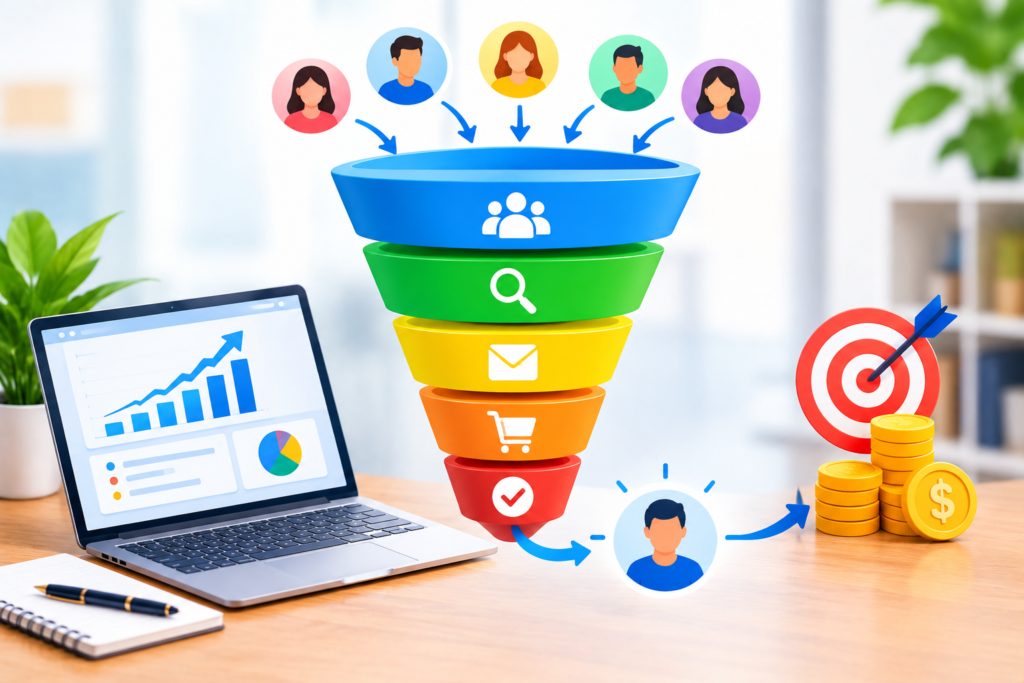
Learn how sales funnels work, how to build each stage, create compelling offers, improve conversions, nurture leads, measure performance, and develop a sustainable funnel strategy.
Introduction
A sales funnel is more than a sequence of landing pages, emails, forms, advertisements, and checkout screens. At its core, it is a structured customer journey designed to move an appropriate prospect from initial awareness toward a meaningful business action. That action might be downloading a resource, booking a consultation, requesting information, starting a trial, purchasing a product, or becoming a repeat customer. The strongest funnels are built around the customer’s needs rather than around a collection of marketing tools. When every stage answers the prospect’s next logical question, the journey becomes easier to understand, easier to measure, and easier to improve.
For businesses competing online, a well-planned funnel can provide a clearer connection between traffic generation and revenue. Instead of sending every visitor to the same generic page and hoping they convert, a funnel allows different audiences to encounter relevant messages based on their awareness, needs, objections, and intent. This approach also makes it easier to identify where potential customers are losing interest. A business may discover that advertising generates sufficient traffic but the landing page is weak, or that the offer attracts leads but the follow-up process fails to build confidence. Those distinctions matter because improving the correct stage is generally more productive than making random changes throughout the marketing system.
This guide explains the principles behind effective funnel development from strategy through optimization. It focuses on practical decision-making, customer psychology, useful content, persuasive communication, measurement, technical foundations, and long-term improvement. The goal is not simply to produce a funnel that looks professional. The goal is to create a customer journey that is understandable, credible, technically reliable, and aligned with a real business offer. For additional guidance on search-friendly content and technical requirements, Google’s Search Essentials provides the official framework for technical requirements, spam policies, and core search best practices. Search Essentials
For businesses looking to develop this approach with structured funnel resources, MyFunnelScript can be part of the wider implementation process. However, the principles in this guide are designed to remain useful regardless of the software, page builder, email platform, analytics system, or advertising channel being used.
What Is a Sales Funnel and How Does It Work?
A sales funnel represents the stages a potential customer typically moves through before and after making a purchasing decision. The traditional model is often described using stages such as awareness, interest, consideration, conversion, and retention. Real customer journeys are not always perfectly linear, however. Someone may discover a business through search, leave the website, watch a video several days later, compare competitors, read reviews, return through an email, and then purchase. A modern funnel therefore needs to accommodate multiple touchpoints rather than assuming that every visitor follows exactly the same path.
At the awareness stage, the prospect may not even recognize that they have a problem that needs solving. Educational content, social media posts, search visibility, videos, guides, and other discovery-oriented resources can introduce the problem and establish relevance. At the consideration stage, the visitor is usually evaluating possible solutions. This is where detailed explanations, comparisons, case studies, demonstrations, testimonials, FAQs, and transparent information can help reduce uncertainty. At the conversion stage, the prospect needs a clear reason and straightforward mechanism for taking action. Confusing forms, unexpected costs, unclear guarantees, weak calls to action, or slow pages can introduce unnecessary friction.
A funnel therefore works as a system rather than a single webpage. Each component should have a specific job. Advertising or organic discovery attracts appropriate visitors. The landing experience establishes relevance. The offer creates a reason to continue. The form or checkout mechanism captures the desired action. Follow-up communications support prospects who are not ready immediately. Measurement reveals what is happening at each stage. This systems-based perspective is important because a business can have excellent individual components while still having a poor overall funnel. Google similarly emphasizes creating helpful, reliable, people-first content rather than content produced primarily to manipulate search visibility.
Defining Your Ideal Customer Before Building the Funnel
One of the most important funnel decisions happens before any page is designed: determining exactly who the funnel is intended to help. A vague audience creates vague messaging. If a funnel attempts to speak simultaneously to beginners, experienced professionals, enterprise buyers, price-sensitive shoppers, and people with completely different problems, the resulting copy often becomes generic. Strong funnel strategy begins by identifying the audience’s situation, desired outcome, frustrations, constraints, and decision-making criteria.
A useful customer profile should go beyond demographic information. Consider what the person is trying to accomplish, what prevents them from achieving it, what they have already tried, what they fear losing, what evidence they need before trusting a provider, and what would make the next step feel reasonable. For example, someone searching for a sales funnel solution may not actually want a “funnel.” They may want more qualified leads, a simpler customer journey, better follow-up, fewer manual sales tasks, or a more predictable way to convert existing traffic. Understanding the underlying desired outcome allows the funnel to communicate benefits rather than simply describing features.
Audience research should also influence segmentation. Different prospects can require different entry points and different levels of explanation. A visitor arriving from an educational article may need introductory information, while someone returning to a pricing page may have much stronger purchase intent. Segmentation can be based on source, behavior, offer interest, customer status, industry, problem, or stage of awareness. The objective is not to create unnecessary complexity. It is to make the journey more relevant. A practical funnel often performs better when it has a small number of clearly defined audience pathways rather than dozens of poorly differentiated segments.
Creating an Offer That Gives Prospects a Reason to Act
A funnel cannot compensate for an unclear or poorly aligned offer. The offer is the value exchange at the center of the customer journey. It should make the prospect understand what they receive, why it matters, who it is designed for, what action they need to take, and what happens after that action. Depending on the business model, the offer could be a product, service, consultation, audit, trial, template, training program, downloadable resource, membership, or another form of commercial value.
Effective offers are usually specific enough to be understood quickly. “Improve your marketing” is broad, while “Build a structured lead-generation system for your consulting business” communicates a more concrete outcome. Specificity helps prospects determine relevance. It also makes the surrounding messaging easier to write because advertisements, landing pages, emails, and calls to action can all reinforce the same central proposition. The offer should also be realistic. Promising extraordinary results without explaining the conditions required to achieve them can create distrust and potentially damage long-term customer relationships.
Value is not simply about adding more bonuses or increasing the number of features. An offer becomes stronger when its perceived usefulness, relevance, credibility, and clarity improve. A practical way to evaluate an offer is to ask whether a qualified prospect can explain the value in their own words after reading the page. If they cannot tell what they are buying, who it is for, why it is different, or what happens next, the funnel has a communication problem before it has a design problem. The offer should therefore be developed alongside the audience research rather than added after the pages have already been created.
Designing the Core Architecture of a Sales Funnel
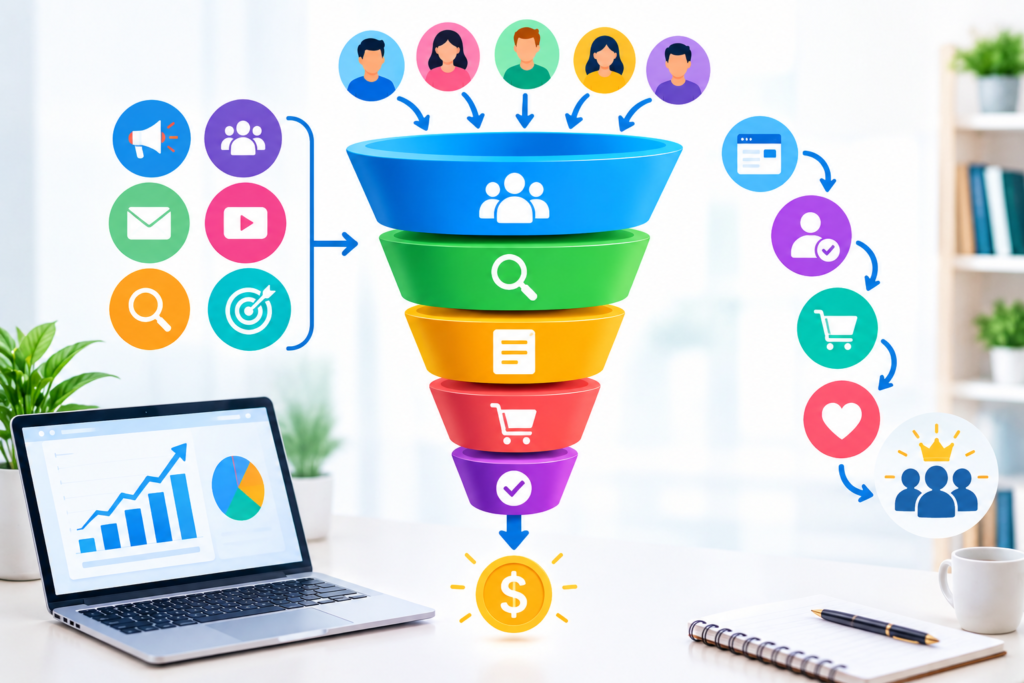
A funnel’s architecture determines how visitors move from one stage to another. A simple lead-generation funnel might consist of an acquisition source, landing page, lead form, thank-you page, email sequence, and sales conversation. A product funnel might include an advertisement, product page, checkout, order confirmation, onboarding sequence, and post-purchase offer. More complex customer journeys can include webinars, demonstrations, qualification forms, multiple email sequences, retargeting campaigns, and account-based sales processes.
The key is to assign a purpose to every step. A landing page should not try to perform the job of an entire sales department. A thank-you page should not merely say “thank you” if the next logical action can be provided there. An email sequence should not repeat the same sales message five times without addressing different questions or objections. Each stage should move the prospect forward by reducing uncertainty, increasing relevance, delivering value, or making the next action easier. This creates a coherent progression rather than a collection of disconnected marketing assets.
The architecture should also account for alternative paths. Some prospects will convert immediately. Others will need additional education. Some will abandon a form but return later. Existing customers may require a completely different experience from new leads. Mapping these pathways before implementation can prevent technical and strategic problems later. Google’s guidance also emphasizes crawlable links and clear site structures when building search-friendly experiences. Link best practices Although search optimization and conversion architecture serve different purposes, both benefit from logical organization and clear relationships between resources.
Building Landing Pages That Turn Attention Into Action
A landing page is often the point where a visitor decides whether to continue or leave. Its job is not simply to look attractive. It must quickly communicate relevance, establish credibility, explain value, address important objections, and provide a clear next step. Strong landing pages usually have a clear relationship between the traffic source and the page message. If an advertisement promises a specific solution but the landing page immediately changes the topic, visitors may feel that they have arrived in the wrong place.
The headline should communicate the primary value or problem being addressed. Supporting copy can then explain the mechanism, benefits, differentiators, and practical details. Visual elements should reinforce the message rather than compete with it. Calls to action should be understandable and positioned where the reader has enough information to make a decision. Forms should request only information that is genuinely useful at that stage. Asking for excessive details before establishing enough value can introduce friction, particularly when the prospect is still early in the decision process.
Technical quality also matters. A landing page should work reliably across relevant devices, load efficiently, use secure connections, and provide a usable experience. Google’s developer guidance recommends that websites be secure, fast, accessible, and functional across devices. Performance can also be evaluated through Core Web Vitals, which include metrics such as Largest Contentful Paint, Cumulative Layout Shift, and Interaction to Next Paint. Core Web Vitals These technical considerations do not replace persuasive messaging, but they can prevent technical friction from undermining an otherwise strong funnel.
Using Lead Magnets and Value-First Entry Points
A lead magnet is a resource offered in exchange for contact information or another low-friction action. Common examples include checklists, templates, guides, calculators, educational reports, mini-courses, worksheets, audits, and short training resources. The best lead magnets are closely connected to the paid offer or next commercial step. If the free resource attracts people who have no relationship to the eventual offer, a funnel can generate a large number of leads without generating meaningful business opportunities.
The strongest lead magnets usually solve a specific problem rather than attempting to teach an entire subject. A practical checklist can be more useful than a 100-page ebook if the audience needs a quick implementation resource. A diagnostic assessment can work well when prospects need to understand what is preventing them from achieving a desired result. A template can provide immediate practical value while naturally demonstrating the type of expertise the business offers. The resource should be genuinely useful on its own rather than being deliberately incomplete simply to force a sales conversation.
The transition from lead magnet to commercial offer should feel logical. If someone downloads a resource about improving their landing-page conversion process, the next communication might explain how to audit their funnel, identify common bottlenecks, or implement a broader conversion system. The lead magnet should therefore establish context for the next stage. This creates a value ladder in which each interaction helps the prospect make a more informed decision. It also supports a people-first approach because the funnel is delivering useful information rather than relying entirely on pressure-based persuasion.
Writing Funnel Copy That Builds Clarity and Trust
Funnel copywriting should help the prospect understand the problem, recognize the relevance of the solution, evaluate the offer, and decide what to do next. Strong copy is not necessarily complicated. In many cases, the clearest language is the most persuasive because it reduces the mental effort required to understand the proposition. Instead of filling a page with exaggerated claims, focus on concrete outcomes, useful explanations, relevant evidence, and honest expectations.
A practical copy structure can begin with the prospect’s situation, explain the consequences of leaving the problem unresolved, introduce a relevant solution, describe how that solution works, provide supporting evidence, address objections, and finish with a clear action. The exact sequence can vary according to the audience and offer. What matters is that the copy follows the prospect’s decision-making process. Someone considering a high-value service may need more evidence and risk reduction than someone purchasing a low-cost digital product.
Trust should be built through specificity and transparency. Explain what the customer receives, what is included, what is not included, how implementation works, what support is available, and what assumptions apply. Testimonials and case studies should represent genuine customer experiences rather than vague claims. If performance depends on factors outside the provider’s control, say so. This type of communication supports credibility because it treats the prospect as someone capable of making an informed decision. It also reduces the risk of creating a gap between marketing promises and the actual customer experience.
Establishing Trust Through Proof, Transparency, and E-E-A-T
Trust is one of the most important components of a high-quality funnel because prospects are often being asked to exchange money, personal information, time, or attention. A professional visual design may create an initial impression, but lasting trust generally requires stronger evidence. Depending on the business, that evidence can include customer stories, relevant experience, demonstrations, credentials, transparent policies, clear contact information, examples of work, product documentation, and explanations of how the service operates.
E-E-A-T—experience, expertise, authoritativeness, and trustworthiness—is particularly useful as a quality framework for content and online experiences. It should not be treated as a checklist of keywords or badges. Instead, businesses can demonstrate experience by showing practical knowledge, expertise by providing accurate and useful explanations, authority by establishing credible subject-matter expertise, and trustworthiness through transparency and responsible claims. These qualities should appear naturally throughout the customer journey rather than being placed into a single “trust” section at the bottom of a page.
Search quality should also be considered when creating funnel content that can appear in organic search. Google’s current Search guidance emphasizes helpful, reliable, people-first content, while its spam policies warn against creating large volumes of low-value content primarily for search manipulation. A funnel can support SEO without becoming an SEO-first experience. The strongest approach is to answer real questions, demonstrate genuine expertise, provide useful resources, maintain accurate information, and make the commercial relationship clear.
Connecting Traffic Sources With the Right Funnel Stage
Traffic is the input that gives a funnel opportunities to work, but not all traffic has the same intent. Search traffic, social media traffic, paid advertising, referral traffic, email traffic, direct visitors, and returning customers can arrive with different expectations. A visitor who discovers an educational article may be researching a problem, while someone clicking a highly specific product advertisement may already understand the category and be comparing available options. Treating both visitors exactly the same can create unnecessary friction.
Traffic-source alignment begins with understanding the promise made before the click. The message in an advertisement, search result, social post, or referral should connect naturally to the destination page. If the visitor expects a guide and lands on an aggressive sales page, the experience may feel mismatched. Conversely, someone with strong commercial intent may become frustrated if they must navigate through several educational pages before finding pricing or a purchase option. Matching the landing experience to intent is therefore one of the simplest ways to improve funnel consistency.
Measurement should also distinguish between traffic quantity and traffic quality. A campaign producing thousands of visitors but very few qualified leads may not be more valuable than a smaller campaign attracting people who closely match the ideal customer profile. Businesses should examine metrics at multiple levels, including source, campaign, landing page, lead quality, sales activity, and eventual customer value. This creates a more accurate picture of what the funnel is actually accomplishing rather than relying on surface-level traffic numbers.
Building Email Nurture Sequences That Move Prospects Forward
Email nurturing gives businesses an opportunity to continue a conversation after the initial conversion. A new subscriber may not be ready to purchase immediately, and that is normal. A thoughtful nurture sequence can provide education, demonstrate expertise, address objections, explain the offer, and make the next step easier. The objective is not to send as many emails as possible. It is to deliver the right information at the right stage of the prospect’s decision.
A useful sequence can begin by delivering the promised resource or next step, then establish context around the problem, provide practical guidance, demonstrate how the solution works, address common concerns, and introduce an appropriate commercial action. The sequence should remain relevant to the reason the person subscribed. Segmentation becomes particularly useful here because someone interested in one product or service should not automatically receive communications designed for a completely different need.
Good nurture emails should also respect the recipient’s attention. Subject lines should accurately represent the content. Messages should be easy to scan while still providing genuine value. Calls to action should be clear rather than excessive. When a subscriber becomes a customer, the communication strategy should change accordingly. Continuing to send acquisition-focused messages to an existing customer can create a poor experience and may undermine trust. Effective automation therefore depends not only on sending messages but on maintaining accurate customer states and meaningful transitions.
Improving Conversion Rates Through Testing and Customer Feedback
Conversion optimization is the process of identifying barriers and opportunities within the customer journey and improving them systematically. It is not simply about changing button colors or headlines at random. Meaningful optimization starts with evidence. Analytics can reveal where users leave, recordings or behavioral tools may reveal usability problems, customer interviews can uncover objections, and sales teams can identify questions that repeatedly prevent prospects from moving forward.
Testing should begin with meaningful hypotheses. For example, if users are abandoning a form because it asks for too much information, reducing the number of fields could be tested. If prospects repeatedly ask whether a service includes implementation support, adding clear information about that support may address an actual uncertainty. If visitors arrive expecting one outcome but encounter a different proposition, improving message alignment could be more useful than changing visual design. This evidence-led approach makes experimentation more valuable because each test is connected to a reason.
It is also important to avoid interpreting every short-term movement as proof of a lasting improvement. Conversion rates can fluctuate because of traffic mix, seasonality, campaign changes, sample size, device behavior, or other external factors. A responsible optimization process evaluates results in context and considers downstream outcomes. Increasing form submissions is not necessarily beneficial if lead quality decreases dramatically. A funnel should ultimately be optimized for meaningful business outcomes, not for isolated metrics that look impressive in a dashboard.
Tracking Funnel Performance With Meaningful Metrics
A funnel needs measurement infrastructure that connects activities with outcomes. At the top of the funnel, businesses may monitor impressions, reach, sessions, engagement, and traffic sources. At the middle, useful measures can include landing-page engagement, lead conversion rate, email engagement, qualification rate, and booked appointments. At the bottom, businesses can examine sales conversion, revenue, average order value, customer acquisition cost, and customer lifetime value where appropriate.
The most useful metrics depend on the business model. A service company may care about qualified enquiries, booked consultations, close rates, and revenue per client. An ecommerce company may focus on product conversion, average order value, repeat purchases, cart abandonment, and customer lifetime value. A subscription business may examine trial activation, paid conversion, retention, and recurring revenue. Choosing metrics based on the business model prevents teams from building dashboards filled with numbers that do not influence decisions.
Measurement should also be implemented consistently. Tracking parameters, conversion events, analytics configurations, CRM stages, and reporting definitions need to use understandable naming conventions. Google provides official documentation for tools such as Search Console and guidance on understanding how pages are crawled, indexed, and served. Google Search Central documentation When technical tracking and business definitions are aligned, funnel reporting becomes much more useful because marketing, sales, and management teams can work from a common understanding of what each metric means.
Common Sales Funnel Mistakes That Reduce Conversions
One common mistake is building the funnel around the company’s internal structure instead of the customer’s decision process. Businesses may organize pages around departments, product features, or internal terminology while prospects are trying to understand a problem, evaluate options, and determine whether a solution is appropriate. A funnel should therefore use customer-centered language and provide information in the order the audience needs it.
Another mistake is asking for too much commitment too early. A first-time visitor may not be ready to schedule a lengthy sales call, provide extensive personal information, or purchase an expensive offer without adequate context. Creating appropriate lower-friction steps can help prospects move forward gradually. This does not mean every business needs a complicated multi-step funnel. It means the requested action should be proportionate to the visitor’s level of trust and intent.
A third mistake is neglecting the post-conversion experience. Some businesses spend significant effort acquiring a lead or customer and then provide little communication after the conversion. This creates a broken journey precisely when expectations are highest. Clear confirmation, onboarding, delivery instructions, support information, and relevant follow-up can improve the overall experience and create opportunities for retention and referrals. Funnel optimization should therefore extend beyond the initial purchase or lead submission.
Best Practices Summary and Conclusion
A sustainable funnel begins with a clearly defined audience and a meaningful offer. From there, every stage should have a specific purpose: attracting relevant attention, explaining value, reducing uncertainty, capturing an appropriate action, nurturing interested prospects, and supporting customers after conversion. The strongest funnels are rarely the ones with the greatest number of pages or automations. They are the ones where every component contributes to a coherent customer journey.
Technical quality should support the strategy rather than distract from it. Pages should be secure, accessible, usable, responsive, and appropriately fast. Content should be accurate, useful, and created for people rather than primarily for search engines. Google recommends following its technical requirements and spam policies while emphasizing helpful, reliable, people-first content. Businesses should also be cautious of anyone promising guaranteed search rankings or claiming that a particular shortcut is officially approved by Google; Google’s own guidance recommends evaluating third-party SEO advice critically.
Ultimately, effective sales funnels are built through continuous learning. Customer questions, analytics, sales conversations, support requests, conversion data, and usability observations can all reveal opportunities for improvement. The objective should not be to create a funnel once and leave it untouched. Instead, treat the funnel as an evolving business system that becomes more relevant and efficient as you learn more about your audience. MyFunnelScript can support businesses looking to turn these principles into a structured implementation process, but the underlying strategy remains centered on clarity, customer value, trust, measurement, and continuous improvement.
Frequently Asked Questions
What Is the Main Purpose of a Sales Funnel?
The main purpose of a sales funnel is to create a structured path that helps potential customers move from initial awareness toward a relevant business action. That action may be a purchase, consultation, registration, application, trial, enquiry, or another conversion goal. The funnel gives each stage of the customer journey a specific purpose instead of expecting one webpage or one marketing message to do everything.
Do Small Businesses Need a Sales Funnel?
A small business can benefit from funnel thinking even when it does not need a complicated automated system. A simple funnel might consist of a traffic source, useful landing page, enquiry form, follow-up process, sales conversation, and customer onboarding. The appropriate level of complexity depends on the offer, buying process, audience, sales cycle, and available resources.
How Many Steps Should a Sales Funnel Have?
There is no universal number of steps that every funnel should contain. A low-cost product may require only a few interactions, while a complex business service may require education, qualification, demonstrations, consultations, proposals, and follow-up. The practical goal is to use enough stages to answer the prospect’s important questions without creating unnecessary friction.
What Makes a Sales Funnel High Converting?
A high-performing funnel generally combines audience relevance, a clear offer, strong message alignment, useful information, credible proof, understandable calls to action, low unnecessary friction, reliable technology, and continuous measurement. Conversion performance also depends on factors outside the funnel itself, including traffic quality, market demand, pricing, competition, brand reputation, and the quality of the actual product or service.
Should SEO Be Part of a Sales Funnel Strategy?
SEO can be an important traffic and education channel for a funnel, particularly when prospects research problems before making decisions. Search-focused content should still be created for people first. Google’s Search Essentials recommends helpful, reliable content and provides guidance covering technical requirements, spam policies, and search best practices. SEO should therefore support the customer journey rather than turning every funnel page into a collection of keywords.
How Can I Know Where My Funnel Is Losing Customers?
Start by mapping the major stages and measuring the transition between them. If many people visit a landing page but few submit a form, investigate relevance, messaging, offer clarity, trust, usability, and friction. If many leads are generated but few become customers, examine lead quality, sales follow-up, qualification, pricing, objections, and offer fit. Looking at the entire journey prevents businesses from assuming that the first visible drop-off is necessarily the root cause.
Should Every Lead Receive the Same Email Sequence?
Not necessarily. Segmentation can make email communication more relevant when prospects have different interests, problems, products, or stages of awareness. A simple segmentation strategy based on the original offer or customer need may be enough to start. More advanced systems can adapt communication based on behavior, but complexity should only be introduced when it improves relevance or operational efficiency.
Can a Sales Funnel Work Without Paid Advertising?
Yes. A funnel can receive visitors from organic search, social media, referrals, email marketing, partnerships, communities, direct traffic, existing customers, and other channels. Paid advertising can accelerate traffic acquisition, but it is not a fundamental requirement for funnel architecture. What matters is having an appropriate source of relevant visitors and a customer journey that gives them a clear reason to continue.
What Should I Test First in a Sales Funnel?
Start with the areas most likely to affect the customer decision and where you have evidence of friction. Examples include message alignment, offer clarity, form complexity, important objections, calls to action, pricing presentation, and page usability. Avoid changing many unrelated elements simultaneously because it becomes difficult to understand what actually influenced the result.
How Often Should a Sales Funnel Be Optimized?
Optimization should be continuous rather than based on a fixed monthly or quarterly schedule. Review performance regularly enough to identify meaningful problems, but allow sufficient data and context before drawing conclusions. Major changes in traffic sources, offers, pricing, audience, technology, or customer behavior should also trigger a review of the funnel because previous assumptions may no longer be valid.
Why Is Trust So Important in a Sales Funnel?
Customers are taking a risk whenever they consider giving a business money, personal information, time, or attention. Trust reduces uncertainty. Clear information, genuine customer evidence, transparent policies, realistic claims, accessible contact information, secure technology, and useful content can all contribute to confidence. Trust should be demonstrated throughout the customer journey rather than added as an afterthought.
What Is the Difference Between a Sales Funnel and a Marketing Funnel?
The terms are often used interchangeably, but they can describe different areas of the customer journey depending on how a business defines them. A marketing funnel may emphasize awareness, discovery, engagement, and lead generation, while a sales funnel may focus more heavily on qualification, evaluation, purchase, and post-purchase expansion. In practice, the two can overlap and operate as one connected customer journey.
What Is the Best Way to Start Building a Sales Funnel?
Begin with the customer and offer rather than the software. Define the audience, identify the problem being solved, establish the desired outcome, create the offer, map the decision journey, determine the conversion goal, and then select the pages, content, automation, analytics, and technology required to support that journey. This approach prevents businesses from purchasing tools before knowing what the funnel actually needs.
Want to Implement This Easily?
Prompt Text:
You are an expert consultant. Based on the blog post titled “Sales Funnels”, provide a step-by-step, practical implementation guide. Include tools, best practices, common mistakes to avoid, and advanced tips. Assume the reader wants to implement everything discussed in this article effectively.
Call to Action: Want our help implementing this? Just reach out to us via our website contact form: Full Sales Funnel Templates