
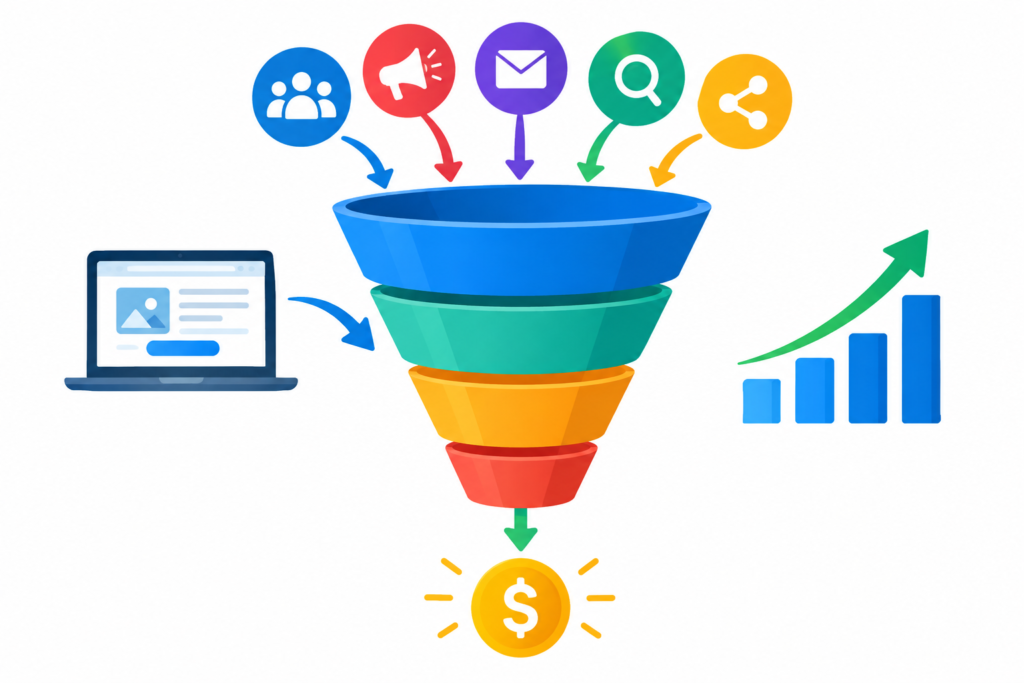
Learn how to build effective sales funnels that attract prospects, generate qualified leads, build customer trust, and increase conversions through strategic landing pages, email marketing, and optimized customer journeys.
Introduction
Building a successful online business requires more than attracting website visitors. You need a structured process that helps potential customers discover your brand, understand your offer, develop confidence, and take meaningful action. This process is known as a sales funnel. It connects marketing, customer education, lead generation, sales communication, and conversion into a journey designed around the needs of your audience.
Many businesses invest in advertising, social media, and content marketing but struggle to turn attention into revenue. A visitor may arrive on a website and leave because the offer is unclear, the page does not answer their questions, or the next step is difficult to find. Others may be interested but not ready to purchase immediately. A sales funnel helps businesses respond to these different situations by providing relevant information and appropriate opportunities to move forward.
For businesses using MyFunnelScript, understanding sales funnels can support better marketing planning and customer experiences. Whether you sell digital products, online courses, consulting services, software, or physical products, the same fundamental principles apply: understand your audience, communicate value clearly, remove unnecessary friction, and measure what happens at each stage.
This complete guide explains how sales funnels work, how to build them, and how to optimize the journey from first contact to purchase. It covers landing pages, lead magnets, email sequences, sales pages, checkout experiences, automation, analytics, and practical strategies for sustainable growth.
What Is a Sales Funnel and How Does It Work?
A sales funnel is a structured marketing and sales process that guides potential customers through different stages of awareness, interest, consideration, and conversion. The funnel concept describes how a business may begin with a broad audience and gradually reach a smaller group of people who become qualified leads and paying customers. Not every visitor will purchase, so the funnel helps organize the steps that support customer progression.
A typical sales funnel begins when someone discovers a business through a search engine, social media post, advertisement, referral, or another marketing channel. The person may then visit a landing page, read an article, download a resource, join an email list, attend a webinar, or explore a product offer. Each interaction provides an opportunity to explain value and build confidence. The next step should be relevant to the visitor’s needs instead of forcing every person toward an immediate purchase.
A sales funnel is more than a collection of webpages. It combines audience research, messaging, offers, user experience, follow-up, and measurement. A simple funnel may consist of a landing page and checkout, while a complex funnel may include educational content, a lead magnet, email automation, a webinar, a consultation, and a sales presentation. The appropriate structure depends on the product, audience, price, buying cycle, and trust required before a decision.
The Main Purpose of a Sales Funnel
A well-planned sales funnel helps a business:
- Attract relevant visitors.
- Explain the value of its offer.
- Capture qualified leads.
- Build customer trust.
- Address questions and objections.
- Encourage appropriate buying decisions.
- Measure and improve conversion performance.
The purpose is not to convert every visitor. It is to help the right people understand the offer and make an informed decision.
How the Funnel Works in Practice
Imagine a business selling an online course about digital marketing. A potential customer discovers a blog article explaining how to improve online sales. The article introduces the problem and provides useful information. At the end, the reader can download a free sales funnel checklist.
After submitting an email address, the reader receives the checklist and a series of helpful emails. These messages explain how funnels work, introduce common mistakes, and demonstrate what the course covers. When the prospect is ready, they can visit the course sales page and review the offer.
This journey gives the customer time to understand the product while allowing the business to communicate relevant information. It also creates opportunities to identify where visitors lose interest and improve the experience.
Sales Funnels and Customer Experience
A funnel should be designed around customer needs rather than simply maximizing the number of steps. Adding more pages, emails, or forms does not automatically improve performance. Every stage should have a clear purpose.
For example, if a customer can understand a simple product from one page, sending them through a lengthy webinar and multiple forms may create unnecessary friction. Conversely, a high-value consulting service may require detailed education and qualification before a purchase decision.
The best funnel is the one that provides the appropriate amount of information and support for the offer.
Understanding the Main Stages of a Sales Funnel
Most sales funnels include awareness, interest, consideration, and conversion. Many businesses also include retention and advocacy because the relationship continues after the first purchase. Understanding these stages helps you create content and offers that match the customer’s current needs.
Awareness: Attracting the Right Audience
The awareness stage begins when someone discovers your business or recognizes a problem they want to solve. This may happen through Google Search, social media, an advertisement, a recommendation, or a blog post.
At this stage, visitors may not know your brand or understand your product. They are often looking for information rather than making an immediate purchase. Educational content can introduce the problem and help the audience understand why it matters.
For example, a business offering email marketing software might publish an article about why potential customers stop responding after showing interest. The article can explain the importance of timely follow-up without immediately promoting a paid product.
Relevant awareness content should answer real questions and provide useful information. Google’s creating helpful content guidance is a useful reference for producing content that serves readers rather than focusing only on search rankings.
Interest: Building Engagement
At the interest stage, visitors begin exploring the problem and possible solutions. They may read multiple articles, watch videos, subscribe to a newsletter, or download a resource.
Your objective is to help them learn more and understand the options available. A useful lead magnet can provide a practical next step.
For instance, someone reading about sales funnels may download a funnel planning checklist. This gives them a resource they can use while creating their own funnel. The business can then provide relevant educational follow-up.
The lead magnet should be closely connected to the main offer. A business selling funnel templates should create resources related to funnel planning, landing pages, conversion optimization, or email follow-up.
Consideration: Helping Prospects Evaluate the Offer
During consideration, prospects compare solutions and decide whether your product or service is suitable. They may review features, pricing, benefits, customer experiences, and alternatives.
This is where detailed product information becomes important. A sales page should explain what the offer includes, who it is for, how it works, and what customers can reasonably expect.
Useful consideration content may include:
- Product demonstrations.
- Case studies.
- Transparent pricing.
- Customer testimonials.
- Comparison information.
- Frequently asked questions.
- Implementation details.
All claims should be accurate. If you publish testimonials, use genuine customer experiences. If you present results, explain the relevant circumstances instead of suggesting that every customer will achieve the same outcome.
Conversion: Making the Next Step Clear
The conversion stage is where the prospect takes the intended action. This could be purchasing a product, booking a consultation, registering for a webinar, or submitting a qualified enquiry.
A clear conversion experience includes an understandable offer, visible pricing where appropriate, accessible forms, and a straightforward checkout or booking process.
The call to action should communicate what happens next. Examples include “Get the Template,” “Book a Consultation,” or “Start the Course.”
A conversion does not always mean a purchase. The desired action depends on the funnel’s purpose.
Retention: Continuing the Customer Relationship
The funnel does not have to end after a purchase. Customer onboarding, support, education, and relevant follow-up can improve the post-purchase experience.
A customer who buys a digital product may need instructions for getting started. Someone purchasing consulting services may need a clear onboarding process. A software customer may benefit from tutorials and product support.
Retention activities should focus on helping customers receive value from what they purchased. A positive experience can create opportunities for repeat purchases, renewals, and recommendations.
Why Businesses Need a Well-Designed Sales Funnel
A business can attract substantial website traffic without generating enough leads or sales. This may happen because visitors are not the right audience, the offer is unclear, the landing page is difficult to use, or prospects do not receive enough information before making a decision.
A sales funnel helps connect different marketing activities so that each one has a clear purpose. Instead of publishing random blog posts, advertisements, and emails, businesses can organize their activities around a customer journey.
For example, an awareness article may attract visitors through search. A related lead magnet may capture email addresses. A follow-up sequence may answer questions about the problem. A sales page may explain the paid solution. Each part supports the next stage.
Improving Marketing Clarity
A funnel gives your marketing team a framework for planning content and campaigns. Every asset can be connected to a specific audience need or conversion objective.
A blog article might focus on education. A lead magnet might provide a practical tool. An email sequence might explain the benefits of a product. A sales page might help prospects evaluate the offer.
This structure makes it easier to identify gaps. If a business attracts traffic but has no useful lead capture opportunity, it may be missing a way to continue the relationship with interested visitors.
Making Better Use of Marketing Budgets
Sales funnels also support more informed marketing decisions. By measuring visits, leads, purchases, and costs, businesses can identify where improvements may be needed.
For example, an advertisement may receive many clicks but generate few leads. Possible causes include a mismatch between the advertisement and landing page, an unclear offer, or a form that asks for too much information.
If a landing page generates leads but few sales, the business may need to review the follow-up sequence, product positioning, pricing, or customer fit.
The important point is that metrics help identify questions. They do not automatically explain why a problem exists.
Creating a More Consistent Customer Journey
A clear funnel helps visitors receive information that matches their stage of decision-making.
Someone discovering a problem may need educational content. Someone comparing products may need pricing and feature details. Someone ready to purchase may need a simple checkout process.
Sending the same message to everyone can create confusion. A funnel allows businesses to organize communication around different needs.
Supporting Long-Term Business Growth
A funnel can also help businesses build repeatable processes. Once the journey is working, you can test improvements, document the process, and train team members.
However, a funnel is not a guarantee of revenue. Results depend on audience fit, product quality, customer experience, competition, pricing, traffic sources, and other factors.
The goal is to create a system that can be measured and improved over time.
How to Identify Your Ideal Sales Funnel Audience
Before creating funnel pages or email sequences, you need to understand who the funnel is designed to serve. An ideal customer profile describes the type of person or business most likely to benefit from your offer.
For business-to-business services, this may include industry, company size, job responsibilities, and business challenges. For consumer products, relevant factors may include needs, preferences, buying situations, and budget.
Audience research should focus on real problems rather than assumptions. What does the customer want to accomplish? What makes the problem difficult? What solutions have they already tried? What questions do they ask before buying?
These answers can influence your landing page copy, lead magnets, product descriptions, and email messages.
Research Customer Problems
Start by identifying the main problem your product or service solves. A problem should be specific enough to guide your messaging.
For example, “business growth” is broad. “Small businesses struggle to convert website visitors into qualified leads” is more specific.
The second statement can help shape a funnel around landing page optimization, lead capture, and follow-up communication.
Review customer enquiries, support conversations, product reviews, surveys, and relevant search queries. Look for recurring questions and concerns.
Understand Customer Awareness
Different prospects require different messages.
Problem-aware prospects recognize a challenge but may not know the available solutions.
Solution-aware prospects understand that solutions exist and are researching their options.
Product-aware prospects know about your offer but still need information about suitability, value, pricing, or trust.
Highly motivated prospects may be ready to act if the offer and buying process meet their expectations.
Your funnel should accommodate these differences.
Identify Buying Objections
A buying objection is a concern that may prevent someone from taking action. Common objections include price, time, complexity, uncertainty, lack of trust, and questions about suitability.
For example, a beginner may wonder whether a sales funnel template is difficult to customize. A consulting client may want to know what happens during the first meeting.
Address relevant questions clearly on the page or through follow-up content. Do not hide important limitations or create artificial urgency.
Choose One Primary Audience
A common mistake is trying to build one funnel for everyone. A business may offer multiple products or services, but each funnel should have a clear purpose.
A funnel for a beginner marketing course will use different messaging from a funnel for enterprise consulting.
Start with one audience, one problem, and one primary offer. This makes it easier to create consistent messaging and measure results.
How to Choose the Right Sales Funnel Model
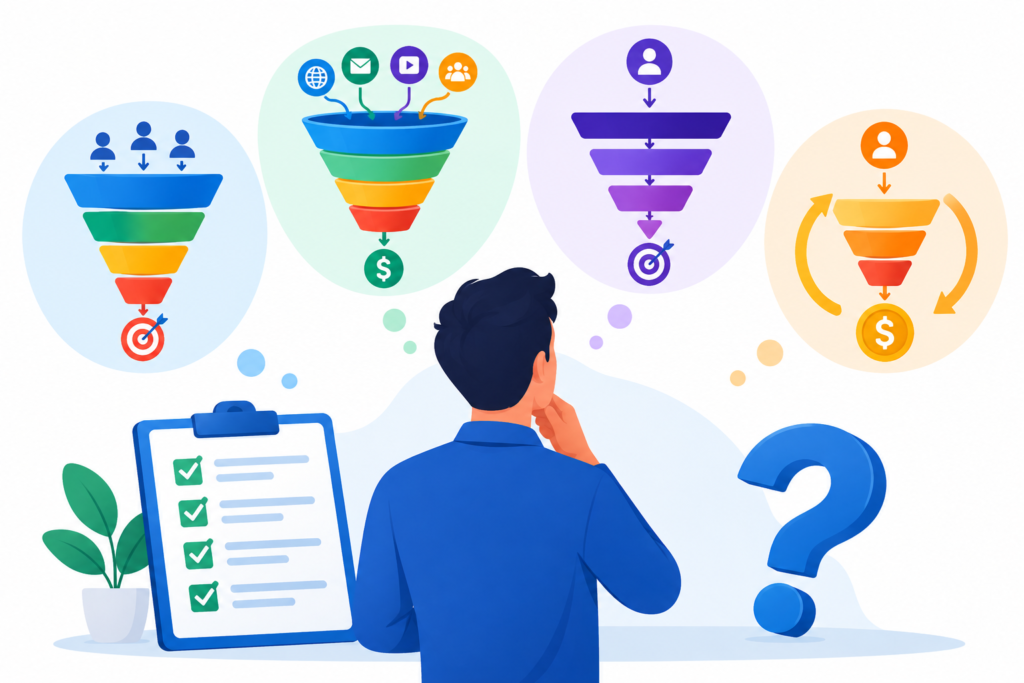
There is no single funnel model that works for every business. The right approach depends on the offer, buying cycle, audience, and desired conversion action.
A low-cost digital product may need only a landing page, product information, and checkout. A complex consulting service may require educational content, a case study, a discovery call, and a proposal.
Choosing the correct model helps prevent unnecessary steps and keeps the customer journey focused.
Lead Generation Funnel
A lead generation funnel is designed to collect contact information from interested prospects. It often includes a traffic source, landing page, lead magnet, and follow-up sequence.
For example, a business offering marketing services might promote a free website conversion checklist. Visitors arrive on a landing page, review the benefits, and submit their email address to receive the resource.
The business can then provide useful educational content and explain its services when relevant.
The lead magnet should be closely related to the paid offer. A generic resource may attract downloads without producing many qualified leads.
Sales Page Funnel
A sales page funnel focuses on presenting a product or service and encouraging a purchase. It may include an overview, benefits, features, proof, FAQs, pricing, and checkout link.
This model is useful for digital products, courses, templates, software, and other offers that can be explained on a dedicated page.
The page should answer important buyer questions and make the purchase process clear.
Webinar Funnel
A webinar funnel uses an educational event to introduce a topic, demonstrate expertise, and explain a relevant offer.
The journey may include registration, reminder emails, the webinar, follow-up communication, and a sales or consultation page.
Webinars can be useful when the audience needs more education before buying. The content should provide real value, and the promotional section should be transparent.
Consultation Funnel
A consultation funnel encourages potential clients to book a conversation. This model is common for agencies, consultants, coaches, and professional service providers.
The funnel may include a service page, qualification form, calendar booking, confirmation email, and consultation process.
Clear information about who the service is for can help reduce unsuitable enquiries.
E-Commerce Funnel
An e-commerce funnel guides shoppers from product discovery to purchase. It may include product listings, product pages, cart, checkout, and post-purchase communication.
Useful improvements include clear product information, transparent shipping details, accessible navigation, mobile-friendly pages, and a checkout process that does not create unnecessary friction.
Choosing the Right Model for Your Offer
Consider the following questions:
- Is the product simple or complex?
- Does the customer need education before buying?
- Is the purchase low-cost or high-value?
- Does the business need qualified enquiries?
- Is the primary action a purchase, registration, or booking?
- What information does the customer need before deciding?
The answers can help determine whether you need a short funnel, educational funnel, webinar funnel, or consultation journey.
How to Build a Sales Funnel From Scratch
Creating a sales funnel becomes easier when you divide the project into clear stages. Instead of starting with design or automation tools, begin with the customer and the desired business outcome.
A well-planned process helps you avoid building pages that do not support the customer journey.
Step 1: Define the Funnel Goal
Choose one primary objective. Examples include generating leads, selling a course, booking consultations, or increasing product purchases.
A funnel may support several business goals over time, but its main conversion action should be clear.
For instance, a funnel for a digital marketing template may focus on selling the template. A secondary goal could be building an email list for future educational content.
Step 2: Research the Customer Journey
Identify how your audience discovers solutions, what information they need, and which objections may prevent a purchase.
Review existing customer questions and feedback. Use this research to decide what pages, content, and follow-up the funnel should include.
Step 3: Create the Offer
A strong funnel needs an offer that is understandable and relevant.
Define what the customer receives, who it is for, the price, delivery method, and expected experience.
Avoid vague promises. Explain the practical value of the product or service and what is included.
Step 4: Plan the Funnel Pages
A simple funnel might include:
- Traffic source.
- Landing page.
- Lead capture or product page.
- Thank-you page.
- Email follow-up.
- Sales or checkout page.
Not every funnel needs all these pages. Choose the steps that support your offer.
Step 5: Write the Messaging
Your messaging should explain the problem, introduce the solution, communicate the benefits, and guide the visitor toward the next appropriate action.
Use clear language and avoid exaggerated claims.
Step 6: Build and Test
Create the pages, connect forms, configure email delivery, and test the customer journey.
Check that links work, forms submit correctly, emails arrive, and checkout functions properly.
Step 7: Measure and Improve
Track the metrics that matter for your goal. Review where visitors leave the funnel and investigate possible causes.
Make improvements based on evidence rather than changing everything at once.
How to Create a High-Converting Landing Page
A landing page is often one of the most important elements in a sales funnel. It helps visitors understand a specific offer and take a particular action.
A landing page may be used to collect email addresses, promote a webinar, sell a product, or encourage a consultation booking.
The first element visitors usually notice is the headline. It should communicate what the page offers and why the visitor should care.
A clear headline is more useful than a clever but confusing phrase. For example, “Download the Sales Funnel Planning Checklist” tells visitors what they can receive.
Explain the Offer Clearly
The page should explain the benefits of the offer. Features describe what is included, while benefits explain how those features help the customer.
A checklist may include funnel planning worksheets. The benefit could be that the customer can organize their funnel more efficiently.
Use accurate descriptions and avoid claiming results that cannot be supported.
Include Important Landing Page Elements
Clear headline: Explains the main offer.
Supporting description: Provides context and clarifies the value.
Relevant visual: Helps visitors understand the product or resource.
Primary call to action: Makes the next step obvious.
Trust information: Includes accurate testimonials, credentials, policies, or product details where relevant.
FAQ section: Answers common questions and objections.
Simple form: Requests only the information needed for the intended action.
Match the Page to the Traffic Source
A landing page should match the message that brought the visitor there.
If an advertisement promotes a free sales funnel checklist, the landing page should clearly offer that checklist.
Sending visitors to a page with a different promise can create confusion and reduce trust.
Improve User Experience
Keep the page readable, use clear headings, and make the main action easy to find.
Avoid unnecessary distractions and ensure the page works well on mobile devices.
Review the page using both desktop and mobile screens before launching.
Follow Helpful SEO Practices
Landing pages should provide useful information for visitors rather than being created only to target search engines.
Follow Google’s SEO Starter Guide when optimizing page titles, headings, content, and links.
How Lead Magnets Help Build a Sales Funnel
A lead magnet is a useful resource offered in exchange for contact information, usually an email address. It can help a business begin a relationship with a potential customer before asking for a purchase.
Common lead magnets include checklists, templates, guides, worksheets, calculators, and short educational courses.
The value of a lead magnet depends on how well it matches the audience’s needs. A resource should solve a specific problem or help the reader complete a useful task.
For example, a sales funnel checklist might help a beginner identify the pages, emails, and tracking requirements needed for a basic funnel.
Types of Lead Magnets
Checklists: Help users complete a task.
Templates: Provide a reusable starting point.
Guides: Explain a topic in more detail.
Workbooks: Help readers apply what they learn.
Webinars: Offer structured education around a specific subject.
Free tools: Provide practical assistance, such as a calculator or planning worksheet.
Create a Relevant Lead Magnet
Start by identifying a problem your audience frequently encounters.
Then create a resource that addresses that problem clearly.
Keep the content focused and make sure the promised resource is actually delivered.
A useful lead magnet should provide genuine value even before the customer purchases anything.
Build a Simple Opt-In Experience
The opt-in page should explain what the visitor receives, why it is useful, and what information is required.
The confirmation or thank-you page should provide clear next steps.
Avoid requesting unnecessary information. A simple form is often easier for visitors to complete.
Connect the Lead Magnet to Your Paid Offer
The lead magnet should naturally relate to your main product or service.
For example, a free funnel planning worksheet may introduce a paid funnel template or consulting service.
This connection helps the prospect understand how the paid offer can support their next step.
Respect Privacy and Consent
When collecting email addresses, provide clear information about how the information will be used.
Follow applicable privacy and marketing requirements, and offer appropriate unsubscribe options in marketing emails.
How Email Marketing Supports Sales Funnels
Email marketing helps businesses maintain communication with prospects after they leave a landing page.
Not every visitor is ready to buy during their first session. Relevant follow-up can provide additional education, answer questions, and remind prospects about useful offers.
A basic email sequence might begin with delivery of a lead magnet, followed by an explanation of a common problem, a practical solution, information about the offer, and an invitation to take the next step.
The sequence should be based on the customer’s needs and the action they have taken.
Common Email Funnel Types
Welcome sequence: Introduces the business and delivers the promised resource.
Educational sequence: Helps prospects understand a topic or problem.
Product sequence: Explains an offer and answers relevant questions.
Abandoned cart sequence: Reminds shoppers about items they left behind, where appropriate.
Post-purchase sequence: Supports onboarding and customer success.
Write Useful Emails
Each email should have a clear purpose.
A welcome email may deliver a resource. An educational email may explain a common mistake. A product email may answer questions about features and suitability.
Avoid sending messages that repeat the same information without adding value.
Use Clear Subject Lines
Subject lines should accurately describe the content of the email.
Examples include:
- Your Sales Funnel Checklist
- How to Plan Your First Funnel
- Common Landing Page Mistakes
- What to Include in a Sales Page
- Questions to Ask Before Buying a Funnel Template
Avoid misleading subject lines or false urgency.
Measure Email Performance
Relevant metrics include delivery rate, click-through rate, unsubscribe rate, and conversions.
Open rates can provide limited insight, but they should not be treated as a complete measure of success.
The most important metric depends on the email’s purpose.
For additional guidance, review Google’s email sender guidelines .
Designing Effective Email Nurture Sequences
Email nurturing helps businesses maintain meaningful communication with prospects who are not yet ready to purchase. Many visitors need additional information, reassurance, demonstrations, and reminders before they feel confident enough to take action. A well-planned email sequence guides subscribers through this decision-making process without overwhelming them or relying on aggressive sales messaging. Each email should have a clear purpose, relevant information, and a logical connection to the previous message.
The first email should usually deliver the promised lead magnet, resource, discount, checklist, or consultation confirmation. It should also introduce the business and explain what subscribers can expect next. The second and third emails can focus on common problems, practical advice, customer questions, and useful educational content. Later messages may introduce case studies, product demonstrations, testimonials, comparisons, or a direct offer. This structure creates familiarity and helps the prospect understand the value of the solution.
Effective email nurturing depends on relevance and timing. A person who downloaded an introductory guide should not immediately receive advanced product messaging that assumes strong buying intent. Use segmentation to separate new subscribers, engaged readers, product viewers, abandoned carts, previous customers, and inactive contacts. Tools such as Google Analytics and email marketing platforms can help identify important user journeys and engagement patterns. Always follow applicable privacy, consent, and email marketing requirements, and provide a clear unsubscribe option.
Using Lead Magnets to Generate Qualified Prospects
A lead magnet is a valuable resource offered in exchange for a visitor’s contact information or permission to continue a marketing conversation. Common examples include ebooks, templates, calculators, checklists, free consultations, mini-courses, webinars, audits, and downloadable guides. The most effective lead magnets solve a specific problem for a specific audience. A broad resource may attract many visitors but fail to generate qualified leads if it does not connect directly with the business’s product or service.
The strongest lead magnets are closely aligned with the next stage of the funnel. For example, a business selling sales funnel templates could offer a funnel planning worksheet, conversion checklist, or campaign mapping template. A consulting company could provide a free assessment or strategy session. An online course provider could offer a short training lesson that demonstrates the teaching style and provides a useful result. The resource should create a genuine improvement while also showing why the complete paid solution may be valuable.
The landing page should clearly communicate what the visitor will receive, who it is for, and why it matters. Avoid vague promises such as “Get More Success” or “Discover Amazing Secrets.” Instead, use specific language that explains the outcome, format, and expected benefit. The form should request only the information needed for the next step. Excessive form fields can reduce completion rates, particularly on mobile devices. After submission, deliver the resource quickly and move the new lead into a relevant nurture sequence.
Building High-Converting Landing Pages
A landing page is designed around one primary conversion objective. That objective may be collecting an email address, booking a consultation, registering for a webinar, purchasing a product, requesting a quote, or starting a free trial. Unlike a general website page, a focused landing page minimizes distractions and directs attention toward one clear action. The headline, supporting copy, visual content, trust elements, form, and call to action should all support the same goal.
A strong landing page begins with a clear value proposition. Visitors should understand what is being offered, who it is intended for, and what benefit they can expect. The headline should match the message that brought them to the page. If an advertisement promotes a free funnel checklist, the landing page should immediately present that checklist rather than forcing visitors to search for it. Consistency between the advertisement, landing page, and follow-up message improves clarity and creates a more connected experience.
Trust is equally important. Include relevant testimonials, client results, guarantees, security information, recognizable payment methods, transparent pricing, and clear contact details where appropriate. Avoid fabricated testimonials, exaggerated claims, fake countdown timers, and misleading scarcity. Page performance also matters, particularly on mobile devices. Review Core Web Vitals and make sure the page loads efficiently, remains visually stable, and responds smoothly to user interactions. Every landing page should also be tested on different screen sizes and browsers.
Creating Persuasive Offers and Calls to Action
A sales funnel cannot perform effectively if the offer is unclear or difficult to understand. The offer should explain what the customer receives, how it solves a problem, what makes it different, and why the value justifies the price. A product description alone is not always enough. Prospects often need to understand the transformation, convenience, risk reduction, time savings, or business improvement associated with the purchase.
A persuasive offer usually combines the core product with supporting value. This may include templates, onboarding, tutorials, bonuses, support, guarantees, implementation resources, or access to a community. The additional elements should be relevant rather than randomly added. Too many bonuses can create confusion and make the offer appear inflated. The purpose of the offer is to reduce uncertainty and help the buyer understand the complete solution.
Calls to action should be direct, specific, and connected to the visitor’s stage in the funnel. “Download the Checklist,” “Book Your Strategy Call,” “Start Your Free Trial,” and “Get the Complete Template Pack” are more informative than generic phrases such as “Click Here.” Use one primary call to action on each focused page, while allowing supporting links for people who need more information. Button text, placement, color contrast, spacing, and surrounding copy should be tested carefully. The goal is not to pressure users but to make the next step obvious.
Tracking Funnel Performance and Conversion Metrics
Tracking allows marketers to understand how visitors move through the funnel and where potential customers stop progressing. Without measurement, it is difficult to determine whether a problem comes from the traffic source, landing page, offer, checkout process, email sequence, or sales team. A useful tracking system records key events such as page views, form submissions, video engagement, add-to-cart actions, checkout starts, purchases, booked calls, and subscription cancellations.
Important funnel metrics include traffic volume, landing page conversion rate, cost per lead, customer acquisition cost, click-through rate, email open rate, email click rate, sales conversion rate, average order value, customer lifetime value, and return on advertising spend. Each metric answers a different question. For example, a high click-through rate may show that an advertisement attracts attention, but it does not prove that the resulting traffic is qualified. Similarly, many leads may not be useful if they rarely become customers.
Use a consistent measurement framework across marketing and sales channels. Configure conversion events correctly, apply suitable campaign tracking parameters, and compare results over a meaningful period. The Google Analytics documentation provides guidance for understanding website and event measurement. Data should be interpreted in context because seasonality, pricing, audience quality, sales cycles, and attribution limitations can influence results. Avoid making major decisions based on one isolated metric.
Testing, Optimizing, and Scaling a Sales Funnel
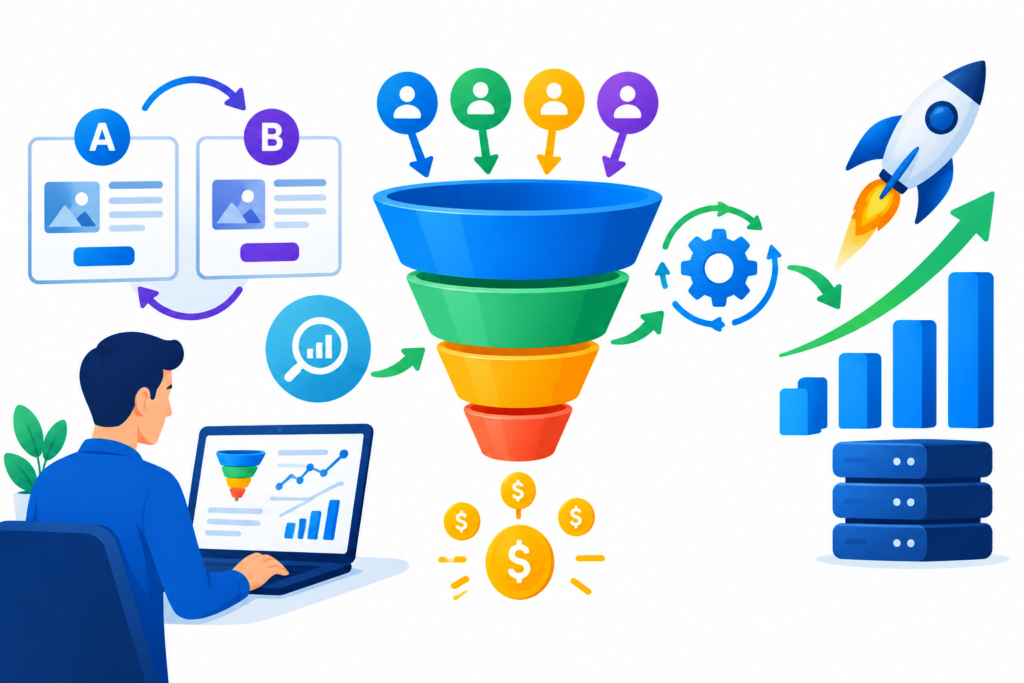
Optimization is the ongoing process of improving the customer journey based on evidence. A funnel should not be considered finished after the pages are published or the advertising campaign is launched. Visitor behavior can reveal problems that were not obvious during planning. Prospects may misunderstand the offer, abandon a form, hesitate at checkout, ignore follow-up emails, or leave because the page does not answer an important question.
A/B testing can be used to compare different versions of headlines, offers, page layouts, forms, pricing presentations, calls to action, email subject lines, and checkout experiences. Test one meaningful variable at a time whenever possible so the results are easier to interpret. Define the primary success metric before beginning the test. A change that increases clicks but lowers qualified leads or purchases may not improve the overall funnel. Testing should focus on business outcomes rather than surface-level engagement alone.
Scaling should begin only after the funnel demonstrates consistent performance and the business can support additional demand. Increasing advertising spend too quickly can expose weaknesses in customer support, fulfillment, sales follow-up, inventory, or onboarding. Improve the funnel’s conversion process first, then expand through additional audiences, traffic sources, products, partnerships, or geographic markets. Document successful processes so the team can maintain quality as volume increases.
Common Sales Funnel Mistakes and Best Practices Summary
One common mistake is building a funnel around the company instead of the customer. Businesses may focus heavily on their history, features, awards, or internal language while failing to explain the visitor’s problem and desired outcome. Another mistake is sending all traffic to the same generic page. Different audiences often require different messages, proof, offers, and levels of education. A funnel should reflect the visitor’s intent rather than treating every prospect as identical.
Other frequent problems include unclear calls to action, complicated forms, slow landing pages, weak follow-up, missing trust signals, poor mobile design, excessive automation, unrealistic promises, and incomplete tracking. Some businesses also create too many funnel steps without a clear reason. Additional pages and emails do not automatically improve conversions. Every stage should have a defined purpose and should move the prospect closer to a useful decision. Remove unnecessary friction while preserving the information customers need.
The following best practices provide a practical foundation for long-term funnel performance:
- Start with one clearly defined audience and one specific problem.
- Match the offer to the visitor’s level of awareness and buying intent.
- Use clear, benefit-focused messaging throughout the customer journey.
- Keep landing pages focused on one primary conversion objective.
- Provide valuable lead magnets that connect naturally to the paid offer.
- Use segmented email sequences instead of sending identical messages to everyone.
- Include genuine proof, transparent pricing, and accurate expectations.
- Track meaningful conversion events from the first visit through the final sale.
- Test important changes using reliable data rather than assumptions.
- Improve the customer experience after the purchase through onboarding and support.
Frequently Asked Questions
What is a sales funnel?
A sales funnel is a structured customer journey that guides people from initial awareness to consideration, conversion, and often repeat purchasing. It includes the content, pages, emails, advertisements, sales conversations, and customer experiences used to move prospects toward a desired action.
Why are sales funnels important for online businesses?
Sales funnels help businesses organize marketing and sales activities around customer needs. They clarify the next step, support consistent follow-up, reduce unnecessary friction, and make it easier to measure where prospects convert or leave the journey.
How many steps should a sales funnel have?
There is no universal number of steps. A simple product may require only a landing page, checkout page, and confirmation email. A high-value service may need educational content, a lead magnet, a consultation, a proposal, and follow-up. Use only the steps necessary to answer customer questions and support the buying decision.
What is the difference between a marketing funnel and a sales funnel?
A marketing funnel generally focuses on attracting attention, building awareness, and generating interest. A sales funnel focuses more directly on qualifying prospects, presenting an offer, handling objections, and converting leads into customers. In practice, the two processes often overlap.
Can a sales funnel work without paid advertising?
Yes. Sales funnels can receive visitors from search engine optimization, social media, email marketing, referrals, partnerships, communities, webinars, and direct traffic. Paid advertising can accelerate traffic generation, but the funnel still needs a relevant offer and a strong customer experience.
How long does it take to build a sales funnel?
The timeline depends on the funnel’s complexity, the number of pages, the offer, the copywriting requirements, integrations, design, tracking, and testing. A basic lead-generation funnel may be built relatively quickly, while a multi-stage funnel for a high-value product may require more planning and optimization.
What is the most important sales funnel metric?
The most important metric depends on the funnel’s objective. A lead-generation funnel may prioritize qualified lead cost and lead-to-customer conversion. An ecommerce funnel may focus on purchase conversion rate, average order value, and customer acquisition cost. The key is to connect measurements to actual business outcomes.
How can a sales funnel be improved?
Start by identifying the stage with the greatest meaningful drop-off. Review the message, page experience, offer, trust elements, form, follow-up, and tracking at that stage. Then test one improvement at a time and evaluate whether it increases qualified conversions or revenue.
Conclusion
A successful sales funnel is more than a series of web pages or automated emails. It is a connected customer journey built around a specific audience, a relevant problem, a valuable offer, and a clear next step. From lead generation and landing pages to email nurturing, conversion tracking, testing, and customer retention, every part of the funnel should support a consistent and helpful experience.
For businesses using MyFunnelScript, the most effective approach is to begin with a focused funnel rather than attempting to automate every possible customer journey at once. Define the audience, create a strong offer, build the essential pages, connect the follow-up sequence, measure the results, and improve the weakest stage through testing. When the process is documented and repeatable, the funnel becomes a practical growth system rather than a one-time campaign.
The strongest long-term results come from combining persuasive messaging with honest claims, useful content, reliable technology, clear analytics, and continuous customer support. A well-built funnel does not simply push people toward a transaction. It helps the right people understand their options, make informed decisions, and receive value before, during, and after the purchase.
Want to Implement This Easily?
You are an expert consultant. Based on the blog post titled “(Sales Funnels)”, provide a step-by-step, practical implementation guide. Include tools, best practices, common mistakes to avoid, and advanced tips. Assume the reader wants to implement everything discussed in this article effectively.
Want our help implementing this? Just reach out to us via our website contact form: Full Sales Funnel Templates