
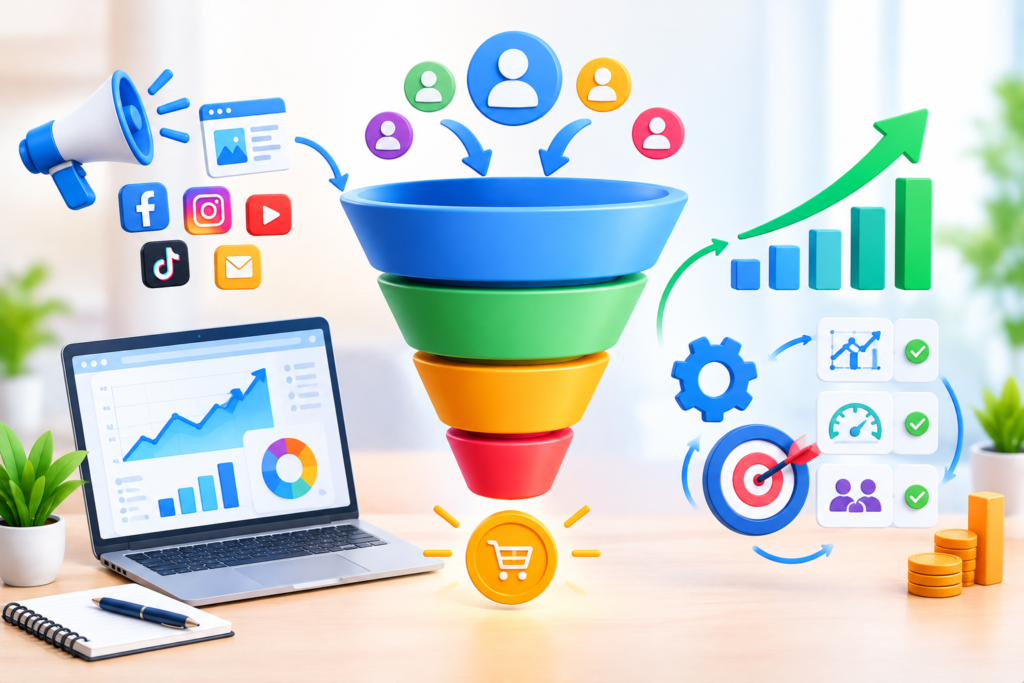
Learn how to build a sales funnel that attracts qualified leads, nurtures prospects, increases conversions, and drives sustainable business growth.
Introduction
A successful business needs more than a great product, an attractive website, or a steady stream of visitors. It needs a reliable system that guides potential customers from their first interaction with a brand to the moment they make a purchase and encourages them to return. This system is known as a sales funnel. When designed strategically, a sales funnel helps businesses understand customer behaviour, communicate value more effectively, generate qualified leads, and turn interested prospects into paying customers.
In today’s competitive digital marketplace, customers rarely make purchasing decisions after a single interaction. They may discover a business through a search engine, encounter its social media content, read a blog post, download a resource, attend a webinar, or compare several competing solutions before deciding what to buy. Each interaction influences their perception of the business and their willingness to take the next step. A well-structured sales funnel connects these interactions into a coherent customer journey, ensuring that prospects receive relevant information and appropriate guidance at every stage.
For entrepreneurs, service providers, coaches, consultants, e-commerce businesses, and digital marketers, understanding sales funnel strategy is essential for building a predictable customer acquisition process. Rather than relying entirely on individual sales conversations or occasional promotional campaigns, businesses can create repeatable systems that attract attention, capture contact information, nurture relationships, present suitable offers, and measure results. Businesses can also use a coordinated content marketing strategy to educate prospects and support their progression through the buying journey.
At MyFunnelScript, the goal is to help businesses understand practical funnel-building principles and apply them to real marketing and sales situations. This guide explores the complete sales funnel process, including its stages, customer psychology, landing pages, lead magnets, email sequences, automation, conversion optimization, analytics, common mistakes, and long-term growth strategies. Whether you are building your first funnel or improving an existing one, you will learn how to develop a customer-focused system that supports measurable and sustainable business growth.
What Is a Sales Funnel and Why Does It Matter?
A sales funnel is a structured process that guides potential customers through the different stages of discovering a business, evaluating its products or services, making a purchasing decision, and developing a longer-term relationship with the brand. The term funnel describes the fact that a business may attract many people at the beginning of the customer journey, while a smaller proportion eventually becomes paying customers. For example, 10,000 people might discover a business through search engines or social media, 1,000 might visit its website, 200 might subscribe to its email list, and 30 might purchase a product. These numbers are illustrative rather than universal benchmarks; actual results depend on the industry, audience, offer, traffic quality, and buying process. The funnel helps a business understand how people move between these stages and where potential customers stop progressing.
A sales funnel is more than a collection of landing pages or automated emails. It is a coordinated strategy that connects marketing messages, customer needs, sales activities, and purchasing experiences. At the top of the funnel, the primary objective is to attract relevant attention and help people recognize a problem or opportunity. In the middle, the business provides useful information, establishes credibility, answers questions, and demonstrates how its solution works. At the bottom, the focus shifts towards helping qualified prospects make informed purchasing decisions through clear offers, relevant evidence, transparent pricing, and appropriate calls to action. After the purchase, onboarding, customer support, and retention activities can extend the relationship beyond the initial transaction. Each stage should have a defined purpose and a logical next step.
The importance of a sales funnel becomes clearer when a business struggles to convert website visitors into customers. Without a structured process, marketing activities can become disconnected: social media attracts attention, blog posts generate traffic, email campaigns collect subscribers, and sales pages promote products without a consistent customer journey. A strategically designed funnel connects these activities and makes their contribution measurable. Businesses can examine visitor behaviour, lead quality, conversion rates, and revenue to determine which parts of the process need improvement. For example, if a landing page attracts visitors but generates few sign-ups, the problem may involve message relevance, perceived value, page usability, or the form itself. If many subscribers engage with emails but few purchase, the offer, qualification process, or sales message may need attention. The central purpose of a sales funnel is not to pressure people into buying; it is to help suitable customers move towards the right decision with less confusion and friction.
Understanding the Main Stages of a Sales Funnel
The traditional sales funnel is commonly divided into three broad stages: awareness, consideration, and conversion. These stages provide a useful starting point because they reflect the different questions customers ask as their understanding of a problem develops. During awareness, a prospect may recognize a challenge without knowing which solution is appropriate. Someone struggling to generate business enquiries, for example, might search for ways to increase website conversions or improve lead generation. At this stage, educational blog posts, search-optimized resources, social media content, and introductory videos can help the person understand the problem. The objective is to provide useful information and attract people whose needs align with the business’s expertise, rather than immediately demanding a purchase from everyone who encounters the brand.
During consideration, prospects begin exploring possible solutions and comparing alternatives. They may evaluate different providers, research product features, examine case studies, request demonstrations, or subscribe to a newsletter. This is where detailed educational resources, comparison guides, webinars, email nurture sequences, and relevant customer testimonials can be particularly useful. The business should help prospects understand how its solution addresses their specific needs, what implementation involves, and which limitations or requirements they should consider. Effective consideration-stage content answers genuine questions instead of repeating broad promotional claims. For a software company, this might mean explaining integrations and onboarding requirements. For a consultant, it might involve outlining the process, expected deliverables, and the circumstances in which the service is most appropriate.
The conversion stage focuses on helping qualified prospects complete an appropriate action, such as purchasing a product, booking a consultation, requesting a proposal, or starting a subscription. A strong conversion experience communicates the offer clearly, explains pricing and terms, addresses important objections, and makes the next step straightforward. However, real customer journeys do not always follow a perfectly linear path. A prospect may discover a business, leave, return after several weeks, compare several offers, and then convert after speaking with a salesperson. Another person may purchase a low-cost product immediately but require months of evaluation before investing in a premium service. Therefore, businesses should use funnel stages as a practical planning framework rather than assuming every customer follows an identical sequence. The most effective sales funnels adapt to customer readiness, delivering the information and support that prospects need at each meaningful decision point.
Identifying Your Ideal Customer and Target Audience
A sales funnel becomes significantly more effective when it is designed around a clearly defined audience. Before creating landing pages, writing advertising copy, or developing lead magnets, businesses should understand who they want to attract, what those people need, and why they might choose one solution over another. An ideal customer profile describes the characteristics of the people or organizations most likely to benefit from a product or service. Depending on the business model, these characteristics may include industry, company size, role, location, budget, buying authority, technical requirements, or purchasing frequency. For consumer businesses, relevant factors may include interests, lifestyle, purchasing motivations, product preferences, and the circumstances that trigger a buying decision. The purpose is not to exclude every person outside a narrow demographic category, but to develop a practical understanding of the customers the business can serve most effectively.
Customer research should combine available evidence with direct conversations whenever possible. Existing sales records, customer support questions, website analytics, customer interviews, reviews, and feedback forms can reveal recurring problems and buying motivations. For example, a marketing consultant may discover that small business owners are not simply looking for more website traffic; they want a reliable way to turn existing traffic into qualified enquiries. That insight changes the funnel’s messaging. Instead of offering a generic guide to digital marketing, the consultant could create a resource explaining how to diagnose conversion problems and identify practical improvements. Businesses should also investigate objections, such as concerns about cost, implementation time, complexity, reliability, or previous disappointing experiences. Understanding these concerns makes it easier to create relevant content and explain the value of a solution honestly.
Once the audience is understood, businesses can create one or more customer personas to guide messaging and funnel design. A persona should summarize meaningful patterns in customer needs rather than inventing unsupported details about age, income, or personality. A useful persona might describe a small business owner who has consistent website traffic but struggles to generate sales enquiries, has limited time to manage marketing, and wants a measurable improvement without hiring a large internal team. This information helps determine the appropriate lead magnet, communication style, sales offer, and follow-up process. Different audiences may require separate funnels because their priorities and readiness to purchase vary. A beginner may need foundational education, while an experienced buyer may prefer a detailed comparison or direct consultation. When the right message reaches the right audience at the right stage, the funnel becomes more relevant, more efficient, and more useful to prospective customers.
Creating a Compelling Value Proposition for Your Sales Funnel
A value proposition explains why a potential customer should consider a particular product or service and what meaningful benefit it offers. In a sales funnel, the value proposition connects the audience’s needs with the business’s solution. It should communicate the problem being addressed, the intended outcome, and the reason the offer deserves attention. A weak value proposition might claim that a business provides high-quality marketing services, professional support, or innovative solutions. Although these statements may sound positive, they do not explain what makes the offer relevant to a specific customer. A stronger message identifies a concrete problem and describes the benefit of addressing it. For example, a funnel-building service could explain how a structured customer journey helps businesses capture qualified leads, nurture prospects, and measure conversions more consistently. The objective is to make the offer understandable and relevant without relying on exaggerated promises.
Developing a compelling value proposition begins with identifying the customer’s desired outcome and the obstacles preventing them from achieving it. Customers may want to increase revenue, reduce administrative work, improve productivity, simplify a complicated process, or make a more confident purchasing decision. The business must then establish how its product or service helps achieve that outcome. Useful questions include: What problem does the customer want to solve? Why have existing solutions been insufficient? What makes the proposed approach different? What evidence supports the promised benefits? What limitations should the customer understand before purchasing? Answering these questions helps create a message grounded in customer needs rather than internal assumptions. It also provides a foundation for landing-page headlines, email subject lines, advertisements, product descriptions, and sales presentations. When multiple messages appear across the funnel, they should communicate the same underlying value while addressing the different questions customers have at each stage.
The strongest value propositions are specific, credible, and easy to understand. Businesses should avoid guaranteeing results they cannot control, such as a fixed revenue increase for every customer or a guaranteed number of sales within an arbitrary timeframe. Instead, they can describe the process, capabilities, deliverables, and measurable outcomes that are reasonably supported by evidence. For example, a service provider may explain that its funnel implementation includes audience research, landing-page development, email automation, conversion tracking, and performance reviews. This gives prospects a clearer understanding of what they will receive. Supporting evidence may include relevant case studies, demonstrations, verified testimonials, or transparent examples of previous work, provided these are genuine and presented with appropriate context. A value proposition should also remain consistent with the actual product, pricing, and service experience. When a business communicates a clear and credible reason to buy, it makes every subsequent stage of the sales funnel easier to develop and optimize.
Designing an Effective Lead Magnet That Attracts Qualified Leads
A lead magnet is a useful resource, experience, or introductory offer provided in exchange for a prospective customer’s contact information or another clearly explained action. Common examples include checklists, templates, educational guides, calculators, short training sessions, webinars, and practical worksheets. In a sales funnel, the lead magnet creates a bridge between initial interest and a deeper relationship with the business. Someone who discovers a company through an educational article may not be ready to purchase immediately, but they might be willing to download a resource that helps them solve a specific problem. This exchange gives the business an opportunity to continue providing relevant information, provided that it obtains the necessary consent and respects the person’s communication preferences. The objective is not simply to increase the number of email subscribers; it is to attract people whose needs are aligned with the products or services the business offers.
Creating an effective lead magnet requires a clear understanding of the audience and the next step in the customer journey. A resource that is too broad may attract people who have little interest in the business’s core offer. For example, a consultant specializing in sales funnel optimization may attract a large number of unrelated visitors with a general productivity checklist, but those subscribers may never become relevant prospects. A more focused resource, such as a sales funnel audit checklist or landing-page conversion worksheet, is more closely connected to the service. A useful lead magnet should solve one identifiable problem, provide immediate practical value, and be easy to consume. It should not withhold essential information merely to force the reader into purchasing another product. Businesses should also ensure that the resource delivers on the promise made in the advertisement or sign-up form. If a page promises a practical implementation template, the user should receive a genuinely usable template rather than a generic promotional document.
The delivery experience is another important part of lead magnet strategy. After a visitor completes the sign-up form, the business should clearly confirm the action and explain how to access the resource. An automated email can deliver the promised material, welcome the subscriber, and introduce an appropriate next step. For example, someone who downloads a funnel audit checklist might receive an email explaining how to assess the results, followed by an educational guide to improving weak funnel stages. Additional messages can answer common questions and introduce a relevant service when appropriate. However, businesses should avoid sending excessive emails or assuming that downloading a resource automatically indicates readiness to purchase. A lead magnet should be evaluated using several measures, including landing-page conversion rate, subscriber engagement, lead quality, unsubscribe rate, and eventual contribution to sales. A smaller list of genuinely interested prospects can be more valuable than a large list of people who have no intention of buying.
Building High-Converting Sales Funnel Landing Pages
A sales funnel landing page is a focused webpage designed to encourage visitors to complete a specific action. That action might involve downloading a resource, registering for a webinar, requesting a consultation, starting a trial, or purchasing a product. Unlike a general homepage, which may contain many navigation options and competing messages, a landing page typically concentrates on one primary conversion objective. Its effectiveness depends on how well it connects the visitor’s expectations with the offer presented on the page. If an advertisement promises a practical guide to sales funnel optimization, the landing page should immediately explain what the guide contains, who it is for, and what benefit the visitor can reasonably expect. Consistency between the advertisement, headline, supporting content, and call to action reduces confusion and helps visitors determine whether the offer is relevant to their needs.
A strong landing page usually includes a clear headline, a concise explanation of the offer, relevant benefits, credible supporting evidence, and an obvious call to action. Depending on the offer, it may also include a demonstration, product screenshots, a short video, testimonials, pricing details, frequently asked questions, or an explanation of the process. Every element should serve the visitor’s decision-making process. For example, a landing page promoting a premium funnel-building service may explain the intended audience, the problems the service addresses, the deliverables included, the implementation timeline, and the information required before work begins. If testimonials or case studies are used, they should be genuine and accurately represent the customers’ experiences. Businesses should avoid fabricated endorsements, misleading scarcity claims, hidden costs, or design elements that make it difficult to understand the offer. A persuasive landing page helps visitors make an informed choice rather than relying on confusion or pressure.
The technical experience also influences landing-page performance. Pages should load reliably, work on mobile devices, present readable text, and provide accessible forms and buttons. Excessive animations, unnecessary scripts, intrusive pop-ups, and complicated sign-up processes can create friction. Businesses should request only the information needed at the current stage. A simple resource download may require only an email address, whereas a consultation request might reasonably ask for a name, business website, and a brief description of the prospect’s needs. Form validation should clearly explain how to correct errors, and users should understand what happens after submission. Teams can improve performance by testing meaningful variations in headlines, calls to action, layouts, and supporting evidence. For technical performance guidance, consult Google’s official documentation on Core Web Vitals. A high-converting landing page combines relevant messaging, credible evidence, accessible design, and a straightforward next step.
Developing a Strategic Email Nurture Sequence
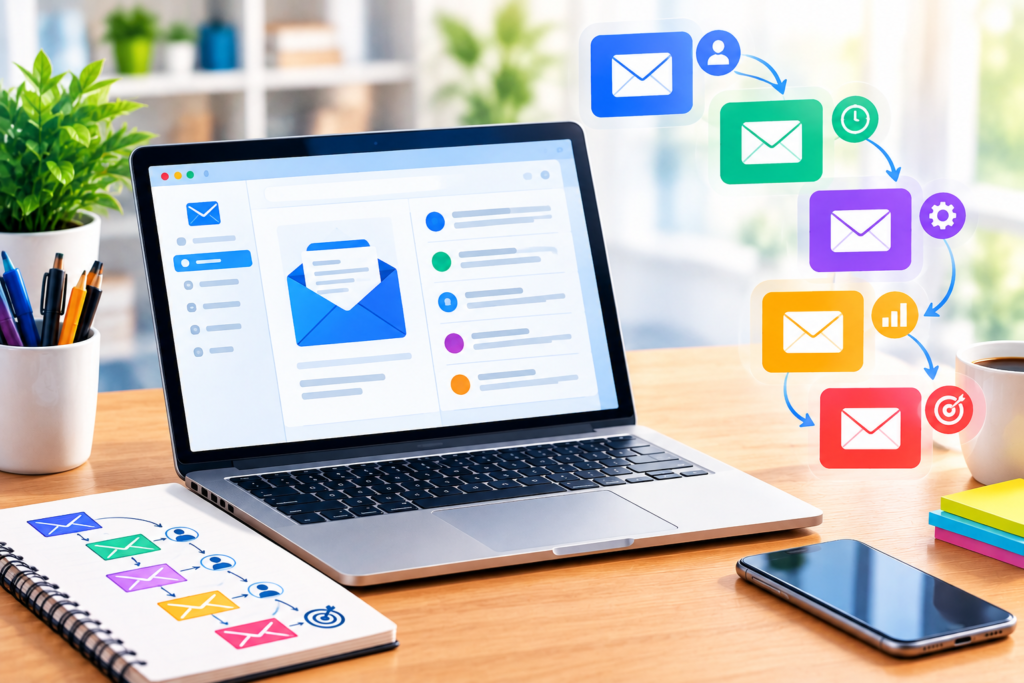
An email nurture sequence is a planned series of messages that helps prospective customers understand a problem, evaluate potential solutions, and decide whether a business’s offer is suitable for them. It is especially valuable when a purchase requires research, comparison, approval, or trust. A subscriber who downloads a sales funnel checklist may not be ready to hire a consultant on the same day. They might need to understand the process, determine the likely costs, compare providers, or discuss the investment with a business partner. A thoughtful email sequence supports this decision-making process by delivering relevant information over time. Rather than sending the same promotional message repeatedly, the business provides useful guidance and gradually introduces the products or services that can help the subscriber make progress.
A practical nurture sequence can begin with a welcome email that delivers the promised resource and explains what the subscriber can expect next. A subsequent message might address a common challenge, such as losing leads between a landing page and a sales conversation. Another could explain a practical method for diagnosing the problem, while a later email presents a relevant example or case study. The sequence may then explain the business’s service, outline its process, answer frequently asked questions, and invite suitable prospects to book a consultation or review a product. These messages should follow a logical progression, but the exact number and timing depend on the audience, offer, and buying cycle. A low-cost digital download may need only a short sequence, whereas a complex business-to-business service may require longer-term education and several opportunities for conversation. Every email should have a clear purpose and offer a useful next step.
Effective email marketing also depends on relevance, consent, deliverability, and measurement. Businesses should use accurate sender information, honest subject lines, clear unsubscribe options, and appropriate consent practices. They should not purchase dubious email lists or assume that every contact has agreed to receive promotional messages. Subscribers should be able to understand why they are receiving emails and how to stop them. Segmentation can improve relevance by separating subscribers according to their interests, previous actions, or stated needs. For example, someone interested in webinar funnels may receive different educational content from someone exploring e-commerce conversion optimization. Performance should be assessed through a combination of delivery rates, clicks, meaningful engagement, conversions, unsubscribes, complaints, and revenue attribution where reliable tracking is available. Open rates can be affected by privacy features and automated email activity, so they should not be treated as a complete measure of interest. The purpose of email nurturing is to build a useful, permission-based relationship that helps qualified prospects make confident decisions.
Using Sales Funnel Automation to Improve Efficiency
Sales funnel automation uses software and predefined rules to carry out repetitive marketing and sales tasks when particular events occur. Examples include delivering a lead magnet after a sign-up, sending a welcome email, assigning a lead to the appropriate team, recording a purchase in a customer relationship management system, or reminding a salesperson to follow up after a consultation request. Automation helps businesses manage these processes consistently without manually handling every interaction. It can be particularly useful when lead volume increases, several marketing channels operate simultaneously, or customers require different communication paths. However, automation should support a well-designed customer journey rather than attempting to compensate for an unclear offer or poorly understood audience. Automating a weak process can make mistakes happen faster and affect more customers.
A reliable automation workflow begins with a defined trigger, a clear action, and a relevant outcome. For instance, when a visitor requests a sales funnel audit checklist, the system may record the subscription, deliver the checklist, and add the contact to an appropriate educational sequence. If the subscriber subsequently requests a consultation, the system can stop unnecessary introductory messages and notify the sales team. If the person purchases a service, promotional emails for the same offer may need to be suppressed while onboarding communications begin. These transitions help prevent contradictory messages and create a more coherent experience. Businesses should map these workflows before configuring software, identify the information each step requires, and define what should happen when an action fails. They should also consider duplicate records, bounced emails, unsubscribes, incomplete forms, and contacts who move between customer segments.
The best automation systems combine efficiency with appropriate human involvement. A business may automate resource delivery and routine reminders while reserving complex consultations, unusual customer requests, complaints, and high-value sales discussions for trained team members. Regular testing is essential because integrations can fail, triggers may be configured incorrectly, and software updates can change behaviour. Teams should test the complete customer journey using controlled test records before launching a workflow, then periodically review whether messages are being sent at the right time and whether contacts are moving between stages correctly. Access controls, data minimization, appropriate retention practices, and secure handling of customer information are also important. Where personal data is involved, businesses should assess the legal requirements that apply to their customers and operations. Effective sales funnel automation removes unnecessary repetitive work while preserving accuracy, customer choice, and meaningful human support.
Measuring Sales Funnel Performance with Analytics
Measuring sales funnel performance helps businesses understand whether their marketing and sales activities are producing meaningful results. Without reliable measurement, it is difficult to determine whether a funnel attracts the right audience, generates qualified leads, or converts prospects into paying customers. Businesses should begin by identifying the primary objective of each funnel stage and selecting metrics that reflect that objective. Awareness-stage metrics may include relevant website visits, advertising reach, and engagement with educational content. Lead-generation metrics can include landing-page conversion rate, cost per lead, and the percentage of leads that meet qualification criteria. Conversion-stage metrics may include sales conversion rate, average order value, customer acquisition cost, and revenue generated. These measures should be interpreted together because an increase in one metric does not necessarily indicate an improvement in overall business performance.
A useful sales funnel analytics framework tracks how people progress from one stage to the next. Suppose a business receives 5,000 relevant website visits, generates 400 leads, qualifies 100 prospects, and closes 20 sales during a defined reporting period. The visitor-to-lead conversion rate is 8%, the lead qualification rate is 25%, and the qualified-prospect-to-sale conversion rate is 20%. These figures are illustrative, not industry benchmarks. They help demonstrate how a business can calculate performance at each stage rather than focusing exclusively on total traffic or sales. If traffic increases but qualified leads remain unchanged, the business may need to investigate traffic relevance or the landing-page experience. If qualified prospects engage with the sales team but few purchase, the offer, pricing, sales process, or competitive positioning may require attention. Comparing conversion rates over time can reveal where improvement is most likely to produce meaningful results.
Businesses can use tools such as Google Analytics to understand website interactions and conversion events, provided that tracking is configured appropriately. Google also provides guidance on key events, which can help teams identify important user interactions in Analytics reporting. Depending on the business model, useful events may include submitting a lead form, registering for a webinar, initiating checkout, or completing a purchase. A customer relationship management system can supplement website analytics by tracking lead qualification, sales conversations, opportunities, and closed deals. However, measurement requires careful planning. Businesses should define events consistently, avoid double-counting conversions, respect applicable consent requirements, and recognize that attribution models may not capture every influence on a purchase. The goal of sales funnel analytics is to make better decisions, not simply to collect more data. Regular reporting should identify what changed, why it may have changed, and which action deserves testing next.
Optimizing Conversion Rates at Every Funnel Stage
Conversion rate optimization (CRO) is the systematic process of improving the proportion of people who complete a desired action. In a sales funnel, conversion optimization applies to multiple stages rather than only the final purchase. A business might improve the percentage of visitors who subscribe, the percentage of subscribers who attend a webinar, the percentage of qualified leads who book a consultation, or the percentage of customers who purchase an additional product. Each stage presents different barriers, so the optimization strategy should reflect the action being measured. For example, a visitor may leave a landing page because the offer is unclear, while a qualified prospect may decline a service because the pricing structure does not match their needs. Treating these situations as the same conversion problem can lead to ineffective changes.
The first step in conversion optimization is to identify a specific problem using available evidence. Businesses can review analytics, examine form abandonment, analyze customer questions, conduct usability testing, and ask prospects why they did not proceed. If a landing page receives substantial relevant traffic but few registrations, possible explanations include a weak headline, a mismatch between the advertisement and the page, insufficient evidence, an unclear offer, or a complicated form. If visitors repeatedly abandon checkout, the business may need to investigate shipping costs, unexpected fees, payment options, technical errors, or uncertainty about the return policy. These are hypotheses to investigate rather than assumptions to treat as facts. The business should prioritize issues according to their potential impact, the strength of the available evidence, the effort required to address them, and the risks of introducing unwanted side effects.
Testing allows businesses to compare proposed improvements rather than relying entirely on personal preferences. For example, a team might compare two accurate headlines that communicate different benefits, or test whether a shorter form improves qualified registrations. A well-designed experiment changes a clearly defined element while keeping other important conditions sufficiently consistent. The team should select a primary metric before launching the test, allow an appropriate testing period, and consider sample size, traffic patterns, and statistical uncertainty. A temporary increase in conversions does not always indicate a lasting improvement, particularly when the number of visitors is small. Businesses should also monitor secondary outcomes, such as lead quality, refunds, complaints, and eventual revenue, so that a change does not increase low-quality sign-ups at the expense of business performance. Google’s page experience guidance can help inform decisions about usability and website experience. Sustainable conversion optimization is based on customer evidence, controlled testing, and business outcomes—not on making a page more aggressive or manipulative.
Increasing Sales Funnel Revenue Through Upsells, Cross-Sells, and Retention
A sales funnel should not end automatically when a customer makes an initial purchase. Existing customers may benefit from complementary products, additional services, advanced training, ongoing support, or subscription options that address their evolving needs. An upsell encourages a customer to choose a more comprehensive version of a product or service, while a cross-sell introduces a related product that complements the original purchase. Retention focuses on helping customers continue receiving value over time. When these strategies are implemented thoughtfully, they can improve the customer experience and increase the long-term value of a customer relationship. However, additional offers should be relevant, clearly explained, and optional. The objective is to help customers achieve their goals, not to increase the transaction value regardless of whether the additional purchase is useful.
An effective post-purchase strategy begins with understanding what the customer has already bought and what they need to succeed with it. For example, someone who purchases a basic sales funnel template may later benefit from an implementation workshop, an email sequence template, or a consultation about improving conversion tracking. The business could introduce these options after the customer has had a reasonable opportunity to use the original product. A complementary offer should explain the additional benefit and make its relationship to the initial purchase clear. If the customer needs help implementing the first product, offering unrelated premium products too quickly may create frustration. Businesses should also ensure that pricing, recurring billing arrangements, cancellation terms, and product limitations are transparent. Customer feedback can help determine which additional offers provide genuine value and which create unnecessary complexity.
Retention strategies may include onboarding emails, practical tutorials, customer support, usage reminders, product updates, renewal communications, and regular opportunities to provide feedback. A service provider might schedule a review after implementation to assess whether the customer is achieving the intended outcome and identify any unresolved problems. A subscription business may monitor renewal rates, cancellation reasons, product usage, and support requests to identify customers who need assistance. These signals should be interpreted carefully rather than used to make unsupported assumptions about individual customers. Businesses can also measure repeat purchase rate, customer lifetime value, refund rate, and revenue from existing customers. Customer lifetime value estimates the financial contribution of a customer relationship over a defined period, but its calculation depends on margins, retention, acquisition costs, and the assumptions used. The most sustainable way to increase funnel revenue is to deliver real value, earn repeat business, and offer the next appropriate solution when the customer is ready.
Common Sales Funnel Mistakes Businesses Should Avoid
One of the most common sales funnel mistakes is trying to sell to everyone with the same message. Businesses sometimes create a single landing page, one generic lead magnet, and an identical email sequence for audiences with very different needs. This can result in irrelevant communication, low engagement, and unqualified enquiries. A beginner exploring a problem may need educational content, whereas an experienced buyer may want pricing, implementation details, and evidence of performance. The solution is to define the intended audience, understand their buying motivations, and align each offer with a clear customer need. Businesses should also avoid choosing a lead magnet simply because it is easy to produce. A resource that attracts large numbers of unrelated subscribers can increase list size without improving sales opportunities. Lead quality and customer relevance matter more than vanity metrics.
Another common mistake is building a complicated funnel before validating the underlying offer. Businesses may invest in multiple landing pages, extensive email automation, advertising campaigns, and complicated integrations without confirming whether the target audience wants the product. A simpler initial funnel can provide useful evidence at a lower cost. For example, a business might begin with one relevant traffic source, one focused landing page, a useful lead magnet, a short email sequence, and a clear sales offer. Once the business has evidence that the message attracts suitable prospects and produces meaningful engagement, it can expand the system. Businesses should also avoid assuming that automation automatically improves performance. Poorly timed emails, duplicate messages, incorrect audience segmentation, broken forms, and missing purchase exclusions can damage trust. Testing the complete customer journey before launch helps identify these problems while the system is still manageable.
A third major mistake is failing to measure the complete customer journey. Businesses may focus on traffic, email subscribers, or advertising clicks without understanding how those activities contribute to qualified leads and profitable sales. A campaign that generates inexpensive leads may ultimately be less valuable than one that attracts fewer but more qualified prospects. Similarly, a high landing-page conversion rate does not guarantee that customers will remain satisfied after purchasing. To avoid these problems, businesses should define meaningful metrics for each stage, review the quality of incoming leads, and compare acquisition costs with the financial contribution of the customers acquired. Other mistakes include making unsupported performance claims, hiding important fees, using fake testimonials, creating artificial urgency, ignoring mobile usability, and neglecting customer support. These tactics may produce short-term activity but can undermine trust and increase refunds or complaints. A reliable funnel should make the offer clear, respect customer choice, and provide the experience promised before purchase.
Best Practices for Building a High-Performing Sales Funnel
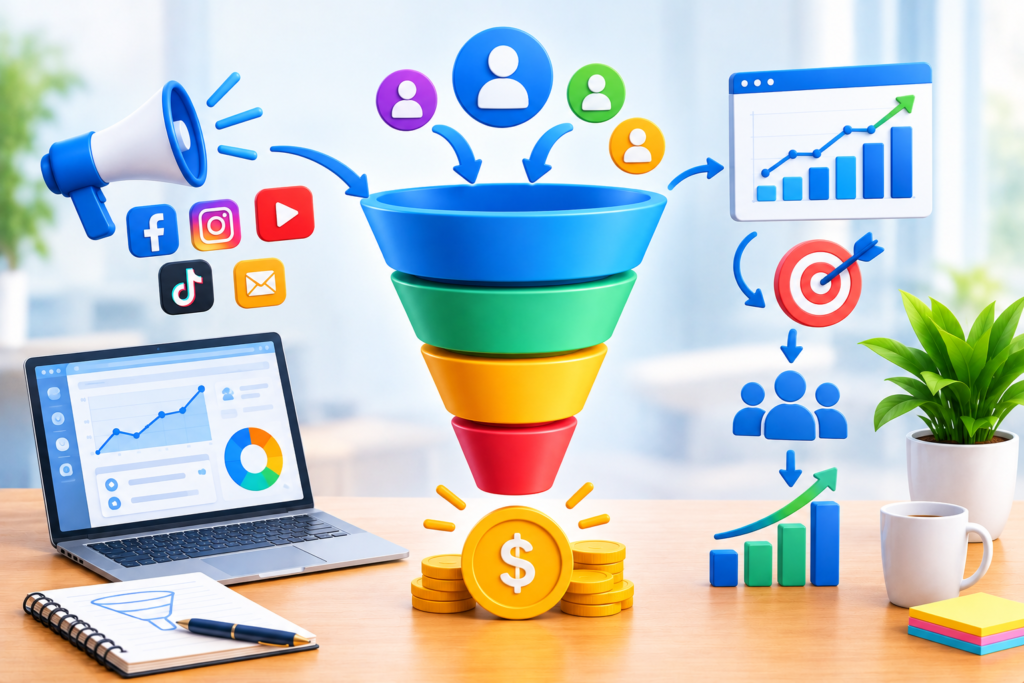
A high-performing sales funnel begins with a clearly defined objective, a specific audience, and an offer that addresses a real need. Before developing the technical elements, businesses should map the customer journey and identify the information people require at each stage. The awareness stage might focus on education, the consideration stage on evaluation and trust, and the conversion stage on making an informed purchase decision. Each step should have a defined purpose, an appropriate message, and a clear next action. Businesses should also ensure that advertisements, landing pages, emails, and sales conversations communicate consistent information. If the landing page promises one outcome while the sales process describes something substantially different, prospects may lose confidence. A clear and consistent customer journey makes the funnel easier to understand, measure, and improve.
Another important practice is to prioritize usability, transparency, and credible evidence. Landing pages should be readable on mobile devices, forms should request only necessary information, and calls to action should explain what happens next. Product descriptions should accurately communicate features, deliverables, limitations, and pricing. Customer testimonials and case studies should be genuine, relevant, and presented without misleading implications. Businesses should also make their websites technically reliable and protect the information they collect. Depending on the implementation, this may involve secure connections, appropriate access controls, software updates, backups, and careful management of third-party integrations. For search-related considerations, Google’s Search Essentials explains foundational practices for helping search engines discover and understand useful website content. Although organic search can contribute to funnel traffic, content should primarily serve the audience rather than being created solely to influence rankings.
Finally, treat funnel improvement as an ongoing process rather than a one-time project. Review performance regularly, investigate significant changes, and prioritize improvements that are supported by evidence. Test one meaningful hypothesis at a time when practical, and evaluate the impact on lead quality, revenue, and customer satisfaction as well as immediate conversion rates. Keep automation workflows organized, document important settings, and periodically verify that forms, email sequences, payment processes, and tracking events function correctly. Gather feedback from customers and sales staff because qualitative observations can reveal problems that analytics alone cannot explain. Businesses should also establish realistic expectations: a new funnel may need time to collect sufficient data, and results can vary with seasonality, market conditions, competition, and offer quality. The best sales funnel is not necessarily the most complicated one; it is the one that consistently connects the right customers with a valuable solution through a measurable, trustworthy process.
Frequently Asked Questions
What Is a Sales Funnel, and How Does It Work?
A sales funnel is a structured customer journey that guides potential buyers from discovering a business to evaluating its products or services and making a purchase. It typically includes awareness, consideration, and conversion stages, although the exact structure depends on the business model. At the awareness stage, businesses attract relevant visitors through content, advertising, social media, referrals, and other channels. During consideration, they provide information, answer questions, and demonstrate the value of their solutions. At the conversion stage, they help qualified prospects complete an appropriate action, such as purchasing a product or booking a consultation. After the sale, customer onboarding and retention activities can encourage repeat purchases and long-term relationships.
A sales funnel works by connecting these stages into a coherent process. For example, a visitor might discover a business through a search engine, read an educational article, download a checklist, receive a series of useful emails, and eventually purchase a service. Each interaction helps the prospect understand the offer and decide whether it meets their needs. Businesses can use analytics to measure progression between stages and identify where improvements are needed. A funnel does not guarantee sales, but it provides a practical framework for understanding customer behaviour and improving marketing and sales activities.
Why Is a Sales Funnel Important for a Business?
A sales funnel helps businesses organize their marketing activities, understand customer needs, and identify opportunities to improve conversions. Without a structured process, businesses may generate traffic without capturing leads or collect email subscribers without guiding them towards a relevant offer. A funnel connects these activities and provides a clearer picture of how marketing contributes to revenue.
It also helps businesses make more informed decisions about where to invest their time and resources. By tracking lead quality, conversion rates, customer acquisition costs, and sales outcomes, a business can identify which activities contribute most effectively to its objectives. A well-designed funnel can improve consistency, reduce unnecessary manual work, and make it easier to understand why prospects purchase or leave. Its effectiveness ultimately depends on the quality of the offer, the relevance of the audience, and the customer experience.
What Are the Main Stages of a Sales Funnel?
The three commonly recognized stages are awareness, consideration, and conversion. Awareness introduces potential customers to a problem, opportunity, or solution. Consideration helps them evaluate their options and understand the benefits and limitations of different approaches. Conversion supports the final purchasing decision by presenting a clear offer, answering relevant questions, and making the next step straightforward.
Some businesses use more detailed models that include additional stages such as interest, evaluation, intent, purchase, onboarding, and retention. These expanded models can be useful when a product has a complicated buying process or requires ongoing customer engagement. For example, a business selling a low-cost digital template may use a relatively short funnel, while a company selling enterprise software may need demonstrations, consultations, security reviews, and contract negotiations. The appropriate structure should reflect how customers actually make purchasing decisions.
How Do You Build a Sales Funnel From Scratch?
Start by identifying your target audience, understanding its main challenges, and selecting a product or service that addresses a genuine need. Develop a clear value proposition that explains why the offer is relevant and what customers can reasonably expect to receive. Next, choose an appropriate way to attract potential customers, such as search-optimized content, social media, paid advertising, partnerships, or referrals.
Create a landing page that communicates the offer clearly and encourages a relevant action. Depending on your business model, this might involve downloading a lead magnet, registering for a webinar, requesting a consultation, or purchasing a product. Develop an appropriate follow-up process using email or direct sales communication, then configure conversion tracking so you can measure results. Start with a manageable funnel, test the complete customer journey, and improve the weakest stages using actual performance data. Avoid investing in complicated automation before validating the audience, offer, and basic conversion process.
What Is a Lead Magnet, and Why Does It Matter?
A lead magnet is a useful resource or introductory offer that encourages potential customers to share their contact information or complete another clearly explained action. Common examples include educational guides, checklists, templates, calculators, webinars, and short training sessions. Lead magnets help businesses build relationships with people who have demonstrated interest but may not be ready to purchase immediately.
An effective lead magnet solves a specific problem and provides immediate value. It should attract people who are likely to benefit from the business’s products or services. For example, a company offering sales funnel implementation could provide a funnel audit checklist that helps business owners identify weaknesses in their customer journeys. After delivering the resource, the business can provide relevant educational emails and introduce an appropriate service when the subscriber is ready. The quality and relevance of the leads are more important than the total number of downloads.
Which Tools Are Useful for Building a Sales Funnel?
The appropriate tools depend on your budget, technical skills, business model, and required features. A typical funnel may use a landing-page builder, email marketing platform, customer relationship management system, analytics solution, payment processor, and automation software. Some businesses can manage these functions through a single integrated platform, while others prefer separate tools that connect through integrations.
Before selecting software, identify the tasks you need to perform. Consider whether the platform supports your landing pages, email sequences, contact segmentation, payment process, reporting requirements, and future growth plans. Evaluate pricing, ease of use, data portability, customer support, security, and integration options. Avoid purchasing several overlapping subscriptions before establishing what your funnel actually requires. A simple, reliable setup is often a better starting point than a complicated system with features the business does not use.
How Can You Improve Sales Funnel Conversion Rates?
Improving conversion rates begins with understanding where prospects experience difficulty. Review your analytics to identify stages with significant drop-offs, then investigate possible causes through customer feedback, usability testing, and controlled experiments. Problems might include an unclear offer, an irrelevant advertisement, a complicated form, missing pricing information, insufficient evidence, or an unreliable checkout process.
Test changes that address specific problems. For example, you could simplify a form, improve a headline, clarify the offer, or add a genuine demonstration that answers a common customer question. Measure whether the change improves meaningful outcomes, including qualified leads and sales, rather than relying only on clicks or sign-ups. It is also important to monitor customer satisfaction, refunds, and lead quality. Increasing the number of conversions is not necessarily beneficial if it attracts unsuitable customers or creates unrealistic expectations.
How Long Does It Take to See Results From a Sales Funnel?
The time required to see results varies according to the offer, audience, traffic volume, sales cycle, marketing budget, and effectiveness of the funnel. A simple funnel promoting a low-cost product may generate purchases relatively quickly if it reaches a relevant audience. A funnel for a premium service or business-to-business solution may require weeks or months of education, evaluation, and conversations before prospects make a decision.
Businesses should distinguish between the time required to generate initial activity and the time needed to establish reliable performance. Early results can help identify obvious problems, but small data samples may not accurately predict long-term outcomes. Set realistic goals, measure performance consistently, and allow sufficient time to evaluate changes. Rather than expecting immediate success, focus on improving the customer experience, validating the offer, and identifying the activities that produce qualified leads and sustainable revenue.
Conclusion
A well-designed sales funnel provides a structured way to connect customer needs with the products and services that can address them. By understanding the customer journey, identifying the right audience, developing a compelling value proposition, and creating relevant landing pages, businesses can make it easier for prospects to discover and evaluate their offers. Lead magnets and email nurture sequences help maintain relationships with interested prospects, while automation supports consistent communication and reduces repetitive administrative work. Analytics and conversion optimization then provide the evidence needed to identify weaknesses, test improvements, and make better decisions.
However, successful funnel building requires more than selecting software and connecting a series of pages. The underlying offer must provide genuine value, the messaging must reflect the audience’s needs, and the customer experience must deliver what the business promises. Misleading claims, excessive communication, unnecessary complexity, and poor follow-up can undermine even a technically sophisticated funnel. Businesses should therefore prioritize transparency, usability, privacy, and meaningful customer relationships throughout the process. Each funnel should be developed around a clear business objective and evaluated according to its contribution to qualified leads, profitable sales, and customer satisfaction.
Long-term success comes from treating a sales funnel as an evolving business system rather than a one-time marketing project. Customer expectations change, offers develop, competitors introduce alternatives, and new data reveals opportunities for improvement. Regular reviews help businesses respond to these changes without making unnecessary adjustments based on assumptions. Start with a clear audience, one relevant offer, a straightforward customer journey, and reliable measurement. Improve the process as evidence becomes available, and introduce additional stages or automation when they solve a genuine problem. MyFunnelScript aims to help businesses understand these principles and apply them to practical funnel-building decisions. A sustainable sales funnel does more than generate individual transactions: it creates a repeatable process for attracting the right customers, earning their trust, delivering value, and supporting long-term business growth.
Want to Implement This Easily?
AI Implementation Prompt
Use the following prompt to turn the principles in this guide into a practical sales funnel implementation plan.
You are an expert consultant. Based on the blog post titled “Sales Funnel”, provide a step-by-step, practical implementation guide. Include tools, best practices, common mistakes to avoid, and advanced tips. Assume the reader wants to implement everything discussed in this article effectively.
Develop a comprehensive action plan that covers the following areas:
- Identify the ideal customer, target audience, customer pain points, and purchasing motivations.
- Develop a compelling value proposition and select an appropriate product or service offer.
- Map the customer journey from awareness and consideration to conversion and retention.
- Select relevant traffic sources, including organic search, social media, paid advertising, and partnerships.
- Create a useful lead magnet that attracts qualified prospects.
- Design a high-converting landing page with a clear headline, relevant benefits, credible supporting evidence, and an appropriate call to action.
- Develop a permission-based email nurture sequence that educates prospects and introduces the offer naturally.
- Configure appropriate sales funnel automation, customer relationship management, and follow-up workflows.
- Implement conversion tracking and analytics to measure traffic, leads, sales, customer acquisition costs, and revenue.
- Establish a conversion optimization process based on customer feedback, performance data, and controlled experiments.
- Develop customer onboarding, retention, upselling, and cross-selling strategies where appropriate.
- Identify technical, operational, privacy, and customer experience risks that should be addressed before launch.
- Create a realistic implementation timeline with priorities, deliverables, and measurable objectives.
- Recommend suitable tools according to the business’s budget, technical capabilities, and requirements.
For every implementation step, explain what to do, why it matters, how to execute it, which tools may help, and how to measure success. Include practical examples and actionable checklists where useful. Distinguish established best practices from assumptions that should be tested.
Avoid unsupported revenue guarantees, misleading claims, unnecessary complexity, and manipulative sales tactics. Prioritize customer value, transparency, privacy, usability, and sustainable profitability.
Begin by asking for any essential business information that is missing, including the business model, target audience, primary offer, budget, and preferred marketing channels. If the reader cannot provide all the information, state reasonable assumptions and explain how to validate them.
Finish with a prioritized launch checklist and a 30-day action plan that helps the reader implement, measure, and improve the sales funnel.
Call to Action
Want help implementing your sales funnel? Explore the available funnel templates and implementation resources through the following page: