
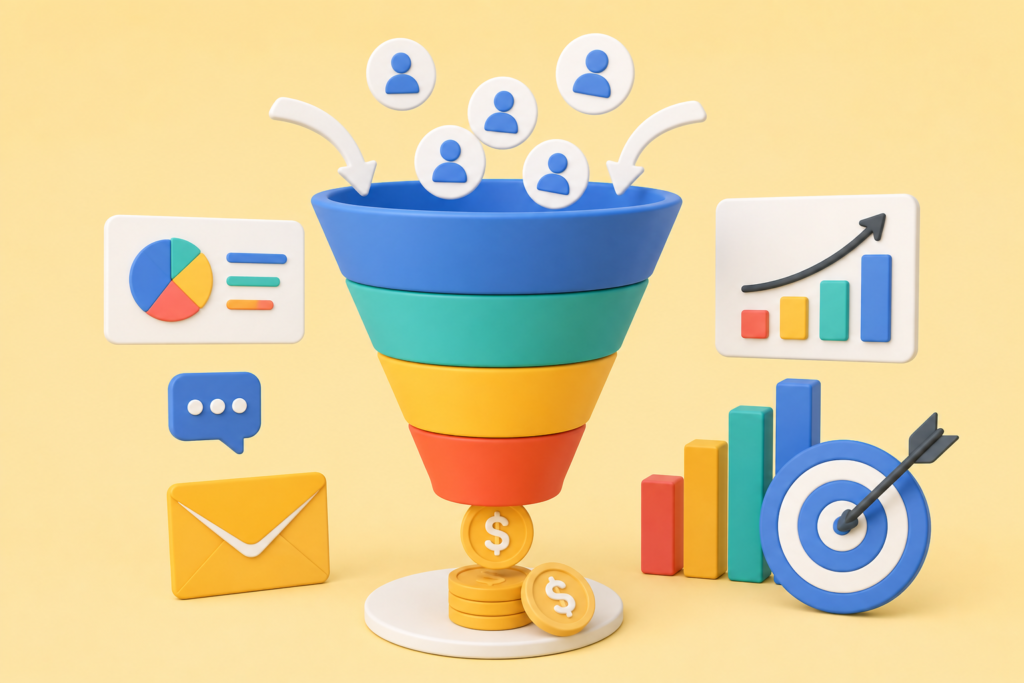
Learn how sales funnels attract qualified prospects, build trust, nurture leads, and turn interest into measurable conversions through a strategic, customer-focused funnel system.
Introduction
A successful online business rarely depends on a single landing page, advertisement, email, or sales message. Sustainable growth comes from creating a connected customer journey that moves people from initial awareness toward informed action. This is where sales funnels become strategically important. Instead of asking every visitor to purchase immediately, a well-designed funnel gives prospects the information, trust, and motivation they need at each stage of their decision-making process.
For businesses operating online, a funnel can connect advertising, organic search, content marketing, landing pages, lead magnets, email campaigns, webinars, product demonstrations, sales pages, checkout experiences, and post-purchase communication. The objective is not simply to generate more traffic. The objective is to create a system that transforms appropriate traffic into qualified leads and qualified leads into customers while improving the experience along the way.
This guide explores the strategic foundations behind effective sales funnel development, including funnel stages, customer intent, lead generation, landing page optimization, conversion strategy, email nurturing, funnel analytics, automation, testing, and scalability. It also explains why some funnels fail even when they receive substantial traffic and how businesses can build a more reliable conversion process.
For SEO and content-driven businesses, funnel strategy should also complement—not replace—helpful content. Google’s guidance emphasizes creating useful, reliable, people-first content rather than content designed primarily to manipulate search rankings.
What Are Sales Funnels and Why Do They Matter?
A sales funnel is a structured customer journey designed to move a prospect from initial awareness to a desired business outcome, usually a purchase, consultation, subscription, application, or another meaningful conversion. The word “funnel” reflects the fact that a business may attract a large number of people at the beginning of the journey, while a smaller percentage ultimately become customers. The funnel provides a framework for understanding what those people need at different stages and how the business should respond.
A typical funnel begins with awareness, where someone first discovers a company, product, service, problem, or solution. The prospect may arrive through Google Search, social media, advertising, referrals, video content, email, or another channel. The next stage is consideration, where the prospect evaluates whether the solution is relevant and trustworthy. Strong funnels then provide useful information, evidence, comparisons, demonstrations, or conversations that reduce uncertainty. Eventually, qualified prospects reach the decision stage, where the offer, pricing, proof, risk reduction, and buying process become central.
The importance of sales funnels comes from their ability to replace disconnected marketing activities with a coordinated conversion system. Without a funnel, businesses often send traffic to generic pages, collect leads without following up, or promote products without understanding the customer’s buying stage. A strategically designed funnel gives every interaction a purpose. It helps determine what message should appear first, what information should follow, when an offer should be introduced, and what happens after a prospect converts. This creates a more measurable and repeatable customer acquisition process rather than relying entirely on individual campaigns or salespeople.
Understanding the Core Stages of a Sales Funnel
Although funnel models vary between industries, most effective sales funnel stages can be understood through four broad phases: awareness, interest, consideration, and decision. Some businesses add separate stages for retention, expansion, advocacy, and reactivation. The exact terminology is less important than understanding the changing needs of the customer. A person discovering a problem for the first time should not receive the same message as someone actively comparing competing solutions.
At the awareness stage, the prospect is becoming conscious of a problem, need, opportunity, or potential solution. Educational blog posts, videos, social content, search-optimized resources, guides, and introductory advertising can be useful here. During the interest and consideration stages, prospects typically want more specific information. They may look for case studies, comparisons, demonstrations, FAQs, pricing information, reviews, technical explanations, or proof that a provider can deliver the promised outcome. Content at these stages should answer real objections rather than simply repeat promotional claims.
The decision stage requires a different level of clarity. Prospects who are close to taking action need to understand the offer, value proposition, process, price, terms, guarantees where applicable, and next step. A confusing checkout, vague call to action, missing information, or unexpected friction can cause an otherwise qualified prospect to abandon the process. After conversion, the journey should continue. Onboarding, customer education, support, cross-sells, retention campaigns, and referral opportunities can increase lifetime value. Consequently, the strongest funnel is not merely a mechanism for obtaining the first sale; it is a framework for building a longer customer relationship.
How Customer Intent Shapes Funnel Strategy
One of the most important principles in funnel development is understanding customer intent. Not every visitor has the same level of awareness, urgency, budget, or willingness to purchase. Treating every visitor as though they are ready to buy can create unnecessary friction and reduce conversion rates. A visitor searching for educational information may need guidance, while someone comparing providers may need proof, pricing, and differentiation. The funnel should respond to these differences instead of forcing every prospect through an identical message.
Search intent provides a particularly useful example. Someone searching for “what is email automation” has a different objective from someone searching for “email automation software for small business.” The first query suggests learning intent, while the second may indicate commercial investigation. A person searching for a specific product or service may be even closer to making a decision. A strong funnel can connect these different stages through relevant content and appropriate calls to action rather than presenting a hard sales pitch immediately.
Customer intent should also influence funnel segmentation. Advertising audiences, organic visitors, returning users, email subscribers, existing customers, and high-intent prospects should not necessarily receive identical experiences. Behavioral signals such as page visits, content downloads, webinar attendance, email engagement, product demonstrations, and previous purchases can help identify where someone is within the journey. The goal is not to manipulate users but to make the next step more relevant. This approach supports a more useful customer experience and aligns with Google’s emphasis on content that genuinely helps people accomplish their goals.
Building a Strong Funnel Strategy Before Creating Pages
Many funnel projects begin with page design, software selection, or advertising campaigns. That is often the wrong starting point. Before creating landing pages or automation sequences, businesses should define the commercial objective, target audience, customer problem, offer, conversion event, and journey. A funnel should be designed around a business model and customer decision process rather than assembled from disconnected templates.
Start by defining the primary customer. Identify the problem they are trying to solve, what outcome they want, what prevents them from taking action, what alternatives they currently use, and what factors influence their purchasing decision. Then establish the funnel’s primary conversion goal. Depending on the business, that could be an email signup, consultation request, application, product purchase, free trial, booked appointment, or another measurable action. Secondary goals can exist, but the primary conversion should remain clear.
Next, map the journey from the first interaction through conversion and beyond. Determine where the prospect will enter, what information they need next, what objections are likely to appear, and which action should move them forward. This creates a funnel architecture before any individual page is written. It also makes it easier to identify gaps. If a prospect has a question that no page answers, the funnel has a weakness. If multiple pages repeat the same information without moving the customer forward, the funnel may contain unnecessary steps. Strategic planning therefore reduces wasted development effort and creates a stronger foundation for optimization.
Creating High-Converting Landing Pages
A landing page is often one of the most important components of a sales funnel because it connects a traffic source with a specific conversion objective. Effective landing pages do not attempt to explain everything about a business. Instead, they focus on one audience, one problem, one primary promise, and one desired action. The clearer that relationship becomes, the easier it is for visitors to understand what the page offers and why they should continue.
The headline should communicate the core value proposition quickly. Supporting copy should explain the problem, desired outcome, mechanism, benefits, and relevant proof. Depending on the offer, useful elements may include testimonials, case studies, demonstrations, FAQs, guarantees, credentials, screenshots, process explanations, or product details. However, adding more elements does not automatically make a page stronger. Every section should reduce uncertainty, communicate value, or help the visitor make an informed decision.
A high-performing landing page also needs conversion-focused UX. The call to action should be easy to identify, forms should request only information that is genuinely necessary, and important information should not be hidden. Mobile usability is particularly important because visitors may encounter the page from social platforms, search results, advertisements, or email on mobile devices. Page speed and overall page experience also matter. Google’s documentation identifies page experience as an important part of creating helpful web experiences, including considerations such as Core Web Vitals and mobile usability.
Designing Offers That Give Prospects a Reason to Act

A funnel cannot compensate for an unclear or poorly positioned offer. Offer strategy determines what the customer receives, how the value is communicated, what makes the solution different, and why taking action now makes sense. A compelling offer is not necessarily the cheapest option. In many markets, prospects are willing to pay more when the solution clearly addresses an important problem and provides confidence that the expected outcome is achievable.
An effective offer should answer several practical questions: What am I getting? Who is this for? What problem does it solve? What outcome can I reasonably expect? How does it work? What does it cost? What happens after I purchase? The answers should be communicated without exaggerated claims. Trust grows when businesses explain limitations, requirements, timelines, deliverables, and conditions clearly. This is especially important for higher-value products and services where prospects may spend considerable time evaluating alternatives.
Offer presentation should also match the customer’s awareness level. Someone encountering a brand for the first time may respond better to an educational resource or low-friction next step than a premium purchase request. A warm prospect may be ready for a consultation, demonstration, or product comparison. A highly qualified prospect may simply need clear pricing and an easy checkout. Funnel offer sequencing allows the business to present appropriate opportunities at appropriate moments rather than relying on one universal sales pitch.
Using Lead Magnets to Turn Traffic Into Qualified Leads
A lead magnet is a useful resource offered in exchange for contact information, usually an email address. Common examples include checklists, templates, guides, calculators, worksheets, reports, mini-courses, webinars, audits, or practical resources. The best lead magnets solve a specific problem for a specific audience. They should provide enough immediate value to establish credibility while naturally connecting to the next step in the funnel.
The quality of a lead magnet matters more than simply having one. A generic “subscribe to our newsletter” invitation may not give prospects a strong enough reason to exchange their information. A highly relevant resource can perform better because it addresses a specific need. For example, a business selling funnel services might offer a sales funnel planning checklist that helps prospects identify missing stages, conversion points, follow-up opportunities, and measurement requirements. The resource becomes useful independently while also attracting people who have a genuine interest in funnel development.
Lead generation should also consider lead quality, not only lead volume. Generating thousands of contacts who have little interest in the product may create impressive numbers but weak commercial results. A smaller audience with strong problem awareness and relevant purchasing intent can be substantially more valuable. Tracking downstream outcomes—such as qualified leads, booked calls, opportunities, purchases, and customer lifetime value—helps businesses determine whether a lead magnet is attracting the right audience. This prevents optimization from becoming a simple race to collect the largest possible email list.
Developing Lead Nurturing That Builds Trust
Not every lead is ready to purchase immediately. Lead nurturing gives prospects time to learn, evaluate, and develop confidence in the solution. Email is commonly used for nurturing, but the broader principle is more important than the channel. The business should provide relevant information that helps the prospect understand the problem, evaluate possible solutions, overcome objections, and determine whether the offer is appropriate.
A strong nurturing sequence usually progresses logically rather than sending unrelated promotional messages. Early communication may deliver the promised resource and establish expectations. Subsequent messages can explain common problems, demonstrate different approaches, share practical insights, address misconceptions, provide evidence, and introduce the product or service when appropriate. The sequence should reflect the customer’s decision process. If prospects repeatedly ask the same question before purchasing, that question probably belongs in the nurturing journey or sales page.
Trust is particularly important in automated communication. Personalization should improve relevance without becoming intrusive. Businesses should avoid misleading subject lines, excessive frequency, fabricated urgency, or unsupported promises. Instead, nurturing should demonstrate expertise, transparency, consistency, and usefulness. This is consistent with Google’s broader people-first guidance, which emphasizes original, substantial, reliable information and discourages content created primarily to manipulate search visibility.
Using Marketing Automation to Scale Funnel Performance
Marketing automation allows businesses to deliver timely actions based on customer behavior without requiring every interaction to be handled manually. In a sales funnel, automation can connect forms, email sequences, customer relationship management systems, analytics platforms, notifications, payment systems, and follow-up campaigns. When implemented correctly, automation reduces repetitive work while helping prospects receive the right information at the right stage.
The most effective automation begins with clearly defined triggers and outcomes. For example, when a prospect downloads a resource, the system might deliver the resource immediately, assign the lead to an appropriate segment, begin a relevant nurture sequence, and record the interaction in a CRM. If that person later books a consultation, the system can stop the introductory sequence and move the contact into a more appropriate workflow. This prevents prospects from receiving irrelevant messages after their behavior has already changed.
However, automation should never become an excuse for poor communication. A complicated workflow with dozens of unnecessary conditions can become difficult to manage and may create broken customer experiences. Start with the most valuable repetitive processes, document them, test them, and expand gradually. Businesses should also maintain appropriate privacy, security, consent, and data-handling practices. Automation works best when it supports a thoughtful customer journey rather than attempting to replace one.
Optimizing Funnel Conversion Rates Through Continuous Testing
A funnel should never be considered permanently finished. Conversion rate optimization (CRO) is an ongoing process of identifying friction, forming hypotheses, testing meaningful changes, and evaluating results. Even small improvements to a headline, form, offer, checkout experience, email sequence, or call to action can have significant commercial effects when they occur at an important point in the customer journey.
Effective testing begins with evidence. Instead of changing several elements simultaneously because they “look better,” examine funnel data and user behavior first. A landing page with substantial traffic but very few form submissions may have a message or offer problem. A checkout page with strong product-page engagement but high abandonment may contain unexpected friction. An email sequence with good opens but weak clicks may have a relevance or call-to-action problem. Each pattern suggests a different hypothesis.
Testing should also distinguish between statistical movement and meaningful business improvement. A higher click-through rate is useful only if those clicks produce better downstream outcomes. Similarly, increasing the number of leads does not necessarily represent success if lead quality falls. Track the complete journey whenever possible—from traffic source to lead, qualified opportunity, customer, revenue, and eventually customer value. This creates a more accurate picture of funnel effectiveness than optimizing individual metrics in isolation.
Leveraging Data Analytics to Understand Funnel Performance
Analytics transforms a sales funnel from a collection of pages into a measurable business system. At minimum, businesses should understand how much traffic enters the funnel, where visitors come from, how many become leads, how many leads become qualified prospects, how many purchase, and what revenue is generated. These measurements help identify the stages that deserve attention and prevent optimization decisions from being based entirely on assumptions.
Useful funnel metrics can include traffic volume, landing-page conversion rate, cost per lead, lead-to-opportunity rate, opportunity-to-customer rate, customer acquisition cost, average order value, revenue per visitor, email engagement, checkout abandonment, refund rate, retention, and customer lifetime value. The correct metrics depend on the business model. A high-ticket consulting company may care more about qualified appointments and closed revenue, while an e-commerce business may prioritize purchase conversion, average order value, and repeat purchases.
Analytics also needs accurate implementation. Tracking should be consistent across traffic sources and funnel stages, and important conversion events should be defined before campaigns begin. Businesses should regularly audit tracking because broken tags, duplicated events, attribution issues, or incorrectly configured platforms can produce misleading conclusions. Google’s Search Console can help website owners understand how their pages perform in Google Search, while Google’s SEO documentation explains how search optimization can help search engines understand content and users discover websites.
Aligning Sales and Marketing for Funnel Success
A funnel becomes substantially stronger when sales and marketing alignment exists. Marketing may generate thousands of leads, but if sales cannot identify which leads are genuinely qualified, resources are wasted. Conversely, a sales team may have valuable knowledge about customer objections, purchasing criteria, and frequently asked questions that never makes its way back into marketing campaigns. Alignment creates a feedback loop between customer acquisition and revenue generation.
The first step is to establish shared definitions. Marketing and sales should agree on what constitutes a lead, marketing-qualified lead, sales-qualified lead, opportunity, and customer. They should also establish criteria for moving a prospect from one stage to another. Depending on the business, qualification may involve company size, budget, urgency, product fit, behavior, engagement, or a combination of factors. Clear definitions prevent teams from measuring success differently.
The second step is creating a consistent feedback process. Sales representatives can identify objections that repeatedly appear during calls. Marketing can then create content, email sequences, FAQs, comparison pages, or case studies addressing those concerns. Likewise, marketing data can reveal which campaigns produce the highest-quality prospects. This information can help sales prioritize conversations. The result is a closed-loop funnel strategy in which every team contributes to improving the customer journey rather than optimizing separate departmental targets.
Scaling a Sales Funnel for Sustainable Business Growth
Once a funnel produces consistent results, businesses naturally want to scale it. Scaling, however, should not mean simply increasing advertising spend. If the funnel contains a weak offer, poor lead qualification, slow follow-up, or a broken checkout experience, more traffic can amplify the underlying problem. Sustainable funnel scaling begins by identifying the constraint that currently limits growth.
Consider the funnel as a chain. If traffic is strong but the landing page converts poorly, additional traffic may not solve the problem. If lead generation is efficient but sales qualification is weak, increasing advertising can create more unproductive conversations. If the front end converts well but customer retention is poor, the business may need to improve onboarding and customer success before aggressively acquiring more customers. Scaling should therefore follow the economics and operational capacity of the entire system.
Businesses can scale through multiple levers, including new acquisition channels, improved conversion rates, higher average order value, upsells, cross-sells, referrals, retention programs, geographic expansion, audience segmentation, and automation. The goal is to increase profitable customer value, not simply traffic or lead volume. A scalable funnel should remain understandable, measurable, maintainable, and aligned with customer expectations even as the number of prospects increases.
Common Sales Funnel Mistakes Businesses Should Avoid
One of the most common mistakes is building a funnel around technology instead of customer needs. Businesses may spend considerable time choosing software, creating elaborate automation, or purchasing templates before defining their audience and offer. Technology is useful only when it supports a clearly understood process. A simple funnel with a strong offer, relevant traffic, persuasive messaging, effective follow-up, and reliable measurement can outperform a complicated system that lacks strategic clarity.
Another frequent mistake is asking for the sale too early. Prospects who have never heard of a business may not yet understand the problem, trust the provider, or recognize the value of the solution. At the opposite extreme, some businesses continue educating prospects indefinitely without presenting a clear opportunity to purchase. The solution is not a universal number of emails or pages. It is understanding what information the audience needs before taking the next reasonable step.
A third mistake is focusing on vanity metrics. High traffic, large email lists, social engagement, or impressive click numbers can look positive while revenue remains stagnant. Businesses should connect marketing metrics to meaningful commercial outcomes. Another major mistake is ignoring mobile performance, accessibility, security, and technical reliability. Google recommends considering overall page experience, including Core Web Vitals, secure delivery, mobile display, and avoiding intrusive experiences.
Businesses should also avoid creating large volumes of shallow pages simply because they believe more content automatically produces more search traffic. Google’s spam policies specifically address scaled content abuse, including producing many pages primarily to manipulate search rankings without providing meaningful value to users.
Future-Proofing Your Sales Funnel Strategy
A durable funnel should be designed to adapt rather than depend on one traffic source, one platform, or one promotional tactic. Search algorithms change, advertising costs fluctuate, customer expectations evolve, and software platforms introduce new capabilities. Businesses that build their entire acquisition strategy around a single channel can become vulnerable when that channel becomes more expensive or less effective. A diversified funnel creates greater resilience.
Future-proofing begins with owning valuable customer relationships wherever practical. Email subscribers, customers, first-party analytics, customer feedback, product usage information, and documented processes can provide greater strategic control than relying exclusively on rented audiences. Businesses should also develop content assets that answer genuine customer questions and demonstrate experience. Strong educational content can support awareness while helping prospects evaluate whether the company is appropriate for their needs.
Technology will continue to influence funnel strategy, including automation, personalization, analytics, artificial intelligence, conversational interfaces, and increasingly sophisticated customer-data systems. The important principle is to use technology to improve relevance, efficiency, clarity, and customer experience rather than using it simply to produce more content or more messages. Google’s guidance states that generative AI can be useful for research and structure, but producing large quantities of content without adding value can fall under scaled content abuse. A future-ready funnel therefore combines automation with human judgment, original expertise, accurate information, and meaningful customer value.
Common Sales Funnel Mistakes Businesses Should Avoid
A successful funnel is easier to build when businesses understand the mistakes that repeatedly create poor results. One major problem is unclear positioning. If visitors cannot quickly determine what the offer is, who it is for, or what problem it solves, they have little reason to continue. Strong positioning should be specific enough to attract the right prospects rather than attempting to appeal to everyone.
Another mistake is creating too many steps without a clear reason for each one. Additional pages, forms, emails, and redirects can create unnecessary friction. Every stage should serve a measurable purpose. If a step does not educate, qualify, build trust, reduce risk, or facilitate the desired action, consider whether it needs to exist.
Poor follow-up is another major issue. Businesses may invest heavily in traffic generation only to respond slowly to leads or provide generic follow-up. A prospect’s interest can decline quickly when communication is delayed or irrelevant. Automated acknowledgement combined with thoughtful human follow-up can improve responsiveness without making the experience feel entirely robotic.
Finally, many businesses fail to review their funnels after launch. Customer behavior changes, offers become outdated, links break, tracking stops working, and market expectations shift. A funnel should be treated as a living system. Regular reviews of conversion rates, customer feedback, technical performance, sales outcomes, and campaign profitability help ensure that the system continues to support the business.
Frequently Asked Questions
What is the main purpose of a sales funnel?
The main purpose of a sales funnel is to provide a structured journey that helps potential customers move from initial awareness toward a meaningful business action. That action may be purchasing a product, booking a consultation, starting a trial, registering for an event, or submitting an application. The funnel helps businesses deliver relevant information at different stages rather than presenting every prospect with the same message.
A good funnel also creates measurement opportunities. Businesses can identify where prospects enter, where they lose interest, which messages generate engagement, and which stages contribute to revenue. This makes the customer acquisition process easier to understand and improve.
How many stages should a sales funnel have?
There is no universal number of stages that every business should use. A simple product may require only a few steps, while a high-ticket service may require educational content, qualification, consultation, proposal, follow-up, and onboarding.
The right structure depends on the buying process. The funnel should contain enough stages to answer important customer questions and reduce meaningful friction, but not so many that the journey becomes unnecessarily complicated.
Can a small business use sales funnels?
Yes. Small businesses can benefit significantly from funnel thinking because it helps them focus limited marketing resources on the most important customer journey. A small business might use a simple system consisting of an educational page, lead magnet, email sequence, consultation page, and sales process.
The objective is not to build the largest funnel possible. It is to build a funnel that fits the business’s audience, offer, resources, and sales cycle. As results become more predictable, additional automation and segmentation can be introduced.
Are sales funnels only useful for online businesses?
No. Funnel principles can also apply to offline businesses. A local service company, professional consultancy, education provider, healthcare organization, event company, or traditional retailer can use funnel concepts to guide prospects from awareness to inquiry, appointment, purchase, and repeat business.
The channels may differ, but the underlying principle remains similar: understand the customer’s journey and provide appropriate information and next steps at each stage.
What is the difference between a marketing funnel and a sales funnel?
The terms are sometimes used interchangeably, but they can emphasize different parts of the customer journey. A marketing funnel often focuses on attracting attention, generating awareness, educating audiences, and creating demand. A sales funnel tends to emphasize qualification, consideration, conversion, and revenue.
In practice, the two systems frequently overlap. A strong business strategy connects marketing and sales rather than treating them as completely separate processes.
How can I improve a low-converting sales funnel?
Begin by identifying exactly where performance declines. Examine traffic quality, landing-page conversion, lead quality, email engagement, sales conversations, checkout behavior, and customer feedback. Avoid changing everything simultaneously.
Once the largest constraint is identified, create a specific hypothesis and test a focused improvement. For example, if many relevant visitors reach a landing page but very few submit the form, investigate the offer, messaging, form friction, trust signals, and page experience before simply purchasing more traffic.
Do I need paid advertising for a sales funnel?
No. Paid advertising can accelerate traffic acquisition, but funnels can also receive visitors through organic search, content marketing, social media, referrals, partnerships, communities, email, webinars, direct outreach, and other channels.
The best traffic source depends on the business. Paid traffic may provide speed and scale, while organic and referral channels can contribute long-term acquisition. Diversification can reduce dependence on any single source.
How long does it take to build a sales funnel?
The timeframe depends on complexity. A simple lead-generation funnel can potentially be created relatively quickly, while a sophisticated funnel involving multiple offers, segmentation, CRM integrations, paid advertising, webinars, sales calls, and post-purchase automation requires substantially more planning and testing.
The most important factor is not speed of construction but quality of implementation. A funnel should be tested thoroughly before significant traffic or advertising investment is directed toward it.
Best Practices Summary for Long-Term Sales Funnel Success
A strong sales funnel strategy begins with the customer rather than the software. Clearly identify the audience, problem, desired outcome, buying objections, offer, and conversion goal before creating pages or automation.
Keep every stage purposeful. Awareness content should educate or create relevant interest. Consideration content should build understanding and trust. Decision-stage content should make the offer, value, proof, terms, and next action clear. Post-purchase communication should help customers achieve value and create opportunities for retention, referrals, or additional purchases.
Use exact, measurable funnel objectives. Track the movement from visitor to lead, qualified prospect, customer, and revenue wherever possible. Avoid judging success entirely through impressions, clicks, or list size. The most useful funnel metrics are the ones that connect customer behavior to business outcomes.
Prioritize customer experience. Make pages easy to understand, forms simple, mobile experiences functional, checkout processes clear, and communication relevant. Google recommends considering overall page experience rather than attempting to optimize a single isolated factor.
Maintain technical quality. Use secure connections, monitor performance, check important pages, test forms, verify analytics, and investigate broken links or tracking problems. Google recommends good Core Web Vitals as part of creating a strong user experience, with metrics covering loading performance, responsiveness, and visual stability.
Create useful content instead of publishing large quantities of repetitive material. Google’s SEO Starter Guide explains that SEO helps search engines understand content and helps users discover websites, while Google’s guidance emphasizes that there are no secret techniques that automatically guarantee top rankings.
Finally, treat your funnel as an evolving system. Review performance regularly, listen to customer feedback, test meaningful improvements, update outdated content, and refine the offer as the market changes. The strongest funnels are not necessarily the most complicated. They are the ones that consistently connect the right audience, right message, right offer, and right next step.
Conclusion
A sales funnel is much more than a sequence of web pages. It is a strategic framework for understanding how people discover a business, evaluate a solution, develop trust, make purchasing decisions, and continue their relationship after conversion. When every stage is intentionally designed, businesses can create a more predictable path from attention to revenue while reducing unnecessary friction.
The strongest funnels combine customer research, persuasive messaging, useful content, effective landing pages, lead nurturing, automation, analytics, conversion optimization, and continuous improvement. They do not depend on manipulation or exaggerated promises. Instead, they help prospects make better-informed decisions by giving them the information, evidence, and confidence needed at each stage.
For businesses looking for practical resources to build this type of system, Sales Funnel Templates can help provide a structured starting point for important funnel assets. The key, however, is always customization. A template becomes valuable when it is adapted to the audience, offer, customer journey, brand, and business objective.
Ultimately, successful sales funnels are built around people first and technology second. When businesses understand what customers need, remove unnecessary friction, measure meaningful outcomes, and continuously improve the experience, the funnel becomes more than a marketing tactic—it becomes a repeatable growth system.
Want to Implement This Easily?
Prompt Text:
You are an expert consultant. Based on the blog post titled “Sales Funnels”, provide a step-by-step, practical implementation guide. Include tools, best practices, common mistakes to avoid, and advanced tips. Assume the reader wants to implement everything discussed in this article effectively.
Call to Action:
Want our help implementing this? Just reach out to us via our website contact form: Full Sales Funnel Templates