
Learn how to create, optimize, and scale Facebook™ Ads with proven strategies, audience targeting, campaign optimization, conversion tracking, and best practices to maximize ROI and grow your business through effective paid social advertising.
Introduction
In today’s competitive digital marketplace, businesses need more than organic visibility to achieve consistent growth. Paid advertising has become one of the fastest ways to reach qualified audiences, generate leads, and increase revenue. Among the available advertising platforms, Facebook™ Ads continue to deliver exceptional opportunities because they combine advanced audience targeting, extensive placement options, detailed analytics, and scalable campaign management.
Whether you’re a local business, an eCommerce brand, a service provider, or a global enterprise, Facebook™ Ads allow you to place the right message in front of the right audience at the right time. Success, however, requires much more than simply boosting posts or selecting an audience. Effective campaigns depend on strategic planning, compelling creative assets, accurate tracking, continuous optimization, and a deep understanding of user behavior.
At MyFunnelScript, we believe successful advertising begins with understanding customer intent and building campaigns around measurable business goals. This comprehensive guide explains everything you need to know about Facebook™ Ads, from campaign planning and audience research to optimization, scaling, and long-term performance improvement. The strategies shared throughout this guide align with Google’s Experience, Expertise, Authoritativeness, and Trustworthiness (E-E-A-T) principles, helping you build campaigns that prioritize genuine value and sustainable results.
What Are Facebook™ Ads and Why Do They Matter?
Facebook™ Ads are paid promotional campaigns delivered across Meta’s advertising ecosystem, including Facebook, Instagram, Messenger, Audience Network, and additional supported placements. Instead of waiting for users to discover your business organically, paid campaigns place your products or services directly in front of highly relevant audiences based on demographics, interests, behaviors, purchasing habits, engagement history, and numerous other targeting signals.
Unlike traditional advertising channels, Facebook™ Ads provide advertisers with remarkable control over campaign objectives, budgets, audience segmentation, bidding strategies, creative formats, and performance measurement. Businesses can launch campaigns designed specifically for brand awareness, website traffic, lead generation, engagement, video views, app installs, catalog sales, or direct purchases. This flexibility enables organizations of every size to develop marketing strategies aligned with their specific business goals rather than relying on one-size-fits-all advertising approaches.
Another significant advantage is the platform’s sophisticated optimization capabilities. As campaigns gather data, Meta’s machine learning systems analyze user interactions to improve delivery toward individuals most likely to complete the desired action. This continuous optimization helps advertisers improve return on investment while minimizing wasted ad spend. When combined with effective conversion tracking, compelling creatives, persuasive copywriting, and ongoing testing, Facebook™ Ads become a powerful engine for sustainable customer acquisition and long-term business growth.
Understanding the Facebook™ Ads Ecosystem
Many advertisers mistakenly believe Facebook advertising is limited to the Facebook platform itself. In reality, Meta’s advertising ecosystem extends far beyond a single social network. A single campaign can appear across Facebook News Feed, Instagram Feed, Instagram Stories, Facebook Stories, Messenger Inbox, Messenger Stories, Reels, Video Feeds, Audience Network, Search Results, Marketplace, and additional placements depending on campaign objectives.
This integrated ecosystem enables advertisers to maintain consistent messaging across multiple customer touchpoints while allowing Meta’s optimization systems to allocate impressions where they are most likely to produce results. Automatic placements often outperform manually selected placements because machine learning continuously evaluates performance signals and shifts delivery toward higher-performing inventory.
Successful advertisers also recognize that each placement serves a different purpose within the customer journey. Short-form video may perform exceptionally well in Reels, visually compelling product photography may drive stronger engagement within Instagram Feed, while detailed offers may convert better within Facebook News Feed. Understanding placement-specific behavior helps marketers design creative assets that feel native to each environment while maintaining consistent branding across the entire advertising ecosystem.
Rather than viewing Facebook™ Ads as isolated advertisements, businesses should think of them as integrated customer experiences that guide users from initial awareness through consideration and ultimately toward conversion. This holistic perspective produces stronger campaign performance and a more efficient advertising strategy.
Setting Clear Campaign Goals Before Launch
Every successful advertising campaign begins with clearly defined objectives. Businesses that launch Facebook™ Ads without measurable goals often struggle to evaluate success, allocate budgets efficiently, or optimize performance over time. Establishing campaign objectives before creating advertisements ensures every decision supports meaningful business outcomes.
Campaign goals generally align with different stages of the marketing funnel. Awareness campaigns introduce new audiences to a brand, increasing recognition and visibility. Consideration campaigns encourage website visits, video views, content engagement, or lead generation. Conversion campaigns focus on measurable business outcomes such as purchases, appointments, subscriptions, or completed forms. Each objective requires different messaging, creative strategies, and optimization settings.
Budget planning should also reflect campaign objectives. Businesses frequently expect immediate sales from campaigns designed primarily for awareness, leading to unrealistic expectations and premature optimization decisions. Instead, advertisers should define key performance indicators such as cost per click, click-through rate, cost per acquisition, return on ad spend, lead quality, customer lifetime value, and conversion rate before launching campaigns.
Documenting success metrics creates accountability and allows marketers to identify opportunities for continuous improvement. Rather than making emotional decisions based on isolated performance fluctuations, advertisers can rely on data-driven evaluation frameworks that support long-term campaign growth and sustainable profitability.
Building Highly Targeted Audiences That Convert
Audience targeting represents one of the strongest competitive advantages offered by Facebook™ Ads. Instead of broadcasting advertisements to broad populations, businesses can identify highly specific audience segments based on interests, demographics, behaviors, online activity, purchasing patterns, geographic location, education, language, device usage, and previous interactions with the brand.
Effective audience research begins with understanding the ideal customer rather than immediately selecting targeting options inside Ads Manager. Businesses should identify customer pain points, motivations, buying behaviors, preferred content formats, purchasing triggers, and common objections. This information helps advertisers develop audience segments that closely match real customer profiles.
Custom Audiences allow businesses to reconnect with existing customers through website visitors, email subscribers, app users, video viewers, or previous purchasers. These audiences typically generate stronger conversion rates because they already possess some level of brand familiarity. Lookalike Audiences further extend campaign reach by identifying new users who share characteristics with existing high-value customers, enabling efficient prospecting without sacrificing targeting precision.
Audience refinement should remain an ongoing process rather than a one-time setup. As campaigns collect performance data, advertisers gain valuable insights into which audience segments respond most positively to specific messaging, creative formats, and offers. Continuous audience optimization supports higher conversion rates while reducing unnecessary advertising expenses.
Creating High-Converting Facebook™ Ad Creative
Creative assets frequently determine whether an advertisement captures attention or disappears unnoticed within busy social media feeds. Even the most sophisticated targeting strategy cannot compensate for weak visuals or uninspiring messaging. Successful Facebook™ Ads combine compelling imagery, persuasive copywriting, strong value propositions, and clear calls to action that encourage immediate engagement.
Visual consistency strengthens brand recognition while improving user trust. Advertisements should use professional photography, high-quality graphics, readable typography, and mobile-friendly layouts that remain visually appealing across different placements. Short-form videos often outperform static images because motion naturally captures user attention during rapid content scrolling.
Equally important is persuasive copywriting. Headlines should communicate clear benefits rather than simply describing products or services. Primary text should address customer challenges, explain meaningful solutions, establish credibility, and encourage action without relying on exaggerated claims. Effective calls to action guide users toward the next logical step, whether that involves learning more, requesting a quote, making a purchase, downloading a resource, or scheduling a consultation.
Creative testing should become part of every advertising strategy. Small changes in headlines, imagery, offers, video thumbnails, or calls to action can significantly influence campaign performance. Advertisers who continuously experiment with creative variations often achieve stronger engagement, lower acquisition costs, and higher return on advertising investment than those relying on a single advertisement indefinitely.
Writing Persuasive Ad Copy That Drives Action
Outstanding Facebook™ Ads combine strategic targeting with persuasive messaging that resonates emotionally while encouraging practical action. Effective ad copy begins by understanding customer intent rather than focusing exclusively on product features. Consumers respond more positively when advertisements explain how a solution improves their lives, saves time, reduces frustration, increases revenue, or solves meaningful problems.
A strong opening sentence captures attention immediately by presenting a relatable challenge, surprising statistic, thought-provoking question, or compelling benefit. Once attention has been secured, advertisers should clearly explain the value proposition using concise language that emphasizes outcomes over technical specifications. Social proof, customer testimonials, industry recognition, or measurable achievements further strengthen credibility by demonstrating real-world success.
The final section of every advertisement should include a direct and specific call to action. Instead of vague instructions such as “Click Here,” stronger alternatives communicate exactly what users will gain by taking the next step. Examples include downloading a free guide, booking a consultation, exploring product collections, requesting a customized quote, or starting a free trial.
Consistency between advertisements and landing pages also plays a vital role in campaign performance. Messaging, design, offers, and calls to action should remain aligned throughout the customer journey. This continuity reduces confusion, increases trust, and improves overall conversion rates while supporting a better user experience.
Campaign Structure and Budget Optimization for Facebook™ Ads
One of the biggest differences between average advertisers and consistently successful marketers is how they structure their campaigns. An organized campaign hierarchy makes reporting easier, improves optimization, simplifies testing, and helps Meta’s machine learning deliver better results. Businesses that launch campaigns without a clear structure often experience overlapping audiences, inconsistent performance, and unnecessary budget waste. Taking the time to organize campaigns correctly from the beginning creates a stronger foundation for long-term advertising success.
Facebook™ Ads are organized into three levels: Campaign, Ad Set, and Ad. The campaign level determines the primary objective, such as Sales, Leads, Engagement, Traffic, or Awareness. At the ad set level, advertisers define audience targeting, placements, budget settings, optimization goals, scheduling, and bidding strategies. The ad level contains the creative assets, including images, videos, headlines, descriptions, primary text, and call-to-action buttons. Understanding this hierarchy helps advertisers isolate variables when testing performance. For example, if a campaign is underperforming, businesses can determine whether the issue lies with targeting, creative, budget allocation, or bidding rather than making unnecessary changes across the entire account.
Budget management is equally important. Meta provides two primary budget options: Campaign Budget Optimization (CBO) and Ad Set Budget Optimization (ABO). CBO automatically distributes spending across ad sets based on performance, making it an excellent choice for advertisers managing multiple audiences under a single campaign. ABO, on the other hand, gives advertisers direct control over how much each audience receives, making it particularly useful during testing phases. Businesses should begin with budgets that allow sufficient data collection rather than making decisions too early. Scaling should occur gradually by increasing budgets in measured increments while monitoring key metrics such as Cost Per Acquisition (CPA), Return on Ad Spend (ROAS), Click-Through Rate (CTR), Frequency, and Conversion Rate. A disciplined budgeting strategy reduces volatility and enables campaigns to grow sustainably over time.
Facebook Pixel and Conversion Tracking
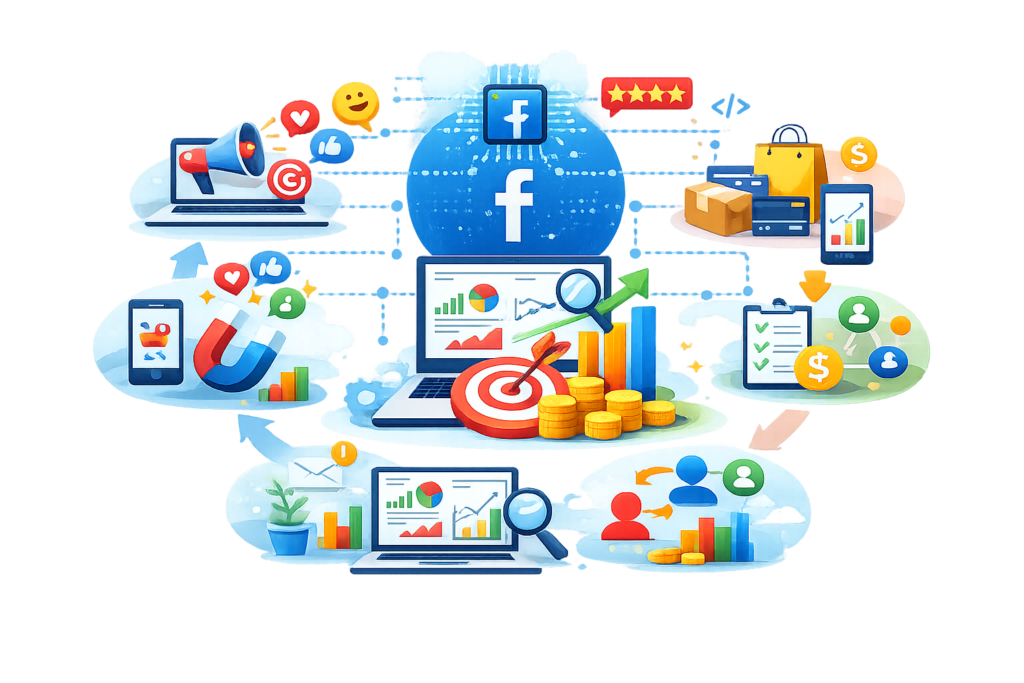
Successful advertising depends on accurate measurement. Without reliable tracking, advertisers are forced to rely on assumptions instead of real performance data. Facebook™ Ads become significantly more effective when paired with accurate conversion tracking because Meta’s optimization systems learn from user behavior and continuously improve campaign delivery. Businesses that fail to implement tracking properly often struggle to identify profitable campaigns, attribute conversions correctly, or optimize future advertising efforts.
One of the most important tracking tools available is the Meta Pixel. This small piece of code is installed on a website and records valuable visitor actions such as page views, product views, add-to-cart events, purchases, lead submissions, registrations, downloads, and other meaningful conversions. As users interact with a website, the Pixel sends anonymized event data back to Meta, allowing campaigns to optimize toward people who are most likely to complete desired actions.
Modern privacy regulations and browser changes have increased the importance of server-side tracking. To improve measurement accuracy, Meta recommends implementing the Conversions API, which sends conversion data directly from the server rather than relying solely on browser cookies. This approach helps maintain more reliable reporting while respecting user privacy preferences.
Businesses should also connect Facebook™ Ads with Google Analytics to obtain deeper insights into user behavior after advertisement clicks. While Meta provides campaign performance metrics, Google Analytics reveals how visitors engage with website content, navigate pages, spend time on-site, and ultimately convert. Combining insights from both platforms creates a more comprehensive understanding of customer behavior and marketing effectiveness. Official resources for implementation include:
Using multiple trusted measurement platforms ensures better decision-making while reducing the likelihood of relying on incomplete or misleading data.
A/B Testing: Turning Data Into Better Performance
Many advertisers make the mistake of changing several campaign elements simultaneously, making it impossible to determine what actually improved performance. A structured A/B testing strategy removes guesswork by evaluating one variable at a time. Over weeks and months, these incremental improvements compound into significantly higher conversion rates and lower advertising costs.
The most effective testing begins with a clear hypothesis. Instead of randomly creating multiple advertisements, businesses should identify a specific question they want to answer. For example, does a customer testimonial outperform a product demonstration video? Does a benefit-driven headline generate more clicks than a feature-focused headline? Does a shorter call-to-action produce higher conversion rates than a detailed explanation? Each experiment should isolate a single variable while keeping the remaining campaign settings consistent.
Creative testing remains one of the highest-impact optimization strategies. Images, videos, thumbnails, headlines, primary text, and calls to action all influence campaign performance differently depending on the target audience. Short-form videos may capture attention quickly, while carousel advertisements often perform well for showcasing multiple products or services. Testing different creative formats helps businesses understand how various audience segments respond throughout the buying journey.
Audience testing is equally valuable. Advertisers can compare broad targeting, interest-based audiences, Custom Audiences, and Lookalike Audiences to identify which segments generate the highest-quality leads or sales. Geographic targeting, age ranges, device types, and placement options should also be evaluated over time rather than assumed to perform equally.
Businesses should avoid ending tests prematurely. Meta’s optimization algorithms require sufficient data before reliable conclusions can be drawn. Waiting until campaigns exit the learning phase allows performance metrics to stabilize, resulting in more accurate decision-making. Documenting every experiment—including objectives, variables tested, outcomes, and future recommendations—creates a valuable knowledge base that improves campaign performance over the long term.
Scaling Winning Facebook™ Ads Campaigns
Once a campaign consistently delivers profitable results, the next objective is sustainable growth. Scaling should never involve simply doubling or tripling budgets overnight. Sudden increases often disrupt Meta’s optimization process, reset the learning phase, and lead to higher acquisition costs. Instead, successful advertisers scale methodically while preserving campaign efficiency.
The safest approach is vertical scaling, which involves gradually increasing campaign budgets. Many experienced advertisers recommend budget increases of approximately 15–20% every few days while carefully monitoring key performance indicators. This steady approach allows Meta’s machine learning system to adapt without causing dramatic fluctuations in delivery or conversion rates. If performance remains stable after several increases, additional scaling opportunities can be explored.
Horizontal scaling focuses on expanding reach rather than increasing spend on a single audience. Businesses can duplicate successful campaigns and introduce new audience segments, additional geographic regions, different placements, or fresh creative variations. This diversification reduces dependence on a single audience while creating new growth opportunities. Combining vertical and horizontal scaling often produces more sustainable long-term growth than relying on either strategy alone.
Creative refreshes also play a crucial role during scaling. Even high-performing advertisements eventually experience ad fatigue, where audiences become less responsive after repeated exposure. Monitoring frequency, engagement, and click-through rates helps advertisers identify when creative updates are needed. Rotating new visuals, headlines, offers, or video content keeps campaigns engaging while maintaining consistent brand messaging.
As campaigns grow, businesses should review performance regularly using reliable measurement tools. Official guidance on advertising best practices, optimization, and campaign management is available through Meta Business Help Center.
Advertisers can also expand their expertise through Meta Blueprint, which offers comprehensive educational resources covering campaign creation, optimization strategies, measurement, and advanced advertising techniques.
Finally, every scaling decision should be guided by data rather than assumptions. Regularly reviewing conversion trends, customer acquisition costs, lifetime customer value, and return on ad spend ensures that growth remains profitable instead of simply increasing advertising expenses.
Measuring ROI and Key Performance Metrics
Running Facebook™ Ads without measuring profitability is like driving without a dashboard. Businesses may see clicks, likes, and engagement, but those numbers alone do not reveal whether advertising is generating meaningful revenue. Effective marketers focus on metrics that connect ad spend directly to business outcomes, allowing them to identify profitable campaigns, eliminate waste, and scale successful strategies with confidence.
One of the most important metrics is Return on Ad Spend (ROAS), which measures how much revenue is generated for every dollar spent on advertising. For example, if a campaign spends $1,000 and produces $4,000 in sales, the ROAS is 4:1. While target ROAS varies by industry and profit margins, tracking this metric helps businesses evaluate overall campaign efficiency. Equally important is Cost Per Acquisition (CPA), which shows how much it costs to generate a lead, sale, booking, or other desired conversion. A campaign with a high ROAS but an unsustainably high CPA may still create profitability challenges.
Advertisers should also monitor Click-Through Rate (CTR), Conversion Rate, Frequency, Cost Per Click (CPC), and Customer Lifetime Value (CLV). CTR helps evaluate how compelling an ad is, while conversion rate reveals how effectively the landing page turns visitors into customers. Frequency indicates how often the same audience sees an ad; excessively high frequency can signal ad fatigue. CLV is particularly valuable because it helps businesses determine how much they can afford to spend on customer acquisition while remaining profitable over the long term.
To improve measurement accuracy, businesses should combine data from Meta Ads Manager with Google Analytics. Meta shows campaign-level advertising performance, while Google Analytics provides deeper insights into user behavior after the click. Together, these platforms create a more complete picture of the customer journey and support better strategic decisions.
Advanced Audience Optimization Strategies
Basic targeting can generate results, but advanced audience optimization often separates high-performing advertisers from average competitors. As campaigns collect data, businesses gain valuable insights into which audience segments produce the best leads, highest purchase values, and strongest long-term customer relationships. The goal is not simply to reach more people—it is to reach more of the right people.
One effective strategy is building value-based Lookalike Audiences from high-value customers rather than from all customers. By using purchase value data, Meta can identify new users who resemble the business’s most profitable buyers, not just its average buyers. This often improves ROAS because campaigns focus on acquiring customers with higher revenue potential.
Another powerful approach is funnel-based retargeting. Instead of showing the same ad to every website visitor, businesses can create separate audiences for product viewers, cart abandoners, video viewers, lead form openers, and previous customers. Each segment receives messaging tailored to its stage in the buying journey. For example, cart abandoners may see urgency-driven offers, while previous customers may receive upsell or cross-sell promotions.
Advertisers should also use exclusion audiences strategically. Excluding recent purchasers from prospecting campaigns prevents wasted spend and improves audience quality. Similarly, excluding low-intent visitors from conversion campaigns can help concentrate budgets on users who are more likely to buy.
Over time, audience performance should be reviewed regularly. Demographics, interests, geographic regions, devices, and placements rarely perform equally. Continuous optimization based on real conversion data allows businesses to refine targeting and improve efficiency as campaigns mature.
Facebook™ Ads Policies and Compliance
Many advertisers focus heavily on targeting and creative while overlooking platform policies. However, policy violations can lead to rejected ads, account restrictions, reduced delivery, or even permanent account suspension. Understanding Meta’s advertising rules is essential for maintaining long-term campaign stability and protecting business operations.
Meta’s policies are designed to promote safe, trustworthy, and non-deceptive advertising. Businesses should avoid misleading claims, unrealistic income promises, sensationalized language, before-and-after images that violate policy guidelines, and content that directly references sensitive personal attributes. Advertisements should present offers clearly, accurately, and transparently.
Special attention should be given to industries such as finance, health, employment, housing, and credit, which often face additional restrictions. Advertisers in regulated industries should review policy requirements carefully before launching campaigns.
Landing pages must also align with ad messaging. A common mistake is creating advertisements that promise one thing while directing users to a page with different information, excessive pop-ups, hidden fees, or poor user experience. Meta evaluates both the advertisement and the destination experience when assessing compliance.
Businesses should regularly review Meta Advertising Standards and stay informed about policy updates. Maintaining compliance not only reduces account risk but also improves user trust and campaign quality over time.
Integrating Facebook™ Ads With Your Sales Funnel
Facebook™ Ads are most effective when they are part of a complete customer acquisition system rather than isolated campaigns. Many businesses struggle because they send traffic directly to generic websites without a clear conversion path. A well-designed sales funnel guides users from awareness to consideration and ultimately toward a specific business outcome.
The first stage of the funnel focuses on awareness. Video ads, educational content, lead magnets, and valuable social content introduce the brand to new audiences and build initial trust. The second stage focuses on consideration, where businesses provide deeper information through case studies, webinars, product demonstrations, testimonials, or comparison content. The final stage focuses on conversion, using targeted offers, consultations, free trials, limited-time promotions, or purchase-focused campaigns to encourage action.
Retargeting plays a critical role throughout the funnel. Users who watched a video can be shown a lead-generation offer, while users who downloaded a guide can be invited to a consultation or product demo. This sequential messaging creates a more personalized experience and often produces higher conversion rates than repeatedly showing the same advertisement to every user.
Businesses looking to strengthen funnel performance can also explore related strategies such as Sales Funnel, Social Funnel, and Webinar Promos, which complement Facebook™ Ads by improving lead nurturing, audience engagement, and conversion optimization.
When advertising is integrated with a thoughtful funnel strategy, businesses gain more than clicks—they build predictable customer acquisition systems capable of generating consistent leads and sales over the long term.
Common Facebook™ Ads Mistakes and How to Avoid Them
Even experienced advertisers can make mistakes that reduce campaign performance and increase advertising costs. Fortunately, most of these issues are preventable with careful planning, consistent monitoring, and a commitment to data-driven optimization. Understanding the most common mistakes allows businesses to build stronger campaigns, improve return on investment, and create a better experience for potential customers.
One of the most common mistakes is launching campaigns without a clearly defined objective. Businesses often expect a single campaign to generate awareness, website traffic, leads, and sales simultaneously. Instead, each campaign should support one primary business goal and use the appropriate optimization settings within Meta Ads Manager. Aligning objectives with campaign strategy enables Meta’s machine learning to optimize delivery more effectively.
Another frequent mistake is targeting audiences that are either too broad or too narrow. Overly broad audiences may include users with little interest in the advertised product or service, while extremely narrow audiences can limit campaign reach and increase advertising costs. Businesses should continuously analyze audience performance, create high-quality Custom Audiences, develop Lookalike Audiences from valuable customer data, and refresh targeting strategies as campaigns mature.
Many advertisers also underestimate the importance of creative quality. Low-resolution images, weak headlines, generic ad copy, or videos that fail to capture attention within the first few seconds often produce poor engagement. Successful campaigns rely on compelling visuals, benefit-focused messaging, strong calls to action, and continuous creative testing. Refreshing creative assets regularly also helps prevent ad fatigue and maintains audience interest.
Ignoring conversion tracking is another costly mistake. Without accurate implementation of the Meta Pixel, Conversions API, and analytics tools, businesses cannot reliably measure campaign effectiveness or identify profitable optimization opportunities. Accurate tracking forms the foundation of every successful advertising strategy and should be verified before campaigns are launched.
Finally, many businesses make optimization decisions too quickly. Facebook™ Ads require sufficient learning time before reliable conclusions can be drawn. Making significant changes during the learning phase may reset optimization and reduce overall performance. Instead, advertisers should monitor trends over meaningful data sets and make incremental improvements based on evidence rather than assumptions.
By avoiding these common pitfalls, businesses can improve campaign efficiency, reduce wasted advertising spend, and create a more predictable customer acquisition process that supports sustainable growth.
Best Practices Summary for Long-Term Facebook™ Ads Success
Long-term success with Facebook™ Ads is not achieved through shortcuts or isolated tactics. It results from consistently applying proven best practices that prioritize customer experience, continuous learning, and measurable business outcomes. Businesses that treat advertising as an ongoing optimization process typically outperform competitors that rely on one-time campaign launches.
Begin every campaign with clearly defined business objectives and measurable key performance indicators. Whether the goal is lead generation, online sales, appointment bookings, or brand awareness, every campaign should support a specific outcome. Clear objectives simplify optimization and help marketers evaluate performance using meaningful business metrics rather than vanity metrics alone.
Invest time in audience research before launching campaigns. Understanding customer needs, motivations, purchasing behavior, and common objections enables advertisers to create highly relevant messaging that resonates with potential buyers. Combining prospecting audiences with strategic retargeting ensures businesses engage customers throughout every stage of the buying journey.
Prioritize creative excellence by producing high-quality images, videos, headlines, and persuasive ad copy. Regular A/B testing should become part of every advertising strategy. Even small improvements in creative performance can significantly increase conversion rates and reduce acquisition costs over time.
Maintain accurate conversion tracking using the Meta Pixel, Conversions API, Google Analytics, and Google Tag Manager. Reliable data supports informed decision-making and allows Meta’s optimization systems to deliver advertisements more efficiently. Businesses should also review campaign performance regularly, monitor key metrics, refresh creative assets, and adjust budgets gradually as profitable campaigns scale.
Finally, stay informed about platform updates, privacy regulations, and advertising policies. Continuous education enables marketers to adapt quickly to industry changes while maintaining compliant, high-performing campaigns. Long-term advertising success depends on consistency, testing, measurement, and a willingness to improve continuously.
Frequently Asked Questions
1. How much should I budget for Facebook™ Ads?
There is no universal budget that guarantees success because advertising costs vary based on industry, competition, audience size, campaign objectives, and geographic targeting. Small businesses often begin with a modest daily budget to collect performance data before increasing investment. The most important consideration is generating enough conversions to evaluate campaign effectiveness. As profitable campaigns emerge, budgets should be increased gradually while monitoring return on ad spend, cost per acquisition, and overall profitability.
2. How long does it take for Facebook™ Ads to produce results?
Results depend on campaign objectives, audience size, optimization settings, creative quality, and competition. Awareness campaigns may generate engagement almost immediately, while conversion-focused campaigns often require additional time for Meta’s learning phase to collect sufficient data. Businesses should avoid making significant changes too early and instead allow campaigns to stabilize before evaluating performance. Consistent optimization over several weeks generally produces more reliable long-term results than frequent adjustments made during the initial learning period.
3. Is Facebook™ Ads still effective despite increasing competition?
Yes. Although competition has increased, Facebook™ Ads remain one of the most sophisticated digital advertising platforms available. Success now depends more on campaign quality than simply participating in the platform. Businesses that combine audience research, compelling creative assets, accurate tracking, landing page optimization, and ongoing testing continue to achieve excellent results. The platform’s advanced machine learning capabilities also help advertisers identify high-value users who are most likely to convert.
4. Should I use automatic placements or manual placements?
For most advertisers, automatic placements provide better overall performance because Meta’s optimization systems distribute advertisements across Facebook, Instagram, Messenger, Reels, and Audience Network based on where conversions are most likely to occur. Manual placements may be useful for specialized campaigns or creative formats designed specifically for certain environments, but businesses should evaluate performance using real data before limiting placement options unnecessarily.
5. How important is the Meta Pixel for Facebook™ Ads?
The Meta Pixel is one of the most valuable tools available for advertisers because it enables accurate conversion tracking and campaign optimization. By recording actions such as page views, lead submissions, purchases, and other meaningful events, the Pixel helps Meta identify users who are most likely to complete similar actions in the future. This improves campaign efficiency, supports remarketing strategies, and provides valuable insights into customer behavior. Businesses that do not implement the Meta Pixel often lose important optimization opportunities and may struggle to measure advertising performance accurately.
6. What type of Facebook™ Ad creative performs best?
There is no single creative format that guarantees success for every business. Performance depends on the target audience, campaign objective, industry, and the stage of the customer journey. Short-form videos often perform exceptionally well for capturing attention, while carousel advertisements are effective for showcasing multiple products or features. High-quality images combined with persuasive copy can also generate excellent results. The best approach is to continuously test different creative formats, messaging styles, headlines, and calls to action to identify what resonates most with your audience.
7. How often should I optimize my Facebook™ Ads campaigns?
Campaigns should be monitored regularly, but optimization should be based on sufficient performance data rather than daily fluctuations. Reviewing key metrics every few days allows advertisers to identify trends without disrupting Meta’s learning process. Creative assets should be refreshed when engagement declines or ad frequency becomes excessively high. Budgets should be increased gradually for profitable campaigns, while underperforming ads should be analyzed to determine whether targeting, creative, bidding strategy, or landing page experience requires improvement.
8. Can small businesses compete successfully using Facebook™ Ads?
Absolutely. One of the greatest strengths of Facebook™ Ads is that businesses of every size can reach highly targeted audiences without requiring enterprise-level advertising budgets. Small businesses can focus on specific geographic areas, niche interests, local communities, or highly qualified customer segments to maximize advertising efficiency. By combining audience research, compelling creative, accurate tracking, and continuous optimization, smaller organizations can compete effectively against much larger competitors while maintaining profitable advertising campaigns.
Conclusion
Facebook™ Ads continue to be one of the most effective digital advertising solutions for businesses seeking predictable growth, qualified leads, and measurable sales. However, long-term success requires much more than launching advertisements. It demands strategic planning, detailed audience research, compelling creative assets, accurate conversion tracking, ongoing testing, careful budget management, and continuous optimization based on real performance data.
Throughout this guide, we explored every major component of a successful Facebook™ Ads strategy, including campaign planning, audience targeting, creative development, conversion tracking, A/B testing, campaign scaling, performance measurement, compliance with advertising policies, and integration with a complete sales funnel. Businesses that consistently apply these principles are better positioned to improve return on investment while creating meaningful experiences for their customers.
At MyFunnelScript, we believe successful advertising is built on strategy, transparency, and continuous improvement. Whether your goal is generating qualified leads, increasing online sales, promoting services, or expanding brand awareness, a structured Facebook™ Ads strategy can become a powerful driver of sustainable business growth. By following the best practices outlined in this guide and staying informed about industry developments, you can build advertising campaigns that deliver lasting value and measurable business results.
Want to Implement This Easily?
Prompt
You are an expert consultant. Based on the blog post titled “Facebook™ Ads”, provide a step-by-step, practical implementation guide. Include tools, best practices, common mistakes to avoid, and advanced tips. Assume the reader wants to implement everything discussed in this article effectively.
Call to Action
Want our help implementing this? Just reach out to us via our website contact form: