
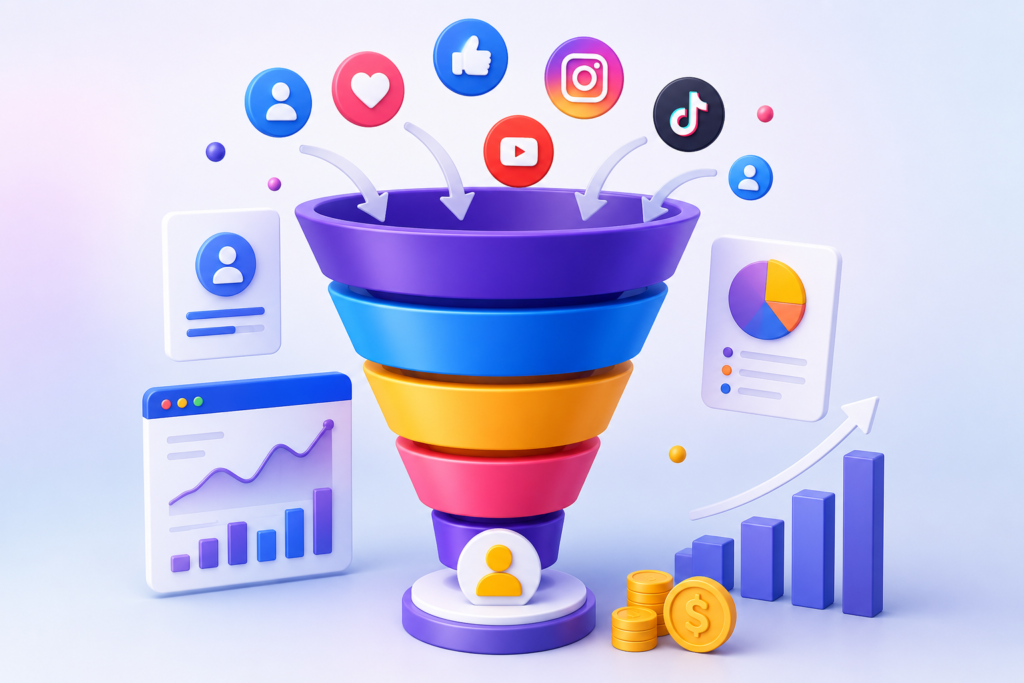
Learn how to build, optimize, and scale a high-converting social funnel that attracts qualified audiences, nurtures relationships, increases engagement, and drives predictable business growth through strategic social media marketing.
Introduction
Modern buyers rarely make purchasing decisions after seeing a single advertisement. Today’s customers research brands, consume content, compare alternatives, read reviews, and engage with businesses across multiple social platforms before committing to a purchase. This behavioral shift has made traditional sales tactics less effective and significantly increased the importance of creating structured customer journeys.
A social funnel serves as a strategic framework that guides prospects from initial awareness to becoming loyal customers through carefully planned interactions on social media channels. Instead of relying solely on direct promotions, businesses can nurture relationships, educate audiences, and establish trust over time. The result is often higher conversion rates, stronger customer retention, and improved return on marketing investment.
At MyFunnelScript, businesses understand that successful marketing is built on systems rather than isolated campaigns. A properly designed social funnel allows organizations to create repeatable processes that continuously generate leads, engage prospects, and drive revenue growth while adapting to changing consumer behaviors. Businesses seeking to improve online visibility and align with search best practices should review Google Search Essentials, which provides guidance on creating useful, people-first content.
What is a Social Funnel?
A social funnel is a customer acquisition and conversion system that uses social media platforms to move users through distinct stages of the buying journey. Unlike traditional marketing funnels that depend heavily on email sequences or paid advertisements, social funnels leverage social interactions, content consumption, engagement signals, and community building to influence purchasing decisions.
Most social funnels include several key stages. The awareness stage introduces potential customers to a brand through educational content, entertaining videos, informative posts, and social conversations. During the consideration stage, prospects engage more deeply by consuming case studies, testimonials, webinars, or downloadable resources. The decision stage encourages users to take action, whether that means scheduling consultations, purchasing products, or signing up for services.
Businesses often mistakenly assume that posting regularly on social media automatically leads to sales. However, successful social funnels require strategic planning, audience segmentation, personalized messaging, and continuous optimization. Every interaction should serve a purpose and guide users toward meaningful engagement.
Why Social Funnels Matter in Modern Marketing
Consumer behavior has changed dramatically over the last decade. Buyers now expect brands to provide value before asking for a sale. Social media platforms have become research tools, communication channels, and trust-building environments where purchasing decisions frequently begin.
A social funnel enables businesses to meet customers where they spend significant amounts of their time. Rather than interrupting audiences with aggressive promotions, companies can educate, inspire, and entertain users while gradually introducing products or services. This approach creates stronger emotional connections and improves brand perception.
Another major advantage is scalability. Once businesses identify successful funnel strategies, they can replicate campaigns, automate nurturing sequences, and expand their reach across multiple platforms. This systematic approach creates more predictable lead generation and sustainable long-term growth opportunities.
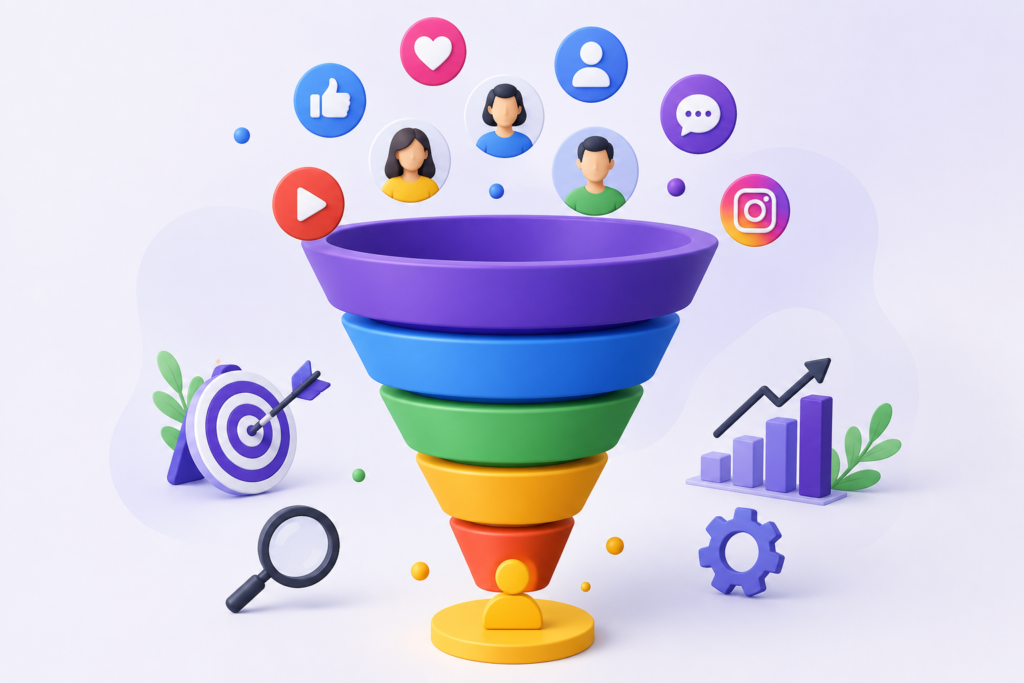
Understanding the Five Stages of a Social Funnel
Every effective social funnel follows a progression that mirrors human decision-making behavior. Understanding these stages allows marketers to create content that addresses specific audience needs at each step.
The first stage is awareness. Here, businesses focus on attracting attention through educational articles, engaging videos, infographics, social posts, and industry insights. Content should solve small problems while positioning the brand as a trusted resource.
The second stage is engagement. Users begin interacting with content through likes, comments, shares, polls, and direct messages. The goal is building familiarity and encouraging deeper participation. Brands can use live streams, community discussions, and interactive experiences to strengthen relationships.
The third, fourth, and fifth stages include lead generation, conversion, and customer advocacy. Prospects exchange contact information for valuable resources, make purchases, and eventually become loyal supporters who recommend products to others. Strong social funnels continue engaging customers long after the initial transaction.
Identifying Your Ideal Social Funnel Audience
Audience research remains one of the most critical components of funnel success. Without understanding customer motivations, marketers risk creating irrelevant content that fails to resonate.
Start by examining demographic characteristics such as age, profession, geographic location, education level, and income range. Behavioral insights are equally important because they reveal buying habits, content preferences, platform usage, and engagement patterns.
Social listening tools provide valuable information about audience conversations, challenges, and emerging trends. Businesses can monitor comments, review discussions, analyze competitors, and identify frequently asked questions to uncover opportunities.
Building detailed customer personas helps marketers tailor messaging more effectively. Instead of targeting broad audiences, brands can develop highly personalized campaigns that speak directly to individual pain points, goals, and aspirations.
Choosing the Right Social Media Platforms
Not every social media platform delivers the same results for every business. Selecting appropriate channels significantly impacts funnel performance and marketing efficiency.
Professional service providers often find success on platforms that support thought leadership and business networking. Visual brands may perform better on image-focused communities. Educational companies frequently benefit from video-based platforms where detailed demonstrations and tutorials thrive.
Businesses should evaluate audience behavior before investing heavily in content production. Important considerations include average engagement rates, advertising opportunities, organic reach potential, and platform demographics.
Diversification can also improve funnel resilience. Relying entirely on a single platform increases risk because algorithm changes may reduce visibility overnight. Maintaining a presence across several relevant channels creates greater stability and expands growth opportunities.
Creating Awareness Content That Attracts Prospects
The awareness stage serves as the foundation of every successful social funnel. If businesses fail to attract attention, the remaining stages cannot function effectively.
Educational content performs particularly well because it addresses immediate audience concerns. Tutorials, industry trends, actionable tips, research findings, and problem-solving guides establish expertise while encouraging users to follow brand accounts.
Storytelling also enhances awareness efforts. Sharing authentic experiences, customer journeys, lessons learned, and behind-the-scenes insights helps humanize brands and build emotional connections. Audiences often remember stories longer than promotional messages.
Consistency remains essential throughout awareness campaigns. Publishing high-quality content regularly increases visibility, strengthens brand recognition, and creates multiple opportunities for prospects to discover businesses organically.
Developing Engagement Strategies That Build Trust

Trust is often the most valuable asset within a social funnel. Without trust, audiences hesitate to share personal information, join communities, or make purchases.
Engagement strategies should prioritize meaningful interactions rather than vanity metrics. Responding promptly to comments, participating in discussions, hosting question-and-answer sessions, and acknowledging customer feedback demonstrate authenticity and accessibility.
User-generated content provides another powerful trust-building mechanism. Encouraging customers to share experiences, reviews, photos, and testimonials offers social proof that influences future buyers. People tend to trust recommendations from peers more than brand advertisements.
Businesses that invest time in relationship building frequently experience stronger customer loyalty, increased referral rates, and improved lifetime value compared to organizations focused solely on short-term conversions.
Lead Magnets That Strengthen Social Funnel Performance
Once audiences begin engaging with content, businesses should provide opportunities for prospects to move deeper into the funnel. One of the most effective methods is offering lead magnets that solve immediate challenges while demonstrating expertise. A lead magnet acts as an exchange of value, where users willingly share contact information in return for resources that help them achieve a goal or overcome a problem.
High-performing lead magnets often include downloadable guides, templates, checklists, calculators, webinars, industry reports, free consultations, mini-courses, or exclusive communities. The best offers address highly specific pain points rather than broad topics. Instead of a generic marketing guide, a business might provide a checklist for improving social engagement rates within thirty days. Specificity typically increases perceived value and conversion rates.
The user experience surrounding lead magnets is equally important. Landing pages should communicate benefits clearly, forms should remain simple, and follow-up messages should deliver promised resources immediately. By reducing friction throughout the process, businesses can capture more qualified leads and establish positive first impressions that support long-term relationship building.
Using Social Proof to Increase Conversions
People often rely on the experiences and opinions of others when making purchasing decisions. Social proof reduces uncertainty and provides reassurance that products or services deliver meaningful results. Integrating social proof into a social funnel can significantly improve conversion rates while strengthening credibility.
Testimonials remain one of the most widely used forms of social proof. However, businesses should move beyond generic praise and focus on measurable outcomes. Statements describing increased revenue, improved efficiency, or reduced costs carry greater persuasive power. Video testimonials can further enhance authenticity because viewers can observe genuine emotions and experiences.
Case studies also provide substantial value. A well-structured case study explains the customer’s challenge, outlines the implemented solution, and highlights achieved results. Sharing customer milestones, user-generated content, industry recognition, certifications, and media mentions can further reinforce trust and demonstrate expertise. Social proof works best when incorporated naturally throughout the funnel rather than concentrated solely near checkout pages.
Leveraging Automation Within a Social Funnel
As businesses grow, manually managing every interaction becomes increasingly difficult. Automation allows marketers to maintain personalized experiences while improving efficiency and scalability. When implemented strategically, automation supports relationship building without sacrificing authenticity.
Automated messaging sequences can welcome new followers, distribute educational resources, and nurture leads based on user behavior. Businesses may segment audiences according to interests, engagement history, or purchase activity, ensuring individuals receive relevant communications tailored to their needs. This targeted approach enhances user experiences while increasing the likelihood of conversions.
Scheduling tools, customer relationship management systems, chatbot integrations, and analytics platforms help streamline repetitive tasks. Nevertheless, organizations should avoid over-automation. Excessive reliance on automated responses may create impersonal experiences that weaken customer relationships. Successful businesses typically combine automation with genuine human interaction to maintain trust and encourage meaningful engagement.
Measuring Key Performance Indicators in a Social Funnel
A social funnel should never operate without measurable objectives. Tracking performance metrics enables businesses to identify strengths, uncover weaknesses, and optimize campaigns continuously. Data-driven decision-making often produces better results than relying solely on assumptions or intuition.
Awareness metrics commonly include reach, impressions, profile visits, follower growth, and content views. Engagement indicators such as comments, shares, click-through rates, and video completion percentages reveal how audiences interact with published content. Monitoring these figures helps marketers determine which content formats resonate most effectively.
Further down the funnel, businesses should evaluate lead generation rates, cost per acquisition, conversion percentages, customer lifetime value, and retention statistics. Comparing these metrics over time allows organizations to refine messaging, improve targeting, and allocate resources more efficiently. Regular performance reviews ensure funnels remain aligned with evolving business goals and changing market conditions.
Scaling a Social Funnel for Sustainable Growth
After identifying a profitable social funnel model, businesses can begin scaling operations to reach larger audiences and generate increased revenue. Scaling requires careful planning because rapid expansion without adequate infrastructure can negatively affect customer experiences.
Content repurposing represents an efficient scaling strategy. A single webinar can become blog articles, social media posts, short-form videos, email campaigns, infographics, and downloadable resources. Repurposing extends content lifespan while maximizing return on investment from original assets.
Paid advertising can also accelerate growth. Businesses may amplify high-performing organic content, retarget engaged users, and test lookalike audiences to attract prospects similar to existing customers. Continuous experimentation, combined with data analysis, enables marketers to identify opportunities for expansion while maintaining profitability.
Common Mistakes Businesses Make With Social Funnels
Many organizations invest substantial resources into social media marketing but fail to achieve desired outcomes due to avoidable mistakes. Understanding these common challenges helps businesses create stronger funnel strategies and minimize wasted effort.
One frequent mistake involves focusing exclusively on selling. Constant promotional messaging often alienates audiences and reduces engagement. Social media users generally seek entertainment, education, inspiration, and connection rather than continuous advertisements. Businesses that prioritize value creation tend to foster stronger relationships and higher conversion rates.
Another issue is inconsistency. Sporadic posting schedules and irregular communication patterns make it difficult to build momentum and maintain audience interest. Businesses should establish content calendars and publishing routines that support long-term visibility. Additionally, neglecting analytics prevents marketers from understanding campaign effectiveness, making optimization nearly impossible.
Poor audience targeting also limits results. Attempting to appeal to everyone frequently leads to generic messaging that resonates with few individuals. Businesses should invest time in audience research and segmentation to create more personalized experiences that align with customer expectations and motivations.
Best Practices for Building an Effective Social Funnel
Developing a high-performing social funnel requires a combination of strategic planning, audience understanding, and continuous refinement. Businesses that consistently apply proven practices often experience stronger engagement, improved conversion rates, and sustainable long-term growth.
First, prioritize audience value above promotional objectives. Educational resources, actionable insights, entertaining content, and authentic conversations help establish trust while positioning brands as reliable sources of information. Value-driven marketing frequently produces more meaningful relationships than aggressive sales tactics.
Second, maintain consistency across messaging, visual branding, and customer experiences. Prospects should encounter a cohesive identity regardless of the platform they use. Consistent communication reinforces brand recognition and strengthens credibility throughout the funnel journey.
Finally, adopt a mindset of ongoing experimentation. Consumer behaviors evolve, platform algorithms change, and competitive landscapes shift regularly. Testing headlines, creative formats, calls to action, audience segments, and content schedules enables businesses to adapt quickly and uncover new growth opportunities.
Best Practices Summary
- Define clear funnel objectives before launching campaigns.
- Develop detailed customer personas.
- Publish educational and engaging content consistently.
- Use lead magnets to capture qualified prospects.
- Incorporate testimonials and case studies strategically.
- Balance automation with authentic human interaction.
- Monitor analytics regularly and optimize campaigns continuously.
- Repurpose successful content across multiple channels.
- Diversify platform presence to reduce dependency risks.
- Focus on building long-term relationships rather than pursuing quick sales.
Frequently Asked Questions
1. What is the primary purpose of a social funnel?
The primary purpose of a social funnel is to guide potential customers through a structured journey that begins with awareness and progresses toward conversion, loyalty, and advocacy. It helps businesses build relationships before requesting a sale.
2. How long does it take to see results from a social funnel?
Results vary depending on industry, audience size, content quality, and promotional efforts. Some businesses observe improvements within weeks, while others require several months to establish momentum and generate predictable outcomes.
3. Which social media platform works best for funnels?
There is no universal answer. The most effective platform depends on audience demographics, business objectives, and content preferences. Businesses should select platforms where their ideal customers spend the most time.
4. Are paid advertisements necessary for social funnels?
Paid advertising is not always necessary, but it can accelerate growth, improve targeting capabilities, and support scaling efforts. Many businesses combine organic and paid strategies for optimal performance.
5. Can small businesses benefit from social funnels?
Yes. Social funnels often provide significant advantages for small businesses because they enable relationship building, targeted communication, and cost-effective lead generation without requiring massive advertising budgets.
6. How frequently should content be published?
Consistency matters more than volume. Businesses should establish realistic publishing schedules that they can maintain over time while ensuring content quality remains high.
7. What metrics should businesses prioritize?
Important metrics include reach, engagement rates, click-through percentages, lead generation performance, conversion rates, customer lifetime value, and retention statistics.
8. How often should social funnels be optimized?
Funnels should be reviewed regularly. Monthly evaluations are common, although high-volume campaigns may benefit from weekly performance assessments and testing initiatives.
Conclusion
A well-designed social funnel is more than a marketing tactic; it is a scalable business system that nurtures relationships, strengthens trust, and generates predictable growth opportunities. By understanding customer behavior, creating meaningful content, leveraging social proof, implementing automation thoughtfully, and monitoring key performance indicators, businesses can transform social media activities into sustainable revenue-generating assets.
Organizations that embrace strategic funnel development often outperform competitors relying solely on short-term promotional campaigns. Success comes from delivering value consistently, adapting to audience needs, and continuously improving every stage of the customer journey. At MyFunnelScript, businesses seeking long-term growth can benefit from adopting structured social funnel methodologies that prioritize customer experiences while driving measurable business outcomes.
Want to Implement This Easily?
Prompt Text:
You are an expert consultant. Based on the blog post titled “Social Funnel”, provide a step-by-step, practical implementation guide. Include tools, best practices, common mistakes to avoid, and advanced tips. Assume the reader wants to implement everything discussed in this article effectively.
Call to Action:
Want our help implementing this? Just reach out to us via our website contact form: https://buywith.thrivecart.com/full-sales-funnel-templates/