
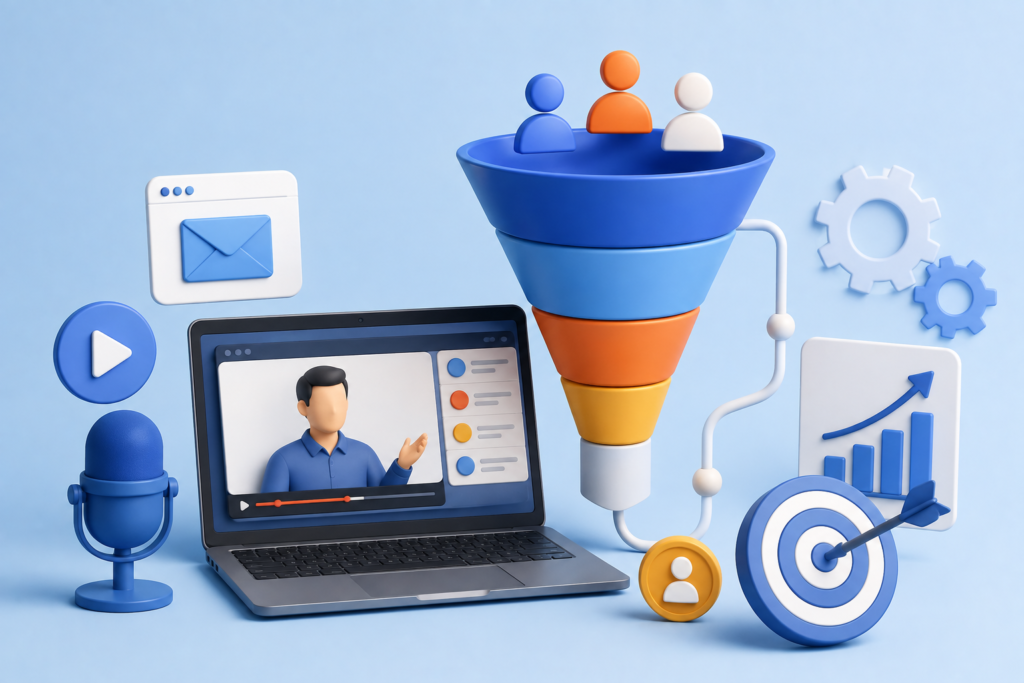
Learn how webinar funnels attract qualified leads, build trust, increase engagement, nurture prospects, and turn webinar attendees into customers through a strategic conversion journey.
Introduction
A webinar can be one of the most effective ways to educate potential customers, demonstrate expertise, overcome objections, and introduce a relevant product or service. However, simply hosting a webinar does not automatically create leads or sales. The real opportunity comes from connecting the webinar to a carefully planned webinar funnel that guides prospects from their first interaction through registration, attendance, engagement, follow-up, and conversion.
For businesses that already use Sales Funnels, a webinar can become a powerful educational layer within the customer journey. Instead of asking a prospect to make an immediate purchasing decision, the webinar creates an opportunity to explain a complex problem, demonstrate possible solutions, answer common questions, and establish credibility before presenting an offer.
This makes webinar funnels particularly useful for consultants, coaches, agencies, educators, software companies, course creators, professional service providers, and businesses selling products or services that require explanation before purchase. A well-designed webinar funnel can combine content marketing, email automation, landing pages, social promotion, paid traffic, sales messaging, and customer nurturing into one connected system.
The concept is simple, but execution matters.
A successful funnel must attract the right audience rather than simply generate large numbers of registrations. The registration page needs to communicate a clear and credible reason to attend. Reminder emails need to maintain interest without becoming annoying. The webinar needs to deliver genuine educational value. The offer needs to be relevant to what the audience has just learned. Finally, follow-up communication needs to help prospects make an informed decision rather than simply repeat the same sales pitch.
This guide explains how to build a webinar funnel from the ground up, how the different stages work together, how to improve registration and attendance, how to structure webinar content, how to connect the presentation to the offer, and how to measure the complete customer journey.
For businesses looking for a structured approach to ready-made marketing assets, Webinar Promos can also form part of the promotional side of the funnel, while Nurture Emails can support the relationship-building stage after registration.
The objective throughout should remain the same: create a useful experience for the prospect while building a measurable path toward the right business outcome.
What Is a Webinar Funnel?
A webinar funnel is a structured marketing and conversion journey that uses a webinar as a central educational experience. The funnel typically begins when a prospect discovers a webinar through search, advertising, social media, email, content marketing, referral traffic, or another acquisition channel. The prospect then reaches a registration page, submits their information, receives confirmation and reminders, attends the webinar, interacts with the content, evaluates an offer, and eventually takes the next appropriate action.
That action can vary depending on the business model. A software company may want the prospect to start a free trial or book a demonstration. A consultant may want the prospect to schedule a discovery call. A coach may direct the prospect toward an application. An e-commerce business might present a product offer. A course creator may invite the attendee to purchase a training program.
Therefore, a webinar funnel is not simply a webinar registration page.
It is a complete customer journey.
A typical structure can look like this:
Traffic → Registration → Confirmation → Reminder → Attendance → Education → Offer → Follow-Up → Conversion
Every stage has a different purpose.
The traffic stage generates awareness and attracts potential prospects. The registration page turns relevant visitors into identifiable leads. Confirmation and reminder communication increase the likelihood that registrants actually attend. The webinar creates the educational experience. The offer introduces a relevant solution. Follow-up helps prospects who are not ready to make an immediate decision. Conversion represents the desired business action.
The relationship between these stages is important because weakness in one part of the journey can reduce the performance of the entire system.
For example, a company might generate thousands of visitors but have a poor registration page. Another business might have an excellent registration rate but very low attendance. A third company might have excellent attendance but a weak offer. Another might generate strong webinar engagement but fail to follow up with prospects after the presentation.
The funnel therefore needs to be evaluated as a connected system rather than as a collection of individual pages.
A strong webinar funnel also respects the prospect’s intent.
Someone who has just discovered your business may need educational information before they are willing to register. Someone who has registered may need reassurance that the event will be worth their time. Someone who attended the webinar may need more evidence before purchasing. Someone who has already purchased needs onboarding rather than additional sales pressure.
This progression makes webinar funnels particularly useful for high-consideration purchases.
When a product or service is complicated, expensive, unfamiliar, or dependent on trust, prospects often need more information before they feel comfortable moving forward.
A webinar provides the space to deliver that information.
The goal is not to pressure every visitor into becoming a customer.
The goal is to help qualified prospects move from awareness to understanding, understanding to confidence, and confidence to action.
Why Webinar Funnels Are Effective for Lead Generation
Traditional lead generation often depends on short interactions. A visitor sees an advertisement, reads a headline, fills out a form, and becomes a lead. While this can work, the resulting lead may have limited understanding of the problem or the business offering the solution.
A webinar introduces a deeper educational stage.
Instead of immediately asking the prospect to buy, the business can teach. It can explain the problem, demonstrate why common approaches fail, introduce a practical framework, provide examples, and show how a better process works.
This can create a stronger foundation for the sales conversation.
Imagine a business selling marketing automation software. A prospect may understand that automation is useful but may not know which processes to automate, how segmentation works, how lead scoring should be configured, or how automated campaigns should connect with a CRM.
A webinar can explain these concepts.
By the end of the presentation, the prospect may understand the problem more clearly and recognize that implementing the solution requires tools, strategy, or expertise.
That is where the commercial opportunity becomes more natural.
The webinar has not merely generated an email address.
It has created context.
Context can be extremely valuable because prospects rarely purchase solely because a company exists. They purchase because they understand a problem, believe a solution is appropriate, trust the organization offering it, and feel that the expected value justifies the investment.
Webinars can contribute to each of these factors.
They can demonstrate expertise through practical teaching.
They can build trust by answering questions.
They can create authority by explaining complex concepts clearly.
They can reduce uncertainty by showing how a solution works.
They can also reveal behavioral signals.
A person who registers but never attends has demonstrated some interest. Someone who attends for five minutes demonstrates another level of engagement. Someone who watches most of the presentation and clicks the offer has demonstrated stronger intent.
This allows businesses to create more relevant follow-up.
For example:
Registered but absent: Send replay information.
Attended briefly: Send key lessons and replay access.
Watched most of the webinar: Provide additional offer information.
Clicked the offer: Address common objections.
Started an application: Encourage completion.
Purchased: Move immediately into onboarding.
This segmentation makes the funnel more responsive to actual behavior.
Google’s own Google Search Essentials emphasizes technical requirements, spam policies, and key practices that help content become eligible to appear in Google Search.
The broader lesson is useful for webinar marketers too: optimization should not be based on manipulation.
The same principle applies to lead generation.
Do not create exaggerated webinar promises simply to increase registrations. Do not use misleading headlines to attract people who are unlikely to benefit. Do not disguise a sales presentation as something entirely different.
Instead, attract people who genuinely need the information.
When the audience and topic are aligned, the quality of the lead can matter much more than the raw registration number.
The Main Stages of a High-Converting Webinar Funnel
A webinar funnel can contain many components, but the most important stages are usually consistent.
The first stage is traffic acquisition.
Traffic can come from organic search, social media, paid advertising, email marketing, partnerships, referrals, YouTube, podcasts, communities, or existing customers. The best source depends on the target audience and the subject of the webinar.
The second stage is the registration page.
This page should explain the webinar clearly and provide a compelling reason for the right visitor to register. It should answer basic questions quickly:
What is the webinar about?
Who is it for?
What will attendees learn?
Why should they trust the presenter?
When is the webinar?
How can they register?
The third stage is confirmation and preparation.
Once a person registers, the business should confirm the registration and provide the information required to attend. Calendar details, event access, preparation instructions, and useful pre-webinar material can all help maintain interest.
The fourth stage is reminder communication.
Registrations do not guarantee attendance. People become busy, forget events, lose emails, or simply change priorities. Strategic reminders help maintain awareness.
The fifth stage is the webinar presentation.
This is the educational core of the funnel. The presentation should deliver on the promise made during registration.
The sixth stage is the commercial offer.
The offer should represent a logical next step based on what the attendee has learned.
The seventh stage is follow-up.
People who do not buy immediately should continue receiving useful and relevant communication.
Finally, the funnel enters the measurement and optimization stage.
Businesses should examine where prospects enter, where they engage, where they leave, and where they convert.
A simplified model looks like:
Attract → Register → Prepare → Attend → Learn → Evaluate → Act → Nurture
Each transition can have its own conversion rate.
For example, a funnel might have excellent traffic but poor registration performance. That suggests the registration experience needs attention.
Another funnel might have a strong registration rate but weak attendance. The problem may be event positioning, reminders, scheduling, or audience quality.
Another might have excellent attendance but poor engagement. That could indicate that the presentation is too long, too generic, or poorly aligned with the registration promise.
A business with strong engagement but weak sales may need to examine its offer, pricing, sales page, checkout, qualification process, or post-webinar follow-up.
This stage-by-stage approach makes optimization much more practical.
Instead of asking, “Why isn’t my webinar working?” the marketer can ask:
Which transition in the funnel is underperforming?
That question produces a much more actionable answer.
How to Choose a Webinar Topic That Attracts the Right Audience
The webinar topic is one of the most important strategic decisions because it affects almost everything that follows.
A weak topic can make an excellent funnel look unsuccessful.
If the audience does not care about the subject, improving the registration button will not solve the underlying problem.
The strongest webinar topics are generally connected to a meaningful problem, desired result, strategic opportunity, or decision that the target audience already cares about.
Compare these two titles:
Our Digital Marketing Webinar
and:
How to Build a Lead Generation System That Turns More Website Visitors Into Qualified Prospects
The second title gives the audience more information.
It identifies a problem and suggests a meaningful outcome.
Specificity helps prospects determine whether the webinar is relevant to them.
When selecting a topic, start with real customer questions.
Look at sales calls.
Review support questions.
Study conversations with existing customers.
Analyze frequently asked questions.
Look at objections.
Review the questions people ask before purchasing.
Search for recurring problems.
The best webinar ideas often come from questions that prospects repeatedly ask.
The topic should also match the audience’s level of awareness.
A beginner may want:
How to Build Your First Sales Funnel
An experienced marketer may prefer:
How to Optimize Funnel Drop-Off Points and Improve Qualified Conversion Rates
Both can be valuable, but they serve different audiences.
Trying to make one webinar appropriate for everyone can make the content too broad.
A strong webinar also needs problem-solution alignment.
If the eventual offer is a sales funnel service, the webinar should discuss a problem that naturally connects to sales funnels.
If the offer is email automation, the webinar should teach something related to nurturing and automation.
If the offer is consulting, the webinar can explain the framework that demonstrates why expert implementation may be valuable.
This does not mean the webinar should become a disguised advertisement.
The educational content should stand on its own.
Google’s SEO Starter Guide recommends creating useful, well-organized, unique content and using descriptive link text so users and search engines can understand linked resources.
The same mindset can improve webinar topic selection.
Create a topic because it helps people, not simply because it contains a keyword.
Keywords can help identify demand and search intent, but they should not dictate the entire educational strategy.
A webinar topic should ultimately answer one question:
What meaningful problem can this session help the right audience understand or solve?
Once that question has a strong answer, promotion and conversion become much easier.
Designing a Webinar Registration Page That Converts
The registration page is the gateway into the webinar funnel.
Every promotional source ultimately needs to lead visitors somewhere, and for most webinar campaigns, that destination is the registration page.
The primary objective is simple:
Convince the right visitor that registering is worth their time.
The page should communicate the webinar’s value quickly.
The headline should explain the primary benefit or problem.
The supporting copy should clarify what the webinar covers.
The benefit section should identify useful takeaways.
The presenter section should establish appropriate credibility.
The event details should eliminate uncertainty.
The registration form should make the next action easy.
The call to action should be obvious.
For example, a weak headline might say:
Join Our Upcoming Webinar
A stronger headline could say:
Discover the Practical Framework for Building a Webinar Funnel That Generates and Nurtures Qualified Leads
The second version tells the visitor more about the experience.
Benefits should also be specific.
Instead of:
Learn valuable strategies
use:
Discover how to structure your registration page, reminder sequence, webinar presentation, and follow-up campaign.
Specificity improves clarity.
The registration form should also be appropriate to the funnel.
If the business only needs an email address to deliver the webinar, asking for ten additional fields may create unnecessary friction.
If the webinar is for a high-value consulting service, a small amount of qualification may be justified.
The principle is simple:
Ask for information because you need it, not because you can collect it.
Trust elements can also help.
Depending on the business, these may include presenter credentials, relevant experience, genuine testimonials, customer examples, professional associations, or recognizable clients where permission exists.
However, credibility elements should be truthful.
Do not manufacture testimonials.
Do not create fake statistics.
Do not imply certifications that do not exist.
The page should also work well on mobile devices.
A visitor should be able to read the headline, understand the offer, complete the form, and submit it without struggling with tiny text or awkward controls.
Performance matters too.
Google’s Core Web Vitals measure real-world aspects of user experience including loading performance, responsiveness, and visual stability. Google recommends aiming for good Core Web Vitals to support a strong user experience.
That makes page performance relevant not only to SEO but also to conversion.
If the page takes too long to load, a prospect may leave before seeing the offer.
If images shift the layout while the visitor is trying to click the registration button, the experience becomes frustrating.
If a form is difficult to use on mobile, registrations can be lost.
A high-converting registration page therefore combines:
Clear messaging + relevant benefits + credibility + simple registration + strong UX + technical reliability.
Building Trust Between Registration and Webinar Attendance
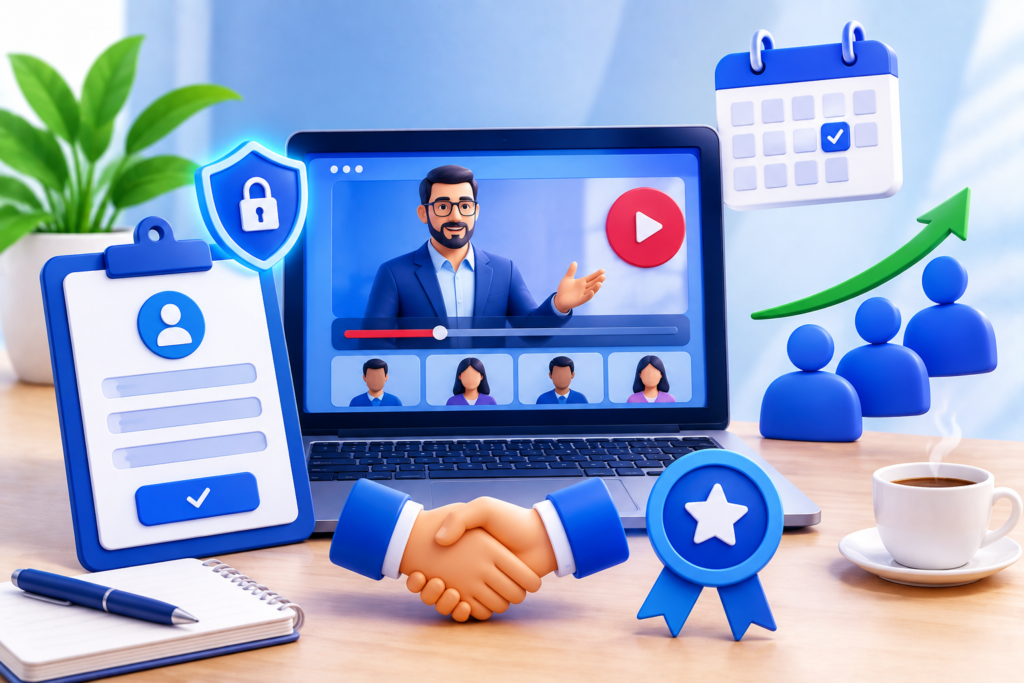
Getting someone to register is only the beginning.
The next challenge is getting that person to actually attend.
A registered prospect may forget the event, lose the confirmation email, become distracted, or decide that the webinar is no longer relevant.
This is why the period between registration and attendance should be treated as its own funnel stage.
Immediately after registration, the prospect should receive a clear confirmation.
The confirmation should explain:
- That registration was successful
- When the webinar takes place
- How to access it
- What they will learn
- Whether they need to prepare anything
- How they can add the event to their calendar
The message should reduce uncertainty.
Then reminder communication can gradually reinforce the value of attending.
A reminder should not simply say:
Don’t forget about our webinar.
It can instead remind the prospect why the webinar matters.
For example:
During the session, we’ll show you how the registration, presentation, and follow-up stages work together—and where most webinar funnels lose potential customers.
That reminder reinforces the learning outcome.
Another effective approach is to provide a small piece of useful information before the webinar.
This creates anticipation.
For example, the business could share one common mistake that attendees should avoid and explain that the webinar will explore a complete framework for solving the larger problem.
This is different from giving away the entire webinar.
The goal is to establish relevance.
Calendar invitations can also make attendance easier because the event becomes part of the prospect’s schedule rather than remaining buried inside an inbox.
The number and timing of reminders should depend on the audience, event type, and registration behavior.
Too few reminders can create no-shows.
Too many can create irritation.
The communication should feel helpful rather than intrusive.
Trust also depends on accuracy.
If the registration page promises a practical workshop, the webinar should be practical.
If it promises a particular topic, the presentation should actually address that topic.
If the event is recorded, do not misrepresent it as live.
If the webinar contains a sales presentation, it is better to communicate that transparently than to create misleading expectations.
The prospect should feel that the business respects their time.
This is especially important because webinar funnels often involve multiple communication points.
The more messages someone receives, the more important relevance becomes.
A good principle is:
Every message should either help the prospect prepare, learn, decide, or take an appropriate next step.
If an email does none of those things, it may not need to be sent.
Creating a Webinar Presentation That Educates and Converts
The webinar itself is the central experience of the funnel.
A registration page can create curiosity, but the presentation must justify the prospect’s decision to attend.
The strongest webinars generally combine education, structure, examples, credibility, and a logical commercial transition.
Start by establishing the problem.
Explain why the subject matters.
Show the consequences of ignoring the problem.
Then clarify the common approaches that often fail.
After that, introduce your framework or solution.
A useful webinar framework might contain three or four major principles rather than dozens of disconnected tips.
For example:
Attract the right audience.
Convert attention into registration.
Turn attendance into engagement.
Use follow-up to create conversion opportunities.
Each principle can then be supported with examples.
This makes the presentation easier to follow and remember.
Practical examples are especially valuable.
Instead of simply saying that a registration page needs a strong headline, show what a vague headline looks like and explain how a more specific headline improves clarity.
Instead of saying that follow-up matters, explain how different messages can be used for attendees and non-attendees.
Instead of saying that the offer should match the webinar, demonstrate how a logical transition works.
This creates a more useful educational experience.
The presenter should also establish credibility without spending excessive time talking about themselves.
Credentials matter when they are relevant.
Experience matters when it helps explain why the recommendations are trustworthy.
Case studies can be powerful when they are accurate and presented with appropriate context.
Avoid unsupported claims.
Avoid guaranteeing specific financial results.
Avoid presenting one customer’s outcome as if it is inevitable for everyone.
A strong presentation also manages attention.
The audience should understand where they are in the presentation.
Transitions help.
For example:
We’ve now established why registration matters. Next, let’s look at the stage that determines whether those registrations actually become attendees.
That sentence creates continuity.
The commercial transition should work the same way.
After teaching the audience what needs to happen, explain the implementation challenge.
The prospect may now understand the strategy but recognize that executing it requires time, tools, copywriting, technology, testing, and experience.
The offer can then be presented as an appropriate way to accelerate implementation.
This creates a natural bridge:
Education → Understanding → Implementation Gap → Relevant Solution
The webinar does not need to hide the fact that a sale may occur.
It simply needs to earn the right to make the offer by providing genuine value first.
Structuring the Webinar Offer Around the Audience’s Needs
The offer is where many otherwise strong webinars lose momentum.
The problem is often not that the product is bad.
The problem is that the offer feels disconnected from the presentation.
If the webinar spends an hour teaching one subject and then suddenly introduces an unrelated product, the audience may not understand why the offer is relevant.
A better approach is to make the relationship explicit.
Suppose the webinar teaches attendees how to design a complete webinar funnel.
During the presentation, they learn that a functioning funnel requires:
- A registration page
- Confirmation messaging
- Reminder emails
- Webinar content
- Offer messaging
- Follow-up emails
- Tracking
- Optimization
At this point, some attendees may realize that implementing everything themselves could take significant time.
That creates a natural opportunity for an implementation-focused offer.
The offer might include templates, consulting, software, training, managed services, or another relevant solution.
The presentation should explain what the offer does and why it matters.
This is where benefits become more important than feature lists.
For example:
Feature: Webinar reminder email templates.
Benefit: Helps businesses maintain communication with registrants before the event without writing every message from scratch.
Feature: Sales page templates.
Benefit: Gives prospects a structured conversion experience after they understand the webinar’s solution.
The difference is important.
Features describe the product.
Benefits explain the practical value.
The offer should also clearly communicate what is included.
If there are templates, explain how many.
If there is consulting, explain the scope.
If there is software, explain the core functionality.
If there is support, explain what support actually means.
Transparency reduces uncertainty.
A prospect should not have to guess what they are purchasing.
Pricing should also be presented clearly when appropriate.
If there are payment plans, explain them accurately.
If there is a guarantee, explain the actual terms.
If availability is genuinely limited, explain why.
Avoid false scarcity.
A countdown timer that resets every day may create short-term pressure, but it can damage long-term trust.
The strongest offers do not depend entirely on artificial urgency.
They demonstrate value.
The CTA should also be clear.
If the next step is purchasing, tell the prospect how to purchase.
If the next step is booking a call, tell them what happens after booking.
If an application is required, explain the qualification process.
The prospect should understand the commitment involved.
A clear offer reduces friction because it replaces uncertainty with information.
The ultimate goal is not to force a decision.
It is to make the right decision easier to understand.
Webinar Funnel Follow-Up and Lead Nurturing
The webinar does not end when the presentation closes.
In many cases, the follow-up stage represents a significant part of the funnel’s conversion opportunity.
Some prospects need more time.
Some need to review the presentation.
Some need to discuss the purchase with another decision-maker.
Some have questions.
Some simply were not ready when the offer was first presented.
A structured follow-up system gives these prospects additional opportunities to evaluate the solution.
The first post-webinar communication can thank attendees and provide the replay or promised resources.
The next message can reinforce one of the main lessons.
Another can address a common objection.
Another can provide a case study.
Another can explain implementation.
Another can present the offer again with additional context.
This is where Nurture Emails can become an important part of the broader funnel strategy.
Segmentation makes the process stronger.
A person who did not attend should not receive exactly the same message as someone who watched the entire presentation.
Possible segments include:
Non-attendees
They need replay access and a reminder of the webinar’s value.
Partial viewers
They may need a concise summary and encouragement to complete the presentation.
Highly engaged attendees
They may be ready for more detailed offer information.
Offer-page visitors
They may need objection handling or FAQs.
Application starters
They may need assistance completing the next step.
Customers
They should leave the marketing funnel and enter an onboarding or customer-success journey.
Behavioral segmentation helps communication become more relevant.
However, automation should not become complicated merely for the sake of complexity.
The objective is not to create hundreds of tiny segments.
The objective is to make meaningful distinctions that improve the customer experience.
Follow-up also needs an appropriate frequency.
If every email says “Buy now,” prospects may stop paying attention.
Instead, continue teaching.
Answer questions.
Clarify misunderstandings.
Share useful examples.
Explain implementation.
Show relevant customer outcomes when they are genuine.
Address objections honestly.
This approach creates a more sustainable relationship.
The funnel should gradually help prospects move from:
Interest → Understanding → Evaluation → Confidence → Action
Not everyone will convert.
That is normal.
Some leads may become customers later.
Others may remain subscribers.
Others may simply determine that the offer is not right for them.
A good funnel respects that process.
The purpose of nurturing is not to pressure everyone into buying.
It is to make sure qualified prospects have the information they need to make an informed decision.
Measuring Webinar Funnel Performance
A webinar funnel should be measured as a complete system rather than through a single headline metric.
Registrations are useful, but registrations alone do not tell you whether the funnel is successful.
A better measurement framework follows the prospect through multiple stages.
Start with traffic.
How many relevant visitors reached the registration page?
Then measure registration conversion rate.
How many visitors registered?
Next, evaluate attendance rate.
How many registered prospects actually attended?
Then examine engagement.
How long did people watch?
Where did viewers leave?
How many asked questions?
How many interacted with polls or other engagement features?
Next, measure offer engagement.
How many people clicked the offer?
How many visited the sales page?
How many started an application or checkout?
Finally, measure conversion.
How many completed the desired action?
The funnel can then be represented as:
Visitors → Registrants → Attendees → Engaged Attendees → Offer Visitors → Customers
Each stage provides diagnostic information.
Suppose 10,000 visitors reach the registration page but very few register.
The problem may be the topic, traffic targeting, headline, page structure, or offer positioning.
Suppose registration is strong but attendance is weak.
The issue may involve reminders, timing, expectations, audience quality, or registration intent.
Suppose attendance is strong but people leave after ten minutes.
The webinar opening may not be delivering value quickly enough.
Suppose viewers stay until the end but few click the offer.
The transition may be weak, or the offer may not solve the problem established during the presentation.
Suppose offer clicks are strong but purchases are weak.
The problem may be on the sales page, checkout, pricing, qualification process, trust layer, or follow-up.
This approach prevents random changes.
Instead of saying:
“The webinar doesn’t work.”
ask:
“Which stage is losing the largest percentage of qualified prospects?”
That question is much more useful.
For organic traffic, Google Search Console can also provide insight into how pages perform in Google Search. Google’s SEO documentation emphasizes useful content, logical organization, relevant linking, and descriptive anchor text as part of good website practices.
Technical performance should also be monitored.
For example, if the registration page receives substantial organic traffic but has poor loading performance, improving the page experience can be worthwhile. Google specifically identifies LCP, INP, and CLS as the Core Web Vitals metrics used to evaluate loading performance, responsiveness, and visual stability.
The most important principle is simple:
Measure the journey, not just the first step.
A webinar with fewer registrations but significantly better lead quality can be more valuable than a webinar that generates thousands of low-intent sign-ups.
Optimizing Webinar Funnels for Search Visibility and Organic Discovery
Although a webinar funnel is primarily a conversion system, organic search can become an important source of qualified registrations when the surrounding content is optimized around genuine audience needs. A webinar should not be treated as a page that exists only for a temporary promotional campaign. When the topic addresses a persistent problem, the supporting website content can attract people who are actively researching that problem and introduce them to the webinar as a deeper educational resource.
A strong organic strategy begins with search intent rather than keyword volume alone. Someone searching for “how to create a webinar funnel” may be looking for educational information, while someone searching for “webinar funnel templates” may be closer to implementation. Understanding these differences helps you create supporting pages, articles, FAQs, comparison content, and resources that answer specific questions at different stages of the buyer journey. The webinar can then become a natural next step rather than an aggressive interruption.
Your supporting content should provide genuine value independently of the webinar. For example, an article about webinar registration pages can explain headline structure, form design, trust signals, mobile usability, and conversion measurement. Within that article, a relevant reference to a webinar can offer readers an opportunity to learn the subject in greater depth. This creates a logical connection between informational content and the webinar funnel.
Google’s Search Essentials provides guidance around technical requirements, spam policies, and key practices for search visibility. Following these principles helps keep an organic acquisition strategy focused on useful content rather than manipulative SEO techniques.
Internal linking can strengthen the overall content ecosystem as well. A page discussing webinar registration can naturally connect to Sales Pages, Nurture Emails, Landing Pages, or Webinar Promos when those resources genuinely help the reader. The important point is relevance. Links should help users navigate to information that supports the topic they are currently researching.
Descriptive anchor text is also preferable to vague phrases such as “click here.” If a page genuinely discusses sales pages, linking the words Sales Pages to a relevant resource gives the reader a clear expectation of what they will find.
This approach also supports topical authority.
Instead of creating one isolated webinar page and expecting it to rank for every related query, businesses can build a connected library of useful resources covering webinar strategy, funnel architecture, registration pages, email reminders, webinar presentations, offers, follow-up, conversion optimization, and analytics.
The result is a more useful website for both visitors and search engines.
Organic traffic should also be evaluated according to quality. A keyword may generate significant impressions but little business value if the visitors have no interest in the webinar’s subject. A smaller audience with strong commercial relevance can produce better results.
The objective is therefore not simply:
Get more traffic.
It is:
Attract more of the right people who are genuinely interested in the problem your webinar addresses.
Mobile Experience, Page Speed, and Technical Performance
A webinar funnel can have excellent copy and a compelling offer but still lose potential registrations because the technical experience is poor. Modern prospects expect pages to load quickly, forms to work correctly, buttons to respond immediately, and content to remain stable while they interact with the page.
This makes technical optimization part of conversion optimization.
The registration page should be tested on smartphones, tablets, and desktop computers. Check the headline, images, registration form, buttons, videos, navigation, confirmation process, and payment or booking experience where applicable.
A common problem is designing a funnel primarily on a large desktop screen and assuming the mobile version will automatically work. It may not.
A headline that looks excellent on desktop may occupy most of the screen on mobile. A multi-column form may become awkward. A large video can increase loading time. A button may become difficult to tap. A popup may cover important information.
These issues can create friction before the visitor even understands the webinar.
Google’s Core Web Vitals documentation identifies Largest Contentful Paint (LCP), Interaction to Next Paint (INP), and Cumulative Layout Shift (CLS) as important user-experience metrics related to loading, responsiveness, and visual stability.
For a webinar funnel, these concepts have practical implications.
If the primary headline or registration area takes too long to appear, visitors may abandon the page.
If the page becomes unresponsive while scripts are loading, completing the registration can become frustrating.
If elements shift while someone is attempting to click a button, the visitor may accidentally select another element or simply lose confidence in the page.
Images and videos should therefore be optimized appropriately. Avoid uploading unnecessarily enormous files when smaller versions provide the same visual quality. Remove scripts and integrations that are not contributing meaningful value. Test tracking systems carefully rather than installing dozens of unnecessary third-party tools.
Technical performance should also extend beyond the registration page.
The webinar room itself needs reliable access.
The confirmation page needs to work.
Calendar links need to function.
Emails need to contain accurate information.
The replay page needs to load correctly.
The sales page and checkout need to work on mobile.
A broken link at any stage can interrupt the customer journey.
Before launching a campaign, complete the funnel yourself.
Register as a prospect.
Open the confirmation email.
Click every link.
Add the event to your calendar.
Attend using the intended device.
Watch the presentation.
Click the CTA.
Visit the offer page.
Complete the intended conversion process.
This simple end-to-end funnel test can reveal problems that analytics alone may not explain.
Live Webinar Funnels vs. Evergreen Webinar Funnels
There are two broad approaches to webinar delivery: live webinars and evergreen webinars.
A live webinar takes place at a scheduled time. Participants attend the event together, and the presenter can answer questions, interact with the audience, conduct polls, and respond to real-time feedback.
This format is particularly valuable when interaction is an important part of the experience.
A consultant may use a live session to answer specific business questions. A software company may demonstrate a product and respond to technical questions. A coach may use audience participation to understand challenges and tailor the presentation.
Live webinars can also create a sense of community.
Attendees know that other people are participating at the same time. Questions can be answered immediately. The presenter can adapt the discussion based on audience reactions.
However, live events require more coordination.
The presenter must be available.
The schedule must work for the target audience.
Technical preparation becomes important.
Reminder communication needs to be carefully managed.
Evergreen webinars work differently.
An evergreen webinar is designed to be available repeatedly rather than requiring the presenter and audience to attend at one specific time. This can make the funnel more scalable because prospects can access the educational experience according to a schedule or delivery system established by the business.
Evergreen webinars can be especially useful when the presentation teaches a relatively stable subject.
For example, a business that teaches a consistent sales funnel framework may not need to deliver the same introductory lesson live every week.
However, automation should not be used as an excuse for deception.
If an evergreen webinar is recorded, communicate that honestly where appropriate. Avoid misleading visitors into believing that a prerecorded presentation is a live event if that distinction materially affects their expectations.
The choice between live and evergreen should therefore depend on the business objective.
A simple framework is:
Choose live when interaction is central.
Choose evergreen when scalability and repeatable delivery are central.
Some businesses can use both.
A live webinar can serve as the flagship educational event, while a refined recording can later become an evergreen resource for new leads.
This creates a content lifecycle rather than treating every webinar as a one-time asset.
Advanced Webinar Funnel Segmentation and Personalization
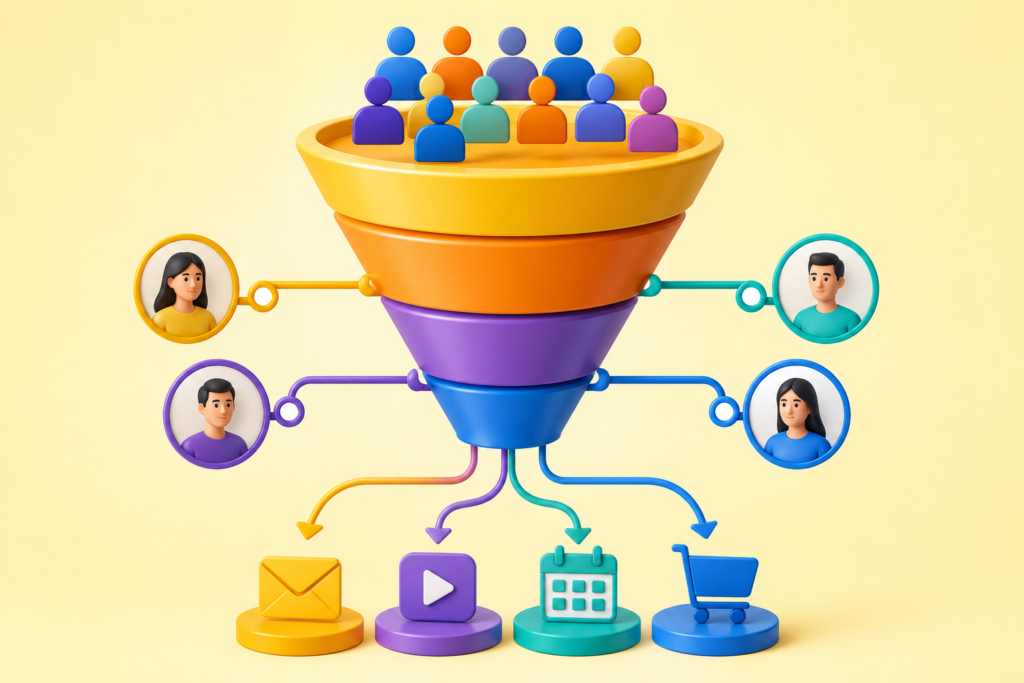
Personalization becomes powerful when it is based on meaningful information rather than superficial customization.
A webinar funnel can collect behavioral signals throughout the customer journey.
For example, you may know whether someone registered, attended, watched most of the webinar, clicked the offer, downloaded a resource, or requested more information.
These signals can help determine what communication should happen next.
Consider two registrants.
The first registered but never attended.
The second attended the entire presentation and visited the offer page.
Sending both people the exact same email sequence ignores the difference in intent.
The first person may simply need another opportunity to watch the presentation.
The second may need objection handling, pricing information, implementation details, or a direct path toward purchasing.
Segmentation allows the funnel to respond differently.
You can also segment by audience type.
For example:
New entrepreneurs
Established businesses
Consultants
Coaches
Agencies
Course creators
Each audience may care about different applications of the same framework.
A consultant may care about appointment generation.
An e-commerce business may care about product conversion.
A course creator may care about enrollment.
Personalization can therefore happen through messaging, examples, follow-up, and offers.
However, more personalization is not automatically better.
Over-segmentation can create unnecessary complexity.
If every small behavioral difference produces a separate campaign, managing the funnel becomes difficult and errors become more likely.
Start with the distinctions that actually affect the customer’s next step.
A useful principle is:
Segment when the information changes the message.
Do not segment merely because your software allows you to.
Behavioral data should also be interpreted carefully.
Someone who clicks an email does not necessarily want a sales call.
Someone who watches a webinar for 50 minutes may still have no intention of buying.
Data provides signals, not certainty.
The best systems combine behavioral information with clear messaging and appropriate human judgment.
This is especially important for high-value products and services where a prospect may need a conversation before making a decision.
Automation should support the customer experience rather than replace it.
Using Content, Email, and Social Promotion to Fill a Webinar Funnel
A webinar funnel needs qualified traffic, and that traffic can come from multiple channels.
Email is often one of the most direct because an existing audience already has some relationship with the business. A newsletter can introduce the webinar, explain why the subject matters, and provide a clear registration opportunity.
Social media can create awareness by turning individual webinar lessons into short educational posts.
For example, if the webinar teaches five webinar funnel mistakes, the business can publish one useful insight as a social post and invite interested readers to explore the full webinar.
This approach provides value before asking for registration.
Blog content can attract people who are actively researching related questions.
A detailed article about webinar conversion rates, webinar email sequences, or registration-page optimization can naturally introduce the webinar as an additional resource.
Paid advertising can accelerate the process by placing the webinar in front of carefully selected audiences.
However, paid traffic should be evaluated beyond cost per registration.
A cheap registration is not necessarily valuable.
Suppose Campaign A produces 1,000 registrations at a very low cost, but only a small percentage attend and almost nobody purchases.
Campaign B produces 300 registrations at a higher acquisition cost, but the attendees are highly qualified and generate significant revenue.
Campaign B may be the better campaign.
This is why cost per qualified attendee and cost per customer can be more useful than registration cost alone.
Promotional messaging should also remain consistent.
If an advertisement promises one outcome but the registration page presents another, the visitor may lose trust.
If the registration page promises practical training but the webinar becomes a long sales pitch, the experience can feel misleading.
The same core promise should therefore flow through:
Advertisement → Registration Page → Reminder Emails → Webinar → Offer → Follow-Up
This is sometimes called message continuity.
When the promise remains consistent, the customer journey feels intentional.
When every stage introduces a completely different message, the funnel becomes confusing.
The promotional campaign should therefore be designed as one experience rather than five independent marketing assets.
Common Webinar Funnel Mistakes Businesses Should Avoid
One of the most common mistakes is choosing a topic based on what the business wants to sell instead of what the audience wants to learn.
A company may be excited about a product feature, but that does not necessarily mean the audience wants a 60-minute presentation about it.
Start with the problem.
Another common mistake is making unrealistic promises.
Claims such as guaranteed income, instant results, or effortless success may increase curiosity temporarily but can undermine trust and create poor-quality leads.
The webinar should communicate a realistic outcome.
A third mistake is creating too much content.
Some presenters try to teach everything they know.
The result is often a long presentation with dozens of disconnected points.
A better webinar has a clear central transformation.
The attendee should understand:
Where they are now → What is wrong → What needs to change → How the framework works → What the next step is
Another mistake is neglecting the follow-up sequence.
Businesses sometimes spend weeks creating the presentation and then send one email afterward.
This leaves substantial opportunity unused.
Follow-up should be planned before the webinar launches.
Another common mistake is treating all attendees identically.
A person who attended for two minutes should not necessarily receive the same message as someone who stayed for the entire presentation.
Segmentation improves relevance.
Technical testing is another area businesses often overlook.
Broken links, incorrect dates, missing calendar information, untested forms, and mobile problems can destroy an otherwise excellent campaign.
Test everything.
Another mistake is using excessive urgency.
Artificial countdowns and fake scarcity can damage credibility.
Urgency should be used only when there is a legitimate reason.
A final major mistake is optimizing for vanity metrics.
A webinar with 5,000 registrations may look impressive, but if the audience is poorly qualified and revenue is minimal, the campaign is not necessarily successful.
Measure business outcomes.
Focus on:
Qualified leads
Engaged attendees
Offer engagement
Conversions
Customer acquisition cost
Revenue
Return on investment
A webinar funnel is successful when it creates meaningful business results while providing a valuable experience for the audience.
Best Practices Summary for High-Converting Webinar Funnels
The strongest webinar funnels combine strategy, education, technology, copywriting, analytics, and follow-up.
Start with the audience.
Identify the specific people you want to attract and understand the problem they are trying to solve.
Then choose a webinar topic that provides meaningful value.
Make the registration page specific.
Tell visitors what they will learn, who the webinar is for, and why the session deserves their time.
Use credible information and avoid exaggerated promises.
After registration, maintain momentum through useful confirmation and reminder communication.
Make attendance easy.
Provide accurate event details and test every access point.
During the webinar, prioritize education.
Teach a clear framework.
Use practical examples.
Explain complex ideas simply.
Avoid overwhelming the audience with unnecessary information.
When presenting the offer, connect it directly to the problem and framework discussed during the webinar.
Explain features, benefits, implementation, pricing, terms, and next steps clearly.
After the webinar, continue nurturing appropriate prospects.
Segment follow-up according to meaningful behavior.
Measure each stage of the funnel rather than focusing on registration numbers alone.
Use analytics to identify the weakest transition.
Then test improvements systematically.
Technical performance should also remain part of the strategy.
Keep pages mobile-friendly.
Monitor loading speed and responsiveness.
Fix broken links.
Test forms.
Validate tracking.
Review the customer experience from beginning to end.
For organic visibility, follow Google’s SEO Starter Guide and focus on useful, people-first content rather than keyword stuffing or manipulative optimization. Google’s guidance also emphasizes descriptive anchor text and logical site organization.
Finally, remember that optimization is ongoing.
There is rarely one perfect webinar funnel.
Audience behavior changes.
Offers evolve.
Traffic sources change.
Competition changes.
New objections appear.
Analytics reveal new opportunities.
The best funnel is therefore one that can be measured, learned from, and improved continuously.
Frequently Asked Questions
What is a webinar funnel?
A webinar funnel is a structured customer journey that uses a webinar to attract prospects, educate them, build trust, introduce a relevant offer, and encourage an appropriate next action. It normally includes traffic acquisition, registration, confirmation, reminders, the webinar itself, an offer, follow-up communication, and conversion tracking.
The important distinction is that a webinar funnel is more than a webinar. The webinar is the educational centerpiece, while the surrounding pages, emails, promotional campaigns, and follow-up systems move the prospect through the broader customer journey.
How do I create a webinar funnel?
Start by identifying your target audience and the specific problem you want to address. Choose a focused webinar topic that provides a meaningful educational outcome. Create a registration page, confirmation experience, reminder sequence, presentation, relevant offer, and follow-up campaign.
Then connect the stages using appropriate automation and tracking.
Before launching, test the complete journey yourself.
Register.
Receive the emails.
Attend.
Click the links.
Visit the offer page.
Complete the intended action.
Finally, monitor the data and improve the weakest stage.
How long should a webinar be?
There is no universal ideal length.
A webinar should be long enough to deliver the promised educational value without adding unnecessary material.
For some subjects, 30–45 minutes may be enough. More complex subjects may require longer sessions, especially when demonstrations or questions are involved.
The important factor is not duration by itself.
Value density matters more than length.
A focused 40-minute presentation can be more effective than a two-hour webinar filled with repetition.
Should I use a live webinar or an evergreen webinar?
Use a live webinar when interaction, questions, demonstrations, or real-time discussion are central to the experience.
Use an evergreen webinar when the subject is relatively stable and you want a repeatable educational asset that can operate with less manual involvement.
Many businesses can benefit from both.
A live event can help refine the presentation based on real audience questions, after which the improved presentation can potentially become an evergreen asset.
How many emails should I send after a webinar?
There is no fixed number that works for every business.
The appropriate sequence depends on the offer, audience, buying cycle, webinar topic, and prospect intent.
A basic follow-up system may include a thank-you or replay email, educational reinforcement, objection handling, proof or case-study content, offer communication, and a final reminder when there is a legitimate deadline.
The goal should not be to send as many emails as possible.
The goal should be to provide relevant information at the right stage of the decision process.
What should I do if many people register but do not attend?
First, investigate the data before changing everything.
Review the registration source, reminder sequence, event timing, webinar promise, and audience quality.
Make attendance easier by providing clear calendar information and reliable access instructions.
Reminder messages should reinforce the reason for attending rather than simply repeating the event date.
Also consider whether your traffic sources are attracting people who genuinely care about the subject.
High registration volume with very low attendance can sometimes indicate low-intent traffic.
How can I improve webinar conversion rates?
Start by identifying where prospects are dropping out.
If registration is weak, improve the topic and registration page.
If attendance is weak, review reminders and audience quality.
If viewers leave early, improve the opening and educational structure.
If viewers stay but do not engage with the offer, review the transition and offer relevance.
If offer clicks are strong but purchases are weak, inspect the sales page, pricing, checkout, trust elements, qualification process, and follow-up.
Optimization should be evidence-driven rather than based on assumptions.
Can a webinar funnel work for small businesses?
Yes.
A webinar does not need a huge audience to be valuable.
A small business may benefit significantly from a webinar that attracts a relatively small number of highly relevant prospects.
For high-value services, a handful of qualified attendees can potentially be more valuable than thousands of low-intent registrations.
The key is to match the webinar topic, offer, audience, and funnel economics to the business model.
Conclusion
A successful webinar funnel is not simply a registration page followed by an online presentation. It is a complete customer journey designed to attract the right audience, educate prospects, build trust, create meaningful engagement, and guide qualified people toward an appropriate next step.
The most effective funnels begin with audience research and a clear problem. They continue with a focused webinar topic, a persuasive but transparent registration page, useful reminder communication, a valuable presentation, a relevant offer, and structured follow-up.
The technical side matters just as much.
Pages should be mobile-friendly and reliable. Forms should work. Links should be tested. Tracking should be accurate. Page performance should be monitored. Google recommends creating helpful, people-first content and maintaining a technically sound website rather than relying on manipulative search tactics.
The measurement strategy should also extend beyond registrations.
Track the entire journey from visitor to registrant, attendee, engaged prospect, offer visitor, and customer. Use this information to identify weak points and make focused improvements.
A webinar funnel can become a valuable long-term marketing asset when it is treated as a system rather than a one-time event.
At My Funnel Script, the broader objective is to make funnel implementation more practical by providing structured marketing resources that can support different stages of the customer journey, including landing pages, sales pages, webinar email sequences, nurture emails, and other funnel content. The website currently presents these types of resources as part of its broader collection of marketing templates.
Ultimately, the strongest webinar funnels do not try to manipulate people into buying.
They help the right people understand a problem, discover a practical solution, evaluate their options, and take the next step with confidence.
That is what turns a webinar from a simple online presentation into a genuine marketing asset.
Want to Implement This Easily?
Prompt Text:
You are an expert consultant. Based on the blog post titled “(Webinar Funnels)”, provide a step-by-step, practical implementation guide. Include tools, best practices, common mistakes to avoid, and advanced tips. Assume the reader wants to implement everything discussed in this article effectively.
Call to Action: Want our help implementing this? Just reach out to us via our website contact form: full sales funnel templates