
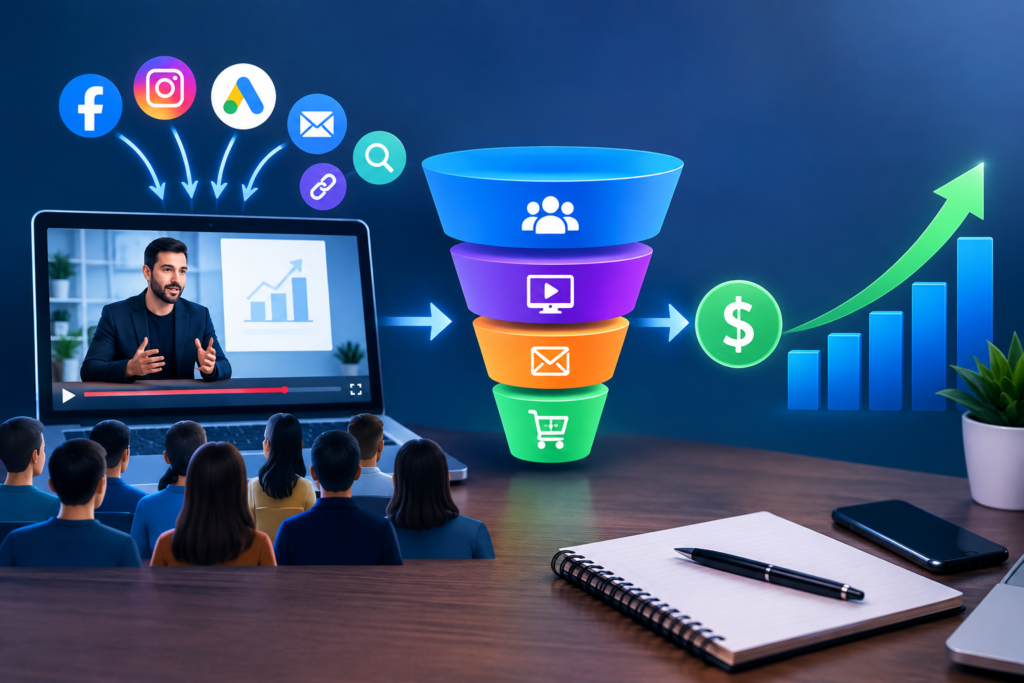
Discover how webinar funnels attract qualified leads, build trust, increase attendance, nurture prospects, and convert engaged audiences into customers through strategic automation and optimization.
Introduction
A well-planned webinar funnel can turn an educational online event into a complete customer acquisition and conversion system. Instead of depending on one advertisement, one landing page, or one sales message, a webinar funnel creates a connected journey that moves prospects from initial awareness through registration, attendance, education, engagement, evaluation, and conversion. Each stage has a specific purpose, and when those stages work together, businesses can create a more consistent experience for prospects while giving potential customers enough information to make confident decisions.
For businesses that sell consulting, coaching, professional services, software, online education, digital products, or other higher-consideration offers, webinars can provide an opportunity to demonstrate expertise before asking for a purchase. My Funnel Script approaches webinar funnels as more than a single presentation. The webinar itself is only one component of the overall system. Registration pages, promotional campaigns, reminder emails, event content, calls to action, follow-up sequences, segmentation, retargeting, and conversion tracking all influence whether the funnel ultimately produces meaningful business results.
The most effective webinar funnels are built around the audience rather than around technology alone. A collection of landing pages, emails, automation rules, and tracking tools does not automatically create a successful funnel. The strategy must begin with a real customer problem and then guide the prospect toward a practical solution. This guide explains how to plan, build, optimize, and scale a webinar funnel while maintaining a strong focus on user experience, credibility, helpful content, conversion strategy, and sustainable marketing practices.
What Is a Webinar Funnel and How Does It Work?
A webinar funnel is a structured sequence of marketing and conversion stages designed to attract prospects to a webinar and guide them toward a specific next action. That action might be purchasing a product, booking a consultation, requesting a demonstration, starting a free trial, enrolling in a program, or contacting a sales team. Unlike a conventional sales page that may ask a visitor to make a purchasing decision quickly, a webinar funnel uses education as part of the conversion process. It gives prospects an opportunity to understand a problem, explore potential solutions, evaluate expertise, and develop confidence before making a decision.
A typical webinar funnel begins with a traffic source. Visitors may come from search engines, social media, email campaigns, paid advertising, partnerships, content marketing, or direct outreach. They are directed to a webinar registration page where the topic, benefits, presenter, event details, and registration process are clearly explained. After registering, prospects enter a reminder and preparation sequence. Following the event, attendees and non-attendees can receive different follow-up communications based on their behavior. Some prospects may receive the replay, while others may receive additional educational material, an offer, a consultation invitation, or a longer-term nurture sequence.
The important point is that every stage should have a clear strategic purpose. Promotional content generates interest. The registration page converts that interest into a commitment. Reminder messages encourage attendance. The webinar provides valuable education and establishes the connection between the prospect’s problem and the available solution. The post-webinar sequence handles questions, objections, and next steps. Analytics then reveal where prospects are leaving the journey. By treating the webinar funnel as a complete system, marketers can improve individual stages instead of guessing why the campaign is or is not converting.
Why Webinar Funnels Are Effective for Lead Generation
One of the strongest advantages of webinar funnels is the combination of lead generation and education. A traditional lead magnet might exchange a visitor’s contact information for a checklist, guide, template, or short resource. A webinar can provide considerably more context. During a live or automated presentation, prospects can learn about the causes of a problem, understand different approaches, see practical examples, hear explanations from a knowledgeable presenter, and discover potential solutions. This extended educational experience can be particularly valuable when the product or service requires trust before purchase.
Webinars can also provide useful behavioral signals. Registering for an event demonstrates a level of interest, but attendance, engagement, replay consumption, link clicks, questions, and offer interactions can provide additional context. These actions can help businesses understand where prospects are in the buying journey. Someone who registers but never attends may require a different follow-up strategy from someone who watches most of the webinar and visits the offer page several times. Effective segmentation should use these signals to make communication more relevant rather than simply increasing the number of messages sent.
Another advantage is the ability to move prospects from problem awareness to solution awareness. A prospect may know that sales are declining but may not understand whether the underlying issue is traffic quality, positioning, pricing, conversion rates, follow-up, or the sales process itself. A well-structured webinar can help clarify that situation. By explaining the problem and presenting a practical framework, the webinar creates a stronger foundation for the eventual offer. The prospect is not simply being told that a product exists; they are being helped to understand why a particular solution may be appropriate.
Defining the Ideal Webinar Audience Before Building the Funnel
Successful webinar funnels begin with audience research, not page design. Before creating the headline, registration form, presentation slides, email sequence, or advertising campaign, marketers should determine who the webinar is actually intended to serve. Useful audience research considers the prospect’s current situation, goals, frustrations, level of knowledge, purchasing authority, objections, priorities, and desired outcomes. A broad audience may appear attractive because it increases the potential reach, but excessive broadness can make the webinar less relevant to the people most likely to become customers.
It is particularly important to distinguish between the symptom a prospect describes and the deeper problem behind it. A business owner might say that they need more leads, for example, when the actual problem is that existing leads are not being qualified or followed up effectively. Another prospect may believe that they need more website traffic when the greater opportunity is improving their conversion rate. Understanding these distinctions allows the webinar to address a problem at the level where the audience can recognize its importance. It also helps prevent the presentation from becoming a generic collection of marketing tips.
Audience clarity should influence every stage of the funnel. The registration headline should use language that reflects the audience’s priorities. The webinar examples should relate to their circumstances. The teaching framework should match their knowledge level. The call to action should provide an appropriate next step. Even the follow-up sequence should reflect what the audience is likely to need after the presentation. When these elements align, the funnel feels intentional and relevant rather than like a generic campaign assembled from unrelated marketing assets.
Choosing a Webinar Topic That Generates Qualified Demand
The webinar topic is one of the most influential components of the entire funnel. A strong topic connects audience demand, practical value, and commercial relevance. It should address a problem that matters enough for someone to exchange their contact information and time for the opportunity to learn. At the same time, the topic should naturally connect with the product or service that the business ultimately wants to promote. If the webinar attracts people who have no realistic need for the offer, high registration numbers may produce disappointing revenue.
Specificity generally makes webinar topics more compelling. A title such as “Online Marketing Strategies” is broad and difficult to evaluate. A topic such as “How to Identify and Fix the Conversion Leaks Costing Your Sales Funnel Qualified Leads” gives the audience a much clearer reason to attend. However, specificity should not become sensationalism. A dramatic promise may increase registrations temporarily but can damage trust if the presentation does not deliver what was promised. A better approach is to create a clear, credible, outcome-oriented promise that the webinar can genuinely fulfill.
Good topic ideas can come from customer questions, sales conversations, support requests, search behavior, existing content performance, industry discussions, competitor positioning, and recurring objections. Businesses should pay particular attention to questions prospects ask immediately before purchasing. These questions often reveal the information gaps preventing people from moving forward. A webinar that answers those questions can simultaneously educate the audience and demonstrate why the business is qualified to help solve the underlying problem.
Designing a High-Converting Webinar Registration Page
The webinar registration page has one central objective: convert qualified visitors into registrants. Its headline should immediately communicate the subject and value of the event. Supporting copy should explain what attendees will learn and why that information matters. The registration form should be straightforward and request only information that serves a genuine purpose. Unnecessary fields can increase friction and reduce the likelihood that an interested visitor completes the registration process.
A strong registration page should communicate the webinar’s benefits rather than simply describing its existence. Instead of saying that attendees will “learn powerful strategies,” explain the specific knowledge or practical outcomes they can expect. A clear agenda can reduce uncertainty by showing what the presentation will cover. Presenter information can establish credibility when it demonstrates relevant experience. Testimonials, case studies, credentials, and business results may also strengthen trust when they are accurate, verifiable, and presented in appropriate context.
Technical quality is equally important. A registration page should work effectively across desktop and mobile devices, load efficiently, provide accessible content, and avoid unnecessary distractions. Its technical implementation should also follow relevant guidance such as Search Essentials when the page is intended to attract organic search traffic. Google emphasizes creating helpful, reliable, people-first experiences rather than producing content primarily for search-engine manipulation. That principle applies directly to webinar landing pages: optimize the page for people first and make search visibility a result of useful, well-structured content.
Creating a Webinar Registration Offer That People Actually Want
The registration offer gives prospects a reason to commit their time. Simply announcing an upcoming webinar is rarely sufficient because audiences have countless competing sources of information. A compelling webinar registration offer communicates a meaningful problem, a useful outcome, and a credible reason why the presentation is worth attending. The visitor should be able to understand the value within seconds without having to decode complicated marketing language.
The strongest registration offers are usually built around a specific transformation. Instead of promising “marketing insights,” the webinar might teach participants how to identify funnel bottlenecks, improve lead follow-up, structure a conversion-focused presentation, or create an effective webinar promotion strategy. The topic should be appropriate for the audience’s level of sophistication. A beginner audience may need foundational education, while experienced professionals may expect frameworks, implementation details, examples, and advanced optimization techniques.
Additional registration incentives can increase perceived value when they genuinely support implementation. These might include a worksheet, checklist, template, planning document, calculator, resource library, or replay access. However, incentives should not become distractions from the central promise. Similarly, urgency should be truthful. If there is a legitimate deadline for registration, an event date, or a time-limited bonus, explain it clearly. Artificial scarcity and misleading countdowns can create short-term pressure but undermine long-term trust. Sustainable webinar marketing is based on relevance, usefulness, and credibility.
Building the Pre-Webinar Email and Reminder Sequence
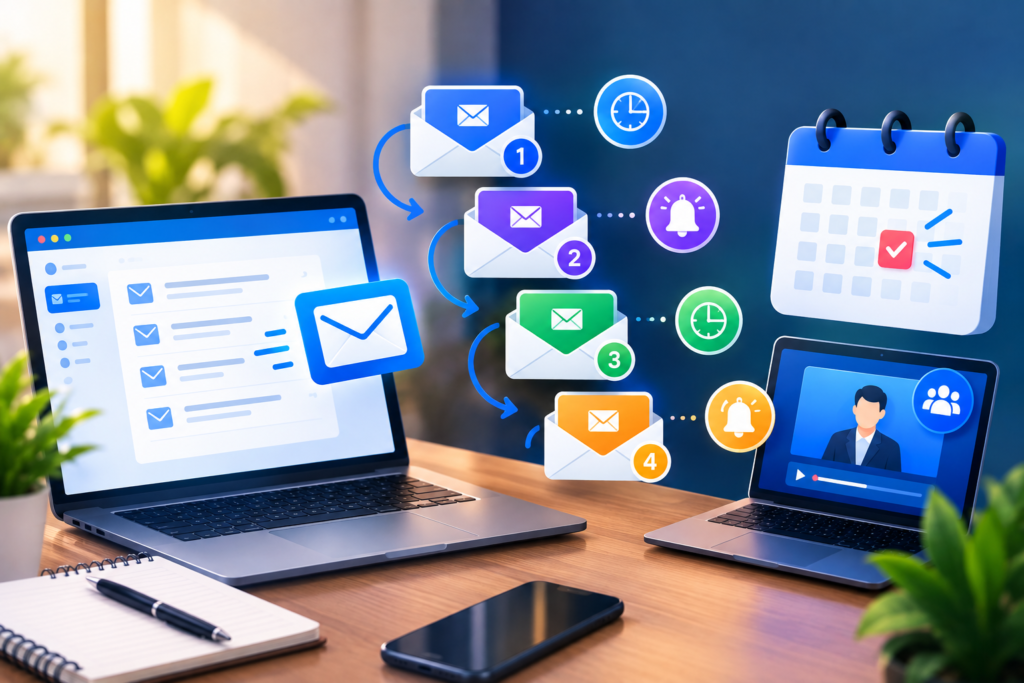
Registering for a webinar is only the beginning. Many campaigns experience a substantial difference between the number of people who register and the number who actually attend. A strategic webinar reminder sequence can reduce this gap by maintaining awareness and demonstrating value between registration and event time. The sequence commonly includes a confirmation message, calendar information, preparation guidance, value-oriented communication, and timely reminders as the event approaches.
Reminder emails should not all say the same thing. The confirmation email should reassure the prospect that registration was completed successfully and provide the essential event information. A preparation email can explain what the attendee should expect and encourage them to reserve uninterrupted time. Another message might introduce a useful concept connected to the webinar topic, giving the prospect an immediate reason to remain interested. The final reminder should prioritize clarity and convenience, making it easy to access the event without forcing the recipient to search through previous messages.
Automation makes these sequences scalable, but automation should not mean irrelevant communication. Behavioral segmentation can improve the experience. A person who has opened multiple emails may require a different approach from someone who has ignored every message. A returning attendee may need less introductory information than a first-time registrant. The objective is to use automation to deliver the right information at the right stage rather than sending increasingly frequent reminders simply because the event date is approaching.
Structuring the Webinar Content for Education and Conversion
A high-performing webinar should provide genuine educational value before presenting a commercial offer. The presentation can begin by establishing the audience’s problem, explaining why common approaches fail, introducing a practical framework, demonstrating how that framework works, and then connecting the remaining implementation requirements to the available solution. This creates a logical progression from problem → understanding → solution → action.
The educational component should stand on its own. Attendees should be able to leave with useful knowledge even if they decide not to purchase anything. This strengthens credibility and supports a people-first approach to content. Google’s guidance on creating helpful, reliable, people-first content reinforces the importance of creating material primarily for users rather than attempting to manipulate search rankings. The same philosophy can strengthen webinar content: teach something useful, explain it clearly, and make claims that can be supported.
The transition to the offer should then feel like a natural continuation of the education. After explaining a framework, the presenter can show where implementation becomes difficult, where specialist expertise may be required, or where technology and ongoing optimization can make the process more effective. The commercial solution becomes relevant because it addresses a problem already discussed during the presentation. This approach is more persuasive than abruptly switching from teaching to a sales pitch because the audience can understand the reasoning behind the recommendation.
Creating Trust and Demonstrating Expertise During the Webinar
Trust is one of the most important assets in a webinar funnel, particularly when the final offer involves a significant financial or business decision. Prospects want to know whether the presenter understands their situation, whether the recommendations are practical, and whether the business can deliver what it promises. Credibility should therefore be demonstrated through evidence, experience, transparency, and useful teaching, rather than through exaggerated claims.
One effective approach is to use relevant examples and explain the reasoning behind decisions. Instead of simply saying that a particular strategy works, demonstrate how it works, where it is appropriate, and what limitations it has. Case studies can be especially useful when they clearly explain the starting situation, actions taken, and measurable outcomes. Claims should remain accurate and appropriately qualified. If results depend on factors such as budget, audience, implementation quality, market conditions, or offer type, those conditions should not be hidden.
Transparency also contributes to trust. If the webinar contains a commercial offer, the presenter should not attempt to disguise that fact. The audience can be told that an offer will be presented near the end while still receiving substantial educational value beforehand. This creates a more honest relationship with attendees. Over time, businesses that consistently demonstrate expertise without relying on exaggerated promises can build stronger authority and generate better-quality leads than campaigns focused exclusively on maximizing immediate conversions.
Developing a Webinar Call to Action That Converts
The webinar call to action is where education transitions into a measurable business outcome. A CTA could invite the attendee to purchase a product, schedule a consultation, request an audit, start a trial, apply for a program, or take another relevant step. The right CTA depends on the audience’s level of awareness and the complexity of the offer. A high-ticket consulting service may require a discovery call, while a lower-priced digital product may be suitable for direct checkout.
The strongest webinar CTAs are specific and connected to the content that came before them. The presenter should explain what the next step is, who it is for, what happens after the prospect takes it, and why it is worth considering. Unclear calls to action create hesitation because prospects do not know what will happen when they click. A simple instruction such as “Book your strategy session” becomes stronger when accompanied by a concise explanation of what the session covers and who should schedule one.
Objection handling is also essential. Before presenting the CTA, the presenter should anticipate legitimate concerns about price, implementation, time, complexity, suitability, or expected outcomes. These objections should be addressed honestly rather than dismissed. If the offer is not suitable for everyone, saying so can actually strengthen credibility. A webinar funnel should not attempt to convert every attendee. Its purpose is to help the right prospects make informed decisions while allowing unsuitable prospects to move on without pressure.
Optimizing the Webinar Funnel for Mobile and User Experience
Modern webinar funnels must work across a wide range of devices and connection conditions. Registration pages, confirmation pages, emails, checkout pages, and webinar interfaces should all provide a consistent experience on smartphones, tablets, and desktop computers. Mobile visitors may represent a substantial portion of campaign traffic, so designing only for desktop users can create unnecessary conversion losses.
Performance optimization should consider loading speed, layout stability, responsiveness, image sizes, scripts, forms, and third-party integrations. Google provides detailed guidance around Core Web Vitals, which can help website owners understand important aspects of loading performance, responsiveness, and visual stability. These metrics should not be treated as a substitute for good UX, but they provide useful technical signals when diagnosing performance problems.
The user experience should also minimize unnecessary friction. A visitor should not have to search extensively for the registration button, navigate through irrelevant pages, complete a complicated form, or struggle to find event access information. The same principle applies after registration. Confirmation details should be easy to understand, calendar information should be convenient, and webinar access should be obvious. Every unnecessary obstacle creates another opportunity for a prospect to abandon the journey.
Using Webinar Automation Without Losing the Human Element
Automation is one of the main reasons webinar funnels can scale. Instead of manually confirming registrations, sending reminders, distributing replay links, segmenting attendees, and following up with every prospect, automated workflows can perform these tasks consistently. However, automation should be designed around the customer journey, not simply around a collection of triggers.
A useful automation system can identify different prospect behaviors. For example, registered prospects may receive confirmation and reminder communications. Attendees may enter a post-webinar sequence focused on the offer. Registrants who did not attend may receive replay access. People who clicked the offer but did not purchase may receive objection-focused content. Customers should exit promotional sequences and enter an onboarding or customer-success journey. This prevents the common mistake of continuing to market the same offer to people who have already taken action.
The human element remains important even in highly automated campaigns. Personalized sales conversations, consultation calls, support responses, and strategic follow-up can provide context that automation cannot. The best systems use automation for consistency and timing while reserving human interaction for situations where expertise, judgment, or relationship-building can improve the outcome.
Measuring Webinar Funnel Performance and Key Metrics
A webinar funnel cannot be improved effectively without measurement. Marketers should track the complete journey rather than focusing only on registration numbers. Useful metrics can include traffic volume, registration conversion rate, cost per registration, attendance rate, average watch time, engagement, CTA clicks, consultation bookings, sales conversion rate, revenue per registrant, customer acquisition cost, and return on advertising spend where paid traffic is involved.
Looking at the funnel as a series of conversion stages makes problems easier to diagnose. If traffic is strong but registrations are weak, the issue may involve the webinar topic, messaging, landing page, audience targeting, or offer positioning. If registrations are strong but attendance is low, reminder communication or event timing may require attention. If attendance is high but sales are poor, the webinar content, offer, CTA, qualification, objection handling, or post-event sequence may need improvement.
Measurement should also account for business quality rather than vanity metrics. One hundred highly qualified registrants can be more valuable than one thousand poorly matched leads. Similarly, a webinar with fewer attendees may generate more revenue if the audience has stronger purchase intent. The goal is not to maximize every metric independently; it is to improve the quality and efficiency of the complete customer journey.
Improving Webinar Funnels Through Testing and Optimization
Optimization should be treated as an ongoing process rather than a one-time project. A funnel can perform well initially and still contain opportunities for improvement. Changes to the webinar topic, registration headline, CTA placement, reminder sequence, presentation structure, offer positioning, or follow-up strategy can influence results. The most useful tests are based on a specific hypothesis rather than random experimentation.
For example, if the registration page has strong traffic but a weak conversion rate, the team might test whether a more specific value proposition improves registrations. If attendance is low, the team could evaluate whether reminder timing or preparation content affects participation. If attendees watch the webinar but rarely click the offer, the issue may involve the transition from education to commercial relevance. Each experiment should isolate a meaningful variable where possible and evaluate the result against a defined metric.
Optimization should also consider qualitative evidence. Analytics can show where people leave, but customer conversations can help explain why. Feedback surveys, sales calls, chat interactions, support requests, and post-webinar questions can reveal confusion or objections that quantitative dashboards cannot explain. Combining behavioral data with direct audience feedback creates a more complete optimization process and helps businesses make decisions based on evidence rather than assumptions.
Building a Sustainable Webinar Funnel Strategy
A sustainable webinar funnel is not built around a single promotional event. It is an evolving marketing asset that can become more valuable as the business learns from audience behavior, improves the presentation, strengthens the offer, and develops better follow-up systems. Some businesses use live webinars to create urgency and interaction, while others use automated or evergreen webinars to provide consistent lead generation. The appropriate model depends on the audience, offer, resources, and sales cycle.
Sustainability also requires maintaining the quality of the underlying content. A webinar that once performed well can become less relevant as customer needs, technology, competitors, and market expectations change. Regular reviews can identify outdated statistics, broken links, obsolete examples, weak claims, or strategies that no longer reflect current conditions. Updating the presentation is not simply a content task; it protects the credibility of the funnel and helps ensure that prospects receive accurate information.
Ultimately, the strongest webinar funnels combine strategy, education, technology, measurement, and trust. They attract the right people rather than everyone, provide genuine value rather than superficial information, use automation without becoming impersonal, and present offers without relying on manipulation. When every stage is aligned with the audience’s real needs, a webinar can become much more than an online event—it can become a repeatable system for building relationships, generating qualified opportunities, and supporting long-term business growth.
Building a High-Converting Post-Webinar Follow-Up Sequence
The webinar does not end when the presentation finishes. In many cases, the period immediately after the webinar represents one of the most valuable opportunities in the funnel because prospects have just spent time learning about the problem, considering potential solutions, and evaluating the presenter’s expertise. A strategic post-webinar follow-up sequence keeps the conversation moving while the subject is still relevant. Instead of sending one generic “Thanks for attending” message, businesses should develop a sequence that reflects attendee behavior and provides a clear path toward the next decision.
The first follow-up should generally reinforce the value of the webinar and make the next step easy to understand. Attendees can receive the replay or supporting resources, along with a concise reminder of the key ideas discussed. Prospects who showed strong engagement may receive more direct information about the offer, while people who did not attend can receive a replay invitation. Those who watched but did not take action may need additional education or objection handling. This behavioral approach makes the funnel more relevant because communication is based on what the prospect actually did rather than treating every lead identically.
Longer-term follow-up is equally important. Not every prospect will be ready to purchase immediately, even after attending a high-quality webinar. Some may need additional evidence, budget approval, internal discussions, or more time to understand the solution. A lead nurturing strategy can continue providing useful information without repeatedly pushing the same sales message. Educational emails, case studies, implementation tips, FAQs, and relevant resources can keep the relationship active until the prospect reaches a stronger buying position. The objective is to remain useful without becoming intrusive.
Turning Webinar Replays Into an Evergreen Conversion Asset
A webinar replay can extend the useful life of an event beyond the original presentation date. Instead of allowing the content to disappear after one session, businesses can create a dedicated webinar replay funnel that allows qualified prospects to access the presentation at a convenient time. This is particularly valuable when the webinar contains educational material that remains relevant for an extended period. The replay can become part of an evergreen acquisition system, provided the content, claims, examples, and promotional elements remain accurate.
The replay page should retain the same basic clarity as the live registration experience. Visitors should understand what the presentation covers, who it is intended for, and what they can expect to learn. If the replay is gated behind a registration form, the form should remain proportionate to the value being provided. If the content is presented immediately, the page should make the viewing experience straightforward. Supporting resources can be included when they genuinely improve implementation.
Evergreen webinars require ongoing maintenance. Broken links, outdated statistics, old offers, expired bonuses, obsolete software demonstrations, and references to past dates can make an automated presentation feel unreliable. Businesses should periodically review the entire experience. If the commercial offer changes, the CTA may need updating. If the webinar no longer reflects the audience’s current problems, the presentation itself may require revision. An evergreen funnel should therefore be treated as a maintained marketing asset, not a piece of content that can simply be published once and forgotten.
Using Segmentation to Personalize Webinar Funnel Journeys
Segmentation allows marketers to create different experiences for people who behave differently. In a webinar funnel, useful segments can include new registrants, repeat attendees, live attendees, no-shows, partial viewers, highly engaged prospects, CTA clickers, consultation bookers, customers, and inactive leads. These categories can help determine which message a person should receive next. The purpose is not to build complicated segmentation for its own sake but to make communications more relevant and reduce unnecessary messages.
Behavioral segmentation can be especially valuable after the webinar. Someone who watched almost the entire presentation and clicked the offer has demonstrated a different level of intent from someone who registered but never attended. A prospect who asked a detailed question during the event may benefit from a personalized response or additional educational material. A person who purchased should immediately leave promotional sequences and enter the appropriate onboarding journey. These transitions can create a much more coherent customer experience.
Segmentation can also be based on information provided during registration, where appropriate. For example, a webinar designed for several business sizes might ask registrants to identify their business stage. That information could then influence examples, follow-up resources, or recommendations. However, data collection should remain purposeful and transparent. Collecting information simply because a form allows it can increase friction without improving the customer journey. Good segmentation focuses on useful differences in intent, needs, or behavior.
Using Retargeting to Recover Lost Webinar Opportunities
Not every visitor who encounters a webinar funnel will register, attend, or purchase. Retargeting can provide another opportunity to reconnect with people who previously demonstrated interest. A visitor who reached the registration page but did not complete the form may be shown a reminder of the webinar’s value. Someone who registered but did not attend may be directed toward the replay. A person who visited the offer page without purchasing may receive educational content that addresses common concerns.
The key to effective retargeting is relevance. Showing the same advertisement repeatedly to everyone can create fatigue and reduce the perceived quality of the campaign. Audience groups should be defined according to meaningful actions whenever possible. Messaging can then reflect the prospect’s position in the funnel. Someone who has never visited the registration page needs an introduction, while someone who already attended the webinar may need a different message entirely.
Retargeting should also respect privacy requirements and the rules of the advertising platforms being used. Tracking technologies should be implemented appropriately, and businesses should provide clear information about relevant data practices. Security and privacy should not be treated as obstacles to marketing; they are part of building trustworthy digital experiences. When retargeting is used thoughtfully, it can recover opportunities without making prospects feel as though they are being followed across every online interaction.
Connecting Webinar Funnels With the Sales Process
A webinar funnel becomes significantly more powerful when it is connected to the broader sales process. Marketing should not operate independently from sales when the offer requires human interaction. Information about registrations, attendance, engagement, questions, CTA clicks, and previous communications can help sales teams understand the prospect’s context before starting a conversation. This can reduce repetitive questioning and allow the conversation to focus on the prospect’s actual needs.
Lead qualification should be based on meaningful business criteria rather than arbitrary engagement scores. A person may watch an entire webinar because they are interested in the subject but still have no need or authority to purchase. Conversely, a busy decision-maker may watch only part of the presentation and still be highly qualified. Scoring systems can help prioritize leads, but they should be treated as indicators rather than absolute truth. Human judgment remains important for complex or high-value sales.
The handoff between marketing and sales should also be clearly defined. Teams should agree on what qualifies as a sales-ready lead, when a prospect should receive personal outreach, what information should be passed along, and how outcomes should be recorded. Closed-loop reporting can then show which webinar sources and behaviors ultimately contribute to revenue. This helps businesses optimize for qualified opportunities and customers, rather than simply maximizing registrations.
Integrating Webinar Funnels With CRM and Marketing Automation
Technology can make webinar funnel management considerably more efficient when it is configured around a clear strategy. A typical system may connect a registration page, email platform, webinar software, CRM, analytics system, payment platform, and advertising channels. These integrations can automatically move contacts between stages based on defined actions. For example, a registration could create a contact record, attendance could update the contact status, and a purchase could remove the person from promotional sequences.
The important principle is to establish the desired customer journey before connecting every available tool. Technology should solve a known process problem. Otherwise, businesses can create complicated automation that is difficult to maintain and provides little practical value. A simple system with reliable data is generally more useful than a highly sophisticated system filled with unnecessary workflows.
Data quality should also receive attention. Duplicate records, incorrect tags, broken triggers, missing tracking parameters, and inconsistent naming conventions can compromise reporting. Regular testing should verify that each workflow behaves as intended. Teams should test the experience from the perspective of a real prospect—from registration through confirmation, attendance, follow-up, purchase, and onboarding. This practical quality-control process can reveal problems that are invisible when looking only at automation diagrams.
Improving Webinar Funnel Conversion Rates Through CRO
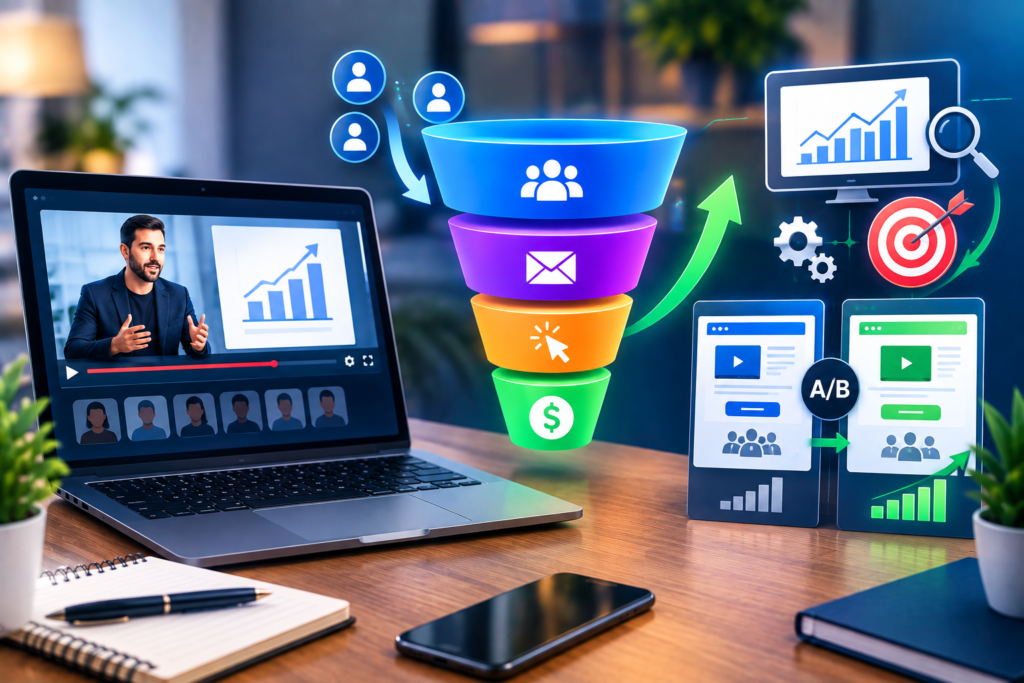
Conversion rate optimization (CRO) is the disciplined process of improving the percentage of visitors or prospects who complete a desired action. In webinar funnels, CRO can be applied to registration pages, forms, confirmation pages, webinar content, offer pages, checkout experiences, and follow-up communications. The most effective optimization begins with identifying a specific problem rather than making random design changes.
Suppose a registration page receives substantial traffic but produces few registrations. Possible causes could include an unclear topic, weak value proposition, poor traffic targeting, excessive form friction, slow page performance, or insufficient trust. Each hypothesis suggests a different test. Similarly, if attendance is strong but offer conversions are weak, changing the registration page may do little to solve the actual problem. The team should investigate the stage where the largest relevant drop-off occurs.
A useful CRO program combines quantitative and qualitative evidence. Analytics can reveal conversion rates and abandonment points. Heatmaps or session analysis, where appropriately implemented, can reveal interaction patterns. Surveys and sales conversations can uncover objections. A/B testing can then evaluate specific hypotheses. Over time, this creates a learning system rather than a collection of isolated experiments. The goal is to understand why prospects behave as they do and use that knowledge to improve the entire funnel.
Common Mistakes That Reduce Webinar Funnel Performance
One common mistake is choosing a webinar topic that is too broad. A generic topic may generate impressions but fail to attract people with a strong reason to attend. Another mistake is focusing heavily on registration volume while ignoring lead quality. Businesses sometimes celebrate a large number of registrations without asking whether those people have a genuine problem that the final offer can solve. A smaller but more relevant audience can produce better commercial results.
Another frequent mistake is creating a webinar that provides either too little value or too much unrelated information. A presentation that feels like an extended advertisement can damage trust, while a presentation containing dozens of disconnected tips can leave attendees without a clear framework or next step. The webinar should have a coherent narrative. It should teach enough to demonstrate expertise while maintaining a logical connection to the solution being offered.
Poor follow-up is another major problem. Businesses may invest significant time and money in promotion, produce a high-quality webinar, and then send only one email afterward. Prospects who are not ready to buy immediately can disappear. Other businesses make the opposite mistake and send overly aggressive sales messages every day. The better approach is a structured sequence that combines education, relevance, evidence, objection handling, and clear calls to action. Follow-up should help prospects make decisions rather than pressure them into decisions.
FAQs
What is the main purpose of a webinar funnel?
The primary purpose of a webinar funnel is to guide qualified prospects through a structured journey from initial interest to a meaningful business action. That action could be purchasing a product, booking a consultation, requesting a demonstration, starting a trial, or joining a program. The webinar itself provides education and establishes credibility, while the surrounding pages, emails, automation, and follow-up communications support the broader conversion process. A webinar funnel is therefore best understood as a complete customer journey rather than simply an online presentation.
Are webinar funnels suitable for small businesses?
Yes. Small businesses can use webinar funnels effectively when the topic is focused and closely aligned with a genuine customer problem. A webinar does not necessarily require a large audience to produce value. For consulting, coaching, professional services, education, and specialized products, even a relatively small group of highly relevant prospects can create meaningful opportunities. The key is to focus on audience quality, useful content, and a realistic conversion path rather than assuming that larger registration numbers automatically mean better performance.
Should a webinar be live or automated?
Both models can work. Live webinars are useful when interaction, questions, demonstrations, and real-time engagement are important. They can also create a stronger sense of event participation. Automated webinars can provide greater scheduling flexibility and may work well when the content is stable and the business wants to create a more consistent acquisition system. Some businesses use a hybrid approach, combining live events for engagement and evergreen replays for ongoing lead generation.
How long should a webinar be?
There is no universal ideal length. The presentation should be long enough to deliver meaningful value and address the audience’s core problem without adding unnecessary material. A highly focused educational webinar may be relatively concise, while a complex subject may require more time. The quality of the content, clarity of the structure, and relevance to the audience are generally more important than reaching an arbitrary duration. Monitoring engagement and audience feedback can help determine whether the presentation is appropriately paced.
What should happen after someone attends a webinar?
After attendance, the prospect should enter a relevant follow-up journey. This may include the replay, supporting resources, key takeaways, additional educational content, case studies, answers to common objections, and a clear CTA. Highly engaged prospects may be appropriate for direct sales follow-up, while less-ready prospects can enter a nurture sequence. Customers should be removed from promotional workflows and transferred into onboarding or customer-success communications.
How can webinar attendance rates be improved?
Attendance can often be improved by setting clear expectations at registration, providing calendar information, using useful reminder emails, explaining why attending live matters, and making access details extremely easy to find. Sending valuable preparation content can also maintain interest between registration and the event. Testing event timing and reminder schedules against actual audience behavior can provide additional insights. Most importantly, the registration promise should be strong enough that people still care about the event after they have signed up.
What metrics should be tracked in a webinar funnel?
Important metrics include traffic, registration conversion rate, cost per registration, attendance rate, engagement, average viewing duration, CTA clicks, consultation bookings, sales conversion rate, customer acquisition cost, and revenue generated. The exact metrics should reflect the business model. A high-ticket service may focus heavily on qualified appointments and closed revenue, while a lower-priced product may emphasize direct purchases. Metrics should ultimately help answer one question: Is the funnel efficiently turning relevant attention into valuable business outcomes?
Can webinar funnels work with paid advertising?
Yes. Paid advertising can be an effective source of webinar registrations when targeting, messaging, economics, and conversion tracking are properly managed. However, the advertising campaign should not be judged only by registration cost. A cheap registration is not necessarily valuable if attendees are poorly qualified or never progress toward the offer. Businesses should evaluate downstream performance, including attendance, engagement, qualified opportunities, sales, and revenue. This creates a more accurate picture of whether paid acquisition is sustainable.
Best Practices Summary for Successful Webinar Funnels
The first best practice is to start with the audience and problem, not the technology. Define who the webinar is for, what problem matters most to them, what outcome they want, and why the subject deserves their attention. Build the webinar topic, registration page, presentation, and CTA around that understanding. Specificity and relevance generally create stronger positioning than broad claims designed to attract everyone.
The second best practice is to make every stage useful. The registration page should communicate a credible promise. Reminder emails should provide timely information. The webinar should teach something genuinely valuable. The offer should solve a problem established during the presentation. Follow-up should answer questions and help prospects evaluate their options. This people-first approach also aligns with Google’s emphasis on helpful content and trustworthy experiences rather than manipulative search-engine tactics. Businesses can review Google Search Essentials when evaluating the broader search visibility and technical foundations of their website.
The third best practice is to measure the complete funnel and continuously improve it. Track the movement from visitor to registrant, registrant to attendee, attendee to engaged prospect, and engaged prospect to customer. Combine quantitative analytics with customer feedback. Test meaningful hypotheses rather than changing multiple variables without a clear reason. Maintain automation carefully, review evergreen content regularly, protect user trust, and make sure every claim and result presented in the funnel is accurate. A successful webinar funnel is not a one-time campaign; it is an evolving system that becomes stronger through evidence, experience, and continuous refinement.
Conclusion
A powerful webinar funnel brings together audience research, compelling positioning, educational content, conversion-focused design, automation, follow-up, analytics, and trust. The strongest systems do not attempt to force every visitor into an immediate purchase. Instead, they help prospects understand a meaningful problem, learn practical solutions, evaluate their options, and take the next appropriate step. This approach can create a more sustainable relationship between marketing and sales while improving the quality of the opportunities generated.
The most important lesson is that the webinar itself is only one part of the strategy. Promotion determines who enters the funnel. Registration messaging determines who commits. Reminder communication influences attendance. Presentation quality influences trust and engagement. The CTA determines whether interested prospects know what to do next. Follow-up determines whether the relationship continues after the event. Measurement determines whether the business can identify what is working and what needs improvement.
For businesses ready to make webinars a consistent part of their marketing strategy, My Funnel Script can be considered as a resource for building a more structured approach to funnel implementation. The objective should always be the same: create a useful experience for the prospect while creating a measurable, repeatable process for the business. When strategy, content, technology, and customer experience work together, webinar funnels can become a powerful engine for qualified lead generation, relationship building, and sustainable conversions.
Want to Implement This Easily?
Prompt Text:
You are an expert consultant. Based on the blog post titled “(Webinar Funnels)”, provide a step-by-step, practical implementation guide. Include tools, best practices, common mistakes to avoid, and advanced tips. Assume the reader wants to implement everything discussed in this article effectively.
Call to Action: Want our help implementing this? Just reach out to us via our website contact form: Contact Form