
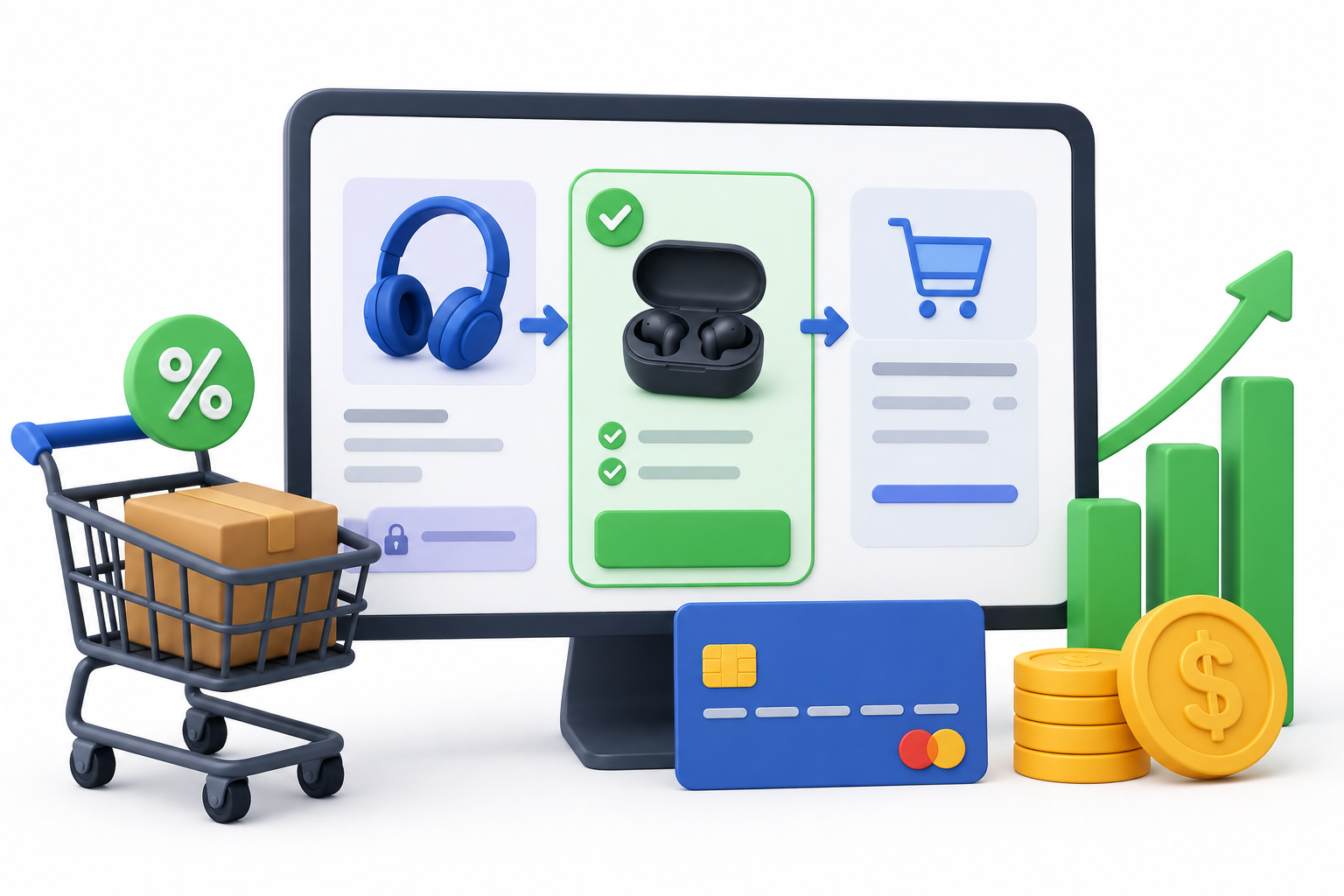
Boost conversions and maximize revenue with strategic Order Bumps. Learn how order bump offers increase average order value, improve checkout optimization, and enhance customer experience for scalable online business growth.
Introduction
In the competitive digital marketplace, businesses are constantly searching for smarter ways to increase revenue without dramatically increasing advertising costs. One of the most effective and underutilized strategies for improving profitability is the implementation of Order Bumps. These small but highly targeted offers appear during the checkout process and encourage customers to add complementary products or services to their existing purchase with a single click.
For online entrepreneurs, coaches, consultants, eCommerce brands, and digital marketers, order bumps represent an opportunity to improve customer value while creating a smoother purchasing experience. Businesses using optimized checkout strategies often see significant increases in average order value, conversion rates, and customer lifetime value without increasing traffic expenses.
At My Funnel Script, businesses are increasingly leveraging advanced funnel systems, persuasive copywriting frameworks, and conversion-focused sales processes to maximize customer acquisition and retention. Order bumps are now considered an essential component of modern sales funnel architecture because they deliver measurable revenue improvements with minimal friction.
According to Google Search Central, high-quality content and user-focused experiences are critical for sustainable growth. Similarly, checkout optimization and friction reduction play a major role in conversion performance. Strategic order bump placement aligns perfectly with these principles because it enhances convenience while providing relevant value to buyers.
This comprehensive guide explores everything businesses need to know about order bumps, including psychology, implementation, optimization strategies, copywriting techniques, common mistakes, advanced automation, analytics, customer behavior, and long-term revenue growth strategies.
What Are Order Bumps and Why Do They Matter?
Order bumps are small supplementary offers presented during the checkout process. These offers are specifically designed to complement the primary product or service the customer is already purchasing. Unlike upsells that often redirect users to another page, order bumps typically appear directly on the checkout form and require only one click to accept.
The simplicity of order bumps is what makes them highly effective. Customers have already committed to making a purchase, which means psychological resistance is lower at this stage. By offering an additional product that enhances the original purchase, businesses can significantly increase revenue without creating friction or interrupting the buying process. This approach is particularly powerful because it focuses on convenience and relevance rather than aggressive selling tactics.
Successful order bumps are strategically aligned with buyer intent. For example, a customer purchasing an online course might see an order bump for downloadable templates, worksheets, or bonus training modules. An eCommerce customer buying skincare products may receive an offer for a travel-size companion product. These highly relevant suggestions improve perceived value and enhance customer satisfaction.
Modern checkout optimization strategies often incorporate behavioral analytics and conversion testing to improve order bump performance. Businesses increasingly rely on tools like Google Analytics and Google Tag Manager to measure customer behavior, click-through rates, and checkout interactions. Data-driven optimization ensures businesses continually improve their funnel efficiency and maximize profitability.
Another reason order bumps matter is their impact on customer lifetime value. Customers who purchase complementary products during checkout often become more engaged buyers over time. They are more likely to perceive the brand as helpful, valuable, and solution-oriented. This contributes to improved trust, higher retention rates, and stronger brand authority.
Businesses operating in highly competitive industries benefit enormously from increased average order value because acquiring new customers is becoming increasingly expensive. By monetizing existing traffic more effectively, businesses can maintain healthier profit margins while scaling sustainably.
The Psychology Behind High-Converting Order Bumps
Understanding consumer psychology is essential when designing effective order bumps. Human purchasing behavior is driven by emotion, convenience, trust, urgency, and perceived value. Order bumps succeed because they align with these psychological triggers during a critical decision-making moment.
One major psychological principle involved is commitment and consistency. Once customers decide to buy something, they naturally become more receptive to related offers. Their brain has already justified spending money, reducing resistance to additional purchases. This makes checkout the perfect moment to present complementary solutions that feel logical and beneficial.
Another powerful factor is cognitive ease. Order bumps simplify decision-making by eliminating the need for customers to search for related products later. Instead of interrupting the purchasing flow, businesses present highly relevant offers at exactly the right time. This convenience creates a smoother user experience and reduces friction during checkout optimization.
Scarcity and urgency can also influence order bump conversions when used ethically. Limited-time bonuses, exclusive add-ons, or discounted companion products encourage immediate action. However, misleading urgency tactics can damage trust and negatively impact brand credibility. According to Google Search Essentials, transparency and helpfulness are critical for maintaining trust and authority online.
Perceived value is another core psychological driver. Customers are more likely to accept order bumps when the offer appears significantly valuable relative to its price. For example, offering a $97 product for $27 as an order bump creates a strong value perception. The lower pricing combined with contextual relevance increases acceptance rates substantially.
Social proof also contributes to higher conversions. Checkout pages that include testimonials, customer reviews, or usage statistics often build confidence and reduce hesitation. Businesses frequently integrate feedback systems and trust indicators to improve checkout credibility and reassure buyers about their purchasing decisions.
Additionally, personalization has become increasingly important in modern funnel optimization. AI-driven recommendation systems analyze customer behavior to present more relevant order bumps based on browsing history, purchase patterns, and customer preferences. Personalized experiences often produce significantly higher conversion rates than generic offers.
How Order Bumps Increase Average Order Value
Average Order Value (AOV) is one of the most important metrics in online business profitability. Increasing AOV allows companies to generate more revenue from the same amount of traffic, making marketing campaigns more sustainable and profitable. Order bumps are among the most efficient tools for increasing this metric.
The primary advantage of order bumps is their ability to create incremental revenue with minimal additional acquisition cost. Businesses already invest heavily in generating traffic through SEO, paid advertising, email marketing, and social media campaigns. Once a customer reaches checkout, maximizing the value of that transaction becomes essential for improving return on investment.
Order bumps increase AOV by encouraging customers to purchase complementary items they may not have considered initially. These offers work best when they naturally enhance the primary purchase. For example, a software subscription could include onboarding support, premium templates, or advanced tutorials as an order bump. These additions improve the customer experience while generating additional profit.
Another important factor is pricing psychology. Order bumps are typically lower-priced than the main offer, making them feel like a small incremental decision rather than a major purchase commitment. This reduces hesitation and encourages impulse buying behavior in a controlled, strategic manner.
Businesses that successfully increase AOV often gain greater flexibility in their advertising strategies. Higher revenue per customer means businesses can afford higher acquisition costs while maintaining profitability. This creates a competitive advantage in crowded digital advertising environments.
Advanced analytics platforms help businesses optimize order bump performance continuously. Tools such as Google Optimize Documentation and PageSpeed Insights support conversion-focused optimization strategies by improving user experience and testing funnel elements. Faster checkout performance combined with optimized offers can dramatically improve acceptance rates.
Additionally, order bumps contribute to customer satisfaction when implemented correctly. Relevant recommendations help customers achieve better outcomes from their purchases, increasing overall value perception and reducing buyer’s remorse.
Key Differences Between Order Bumps, Upsells, and Cross-Sells
Many businesses confuse order bumps with upsells and cross-sells, but these sales techniques function differently within the customer journey. Understanding these distinctions is essential for building high-performing sales funnels and maximizing conversions effectively.
Order bumps are presented directly on the checkout page and require minimal effort to accept. They are usually small, complementary offers designed to enhance the primary purchase. The simplicity and timing of order bumps make them highly effective because customers can add them instantly without leaving the checkout process.
Upsells, on the other hand, occur after the initial purchase decision. Customers are presented with a higher-value or upgraded version of the original product. Upsells often involve separate landing pages or additional purchase steps. While upsells can generate substantial revenue increases, they typically require more persuasion and commitment from the customer.
Cross-sells recommend related products that complement the primary purchase but are not necessarily presented during checkout. These suggestions may appear on product pages, cart pages, post-purchase emails, or recommendation widgets. Cross-selling focuses on expanding the customer’s overall product ecosystem rather than increasing immediate checkout value alone.
One reason order bumps often outperform other strategies is their low-friction nature. Since customers remain on the checkout page, there is less interruption to the purchasing process. This streamlined experience supports better conversion optimization and minimizes abandonment risk.
Businesses frequently combine all three techniques within a broader funnel architecture. For example, a customer may encounter a checkout order bump, followed by a one-time offer upsell, and later receive cross-sell recommendations through email automation. When integrated properly, these strategies work together to maximize revenue and customer engagement.
Customer intent also differs across these approaches. Order bumps target impulse convenience purchases, upsells target enhanced transformation or premium outcomes, and cross-sells target broader solution expansion. Understanding buyer psychology at each stage helps businesses craft more effective messaging and improve funnel performance.
Additionally, funnel analytics play a major role in optimizing these strategies. Platforms such as Google Search Console and Lighthouse support performance optimization and user experience improvements that directly impact checkout success.
The Most Effective Types of Order Bump Offers

Not all order bump offers perform equally well. High-converting order bumps are highly relevant, easy to understand, and directly connected to the customer’s primary purchase intent. Businesses that carefully design these offers typically experience stronger conversion rates and better customer satisfaction.
One of the most effective types of order bumps is digital add-ons. These may include templates, checklists, swipe files, bonus training modules, downloadable guides, or premium resources. Digital products are attractive because they have high perceived value while maintaining low fulfillment costs. Customers also appreciate instant access and convenience.
Service-based order bumps are another strong performer. Businesses often offer expedited support, onboarding assistance, strategy consultations, or setup services during checkout. These offers reduce customer uncertainty and improve the overall user experience. Service enhancements are especially effective for software companies, agencies, and educational platforms.
Extended warranties and protection plans are widely used in eCommerce because they align with customer concerns about product longevity and security. Buyers frequently choose these options when they perceive the risk of future issues or replacement costs.
Subscription upgrades can also function effectively as order bumps. Businesses may offer premium memberships, exclusive communities, recurring content libraries, or VIP access during checkout. Subscription-based order bumps often increase recurring revenue and improve long-term customer retention.
Physical product bundles are commonly used by eCommerce brands to encourage larger purchases. For example, a customer purchasing fitness equipment might receive an order bump for resistance bands, meal plans, or workout guides. These bundles improve customer outcomes while increasing transaction value.
Educational resources are especially powerful when customers require implementation guidance. Businesses often include mini-courses, tutorials, workshops, or strategy blueprints as checkout add-ons. Customers appreciate practical support that helps them achieve faster results.
High-performing order bump offers typically meet several important criteria:
- They solve an immediate problem
- They enhance the primary purchase
- They feel low-risk
- They are priced attractively
- They provide clear benefits
- They require minimal explanation
The best order bumps feel like natural extensions of the customer’s original decision rather than unrelated sales pitches. Relevance and convenience remain the foundation of successful checkout optimization.
How to Create Irresistible Order Bump Copy
Persuasive copywriting plays a crucial role in order bump success. Even highly relevant offers can underperform if the messaging lacks clarity, urgency, or perceived value. Effective order bump copy must communicate benefits quickly because customers make rapid decisions during checkout.
The first principle of strong order bump copy is clarity. Customers should immediately understand what the offer is, why it matters, and how it improves their purchase. Complicated explanations create confusion and reduce conversions. Simple language and concise messaging often outperform overly technical descriptions.
Benefit-driven language is essential. Instead of focusing only on features, businesses should emphasize outcomes and transformation. Customers care more about the results they will achieve than the mechanics of the product itself. For example, “Get faster results with ready-to-use templates” is more compelling than simply describing file formats or technical specifications.
Effective order bump copy also highlights convenience. Since customers are already in purchasing mode, emphasizing simplicity and ease encourages action. Phrases like “Add this with one click” or “Instantly enhance your purchase” reinforce low friction and increase perceived accessibility.
Pricing presentation significantly impacts conversions as well. Businesses frequently position order bumps as special checkout-only discounts. This creates exclusivity and urgency while increasing perceived value. However, pricing transparency remains important for maintaining trust and credibility.
Trust indicators strengthen conversion performance by reducing hesitation. Testimonials, user statistics, security badges, and satisfaction guarantees reassure customers that the offer is legitimate and valuable. According to Google Safe Browsing, security and trust are critical components of positive online experiences.
Formatting also matters during checkout optimization. Short paragraphs, bold benefit statements, bullet points, and visual hierarchy improve readability and guide customer attention effectively. Strategic emphasis using bold, italic, and <u>underline</u> formatting helps key benefits stand out naturally.
Strong order bump copy often includes:
- A compelling headline
- A clear value proposition
- Immediate benefits
- Risk reduction
- Convenience-focused language
- Action-oriented phrasing
Ultimately, effective copywriting transforms a simple add-on into a highly desirable enhancement that customers feel excited to include in their purchase journey.
Choosing the Right Pricing Strategy for Order Bumps
Pricing strategy has a major influence on order bump conversion rates. Even highly valuable offers may underperform if pricing feels disproportionate to the primary product or creates psychological resistance during checkout. Businesses must carefully balance affordability, perceived value, and profitability.
One common strategy involves pricing order bumps significantly lower than the core offer. Customers who already committed to spending money are more likely to accept smaller incremental purchases because the psychological impact feels minimal. This is often referred to as the “impulse acceptance” effect within conversion optimization.
Relative pricing is another important factor. Customers judge order bump value in comparison to the primary purchase. For example, adding a $27 enhancement to a $297 course feels reasonable, whereas a $197 add-on may create hesitation. Strategic pricing alignment helps maintain positive momentum throughout the checkout process.
Discount framing is widely used to increase perceived value. Businesses often present order bumps as exclusive one-time checkout discounts unavailable elsewhere. This positioning encourages immediate action while reinforcing urgency and exclusivity.
Bundling strategies can further improve acceptance rates. Instead of offering a single add-on, businesses may combine several related bonuses into one comprehensive package. Customers frequently perceive bundled offers as more valuable because they receive multiple solutions at once.
Free trial order bumps are increasingly popular among subscription businesses. Customers may receive limited-time premium access during checkout, which later converts into recurring billing. This approach reduces upfront commitment while encouraging long-term engagement.
Another effective tactic is value stacking. Businesses highlight the individual value of each included component before presenting the discounted order bump price. This creates stronger perceived savings and increases purchase motivation.
Testing is essential for pricing optimization. Businesses often use A/B testing methodologies to determine ideal price points, discount percentages, and value positioning strategies. Data-driven experimentation helps identify the most profitable combinations over time.
Finally, businesses must avoid overpricing order bumps purely for short-term profit. Excessive pricing can damage trust, reduce conversions, and negatively affect customer experience. Sustainable growth depends on balancing profitability with genuine customer value.
Designing High-Converting Checkout Pages for Order Bumps
A well-designed checkout page plays a critical role in the success of any order bump strategy. Even the most compelling offer can fail if the checkout experience creates friction, confusion, or distrust. Businesses that prioritize user experience and conversion-focused design often see substantial improvements in acceptance rates and overall revenue performance.
The placement of the order bump is one of the most important design considerations. High-performing checkout pages usually position the offer directly beneath the order summary or near the payment section. This placement ensures visibility without distracting users from completing the primary purchase. Customers should naturally encounter the order bump as part of the checkout flow rather than feeling interrupted by it.
Visual hierarchy significantly influences buyer behavior during checkout optimization. Effective pages use spacing, contrast, typography, and emphasis strategically to draw attention to the order bump without overwhelming the customer. Important benefits may appear in bold, while limited-time offers or unique value propositions can be highlighted using italic formatting or <u>underlined</u> text where appropriate.
Mobile responsiveness is equally essential because a large percentage of online purchases now occur on smartphones and tablets. Checkout forms must remain easy to navigate across all devices. Slow-loading pages, broken layouts, or difficult form interactions can dramatically increase cart abandonment rates. Businesses often use PageSpeed Insights and Core Web Vitals Documentation to improve checkout speed and user experience.
Trust signals also contribute to higher conversion performance. Security badges, payment encryption indicators, testimonials, and money-back guarantees reassure customers during the final purchasing stage. Since checkout is where customers share financial information, credibility becomes especially important.
Reducing unnecessary distractions is another best practice. Cluttered checkout pages with excessive navigation links, pop-ups, or unrelated offers can reduce focus and negatively impact conversions. Minimalist checkout design often produces better results because it keeps attention centered on completing the purchase.
Finally, businesses should continually test checkout elements such as button colors, offer placement, copy variations, and pricing structures. Continuous optimization ensures that checkout performance improves over time based on real customer behavior rather than assumptions.
Advanced Order Bump Funnel Strategies
As businesses become more experienced with sales funnels, they often implement advanced order bump strategies designed to maximize customer value and long-term profitability. These sophisticated approaches go beyond simple add-ons and integrate behavioral targeting, segmentation, automation, and personalization into the customer journey.
One advanced strategy involves dynamic order bumps. Instead of showing every customer the same offer, businesses tailor order bumps based on purchase history, browsing behavior, geographic location, or customer interests. Personalized recommendations often produce significantly higher conversion rates because they align more closely with user intent.
Behavioral segmentation allows businesses to present different offers to different customer groups. For example, first-time buyers may receive beginner-friendly add-ons, while returning customers are shown premium upgrades or advanced resources. This level of targeting improves relevance and enhances customer satisfaction.
Automation also plays a major role in modern funnel optimization. AI-powered systems analyze customer behavior in real time and automatically determine which order bumps are most likely to convert. These intelligent systems reduce manual decision-making while improving funnel efficiency and revenue scalability.
Sequential funnel architecture is another advanced technique. Businesses may present an initial order bump during checkout followed by post-purchase upsells, membership offers, or email-driven cross-sells. Each step in the funnel is strategically designed to increase customer lifetime value while maintaining a positive experience.
Subscription-focused businesses frequently use recurring order bumps to create predictable revenue streams. Customers may add monthly memberships, premium support plans, or ongoing training access during checkout. Recurring revenue models provide long-term business stability and improve customer retention.
Data analysis is critical for advanced funnel optimization. Businesses use platforms such as Google Analytics 4 and Google Looker Studio to monitor customer behavior, conversion patterns, and revenue performance across funnel stages.
Another emerging trend is contextual personalization using AI-generated recommendations. Machine learning algorithms can identify customer preferences and dynamically display highly relevant offers based on predictive behavior modeling. This creates a more customized checkout experience and increases conversion efficiency.
Ultimately, advanced order bump strategies focus on delivering relevant value while maximizing monetization opportunities throughout the customer journey.
Common Mistakes Businesses Make with Order Bumps
Although order bumps can generate substantial revenue increases, many businesses implement them incorrectly and unintentionally reduce conversion performance. Understanding these common mistakes helps businesses avoid costly errors and create more effective checkout experiences.
One of the most frequent mistakes is offering irrelevant products. Customers are unlikely to accept add-ons that do not directly enhance their original purchase. Relevance is the foundation of successful order bump strategy. Businesses should focus on complementary solutions that naturally align with buyer intent.
Overcomplicating the offer is another major issue. Checkout decisions happen quickly, and customers rarely spend significant time analyzing order bump details. Long explanations, technical jargon, or confusing messaging create friction and reduce conversions. Effective order bumps communicate value clearly and concisely.
Excessive pricing also harms performance. Businesses sometimes assume that customers in buying mode will accept expensive add-ons without hesitation. However, high-priced order bumps often trigger additional scrutiny and disrupt checkout momentum. Strategic pricing alignment is essential for maintaining conversion flow.
Poor checkout design can significantly reduce order bump visibility and effectiveness. Cluttered layouts, difficult mobile navigation, and distracting page elements create negative user experiences. According to Google Search Central Documentation, usability and user experience strongly influence overall digital performance.
Another mistake involves using too many offers simultaneously. Overwhelming customers with multiple order bumps, upsells, and pop-ups can create decision fatigue. Simplified checkout experiences generally perform better because they reduce cognitive overload.
Lack of testing is also problematic. Many businesses launch order bumps and never optimize them further. Continuous A/B testing is necessary for improving copy, pricing, placement, and design effectiveness over time. Customer behavior evolves, and businesses must adapt accordingly.
Ignoring mobile optimization is increasingly dangerous as mobile commerce continues to grow. Checkout forms that perform poorly on smaller screens often experience significantly higher abandonment rates. Mobile responsiveness should be a priority from the beginning of the funnel design process.
Finally, businesses sometimes focus too heavily on short-term revenue while neglecting customer trust. Aggressive tactics, misleading scarcity, or deceptive pricing may increase short-term sales but damage long-term credibility and retention. Sustainable growth depends on transparency, authenticity, and genuine value delivery.
Using Analytics and Data to Improve Order Bump Performance
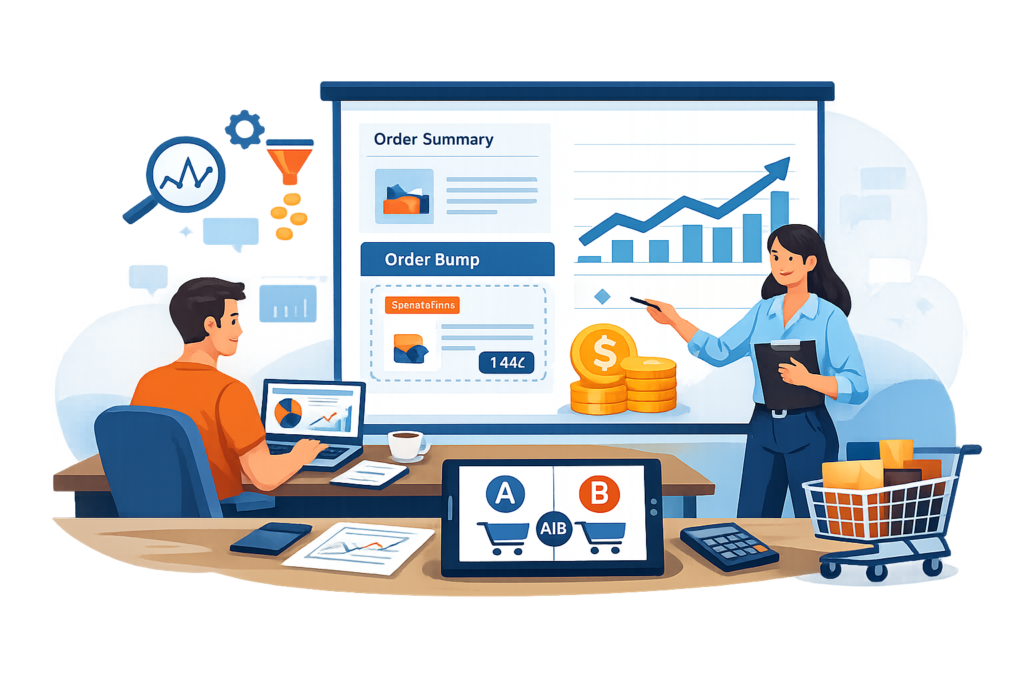
Data-driven optimization is essential for maximizing order bump effectiveness. Businesses that rely on analytics rather than assumptions can identify customer behavior patterns, uncover conversion barriers, and continuously improve checkout performance over time.
One of the most important metrics to monitor is order bump acceptance rate. This percentage indicates how many customers add the offer to their purchase. Low acceptance rates may suggest problems with relevance, pricing, placement, or messaging. Tracking these patterns helps businesses make informed adjustments.
Average Order Value (AOV) is another key performance indicator. Since the primary purpose of order bumps is increasing transaction value, businesses should closely monitor revenue growth across different customer segments and funnel variations.
Checkout abandonment data also provides valuable insights. If customers frequently abandon the checkout page after encountering order bumps, the offer may be too aggressive, confusing, or poorly positioned. Businesses can analyze user flow reports to identify friction points and improve the customer experience.
Heatmaps and session recordings are increasingly used for behavioral analysis. These tools reveal how users interact with checkout pages, where attention is focused, and which elements create confusion. Understanding visual engagement patterns helps businesses optimize page layout and offer placement.
Conversion tracking platforms such as Google Tag Manager enable businesses to monitor specific customer actions throughout the checkout process. Detailed event tracking supports more accurate attribution and funnel analysis.
A/B testing is one of the most powerful optimization methods available. Businesses can test:
- Different headlines
- Pricing structures
- Offer designs
- CTA wording
- Color variations
- Mobile layouts
- Benefit-focused messaging
Small adjustments often produce surprisingly large performance improvements over time.
Customer feedback should also inform optimization efforts. Surveys, support conversations, and post-purchase reviews provide valuable insights into customer expectations and frustrations. Businesses that actively listen to customer feedback often create more effective and trustworthy order bump experiences.
Additionally, predictive analytics and AI-driven insights are becoming more common in advanced conversion optimization strategies. These technologies help businesses forecast buying behavior and personalize checkout experiences more effectively.
Ultimately, analytics transform order bump optimization from guesswork into a measurable, scalable growth system.
Best Practices for Long-Term Order Bump Success
Sustainable order bump success requires more than short-term conversion tactics. Businesses that consistently achieve strong results focus on long-term customer relationships, ethical marketing practices, and continuous optimization strategies.
One of the most important best practices is prioritizing customer value above immediate profit. Order bumps should genuinely improve the customer’s experience and help them achieve better results. When customers perceive offers as helpful rather than manipulative, trust and retention improve significantly.
Consistency across the customer journey also matters. Checkout messaging, branding, pricing, and offer positioning should align with the broader brand experience. Inconsistent messaging can create confusion and reduce credibility during critical purchasing moments.
Continuous testing and experimentation are essential for maintaining high performance. Consumer behavior evolves over time, and strategies that worked previously may become less effective. Businesses that regularly test new offers, copy variations, and pricing models stay competitive in changing markets.
Transparency strengthens customer trust and brand authority. Businesses should clearly explain pricing, billing structures, subscription terms, and product details. Hidden fees or deceptive tactics may increase short-term revenue but damage long-term customer relationships.
Another important best practice is minimizing checkout friction. Simplified forms, fast-loading pages, mobile optimization, and secure payment systems contribute to smoother purchasing experiences. According to Google Page Experience Guidelines, usability and performance are critical for positive user engagement.
Personalization is becoming increasingly valuable in modern funnel optimization. Businesses that tailor order bump offers based on customer preferences, purchase history, and behavioral patterns often achieve higher engagement and stronger conversion rates.
Email automation can further enhance order bump strategies by supporting post-purchase engagement. Customers who decline checkout offers may later receive personalized follow-up recommendations or educational content that encourages future purchases.
Finally, businesses should regularly review customer satisfaction metrics alongside revenue metrics. High-performing funnels balance profitability with customer trust, long-term retention, and positive brand reputation.
The Future of Order Bumps and Checkout Optimization
The future of order bumps is closely tied to advancements in personalization, artificial intelligence, automation, and customer experience optimization. As digital commerce becomes increasingly competitive, businesses are investing heavily in smarter checkout systems designed to improve both conversions and customer satisfaction.
AI-powered recommendation engines are already transforming checkout experiences. These systems analyze massive amounts of behavioral data to determine which products customers are most likely to purchase. Personalized order bump suggestions are becoming more accurate and effective through machine learning algorithms.
Voice commerce and conversational checkout experiences may also influence future order bump strategies. As smart devices and AI assistants become more integrated into eCommerce ecosystems, businesses may present personalized offers through voice-driven purchasing interactions.
Predictive analytics will continue playing a major role in conversion optimization. Businesses increasingly use customer behavior forecasting to identify buying intent and optimize offer timing. Predictive systems help businesses create more relevant and less intrusive checkout experiences.
Subscription commerce is expected to grow significantly in the coming years, creating additional opportunities for recurring order bumps and membership-based offers. Businesses that successfully integrate recurring revenue strategies into checkout flows may achieve greater financial stability and customer retention.
Augmented reality and immersive shopping technologies may also impact future order bump implementation. Interactive product visualization and personalized digital experiences could create more engaging checkout interactions that increase buyer confidence.
Privacy and data protection will remain critical considerations. Businesses must balance personalization with ethical data usage and transparent privacy practices. Secure systems and responsible data management are essential for maintaining customer trust.
According to Google Privacy & Security Resources, transparency and responsible data handling are fundamental for building sustainable digital experiences. Businesses that prioritize customer trust alongside personalization will likely perform better in evolving online markets.
Ultimately, the future of order bumps centers around relevance, convenience, personalization, and trust. Businesses that adapt to emerging technologies while maintaining customer-focused strategies will continue gaining competitive advantages.
FAQs
What is the main purpose of an order bump?
The primary purpose of an order bump is to increase average order value by encouraging customers to add complementary products or services during checkout. These offers are designed to improve customer outcomes while generating additional revenue for businesses.
Are order bumps suitable for all businesses?
Order bumps can work effectively for many business models, including eCommerce stores, digital products, coaching programs, SaaS companies, agencies, and subscription services. The key is offering highly relevant add-ons that enhance the customer’s primary purchase.
How much should an order bump cost?
Most successful order bumps are priced lower than the core offer to reduce psychological resistance. Businesses often test different pricing structures to identify the most profitable balance between affordability and perceived value.
What makes an order bump convert well?
High-converting order bumps are:
- Relevant to the main purchase
- Easy to understand
- Convenient to add
- Priced attractively
- Focused on customer benefits
- Positioned clearly during checkout
Can too many order bumps hurt conversions?
Yes. Presenting too many offers simultaneously can overwhelm customers and create decision fatigue. Simplified checkout experiences generally produce stronger results and lower abandonment rates.
Should businesses use urgency in order bumps?
Ethical urgency can improve conversions when used honestly. Limited-time discounts or exclusive checkout bonuses may encourage action, but misleading scarcity tactics can damage customer trust and brand reputation.
How do businesses track order bump performance?
Businesses typically use analytics platforms such as Google Analytics and conversion tracking systems to monitor acceptance rates, revenue growth, checkout abandonment, and customer behavior patterns.
Are mobile-optimized order bumps important?
Absolutely. Mobile commerce continues to grow rapidly, and poorly optimized checkout pages often experience higher abandonment rates. Responsive design and fast-loading mobile experiences are essential for conversion optimization.
Best Practices Summary
Successful order bump implementation requires a balance of psychology, strategy, customer experience, and analytics. Businesses that consistently achieve strong performance usually follow several key principles.
First, relevance is critical. Order bumps should directly complement the primary purchase and provide meaningful value to customers. Random or unrelated offers typically underperform and may reduce trust.
Second, simplicity improves conversions. Clear messaging, concise copywriting, and low-friction checkout design create smoother purchasing experiences. Customers should immediately understand the offer and its benefits.
Third, pricing strategy matters significantly. Lower-priced add-ons often perform better because they feel like easy incremental decisions rather than major commitments. Businesses should test pricing continuously to optimize results.
Fourth, personalization is becoming increasingly important. Tailored offers based on customer behavior and purchase history generally outperform generic checkout recommendations.
Fifth, ongoing testing and analytics are essential for long-term growth. Businesses should regularly evaluate conversion metrics, customer feedback, and behavioral data to refine checkout performance.
Finally, trust should remain a top priority. Ethical marketing practices, transparent pricing, secure checkout systems, and customer-focused strategies contribute to stronger retention and sustainable business growth.
When businesses combine these best practices with continuous optimization and high-quality customer experiences, order bumps become one of the most powerful tools for increasing profitability and improving funnel performance.
Conclusion
Order bumps have evolved into one of the most effective strategies for increasing online revenue, improving average order value, and enhancing customer experience. When implemented strategically, these checkout offers provide meaningful value to customers while helping businesses maximize the profitability of existing traffic and marketing campaigns.
From psychology-driven copywriting and pricing strategies to advanced funnel automation and AI-powered personalization, modern order bump systems are becoming increasingly sophisticated. Businesses that prioritize relevance, trust, transparency, and user experience consistently outperform competitors using outdated or overly aggressive sales tactics.
At My Funnel Script, businesses continue exploring innovative ways to optimize funnels, improve conversions, and create scalable online growth systems. Order bumps remain a foundational component of these strategies because they deliver measurable revenue improvements without requiring significant increases in advertising spend.
As customer expectations evolve and digital commerce becomes more competitive, businesses that invest in intelligent checkout optimization and customer-focused sales processes will be better positioned for sustainable long-term success.
Want to Implement This Easily?
Prompt Text:
You are an expert consultant. Based on the blog post titled “Order Bumps”, provide a step-by-step, practical implementation guide. Include tools, best practices, common mistakes to avoid, and advanced tips. Assume the reader wants to implement everything discussed in this article effectively.
Call to Action
Want our help implementing this? Just reach out to us via our website contact form: