
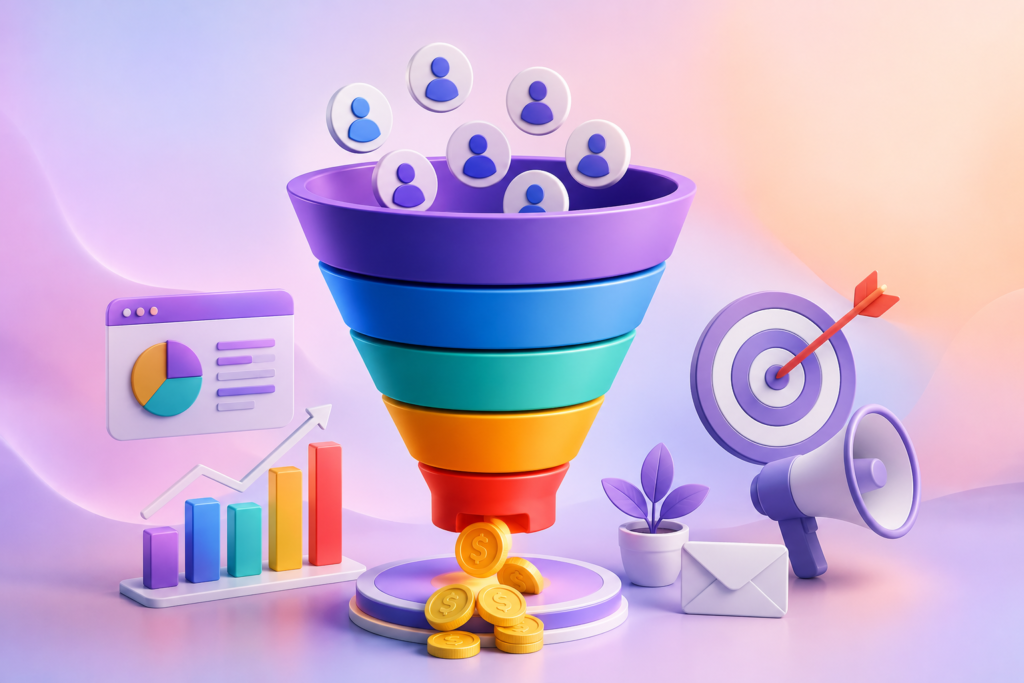
Discover everything you need to know about Sales Funnels, including strategy, customer journey optimization, lead generation, automation, conversion techniques, and best practices for building scalable, high-converting funnels in 2026.
Introduction
Every successful online business follows a structured process that transforms visitors into loyal customers. That process is known as a sales funnel. Rather than relying on chance, modern businesses guide potential customers through carefully designed stages that build trust, answer objections, and encourage confident purchasing decisions.
At My Funnel Script, we understand that a well-designed sales funnel is much more than a collection of landing pages. It is a complete customer acquisition system that combines persuasive messaging, automation, user experience, analytics, and continuous optimization. When each stage works together, businesses experience higher conversion rates, lower customer acquisition costs, and sustainable long-term growth.
This comprehensive guide explores everything you need to know about Sales Funnels in 2026. Whether you are launching your first digital product, generating qualified leads, or scaling an established business, this guide will help you build smarter funnels that deliver measurable results while following modern marketing best practices.
Understanding Sales Funnels and Why They Matter
A sales funnel represents the journey a potential customer takes from discovering your business to becoming a paying customer and eventually a loyal advocate. Every visitor enters the funnel with different intentions, levels of awareness, and purchasing readiness. An effective funnel anticipates these differences by providing relevant information, solving specific problems, and gradually increasing trust throughout the buying process.
Unlike traditional marketing, which often focuses on attracting traffic alone, modern funnel strategies prioritize the complete customer experience. Each interaction—whether through advertisements, landing pages, email sequences, webinars, product demonstrations, or follow-up communications—plays a meaningful role in moving prospects toward conversion. Businesses that invest in structured funnels consistently outperform those relying solely on standalone marketing campaigns because every stage supports the next.
<u>Sales funnel optimization</u> also enables businesses to collect valuable customer insights. Analytics reveal where visitors enter, where they leave, which content performs best, and which offers generate the highest revenue. Continuous testing, customer feedback, and performance measurement allow organizations to refine messaging and improve conversion rates over time. Rather than guessing what customers want, businesses make informed decisions backed by measurable data, resulting in stronger marketing performance and higher return on investment.
The Evolution of Modern Sales Funnels
The concept of guiding customers through a purchasing journey has existed for decades, but today’s digital landscape has transformed how funnels operate. Modern buyers conduct extensive research before making purchasing decisions, often interacting with multiple channels before converting. Businesses must therefore create connected experiences that meet customers wherever they are in their journey.
Today’s funnels extend beyond a single landing page. They integrate websites, email marketing, social media, search engines, video content, live chat, customer reviews, and automated follow-up systems. This interconnected approach creates a seamless experience that strengthens trust and reduces friction throughout the buying process. Every touchpoint contributes to moving prospects closer to becoming satisfied customers.
Artificial intelligence, personalization, behavioral segmentation, and predictive analytics are further shaping the future of funnel marketing. Businesses can now tailor messages based on browsing behavior, previous purchases, geographic location, and engagement history. These personalized experiences significantly improve conversion rates because customers receive information that directly aligns with their interests and needs instead of generic marketing messages.
The Core Stages of a High-Converting Sales Funnel
Every effective sales funnel follows a structured progression designed to nurture potential customers through increasingly meaningful interactions. Although businesses may adapt funnel structures for different industries, most successful funnels include awareness, interest, consideration, conversion, and retention stages.
During the awareness stage, potential customers first discover your business through organic search, paid advertising, referrals, social media, or content marketing. At this point, prospects are identifying problems or exploring possible solutions rather than actively purchasing. Educational content, informative articles, videos, and valuable resources establish credibility while encouraging further engagement.
As prospects progress through the funnel, they begin comparing solutions, evaluating trust signals, reviewing testimonials, and assessing product value. Strategic email nurturing, product demonstrations, consultations, and personalized offers address remaining objections while reinforcing confidence. After conversion, businesses continue engaging customers through onboarding, customer support, upselling opportunities, loyalty initiatives, and referral programs, transforming one-time buyers into long-term brand advocates.
Creating Customer-Centric Funnel Strategies
The most successful funnels are built around customer needs rather than business objectives alone. Businesses that understand customer motivations, pain points, purchasing behaviors, and expectations develop significantly stronger conversion strategies. Customer research should therefore become the foundation of every funnel before design or copywriting begins.
Developing detailed buyer personas helps identify the specific challenges customers face at each stage of their journey. Understanding demographics, purchasing triggers, preferred communication channels, objections, and desired outcomes enables marketers to create highly relevant messaging that resonates naturally. Instead of promoting features, businesses focus on solving real problems and delivering measurable value.
Customer-centric funnels also emphasize consistency across every interaction. Messaging should remain aligned from advertisements to landing pages, email campaigns, checkout processes, and post-purchase communications. Consistent branding, clear value propositions, transparent pricing, and trustworthy customer support create confidence throughout the experience while reducing unnecessary friction that often causes prospects to abandon the purchasing process.
Building High-Converting Landing Pages
Landing pages remain one of the most influential components of any sales funnel because they often determine whether visitors continue engaging or leave entirely. Effective landing pages eliminate distractions while presenting a clear value proposition supported by compelling copy, persuasive visuals, and strategic calls to action.
A strong headline immediately communicates the primary benefit visitors will receive. Supporting content explains how the solution addresses customer challenges while reinforcing credibility through testimonials, certifications, case studies, guarantees, and measurable results. Rather than overwhelming visitors with excessive information, effective pages maintain clarity, readability, and logical progression toward conversion.
Page performance also significantly influences conversions. Fast loading speeds, mobile responsiveness, accessibility, intuitive navigation, and secure browsing contribute to positive user experiences. Google’s Core Web Vitals recommendations emphasize page speed, visual stability, and responsiveness as essential quality signals. Businesses should regularly review Core Web Vitals and follow Google Search Essentials to ensure their websites meet modern performance expectations.
Lead Generation Strategies That Feed Your Sales Funnel
Generating consistent, high-quality leads forms the foundation of every profitable sales funnel. Without qualified prospects entering the funnel, even the most sophisticated automation systems cannot deliver sustainable business growth. Effective lead generation combines educational content, targeted outreach, search visibility, and compelling incentives that encourage meaningful engagement.
Lead magnets remain one of the most effective acquisition strategies. Free resources such as comprehensive guides, templates, industry reports, webinars, calculators, or assessment tools provide immediate value while encouraging visitors to share their contact information. Successful lead magnets solve a specific problem quickly, establishing trust before introducing paid solutions later in the customer journey.
Businesses should diversify acquisition channels to maintain a healthy and scalable lead pipeline. Organic search optimization, paid advertising, referral partnerships, email campaigns, video marketing, podcasts, and professional networking each contribute unique traffic sources. Measuring lead quality instead of lead quantity ensures marketing investments attract prospects who genuinely align with business offerings, increasing conversion rates while reducing acquisition costs.
The Role of Automation in Modern Sales Funnels
Marketing automation has become an essential component of scalable sales funnels because it enables businesses to nurture thousands of prospects without sacrificing personalization. Automated workflows deliver timely communications based on customer behavior, ensuring prospects receive relevant information exactly when they need it.
Email automation remains one of the most effective applications. Welcome sequences, educational campaigns, abandoned cart reminders, appointment confirmations, product recommendations, and post-purchase follow-ups keep customers engaged throughout their journey. Behavioral triggers allow businesses to respond dynamically to customer actions, creating highly personalized experiences that increase engagement and conversions.
Automation extends beyond email. Customer relationship management systems, live chat, appointment scheduling, lead scoring, payment processing, analytics dashboards, and reporting tools work together to streamline operations while improving customer satisfaction. Businesses should regularly review workflow performance, remove unnecessary complexity, and update automation rules based on evolving customer behavior to ensure long-term effectiveness.
Measuring Funnel Performance Through Data and Analytics
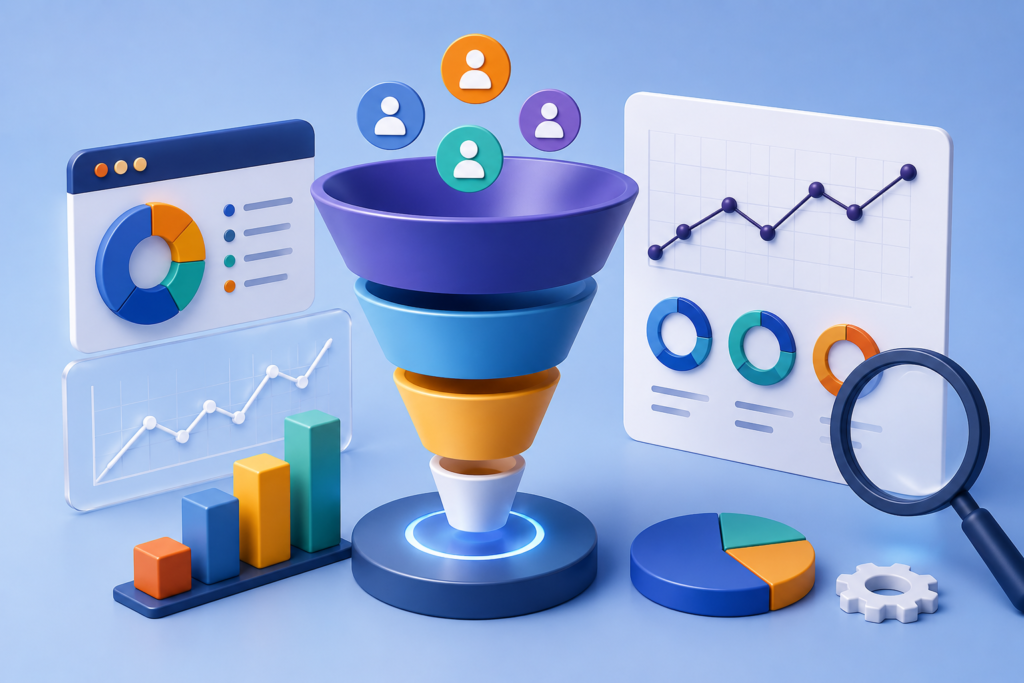
Building a sales funnel is only the beginning. Continuous measurement and optimization determine whether a funnel delivers sustainable business growth. Without reliable analytics, businesses risk making decisions based on assumptions rather than measurable customer behavior.
Key performance indicators should align with each funnel stage. Traffic volume, click-through rate, landing page conversion rate, lead quality, email engagement, appointment bookings, sales conversion rate, average order value, customer acquisition cost, customer lifetime value, and return on investment collectively provide a comprehensive understanding of funnel performance. Monitoring these metrics consistently helps identify opportunities for improvement before small issues become significant obstacles.
Businesses should also embrace experimentation through structured A/B testing. Testing headlines, call-to-action buttons, page layouts, pricing strategies, images, email subject lines, and form designs reveals which variations produce stronger engagement. Decisions supported by analytics create continuous improvements that compound over time, allowing businesses to maximize profitability while delivering increasingly valuable customer experiences.
Funnel Optimization Through Continuous Testing and Improvement
Building a sales funnel is only the beginning. The highest-performing businesses understand that optimization is an ongoing process rather than a one-time project. Customer behavior changes, market conditions evolve, and technology continues to advance. Businesses that regularly review and refine their funnels consistently achieve stronger conversion rates, higher customer satisfaction, and improved return on investment. Continuous optimization ensures every stage of the customer journey remains effective while adapting to new opportunities and changing expectations.
Effective optimization begins with accurate data collection. Every page, email, advertisement, and conversion point should be measured using reliable analytics. Businesses should monitor visitor behavior, bounce rates, time on page, click-through rates, conversion percentages, and revenue generated from each stage of the funnel. Heatmaps, session recordings, and customer feedback surveys provide additional insight into how users interact with content and where they experience friction. These findings help prioritize improvements that have the greatest impact on overall performance.
A/B testing should become part of every optimization strategy. Headlines, calls to action, page layouts, pricing structures, images, testimonials, and form designs can all influence conversion rates. Testing one variable at a time allows businesses to identify what truly drives customer engagement. Incremental improvements across multiple funnel stages often produce significant long-term gains, making optimization one of the most valuable investments in sustainable business growth.
Personalization and Artificial Intelligence in Sales Funnels
Modern consumers expect experiences tailored to their interests, behaviors, and needs. Generic marketing messages are becoming less effective because customers respond more positively to personalized communication. Artificial intelligence enables businesses to deliver relevant content, product recommendations, and follow-up sequences that align with each visitor’s unique journey, creating stronger engagement and improved conversion rates.
Behavioral data allows businesses to segment audiences based on browsing history, previous purchases, geographic location, device usage, and engagement patterns. Personalized landing pages, targeted email campaigns, and customized offers increase relevance while reducing unnecessary distractions. Customers appreciate businesses that understand their needs and provide solutions that directly address their challenges rather than presenting one-size-fits-all marketing messages.
Artificial intelligence also enhances decision-making through predictive analytics and automation. AI-powered systems can identify high-value prospects, recommend optimal communication times, forecast purchasing behavior, and automate repetitive marketing tasks. Human expertise remains essential, however, because successful funnels require empathy, creativity, and strategic thinking. AI should support marketers by improving efficiency while allowing professionals to focus on relationship building, customer experience, and long-term business strategy.
Writing Persuasive Sales Funnel Copy That Converts
Exceptional copywriting remains one of the most influential factors in sales funnel success. Visitors rarely convert because of design alone; they convert because the messaging clearly explains the value offered and demonstrates how it solves their problems. Effective copy guides readers naturally from curiosity to confidence while addressing concerns before they become objections.
Strong headlines capture attention by focusing on customer outcomes rather than product features. Supporting copy should emphasize benefits, explain solutions clearly, and demonstrate measurable results whenever possible. Real customer stories, case studies, statistics, and testimonials reinforce credibility while reducing perceived risk. Every paragraph should move readers closer to taking the desired action without relying on exaggerated claims or manipulative sales tactics.
Calls to action should be specific, visible, and aligned with the visitor’s stage in the buying journey. Early-stage visitors may prefer educational resources or consultations, while purchase-ready prospects require clear opportunities to complete transactions. Consistency across advertisements, landing pages, emails, and checkout experiences reinforces trust and creates a seamless customer journey that supports higher conversion rates.
Building Trust Through Social Proof and Transparency
Trust is the foundation of every successful sales funnel. Even the most persuasive marketing campaign will struggle if potential customers question the credibility of the business. Modern buyers research extensively before making purchasing decisions, making transparency and social proof essential components of conversion optimization.
Customer testimonials, verified reviews, detailed case studies, and measurable success stories demonstrate real-world results. Rather than making broad promises, businesses should present authentic experiences supported by factual outcomes whenever possible. Video testimonials, before-and-after examples, and client interviews often provide stronger credibility than anonymous written reviews because they showcase genuine customer experiences.
Transparency extends beyond testimonials. Clear pricing, refund policies, privacy practices, secure payment processing, and accessible customer support contribute significantly to customer confidence. Businesses should communicate honestly about product capabilities, implementation timelines, and expected outcomes. Trust develops when expectations consistently match actual experiences, encouraging repeat business, referrals, and long-term customer loyalty.
Common Sales Funnel Mistakes Businesses Should Avoid
Many businesses invest significant resources in attracting traffic but overlook critical issues that reduce conversions throughout the funnel. One of the most common mistakes is creating overly complicated customer journeys with unnecessary steps. Every additional form field, page, or decision point increases the likelihood that prospects will abandon the process before completing their purchase.
Another frequent mistake is inconsistent messaging between advertisements, landing pages, and follow-up communications. When visitors encounter conflicting information or unexpected offers, trust declines rapidly. Businesses should maintain consistent branding, value propositions, and customer expectations across every interaction. Mobile optimization is equally important, as a growing percentage of customers complete purchases using smartphones and tablets.
Neglecting analytics is another costly error. Without monitoring key performance indicators, businesses cannot identify weaknesses or prioritize improvements effectively. Failing to test new ideas, ignoring customer feedback, and allowing outdated content to remain unchanged can gradually reduce funnel performance. Continuous measurement, optimization, and customer-focused improvements are essential for maintaining long-term success.
Best Practices Summary
Successful sales funnels begin with a deep understanding of customer needs and a commitment to delivering genuine value at every stage of the journey. Businesses should focus on solving real problems rather than simply promoting products, ensuring that each interaction builds trust and strengthens customer relationships. High-quality content, persuasive messaging, intuitive design, and seamless user experiences collectively contribute to stronger conversion rates.
Performance should be measured continuously through reliable analytics, customer feedback, and structured experimentation. Regular optimization allows businesses to improve every stage of the funnel while adapting to changing customer expectations and industry trends. Automation and artificial intelligence should enhance personalization and operational efficiency without replacing authentic human communication or strategic decision-making.
Finally, long-term success depends on transparency, credibility, and customer satisfaction. Organizations that consistently prioritize helpful experiences over aggressive sales tactics build stronger reputations, encourage repeat business, and create sustainable growth. A well-designed sales funnel is not merely a marketing asset—it is a long-term business system that supports lasting customer relationships and measurable revenue growth.
Frequently Asked Questions
1. What is a sales funnel?
A sales funnel is a structured process that guides potential customers from discovering a business to making a purchase and becoming loyal, repeat customers through carefully planned marketing and sales stages.
2. Why are sales funnels important?
Sales funnels help businesses improve conversion rates, nurture leads, reduce customer acquisition costs, and create predictable revenue by guiding prospects through a strategic buying journey.
3. How long does it take to build an effective sales funnel?
The timeline depends on complexity. A simple funnel may take a few days, while advanced funnels with automation, testing, and multiple customer journeys may require several weeks.
4. Which metrics should businesses monitor?
Important metrics include conversion rate, click-through rate (CTR), cost per acquisition (CPA), return on ad spend (ROAS), customer lifetime value (CLV), average order value (AOV), bounce rate, and lead quality.
5. Can small businesses benefit from sales funnels?
Yes. Sales funnels help businesses of every size attract qualified leads, automate follow-up communication, improve customer engagement, and generate consistent sales without significantly increasing marketing costs.
6. How often should a sales funnel be updated?
Funnels should be reviewed regularly. Monthly performance reviews and quarterly optimization projects help maintain strong conversion rates while adapting to changing customer behavior and market trends.
7. Is automation necessary for modern sales funnels?
Automation significantly improves efficiency by managing repetitive tasks such as email follow-ups, lead nurturing, appointment scheduling, and customer segmentation. However, automation should complement—not replace—personalized customer interactions.
8. What makes a sales funnel successful?
A successful sales funnel combines valuable content, persuasive copywriting, excellent user experience, consistent branding, data-driven optimization, transparent communication, and continuous improvement based on customer feedback.
Conclusion
Building a successful Sales Funnel requires much more than attractive landing pages or automated email campaigns. It demands strategic planning, customer-focused messaging, continuous optimization, reliable analytics, and a commitment to delivering genuine value throughout the customer journey.
At My Funnel Script, we believe that businesses achieve sustainable growth when every stage of the funnel is designed to educate, build trust, solve problems, and encourage confident purchasing decisions. By implementing the strategies outlined in this guide, organizations can create scalable sales systems that improve conversions, strengthen customer relationships, and support long-term business success in an increasingly competitive digital marketplace.
Want to Implement This Easily?
Prompt
You are an expert consultant. Based on the blog post titled “Sales Funnels”, provide a step-by-step, practical implementation guide. Include tools, best practices, common mistakes to avoid, and advanced tips. Assume the reader wants to implement everything discussed in this article effectively.
Call to Action
Want our help implementing this? Just reach out to us via our website contact form: