
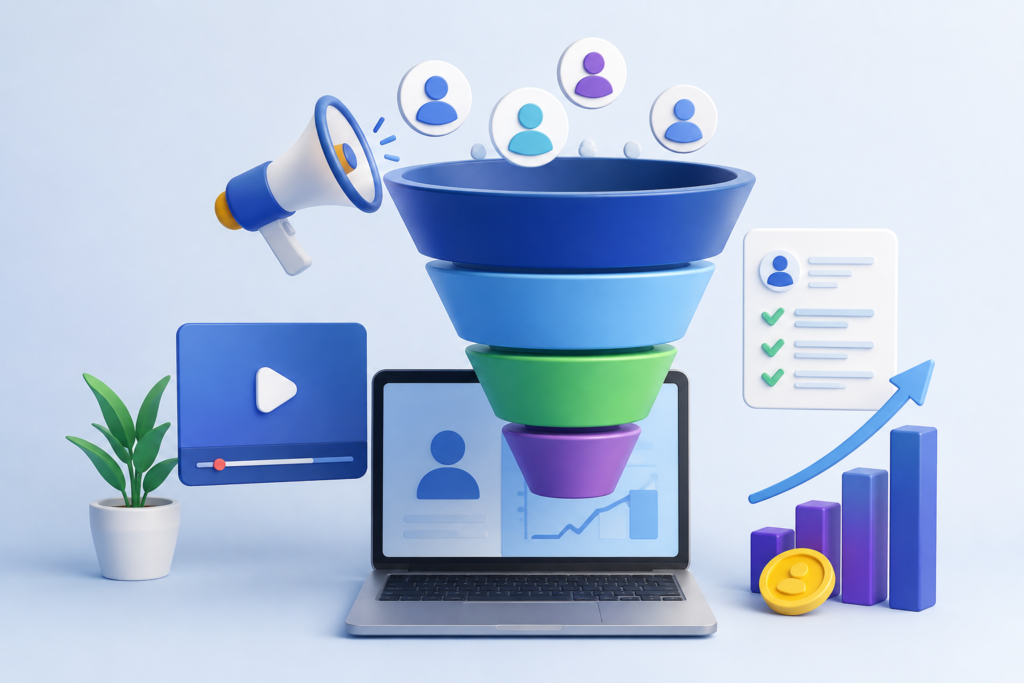
Learn how webinar funnels attract qualified prospects, increase registrations, build trust, nurture leads, and turn engaged webinar attendees into customers through a strategic conversion journey.
Introduction
A webinar can be one of the most valuable educational and conversion assets in a modern digital marketing strategy. Unlike a short advertisement, social media post, or simple landing page, a webinar gives a business enough time to explain a complex problem, demonstrate expertise, answer important questions, establish credibility, and present a relevant solution. When all of these elements are connected through a carefully planned customer journey, the result is a webinar funnel.
A webinar funnel is more than a registration page followed by an online presentation. It is a coordinated system that can include audience research, promotional campaigns, registration pages, confirmation pages, reminder emails, webinar presentations, offers, sales pages, follow-up sequences, analytics, and conversion optimization. Each component has a specific purpose, but the greatest results come from making those components work together.
For businesses that sell consulting, coaching, professional services, software, education, courses, digital products, or other solutions that require explanation before purchase, webinars can create an important bridge between awareness and action. Instead of expecting a prospect to make an immediate purchasing decision, the funnel gives that person an opportunity to understand the problem, learn a useful framework, evaluate possible solutions, and decide whether the next step is appropriate.
This makes webinar funnels especially useful when trust and education are important parts of the buying process. A prospect may see an advertisement and recognize a problem, but that does not necessarily mean they understand the solution. A well-designed webinar can close that knowledge gap by providing context and demonstrating how the proposed approach works.
For businesses building a broader conversion system, resources such as Sales Pages, Sales Funnels, and Webinar Promos can support different stages of the customer journey.
The purpose of this guide is to explain how to build a webinar funnel that is useful for both the audience and the business. It covers strategy, audience research, funnel architecture, registration pages, attendance, webinar presentation, conversion, email nurturing, analytics, technical performance, SEO, optimization, common mistakes, and long-term growth.
The goal is not to create the most complicated funnel possible.
The goal is to create the right funnel for the right audience and the right offer.
What Is a Webinar Funnel and How Does It Work?
A webinar funnel is a structured marketing and conversion journey that uses a webinar as a central educational experience. The journey generally begins when a potential customer discovers a webinar through an advertisement, search engine, social media post, email campaign, referral, content marketing, video, partnership, or another acquisition channel. The prospect then moves toward registration, preparation, attendance, education, offer evaluation, and eventually a relevant business action.
That action depends on the business model. A consultant may want the attendee to book a strategy call. A software company may encourage a product demonstration or free trial. A course creator may invite the attendee to enroll in a program. A professional service company may request an application or consultation. The funnel should therefore be designed around the desired customer journey rather than around the webinar platform itself.
The webinar is the center of the funnel, but it is not the whole funnel.
A typical structure can look like this:
Traffic → Registration → Confirmation → Reminder → Webinar → Offer → Follow-Up → Conversion
Each stage answers a different question in the prospect’s mind.
The traffic stage answers:
“Why should I pay attention to this?”
The registration page answers:
“Why is this webinar worth my time?”
The confirmation experience answers:
“What happens next?”
The reminder sequence answers:
“Why should I still attend?”
The webinar answers:
“Can I understand and solve this problem?”
The offer answers:
“How can I implement this more completely?”
The follow-up answers:
“What information do I need before making a decision?”
This structure is important because different prospects enter the funnel with different levels of awareness. Some may already understand the problem. Others may only recognize that something is not working. Some may be actively comparing solutions, while others are simply researching.
A strong funnel does not force all of these people through identical messaging.
Instead, it gradually increases understanding.
The best webinar funnels also maintain message continuity. If an advertisement promises a practical framework, the registration page should reinforce that framework. If the registration page promises three specific lessons, the webinar should deliver those lessons. If the webinar teaches a process, the offer should logically help the attendee implement that process.
When the message changes dramatically between stages, trust can decline.
When the message remains consistent, the customer journey feels natural.
This people-first philosophy is also relevant to search optimization. Google’s Search Essentials provide guidance around creating content that can be discovered and understood by Google while following its technical and spam requirements.
The objective should therefore be to build a useful funnel first and optimize its discoverability second.
Why Webinar Funnels Are Effective for Lead Generation
Webinar funnels can be particularly effective when a product or service requires education before a prospect feels comfortable making a decision. Traditional advertisements often have limited space to explain a complex problem. A landing page can provide more detail, but visitors may still leave before fully understanding the value proposition.
A webinar creates a dedicated educational environment.
Instead of asking someone to buy immediately, the business can first teach.
This teaching process can include:
- Explaining the problem
- Identifying common mistakes
- Introducing a new perspective
- Demonstrating a framework
- Showing practical examples
- Answering common questions
- Addressing objections
- Explaining implementation
- Introducing a relevant solution
This creates several opportunities to build trust.
For example, consider a business selling marketing automation services. A prospect may understand that automation could save time, but they may not know which processes should be automated, which should remain human-led, how lead segmentation works, or how follow-up should be measured.
A short advertisement cannot realistically explain all of this.
A webinar can.
The presenter can demonstrate the problem, explain the underlying process, show examples, and then introduce a service that helps businesses implement the system.
This is one reason webinar funnels can work particularly well for high-consideration purchases.
The prospect has more information before making the decision.
However, a webinar should not be treated as automatically superior to every other lead-generation method.
A simple product with a low price and straightforward value proposition may not require a 60-minute educational experience. Adding unnecessary complexity can actually create friction.
The correct question is:
Does the audience need education, demonstration, trust, or explanation before making the decision?
If the answer is yes, a webinar may be an excellent fit.
Webinars can also generate useful behavioral data.
A registration tells you that someone showed interest.
Attendance tells you they were willing to invest time.
Engagement can indicate deeper interest.
Offer clicks can indicate buying intent.
A consultation booking or purchase represents a stronger commercial signal.
This creates an opportunity for behavior-based segmentation.
For example, someone who registered but did not attend should not necessarily receive the same follow-up message as someone who watched almost the entire webinar.
Likewise, someone who clicked the offer but did not purchase may need a different message from someone who attended but never visited the offer page.
The funnel therefore becomes both a marketing system and a source of customer insight.
Another benefit is that webinars can create reusable content.
A live presentation can potentially become:
- A replay
- Short-form video clips
- Blog content
- Email content
- Social posts
- Frequently asked questions
- Educational resources
- Sales enablement material
This increases the potential value of the original webinar investment.
The key is to ensure that repurposed content adds genuine value rather than simply reproducing the same material repeatedly.
Google specifically warns against creating large quantities of unoriginal content primarily to manipulate search rankings. Its current spam policies address practices such as keyword stuffing, link spam, scaled content abuse, and other search-manipulation techniques.
For webinar marketers, the lesson is straightforward:
Create content because it helps the audience, not simply because it gives you another page to publish.
Defining the Target Audience Before Building the Funnel
One of the most common webinar funnel mistakes happens before the funnel is even created: the audience is defined too broadly.
A webinar designed for “business owners” may technically target millions of people, but that does not make the message compelling.
Different business owners have different problems.
A startup founder may need customer acquisition.
An established agency may need better lead qualification.
A course creator may need higher webinar attendance.
A consultant may need a more predictable sales process.
A software company may need product demonstrations.
The more precisely the audience is defined, the easier it becomes to create relevant messaging.
Start with the audience’s current situation.
Ask:
- What are they trying to accomplish?
- What problem is stopping them?
- What have they already tried?
- Why have those approaches failed?
- What information are they missing?
- What objections are likely to arise?
- What would make them trust a solution?
- What would prevent them from taking action?
These questions can produce much stronger webinar concepts than simply choosing a keyword.
Next, identify the audience’s level of awareness.
A person who has never heard of a problem requires introductory education.
A person who understands the problem but has not chosen a solution needs comparison and evaluation information.
A person actively searching for a solution may be ready for a more tactical or implementation-focused webinar.
This can influence the title, presentation depth, examples, and offer.
For example, a beginner webinar might focus on:
How to Build Your First Webinar Funnel From the Ground Up
An experienced marketer might respond better to:
How to Diagnose Webinar Funnel Drop-Off and Improve Qualified Conversions
Both subjects are related, but the intent is different.
Audience research should also influence language.
Avoid unnecessary jargon when the audience is unfamiliar with the subject.
At the same time, avoid oversimplifying content for an experienced audience.
A strong webinar speaks at the appropriate level.
Another important consideration is problem specificity.
A webinar should solve a meaningful problem rather than attempt to cover an entire industry.
Compare:
Digital Marketing Strategies
with:
How to Build a Lead-Nurturing System That Turns Webinar Registrants Into Qualified Opportunities
The second topic creates a clearer expectation.
It tells the prospect:
- What the subject is
- What part of the subject matters
- What outcome is being discussed
Specificity also makes promotional campaigns easier.
Paid advertisements can be more focused.
Email invitations become more relevant.
Landing pages become clearer.
The presentation becomes easier to structure.
Follow-up becomes more personalized.
The audience should also be considered when choosing the webinar format.
A technical B2B audience may prefer a detailed demonstration.
A beginner audience may prefer a step-by-step educational workshop.
A professional audience may value case studies and implementation frameworks.
A product-focused audience may benefit from demonstrations.
There is no universally perfect webinar format.
The correct format depends on the audience’s needs and expectations.
Choosing a Webinar Topic That Attracts Qualified Prospects
The webinar topic is one of the strongest determinants of registration quality.
A topic should be attractive enough to generate interest while specific enough to filter out people who are unlikely to benefit from the offer.
This distinction is important.
A business should not simply maximize registrations.
It should maximize qualified registrations.
Suppose a company sells advanced funnel consulting.
A broad webinar titled:
How to Make More Money Online
could potentially attract a huge audience.
But many attendees may not need funnel consulting.
They may be students, beginners, job seekers, hobbyists, or people interested in unrelated business models.
A more focused topic such as:
How to Build a High-Converting Webinar Funnel for High-Consideration Offers
will likely attract fewer people, but those people may be considerably more relevant.
This is a classic example of quality over quantity.
The topic should also promise a realistic outcome.
Avoid exaggerated claims such as:
- Guaranteed revenue
- Instant results
- Effortless conversions
- Overnight success
- Guaranteed rankings
- Guaranteed customers
These claims can create unrealistic expectations.
Instead, communicate what the attendee will learn, understand, build, evaluate, or improve.
For example:
Learn the Framework for Building a Webinar Funnel That Moves Prospects From Registration to Conversion
is educational and specific.
A useful topic formula is:
Audience + Problem + Desired Outcome + Method
For example:
For Service Businesses: How to Build a Webinar Funnel That Educates Prospects and Generates Qualified Leads
The topic should also connect naturally with the offer.
If the business sells funnel templates, the webinar can teach funnel planning and implementation.
If the business sells consulting, the webinar can teach the strategic framework and show where expert implementation becomes valuable.
If the business sells software, the webinar can explain the workflow the software supports.
This creates offer-topic alignment.
The audience should never feel that they attended one webinar only to be presented with a completely unrelated product.
Another useful strategy is to identify the audience’s most expensive or frustrating problem.
What problem costs them time?
What problem costs them money?
What problem repeatedly creates confusion?
What problem are they already trying to solve?
The strongest webinar topics often sit at the intersection of:
High relevance + meaningful pain + educational opportunity + commercial alignment
Keyword research can help validate how people describe the problem, but search volume should not become the only consideration.
A keyword with high volume may attract a broad audience that does not convert.
A lower-volume topic may produce fewer visitors but substantially better customers.
The goal is not to win a popularity contest.
The goal is to create a topic that the right audience considers worth their time.
Designing a High-Converting Webinar Registration Page
The registration page is the primary conversion point between promotional traffic and webinar attendance.
Its job is not to explain everything about the business.
Its job is to make the right visitor understand why the webinar is worth attending and how to register.
The page should communicate the core information quickly.
A strong registration page commonly includes:
Headline
The headline should communicate the webinar’s primary benefit or educational outcome.
Supporting statement
This explains the problem being addressed and provides additional context.
Learning outcomes
Tell visitors what they can expect to learn.
Presenter information
Explain why the presenter is qualified to discuss the subject.
Event details
Include the date, time, format, duration, and access information when applicable.
Registration form
Keep the form appropriate to the funnel’s qualification needs.
Trust elements
Use genuine testimonials, credentials, case studies, client information, or relevant proof where available.
FAQ
Address practical objections before registration.
Call to action
Make the registration action obvious.
The headline should prioritize clarity over cleverness.
A vague headline such as:
Join Our Exciting Webinar
does not communicate enough.
A clearer headline might be:
Learn How to Build a Webinar Funnel That Attracts Qualified Leads and Turns Engagement Into Sales Opportunities
The visitor immediately understands the subject and potential benefit.
The page should also maintain message match.
If the advertisement says the webinar will teach three specific strategies, the registration page should reinforce those strategies.
If the advertisement promotes a free workshop, the page should clearly present it as a workshop.
If the advertisement focuses on a specific audience, the page should confirm that the webinar is intended for them.
This reduces confusion.
The registration form should also be carefully considered.
For many webinars, asking for an email address and name may be sufficient.
Additional questions can be useful when qualification matters, but every field introduces some friction.
Ask only for information that serves a genuine purpose.
For example, asking:
What is your biggest challenge with webinar marketing?
may help personalize the presentation or follow-up.
But asking for unnecessary personal or business information can discourage registration.
The CTA should also accurately describe the next step.
Examples include:
Reserve My Webinar Seat
Register for the Webinar
Save My Spot
The CTA should not promise something the next page does not provide.
Accessibility matters too.
Text should remain readable.
Buttons should be easy to identify.
Forms should be usable with keyboards and assistive technologies.
Images should have appropriate alternative text where necessary.
The page should work properly across common mobile devices.
Technical quality is especially important because registration pages often contain multiple scripts, analytics tools, video elements, forms, and third-party integrations.
Google’s web performance resources provide guidance around Core Web Vitals, which focus on important aspects of real-world user experience such as loading performance, responsiveness, and visual stability.
The objective is not to make the page technically perfect at the expense of conversion.
The objective is to remove avoidable friction.
Building Confirmation Pages and Reminder Sequences That Increase Attendance

Registration does not equal attendance.
Someone can register with genuine intent and still fail to attend because they become busy, forget the event, lose the confirmation email, experience scheduling conflicts, or simply fail to prioritize the session.
This is why the period between registration and attendance is strategically important.
The confirmation page should immediately reinforce the registration decision.
It should tell the prospect:
You are registered.
Then explain:
Here is what happens next.
Provide the essential access information.
Where appropriate, include a calendar option.
Explain the date and time clearly.
Tell attendees what they should prepare.
Explain what they will learn.
If there is a workbook, checklist, worksheet, or preparation resource, provide it.
This creates a sense of progress.
The prospect has not simply filled out a form.
They have started a process.
The confirmation page can also reinforce the webinar’s central promise.
For example:
During the webinar, you will learn how to map your funnel, improve registration messaging, structure your presentation, and build a post-webinar follow-up sequence.
This reminds the registrant why they signed up.
The reminder sequence should then maintain that momentum.
A basic reminder system could include:
Immediately after registration: Confirmation and access details.
Several days before the webinar: Reminder plus educational benefit.
The day before: Clear event reminder and preparation information.
Several hours before: Short reminder with access details.
Shortly before the event: Final access message.
The exact schedule should depend on the event type and audience.
Live webinars require stronger time-based reminders.
Evergreen webinars require a different sequence.
On-demand experiences can focus more heavily on immediate access.
Reminder emails should not all say the same thing.
Instead, each message should have a purpose.
One can reinforce the outcome.
Another can highlight a key question the webinar will answer.
Another can explain what attendees should prepare.
Another can provide the access information.
This reduces repetition.
The messaging should also avoid artificial urgency.
Do not tell people that “only five seats remain” if unlimited digital attendance is available.
Do not create fake scarcity.
Trust is more valuable than a temporary increase in clicks.
The reminder system should also be tested.
Check:
- Date
- Time
- Time zone
- Webinar URL
- Calendar link
- Mobile rendering
- Personalization
- Unsubscribe mechanism
- Tracking
- Automation triggers
One incorrect date can damage attendance.
One broken link can create unnecessary support requests.
One incorrect personalization field can make the communication look careless.
For email-based nurturing, relevant resources such as Nurture Emails can be incorporated into a broader customer journey when they genuinely support the reader’s next stage.
The principle is simple:
Every communication should make attendance easier, more relevant, or more valuable.
Creating a Webinar Presentation That Educates Before It Sells
The webinar presentation is where the funnel’s promise is tested.
If the registration page creates expectations that the presentation fails to meet, the funnel loses credibility.
The presentation should therefore be built around a clear educational transformation.
A practical structure is:
Opening → Problem → Insight → Framework → Demonstration → Application → Offer → Questions → Next Step
The opening should quickly establish relevance.
Explain:
- Who the webinar is for
- What the attendee will learn
- Why the topic matters
- What the session will cover
Do not spend the first fifteen minutes talking about the company.
The audience registered because they want help with a problem.
Give them that help.
The problem section should demonstrate understanding.
Describe the situation realistically.
Explain why the problem matters.
Identify the consequences of leaving it unresolved.
Then introduce a new perspective.
This is where the webinar can challenge assumptions.
Perhaps the audience believes they have a traffic problem when they actually have a conversion problem.
Perhaps they believe they need more leads when their real problem is poor follow-up.
Perhaps they believe their webinar needs more attendees when the bigger issue is weak qualification.
These insights create intellectual value.
Next comes the framework.
A framework should simplify complexity.
For example:
Attract → Register → Prepare → Educate → Convert → Nurture
Explain each stage.
Give examples.
Show how the stages connect.
Where possible, demonstrate the process rather than simply describing it.
Screenshots, diagrams, walkthroughs, case studies, calculations, or live examples can make abstract ideas easier to understand.
The presentation should also include practical application.
Ask:
What should the attendee do after this webinar?
Provide a logical sequence.
Then transition into the offer.
The offer should not feel disconnected.
It should represent the next step for people who want help implementing the framework.
For example:
The webinar teaches the framework.
The offer provides templates, software, consulting, training, or implementation support.
This creates a natural connection.
The presentation should also address objections honestly.
Prospects may ask:
- Is this suitable for beginners?
- How much time does implementation require?
- What tools are necessary?
- Does this work for service businesses?
- Can this work without paid advertising?
- What happens after purchase?
- Is support included?
- How does pricing work?
Answer these questions directly.
A persuasive presentation does not attempt to hide limitations.
It explains them.
That creates stronger trust.
Google’s guidance emphasizes creating useful, reliable, people-first content rather than content created primarily to manipulate search systems. The current spam policies specifically address tactics such as keyword stuffing, link spam, misleading functionality, and scaled content abuse.
The same philosophy works in webinar selling:
Teach first. Persuade honestly. Make the next step clear.
Structuring the Webinar Offer for Higher Conversions
Once the educational portion of the webinar has delivered meaningful value, the presentation can transition into the offer. This transition is one of the most important moments in a webinar funnel because the audience has already invested time, attention, and trust. The offer should therefore feel like a logical continuation of the learning experience rather than an unexpected sales pitch.
Start by connecting the offer directly to the problem discussed during the webinar. Explain what the attendee now understands, what remains difficult to implement independently, and how the product or service helps bridge that gap. For example, if the webinar teaches attendees how to plan a conversion-focused funnel, the offer could provide templates, implementation support, software, consulting, or training that makes the process faster and easier. The connection should be obvious without requiring aggressive persuasion.
A strong webinar offer should communicate value, relevance, clarity, and risk reduction. Explain exactly what the customer receives, how the components work together, who the offer is designed for, and what happens after purchase. If there are bonuses, explain why they are useful rather than simply listing them. If there is a guarantee, describe its actual terms clearly. If there are payment options, present them transparently. Avoid exaggerated claims that cannot be supported.
The call to action should be equally clear. A prospect should know exactly what happens after clicking the button. If the next step is purchasing, say so. If the next step is booking a consultation, explain that. If an application is required, explain why. Ambiguity at this stage can create unnecessary hesitation.
It is also useful to distinguish between features and outcomes. Features describe what the customer receives; outcomes explain why those components matter. A collection of templates, for example, is a feature. Saving implementation time by starting with professionally structured templates is an outcome.
However, outcomes should remain realistic. Never turn a potential benefit into a guarantee unless it can genuinely be guaranteed.
Social proof can strengthen the offer when it is authentic and relevant. Testimonials should describe real experiences. Case studies should provide sufficient context to make the results meaningful. Avoid anonymous claims that provide no evidence or context.
The strongest offer section answers five practical questions:
What is it?
Who is it for?
What problem does it solve?
What is included?
What should I do next?
If attendees can answer those questions confidently, the conversion experience becomes substantially clearer.
Building a Strategic Webinar Follow-Up Sequence
A major mistake in webinar marketing is assuming that the sales process ends when the presentation ends. In reality, many prospects require additional time before making a decision. Some need to review the offer. Others need answers to objections. Some may have attended but were distracted. Others may have registered and missed the webinar completely.
This is why webinar follow-up deserves as much strategic attention as the live presentation.
The first step is segmentation.
At minimum, consider separating:
- Registered but did not attend
- Attended but left early
- Attended most of the webinar
- Clicked the offer
- Visited the sales page
- Purchased
- Requested additional information
These groups have different levels of intent.
A person who did not attend should receive access to the replay or an appropriate alternative. Someone who watched the entire presentation but did not purchase may need objection-handling content. Someone who clicked the offer may already understand the value and simply need additional reassurance.
This is where behavioral email marketing becomes powerful.
A follow-up sequence might begin with a simple message thanking the attendee and providing the promised resources. The next message can reinforce an important lesson from the webinar. Another can answer a common objection. A later message can explain the offer more clearly. Finally, a message can provide a straightforward reminder about the next step if a genuine deadline exists.
The emails should not simply repeat the sales pitch.
They should continue the educational conversation.
For example:
Email 1: Replay and key resources.
Email 2: The most important lesson from the webinar.
Email 3: Common mistakes and how to avoid them.
Email 4: Frequently asked questions about implementation.
Email 5: Detailed explanation of the solution.
Email 6: Relevant proof or case study.
Email 7: Clear final call to action where appropriate.
The sequence should also respect the recipient’s preferences and applicable email regulations. Include a clear unsubscribe mechanism and avoid misleading subject lines.
Follow-up timing depends on the offer and buying cycle.
A low-cost digital product may have a shorter decision window.
A high-value consulting service may require several weeks of consideration.
Therefore, do not copy another company’s exact email schedule and assume it will work for your audience.
Use behavioral data to determine where prospects are losing momentum.
If many people attend but few click the offer, the offer positioning may need improvement.
If many click but few purchase, the sales page, pricing, trust signals, or offer structure may need attention.
If few people attend, the problem may be reminders or registration quality.
If few people register, the acquisition campaign or webinar topic may be weak.
The follow-up sequence should therefore be viewed as part of the conversion architecture, not as an afterthought.
Driving Qualified Traffic Into a Webinar Funnel
A webinar funnel cannot generate meaningful results without relevant traffic. However, traffic volume alone is not a reliable measure of success. Sending thousands of poorly matched visitors to a registration page can produce impressive click numbers while generating very few qualified opportunities.
The objective should be qualified traffic.
Potential acquisition channels include:
- Search engine optimization
- Paid search
- Social advertising
- Organic social media
- Email marketing
- Partner promotions
- Referral traffic
- Industry communities
- Video marketing
- Content marketing
- Existing customer audiences
Each channel can attract people at different stages of awareness.
Search traffic may capture users actively researching a problem.
Social media may create awareness among people who have not yet recognized the problem.
Email can activate an existing audience.
Partnerships can introduce the webinar to a trusted community.
Paid advertising can provide scale and precise audience targeting.
The funnel should therefore use different messages for different traffic sources.
Someone searching for webinar funnel strategy already demonstrates a certain level of intent. Someone scrolling through social content may require more context.
This is where landing-page message match becomes important.
If the advertisement says:
Learn how to build a webinar funnel from registration through follow-up
the landing page should immediately reinforce that promise.
If the advertisement promotes a workshop for service businesses, the registration page should make the intended audience clear.
The campaign should also track the source of each registration. UTM parameters, analytics platforms, advertising-platform reporting, and CRM data can help identify which sources generate meaningful outcomes.
Do not judge a traffic source only by cost per registration.
A source that generates registrations cheaply but produces no qualified opportunities may be less valuable than a more expensive source that consistently generates customers.
A more useful evaluation framework is:
Traffic → Registration → Attendance → Engagement → Offer Click → Qualified Lead → Customer
This creates a complete performance picture.
Organic search can also contribute to webinar discovery when the webinar has a supporting content ecosystem. Helpful articles can answer related questions and naturally introduce the webinar as a deeper educational resource.
However, avoid creating dozens of low-value pages simply to target minor keyword variations.
Google’s SEO Starter Guide emphasizes making content useful and accessible to users rather than focusing exclusively on search-engine manipulation.
A strong content strategy may include one comprehensive webinar landing page supported by genuinely useful articles covering related questions.
The objective is to build topical relevance and audience trust, not simply increase the number of indexed URLs.
Optimizing Webinar Funnels for SEO and Search Visibility
A webinar funnel can benefit from search optimization, but not every funnel page needs to rank organically.
The primary registration page should usually focus on conversion, clarity, and user experience. Supporting educational content can often carry more of the organic-search workload.
For example, a business offering a webinar about conversion funnels could publish helpful resources addressing questions such as:
- What is a webinar funnel?
- How does a webinar sales funnel work?
- What should a webinar registration page include?
- How do webinar reminder emails work?
- What should a webinar presentation contain?
- How should webinar leads be followed up?
- What webinar metrics should businesses track?
Each article should provide genuine information and naturally connect to the relevant webinar when appropriate.
This creates a content-to-webinar pathway.
A visitor discovers an educational article through search.
The article answers the immediate question.
The webinar offers deeper implementation.
The registration page explains the event.
The webinar provides education.
The offer provides implementation.
This is much more useful than forcing commercial messaging into every page.
Technical SEO also matters.
Important areas include:
- Crawlability
- Indexability
- Page experience
- Mobile usability
- Internal linking
- Structured data where appropriate
- Canonicalization
- Page titles
- Meta descriptions
- Image optimization
- Site architecture
- HTTPS
- Core Web Vitals
Google’s technical requirements explain the fundamental conditions that help Google access, crawl, index, and understand web content.
Security is equally important.
Webinar registration pages collect information from visitors, so the website should use HTTPS and appropriate security practices. Google’s HTTPS documentation explains why secure connections are important for websites.
Structured data can also help search engines understand eligible content, but it should never be treated as a guaranteed ranking mechanism.
The content itself remains more important.
Use the primary keyword naturally.
Use related terminology where it improves clarity.
Avoid repeating the phrase “webinar funnels” unnaturally in every paragraph.
Search engines have become increasingly sophisticated at understanding context, so useful writing should take priority over mechanical keyword repetition.
Internal links should also have descriptive anchor text.
For example, if a relevant resource is specifically about Sales Funnels, use that exact phrase when it accurately describes the destination.
Do not use vague anchors such as “click here.”
Good internal linking helps users discover related information while also clarifying relationships between pages.
Improving Webinar Funnel Performance, Speed, and User Experience
A beautiful webinar funnel can still underperform if it is slow, unstable, difficult to navigate, or frustrating on mobile devices.
Performance optimization should therefore be treated as part of conversion optimization.
Start by evaluating the registration page.
Does the main content appear quickly?
Are large images optimized?
Are unnecessary scripts being loaded?
Does the page shift while loading?
Does the registration form work smoothly?
Are buttons responsive?
Can visitors complete registration easily on a smartphone?
Google’s PageSpeed Insights provides a practical way to evaluate web performance, while Core Web Vitals provides metrics focused on important aspects of real-world user experience.
Third-party tools deserve special attention.
Webinar funnels frequently include:
- Analytics scripts
- Advertising pixels
- Chat widgets
- Scheduling tools
- Embedded video
- Form systems
- CRM integrations
- Heatmaps
- Testing tools
Every external script can introduce additional requests or processing.
This does not mean that every third-party tool should be removed.
Instead, evaluate whether each tool serves a measurable purpose.
A script that provides critical attribution data may be justified.
A widget that nobody uses may not be.
Mobile optimization deserves particular attention because many webinar registrations originate from smartphones.
Make sure:
- Text is readable without zooming.
- Forms are easy to complete.
- Buttons have sufficient touch space.
- Video elements do not break the layout.
- Pop-ups do not obstruct important information.
- Navigation remains simple.
- Checkout or booking processes work correctly.
Accessibility should also be incorporated into the experience.
Use appropriate heading structure.
Provide meaningful alternative text for informative images.
Ensure adequate contrast.
Make interactive elements keyboard accessible.
Use captions where appropriate.
Avoid relying exclusively on color to communicate important information.
A more accessible webinar funnel can improve the experience for a broader audience while reducing unnecessary barriers.
User experience should also be evaluated beyond technical speed.
Ask:
Does the visitor understand what to do next?
Does the page answer the most important questions?
Does the content match the advertisement?
Does the form ask for unnecessary information?
Does the confirmation process feel reassuring?
Can attendees easily access the webinar?
Is the offer understandable?
These questions often reveal conversion problems that analytics alone cannot explain.
A high-performing funnel is therefore not simply fast.
It is clear, accessible, reliable, and easy to use.
Tracking Webinar Funnel Metrics and Measuring ROI
You cannot reliably improve a webinar funnel without measuring what happens at each stage.
The most useful approach is to track the funnel as a sequence rather than focusing on one headline metric.
Important metrics can include:
Landing Page Conversion Rate
Measures how many visitors become registrants.
Cost Per Registration
Measures the acquisition cost of generating a registration.
Attendance Rate
Measures how many registrants actually attend.
Average Watch Time
Shows how long attendees remain engaged.
Engagement Rate
Can include interactions such as questions, polls, clicks, or other participation signals.
Offer Click-Through Rate
Measures how many attendees take the next commercial step.
Sales Conversion Rate
Measures how many qualified prospects become customers.
Revenue Per Registrant
Shows the average revenue generated from each registration.
Customer Acquisition Cost
Measures the overall cost of acquiring customers.
Return on Ad Spend
Useful when evaluating paid advertising specifically.
However, metrics should always be interpreted in context.
Suppose a webinar receives 1,000 registrations and 500 attendees.
A 50% attendance rate may sound good.
But if only five attendees are qualified buyers, the funnel may still be inefficient.
Conversely, a webinar with 200 registrations and 120 highly qualified attendees may produce significantly more revenue.
This demonstrates why quality metrics matter alongside volume metrics.
Analytics should also help identify the exact point of friction.
For example:
High traffic + low registration conversion
Potential registration-page problem.
High registrations + low attendance
Potential reminder or scheduling problem.
High attendance + low engagement
Potential presentation or audience-alignment problem.
High engagement + low offer clicks
Potential offer positioning problem.
High offer clicks + low purchases
Potential sales-page, pricing, trust, or checkout problem.
This diagnostic approach is much more useful than simply saying, “The webinar is not converting.”
Where appropriate, connect analytics data with CRM or sales data so that marketing metrics can be connected to actual business outcomes.
Google Analytics resources can be found through the official Google Analytics documentation, which provides guidance for measurement and implementation.
Do not track metrics simply because they are available.
Every metric should answer a business question.
Ask:
What decision will this number help us make?
If there is no useful decision attached to a metric, it may not deserve significant attention.
Testing and Optimizing a Webinar Funnel Over Time
The first version of a webinar funnel should be treated as a starting point, not a final product.
Even experienced marketers cannot predict every audience response accurately.
Testing reveals what actually happens.
However, testing should be systematic.
Do not change the headline, registration form, webinar length, offer, pricing, email sequence, and advertising audience simultaneously. If everything changes at once, it becomes difficult to understand which change affected performance.
Instead, prioritize the biggest potential bottlenecks.
If registration conversion is low, test:
- Headline
- Webinar promise
- Page structure
- CTA
- Form length
- Presenter positioning
- Audience specificity
If attendance is low, test:
- Reminder sequence
- Calendar integration
- Event timing
- Confirmation messaging
- Webinar format
- Registration expectations
If attendees leave early, test:
- Opening section
- Presentation pacing
- Content relevance
- Slide design
- Interaction
- Length
If offer clicks are low, test:
- Offer transition
- Value proposition
- Pricing presentation
- Proof
- CTA clarity
- Objection handling
If purchases are low, test:
- Sales page
- Checkout process
- Offer structure
- Guarantee clarity
- Trust signals
- Follow-up
A/B testing can be useful when enough traffic exists to produce meaningful evidence.
Avoid declaring a winner based on a handful of visitors.
Statistical confidence matters, but practical significance matters too.
A tiny improvement may not justify a complicated implementation if the business impact is negligible.
Qualitative research should also be included.
Read questions submitted during webinars.
Review sales-call objections.
Analyze customer support conversations.
Read survey responses.
Talk to customers.
These sources can reveal problems that conversion metrics cannot explain.
For example, analytics might show that attendees are not purchasing.
Customer conversations may reveal that they do not understand what implementation involves.
The solution might therefore be better education rather than a new button color.
This is why experience-based optimization is so valuable.
Data tells you what happened.
Customer feedback often helps explain why it happened.
Use both.
Over time, the funnel can become more efficient because every improvement is informed by actual evidence rather than assumptions.
Scaling a Webinar Funnel Without Sacrificing Quality
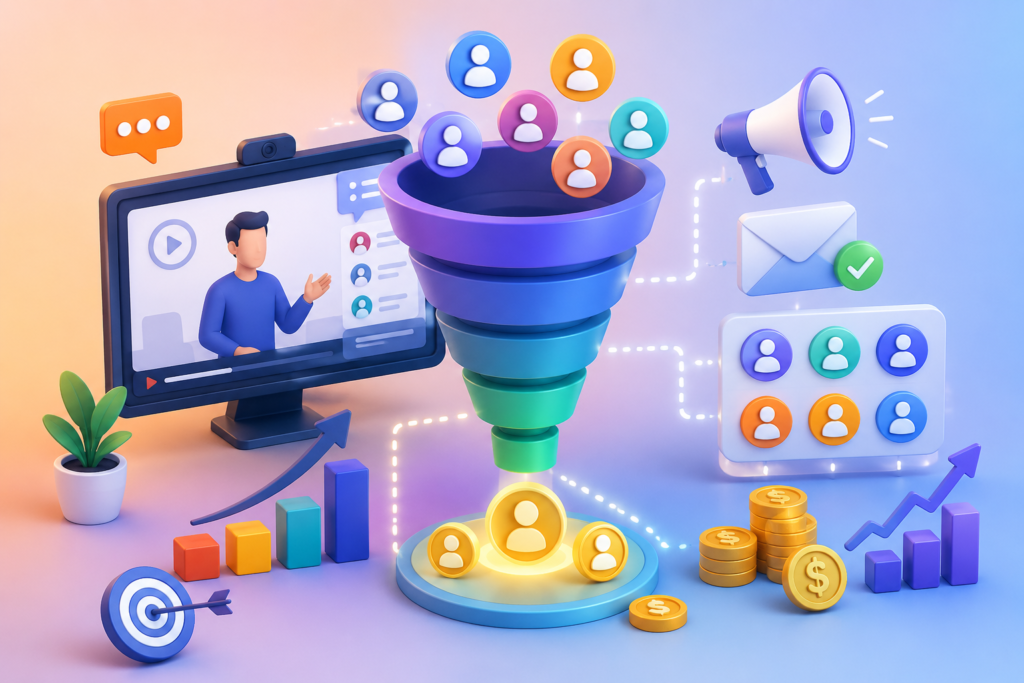
Scaling a webinar funnel is not simply a matter of spending more money on advertising.
If the funnel has a fundamental weakness, increasing traffic can amplify the weakness.
For example, if the registration page converts poorly, more advertising produces more expensive lost opportunities.
If the webinar attracts the wrong audience, scaling traffic increases the number of unqualified attendees.
If the offer is unclear, additional attendees do not automatically create additional customers.
Therefore, scale only after the core customer journey is reasonably stable.
Start by identifying the funnel’s strongest acquisition source.
If organic search generates qualified registrants, expand the supporting content strategy.
If paid advertising generates profitable customers, carefully increase spend while monitoring acquisition costs.
If partnerships produce strong attendees, develop additional relationships with relevant organizations or creators.
If email generates strong conversion, improve segmentation and nurture.
Scaling should also preserve audience quality.
Do not broaden targeting simply because broader audiences are cheaper.
A lower cost per click does not necessarily mean a lower cost per customer.
Monitor downstream metrics.
The most important question is:
What happens after the registration?
This protects the business from optimizing the top of the funnel while damaging the bottom.
Automation can support scaling.
Automate:
- Registration confirmations
- Reminder emails
- Webinar access
- Replay delivery
- Basic segmentation
- Follow-up sequences
- Lead notifications
- Reporting
But automation should not eliminate appropriate human interaction.
High-value prospects may benefit from personal follow-up.
Complex services may require sales conversations.
Customer questions may require human answers.
Automation should remove repetitive work, not remove trust.
Documentation also becomes increasingly important as the funnel grows.
Document:
- Audience definition
- Webinar promise
- Traffic sources
- Landing-page structure
- Email sequence
- Webinar script
- Offer
- Tracking setup
- Testing history
- Performance benchmarks
This creates an operational system that can be improved by a team rather than remaining dependent on one individual.
Scaling should also include contingency planning.
What happens if the webinar platform fails?
What happens if the presenter cannot attend?
What happens if the payment system stops working?
What happens if an email automation breaks?
Reliable businesses prepare for these situations.
Ultimately, sustainable scaling comes from combining traffic, conversion, technology, measurement, and customer experience.
The strongest webinar funnel is not necessarily the most complicated one.
It is the one that consistently delivers value to the audience while producing commercially sustainable results.
Common Webinar Funnel Mistakes Businesses Make
Even a well-designed webinar strategy can fail because of relatively simple implementation mistakes. Understanding these problems before launching can save time, advertising budget, and lost opportunities.
1. Choosing a Topic That Is Too Broad
A topic such as “Online Business Success” may attract attention but does not clearly identify the audience or problem.
Better approach: Choose a specific problem and meaningful educational outcome.
2. Selling Too Early
If the presentation begins with a long company introduction and an immediate sales pitch, attendees may disengage.
Better approach: Establish relevance, provide valuable education, and transition naturally into the offer.
3. Overpromising Results
Claims involving guaranteed income, instant results, or unrealistic transformations can damage trust.
Better approach: Explain realistic benefits and support important claims with genuine evidence.
4. Ignoring No-Shows
Registration numbers can look impressive while actual attendance remains weak.
Better approach: Build confirmation and reminder systems into the funnel from the beginning.
5. Using the Same Follow-Up for Everyone
A non-attendee and a highly engaged attendee should not necessarily receive identical messaging.
Better approach: Segment follow-up based on meaningful behavior.
6. Collecting Too Much Information
Long registration forms can create unnecessary friction.
Better approach: Ask only for information that has a legitimate purpose.
7. Focusing Only on Registration Rate
A high registration rate does not guarantee revenue.
Better approach: Track the entire journey from visitor through customer.
8. Neglecting Mobile Users
A registration page may look excellent on desktop while being difficult to use on a phone.
Better approach: Test the complete registration and purchase journey across mobile devices.
9. Using Fake Scarcity
Artificial countdowns and false “limited seats” claims may create short-term pressure but can damage long-term credibility.
Better approach: Use urgency only when it is genuine.
10. Ignoring Technical Performance
Heavy scripts, large media files, and poorly optimized pages can create unnecessary friction.
Better approach: Regularly evaluate performance using tools such as PageSpeed Insights and monitor relevant Core Web Vitals.
11. Creating SEO Content Solely for Keywords
Publishing many thin pages with slightly different keyword variations can produce poor user experiences.
Better approach: Create genuinely useful content that answers real questions and supports the webinar naturally.
12. Failing to Test the Entire Funnel
Businesses sometimes test the registration page but never test the complete journey.
Better approach: Conduct a full end-to-end test covering registration, confirmation, reminders, webinar access, offer, checkout, and follow-up.
Best Practices Summary
A reliable webinar funnel is built around the audience rather than around technology.
The first priority should be audience relevance. Define who the webinar is for, understand the problem they are trying to solve, and create a topic that directly addresses that problem.
The second priority is message consistency. The advertisement, landing page, confirmation page, webinar, offer, and follow-up should communicate one connected story.
The third priority is genuine educational value. Teach something useful. Demonstrate expertise through practical explanations and real experience. Do not turn the entire webinar into an extended advertisement.
The fourth priority is conversion clarity. Make the next action obvious. Explain what the offer includes, who it is for, and how it solves the problem.
The fifth priority is segmentation. Treat registrants, attendees, non-attendees, engaged prospects, and customers differently when their behavior indicates different needs.
The sixth priority is technical reliability. Use HTTPS, optimize performance, test forms, verify integrations, and make the experience accessible across devices.
The seventh priority is measurement. Track the complete customer journey rather than relying on a single metric.
The eighth priority is continuous improvement. Use quantitative data and qualitative customer feedback to identify bottlenecks and test meaningful improvements.
Finally, maintain a people-first approach.
Google’s Search Essentials provide foundational guidance for websites seeking visibility in Google Search, while Google’s spam policies explain practices that can negatively affect search visibility.
These principles reinforce an important lesson for webinar marketers: sustainable digital growth comes from creating useful experiences rather than trying to manipulate algorithms or audiences.
Frequently Asked Questions
1. What is a webinar funnel?
A webinar funnel is a structured customer journey that uses a webinar as an educational and conversion component. It typically includes traffic generation, registration, confirmation, reminders, webinar delivery, an offer, and follow-up.
The purpose is to move qualified prospects from initial awareness toward a relevant business action while providing useful information along the way.
A webinar funnel can be used to sell courses, consulting, coaching, software, professional services, digital products, memberships, and other solutions where education and trust are important.
2. How long should a webinar be?
There is no universal ideal webinar length.
The appropriate duration depends on the complexity of the topic, audience expectations, format, and commercial objective.
A short educational workshop may require less time than an advanced training session with demonstrations and Q&A.
The important principle is to avoid unnecessary length.
A webinar should be as long as necessary to deliver the promised value and no longer than necessary.
Track average watch time and audience engagement to understand whether the presentation is maintaining attention.
3. What should a webinar funnel include?
A complete webinar funnel can include:
- Traffic campaign
- Registration page
- Confirmation page
- Calendar or access instructions
- Reminder sequence
- Webinar presentation
- Offer
- Sales or booking page
- Follow-up emails
- Retargeting
- Analytics
- CRM integration
Not every business needs every component.
The funnel should be designed around the customer journey and business model.
4. How do I increase webinar attendance?
Start by improving the experience between registration and the event.
Provide clear confirmation immediately after registration.
Make the event easy to add to a calendar.
Send useful reminders.
Explain what attendees will learn.
Make access instructions extremely clear.
Avoid misleading promises because attracting people with the wrong expectation can increase registrations without improving meaningful attendance.
You can also test event timing, reminder frequency, subject lines, and confirmation-page messaging.
5. Should a webinar be live or automated?
Both models can work.
A live webinar can provide interaction, real-time questions, demonstrations, and a stronger sense of personal engagement.
An automated or evergreen webinar can provide greater scheduling flexibility and operational scalability.
The right option depends on the offer, audience, content, sales cycle, and available resources.
Some businesses use both: live webinars for engagement and research, followed by evergreen experiences for ongoing acquisition.
6. How many emails should follow a webinar?
There is no fixed number.
The sequence should be long enough to answer legitimate questions and provide appropriate opportunities to act without becoming repetitive or intrusive.
A practical sequence may include replay access, key lessons, objection handling, proof, offer explanation, and a final relevant call to action.
The ideal sequence depends on the buying cycle.
A high-consideration service may require more nurturing than a low-cost digital product.
7. What is the most important webinar funnel metric?
There is no single metric that is always the most important.
For a business focused on revenue, qualified customers and revenue generated by the funnel are generally more meaningful than registration volume alone.
However, intermediate metrics such as registration conversion, attendance, watch time, offer clicks, and sales conversion help identify where the funnel needs improvement.
The best measurement system connects these stages together.
8. Can webinar funnels work without paid advertising?
Yes.
Webinar funnels can receive traffic from organic search, email marketing, social media, referral campaigns, partnerships, communities, existing customers, video content, and other organic channels.
Paid advertising can accelerate traffic acquisition, but it is not a requirement.
In fact, building organic content around the webinar topic can create a sustainable acquisition system that continues generating interest over time.
The most important factor is not whether traffic is paid or organic.
It is whether the traffic is relevant and qualified.
Conclusion
A successful webinar funnel is not simply a registration page, a video presentation, and a sales button.
It is a complete customer experience.
The process begins with understanding the audience and selecting a problem worth solving. From there, the business develops a focused webinar promise, creates a clear registration experience, builds attendance momentum, delivers valuable education, introduces a relevant offer, and continues the conversation through strategic follow-up.
The best funnels do not depend on pressure.
They depend on relevance and trust.
When a prospect recognizes their problem, learns something genuinely useful, sees credible expertise, understands the available solution, and receives a clear next step, the conversion becomes a natural progression rather than a forced event.
Technical quality matters as well. Fast pages, secure connections, accessible experiences, reliable forms, accurate analytics, and mobile-friendly design all contribute to a stronger customer journey.
Search optimization also has an important supporting role. Creating useful content around the webinar topic can attract people who are already researching related problems. Internal linking can connect educational resources with relevant webinar pages. Technical SEO can help search engines discover and understand the content. But optimization should never replace usefulness.
The most sustainable approach is therefore:
Understand the audience.
Solve a meaningful problem.
Teach before selling.
Make the offer relevant.
Follow up intelligently.
Measure the complete funnel.
Improve based on evidence.
Scale only when the customer journey is working.
When these principles are applied consistently, a webinar can become much more than a one-time online event. It can become a repeatable educational, lead-generation, nurturing, and conversion system that supports long-term business growth.
For businesses looking to strengthen their overall funnel strategy, My Funnel Script can be explored as part of a broader approach to conversion-focused marketing assets.
Want to Implement This Easily?
Prompt Text:
You are an expert consultant. Based on the blog post titled “Webinar Funnels”, provide a step-by-step, practical implementation guide. Include tools, best practices, common mistakes to avoid, and advanced tips. Assume the reader wants to implement everything discussed in this article effectively.
Call to Action:
Want our help implementing this? Just reach out to us via our website contact form: https://buywith.thrivecart.com/full-sales-funnel-templates/